How to Detect an AI Watermark (And What the Results Actually Mean)?
10 min read
When people search for how to detect an AI watermark, they're usually looking for two very different things and most don't realize it.
One is a cryptographic signal embedded by the model itself, invisible and only verifiable by the provider. The other is the statistical pattern that AI detectors actually scan for. Confusing the two is exactly why so many content checks come back with results that don't make sense.
This article clears up. What each type of AI watermark actually is, how detection works, and what the results mean for your content.
Already worried about AI flags? Get a free sentence-level breakdown instantly. 👇
The Two Types of AI Watermarks (Most Guides Miss This)
When users search “how to detect AI watermark”, they’re typically referring to two separate issues without realizing it. Mixing them together causes misinterpreted results and false conclusions.
To understand the distinction clearly, it helps to first understand what AI text watermarks actually are.
Type 1 - Cryptographic / Statistical Watermarks: These watermarks are invisibly embedded by biasing token probabilities during generation. The provider of the model possesses a private cryptographic key.
Third parties cannot confirm the presence of the watermark without that key. As of 2026, SynthID text watermarking (Google DeepMind) for Gemini outputs is the only known example in production at scale.
This type of invisible AI watermark leaves no perceptible evidence for humans.
Type 2 - Statistical Detection Patterns: This is the "fingerprints" AI detectors look for. Things like perplexity score, burstiness score, sentence-length consistency, and word choice distribution.
It's not like a hidden watermark; it's a natural statistical watermark pattern that results from the way LLMs write.
The critical point: most people searching for watermark detection are actually trying to detect Type 2 signals.
Type 1 detection is only possible by the model developer who holds the secret key.
| Type 1: Cryptographic Watermark | Type 2: Statistical Patterns | Practical Impact |
Who can detect it? | Only the model provider (e.g. Google) | Any AI detector tool (Phrasly, GPTZero, etc.) | Public tools detect Type 2 only |
What tools work? | Provider's private API (not public) | AI detection tools using ML classifiers | No free tool accesses Type 1 |
Reliability | Near-perfect when the key is available | 62–88% depending on content type | Type 2 results require careful interpretation |
Disrupted by rewriting? | Potentially, with significant rewrites | Yes, humanized text scores lower | Neither is immune to editing |
How to Detect a True AI Watermark (SynthID & Cryptographic Systems)?
This section covers Type 1, the actual, embedded watermark. AI-generated content detection of this type isn't something any commercial tool can do by itself. Here's why, and what the alternatives are.
SynthID Detector: How Google's System Works?
Gemini uses Google DeepMind's SynthID text watermarking technique. This method biases model-generated tokens ever so slightly. Rather than always selecting the most likely token, Gemini shifts the probability distribution based on a private cryptographic key.
An API can then determine if the watermark bias is present.
As of 2026, SynthID text verification is not publicly available. The Gemini watermark detector API is available to Google and certain enterprise partners. It is not available for end users or third party tools.
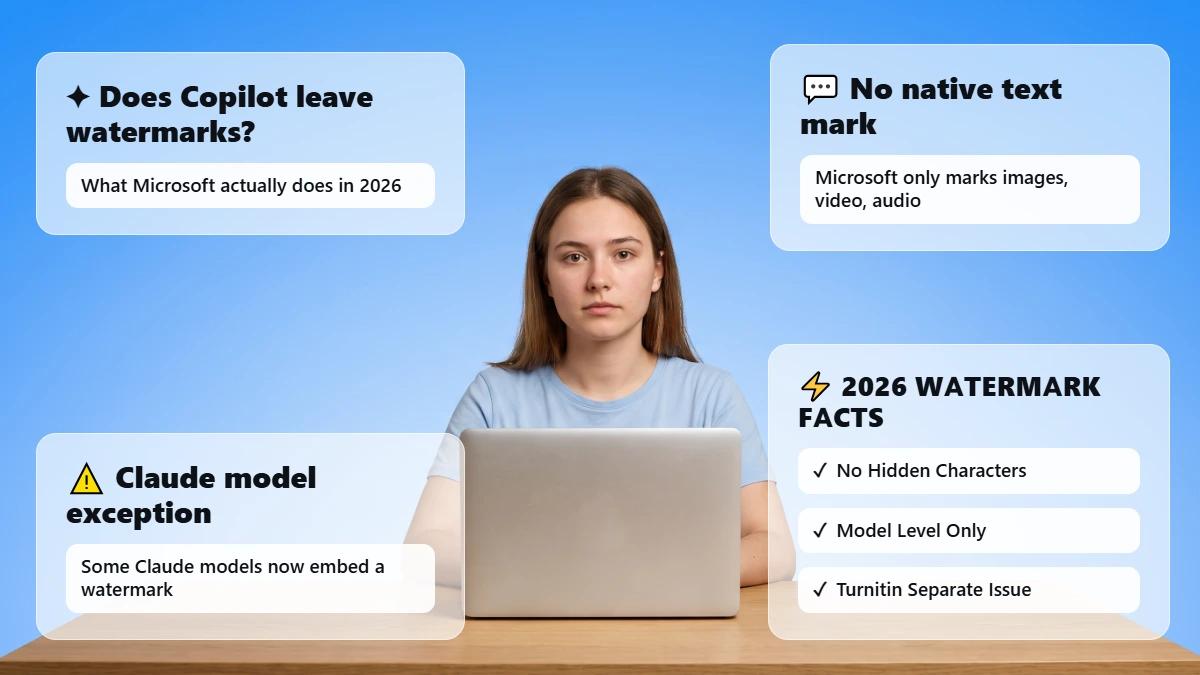
SynthID offers public detection for images/audio/video, but text detection is internal only. You can't verify a Gemini text watermark yourself with any existing tool.
ChatGPT / GPT-5 Watermark: What's the Status in 2026?
OpenAI has released extensive research on text watermarking. Indications existed that GPT-5 watermark embedding was being explored. As of 2026, OpenAI has not released a detectable watermark within ChatGPT or GPT-5.
Output from ChatGPT has no signal embedded within it that some other party can check. There is research, but there isn't production deployment.
Claude Watermark: Anthropic's Position
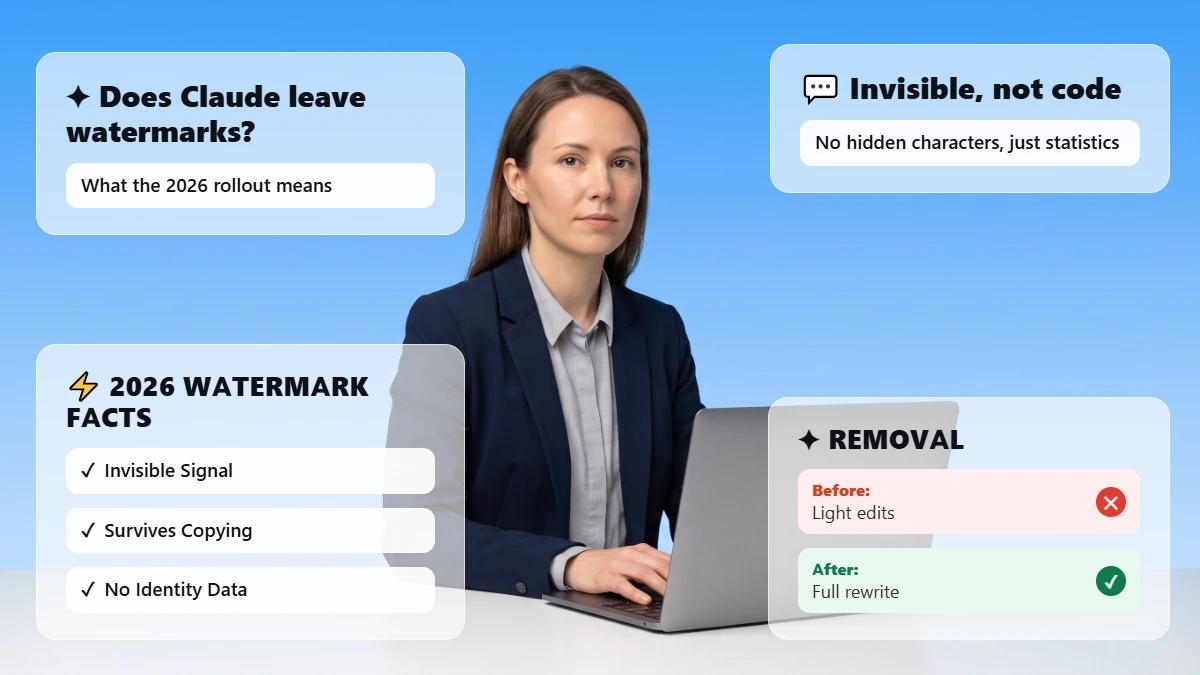
Anthropic has stated that, as of 2026, they do not have a public text watermarking system. Text generated by Claude will not have any cryptographic signature embedded within it, and cannot be detected by a watermarking verifier tool.
Claude samples can only be detected through Type 2 statistical analysis.
Model | Watermark Status | Verifiable By | Detection Method |
ChatGPT / GPT-5 | No deployed watermark (2026) | N/A | Type 2 statistical detection only |
Gemini (Google) | SynthID — active | Google internal API only | Type 1 (private) + Type 2 (public) |
Claude (Anthropic) | No watermark system (2026) | N/A | Type 2 statistical detection only |
Llama (Meta) | No watermark system (2026) | N/A | Type 2 statistical detection only |
How to Detect AI Writing Patterns (The Practical Detection Method)?
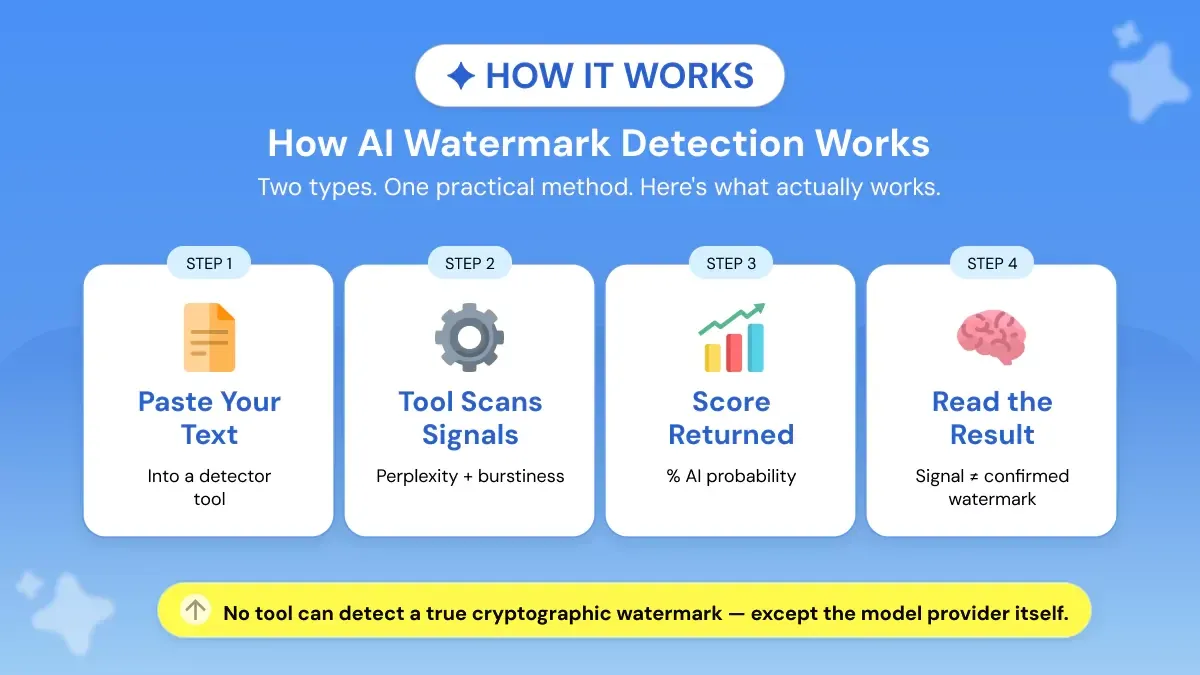
Machine-generated text often leaves behind detectable clues. For most people, such as writers, marketers, teachers, and publishers, the easiest method of detection is Type 2: looking for the statistical watermark pattern. Here's what that means.
AI detectors look for two main signals. First, perplexity. This is how unsurprising the text is to the language model. Something with very low perplexity uses very probable sentence constructions, verbatim from the transformer-based detection signal.
Burstiness is simply how much the text differs in sentence length and cadence. Humans often write long sentences and then short sentences. AI text often tries to stay squarely in "medium" territory.
Low perplexity score and low burstiness AI detection reading means high AI probability.
Step-by-Step: How to Check Your Content for AI Signals
Paste your text into a detector (Phrasly, GPTZero, or similar). For reliable results, use at least 200 words. Short texts produce notoriously unreliable scores.
Read the perplexity score detection output, not just the headline "AI percentage." The score breakdown by sentence tells you which specific passages triggered the flag.
Identify which sentences are flagged. Phrasly's sentence-level breakdown shows exactly where AI patterns cluster, letting you target revisions rather than rewriting everything.
Interpret the result carefully. A high AI score does not confirm a watermark. It confirms statistical similarity to AI output. Those are different claims.
What Do the Results Actually Mean?
"50% AI" does not indicate that your text will have a watermark.
It means that approximately half of your text has the statistical properties typically found in AI-generated content detection, namely, low perplexity, low burstiness, and even vocabulary distribution.
According to independent tests by CompareAITools in 2026, AI detection accuracy ranges from 62–88% depending on content type and model used.
Paraphrased or humanized content consistently falls at the lower end of that range, so treat any score as directional guidance, not a verdict.
A well-written college-level paper entirely written by a human can have a high score. A copied-and-paraphrased version of AI text can have a low score.
The score is not about the presence of any kind of watermark verification key. It's seeing how close your text's patterns are to those of AI-generated output.
If you want to understand exactly how these scoring systems are built and why they produce the results they do, here's how AI detectors actually work.
Rewrite Flagged Sentences So They Read Naturally
AI Watermark Detection Tools Compared (2026)
No tool on the public market detects Type 1 cryptographic watermarks. Only SynthID's own API does that, and only for Gemini. The table below is honest about what each tool actually checks for.
Tool | What It Actually Detects | Free Option | Accuracy | Best For |
Phrasly | Type 2 statistical patterns — with sentence-level breakdown | ✅ Yes | Up to 88% | Creators who want to detect and improve AI-flagged content |
GPTZero | Type 2 — perplexity + burstiness, model classification | ✅ Limited | ~80% | Academic and professional document review |
Originality.ai | Type 2 statistical patterns, plagiarism overlay | ❌ Paid only | ~82% | Content agencies and SEO teams |
SynthID | Type 1 — cryptographic watermark (Gemini only, internal) | ❌ Not public | Near-perfect (Gemini) | Google-internal verification of Gemini output |
Turnitin | Type 2 AI writing characteristics — not watermarks | ❌ Institutional | ~75–80% | Academic institutions evaluating submissions |
The standout feature of Phrasly: unlike any other tool in this comparison, Phrasly doesn’t just detect AI signals. It also offers a built-in solution to remediate them.
It offers a sentence-level breakdown and editing tools to help you refine the content and make it read naturally and humanely.
Detected AI signals in your content? Clean them up naturally without losing your voice or meaning 👇
Why AI Watermark Detection Isn't Always a Simple Yes or No?
AI-generated content is difficult to detect, even for these detection tools. Here’s what we know so far:
Paraphrased or humanized text disrupts statistical patterns significantly.
Work that is 90% AI pre-edit can fall below 40% post-edit with focused rewriting – not due to the origin changing, but due to shifts in human-written vs AI-written signal patterns.
Short texts (under 200 words) are notoriously unreliable.
Too little data for the model to estimate a reasonable perplexity score or burstiness. Results may have high variance.
False positives are a real problem. The false positive rate problem undermines confidence in blanket AI detection verdicts.
Polished academic or professional human writing often triggers AI flags. A landmark Stanford HAI study found that 61% of essays written by non-native English speakers were incorrectly flagged as AI-generated (Liang et al., Cell Patterns, 2023).
Type 1 watermarks can potentially be disrupted. Sufficient rewriting can break the statistical bias pattern SynthID relies on, though Google continues to refine its robustness.
AI detection accuracy is a moving target as both generation and detection methods evolve. Google DeepMind's own research makes this explicit.
As Pushmeet Kohli, VP of Research at Google DeepMind, noted when open-sourcing SynthID: "While not a silver bullet for addressing problems such as misinformation or misattribution, SynthID is a suite of promising technical solutions to this pressing AI safety issue."
The watermark also becomes less reliable when AI-generated text has been thoroughly rewritten or translated, as Google acknowledges directly in its Nature paper on SynthID.
AI Content Provenance in 2026: The Bigger Picture
Beyond individual tools, the industry is converging on a standards-based approach to provenance verification.
The C2PA standard 2026, the Coalition for Content Provenance and Authenticity, founded by Adobe, Microsoft, BBC, and Intel, is the most significant development in this space.
As of early 2026, over 6,000 members and affiliates have joined the initiative, including Google, Meta, OpenAI, Sony, and Nikon, signaling that AI content provenance is becoming infrastructure, not a niche feature.
Google has developed SynthID, which fits broadly into this AI content provenance direction, in that it inserts verifiable signals at generation time instead of doing post-hoc statistical inference.
AI transparency advocates would like to see a future where we can confirm content authenticity across platforms external to whatever model generated the content. We aren't there yet for text, but are laying the groundwork.
How Phrasly Helps After Detection?
You’ve had your content run through a detector. The results flag multiple paragraphs with a high AI signal. Now what?
Detection is step one. A more useful question is: how do you rewrite those paragraphs so they read naturally, sound like you, and avoid flags not as a workaround, but as part of an honest effort to improve quality?
Phrasly AI Detector provides a sentence-by-sentence analysis of what specific parts of your text are detected as AI-generated instantly, for free, with no guessing. View problem areas line-by-line instead of a single scored summary.
Phrasly AI Watermark Remover rewrites those sentences to change rhythm, tone, and syntax, creating text that looks human because it's just better written. Lower AI scores are a byproduct of increasing quality, not avoiding it.
Run your content through Phrasly's AI Watermark Remover. Rewrite flagged sentences so they read naturally and avoid detection 👇
FAQs
Is there a free tool to check for an AI watermark?
Yes, but there's a big qualifier. Free tools like Phrasly's AI Detector look for Type 2 statistical AI fingerprints, not Type 1 cryptographic watermarks.
Only Google's internal API can identify a true embedded watermark (SynthID), and that system is not publicly available.
Can Turnitin detect AI watermarks?
No! Turnitin looks for signs of AI-generated text characteristics: perplexity, burstiness, and vocabulary patterns, among others. It is a Type 2 pattern detection. It does not contain any model provider's watermark verification key.
Turnitin's detection still does not include any verification of watermarks.
How accurate is the AI watermark checker detection?
Accuracy is reported to be between 62–88% depending on the type of content, length, and amount of post-generation editing. The low end of that range would be for short documents and paraphrased content.
The risk of false positives with clean human-created writing, especially by non-native English writers, is also well known and should be considered when making high-stakes decisions based upon a detection score.
Phrasly's AI Watermark Remover rewrites the flagged passages naturally, improving rhythm and variation so the content reads as human because it genuinely is better written.
Does GPT-5 have a detectable watermark?
Not publicly! OpenAI has researched text watermarking thoroughly, and it's still under development. As of 2026, no detectable watermark has been used with ChatGPT or GPT-5.
What is SynthID, and can it detect AI text?
SynthID is Google DeepMind's watermarking system, meant to prove that content was created by Gemini. This scheme embeds a watermark into text by adding an undetectable cryptographic bias to token selection probabilities when generating content.
SynthID text verification was not made available to the public as of 2026. While the watermark is present in Gemini's text outputs, you cannot use SynthID to verify arbitrary text. SynthID can only verify Gemini's output, and only via Google's private API.

Written by
Muhammad Usman Ali
Pakistan
Muhammad Usman Ali is an experienced SEO content writer with 3+ years of professional writing experience. He specializes in AI tools, AI detection technologies, and search engine optimized content.