Do Scholarships Check for AI? How Committees Review Essays in 2026
10 min read
Some scholarships do check for AI, and many don't. There's no universal screening system. A provider may run an AI detector, screen submissions inside its application platform, rely on human readers, or ask you to declare any AI help. Each scholarship sets its own rule.
You wrote your essay yourself, so the real question is whether a reviewer's tool might misread it. We checked the live 2026 guidance published by Rhodes, the Jack Kent Cooke Foundation and Gilman, plus the only public detector test run on real scholarship essays.
Below, you’ll find: who checks, the four methods they use, what the named policies say, and how to protect an honest essay.
Question | Short answer |
|---|---|
Do scholarship committees check for AI? | ✅ Some do. There's no universal requirement. |
Do all scholarships use AI detectors? | ❌ No. |
Can scholarship essays be scanned for AI? | ✅ Yes. |
Can AI detection prove you used AI? | ❌ No. It's an estimate. |
Can AI use disqualify you? | ✅ Yes, when it breaks the scholarship's rules. |
Is brainstorming with AI always banned? | ❌ No. Policy varies by scholarship. |
Worried an honest essay could be misread before a person even reads it? Check it yourself first. 👇
🔍 Do Scholarship Committees Actually Check for AI?
Some scholarship committees do screen essays for AI-generated writing, but there's no universal requirement. Depending on their own rules, providers may use AI detectors, automated platform screening, human review, originality declarations, or AI-use disclosure questions.
📊 The only public detector test on real scholarship essays: Scholarships360 ran 986 submissions through GPTZero. 410 of them, about 42%, scored a 75% or higher AI probability. Updated December 1, 2025.
The Hechinger Report covered the same experiment on March 25, 2025, reporting that nearly 1,000 scholarship essays were checked and about 42% were assessed as likely written with generative AI.
A detector score estimates probability and nothing more. Those 410 essays scored high in one tool. The tool never established who typed them.
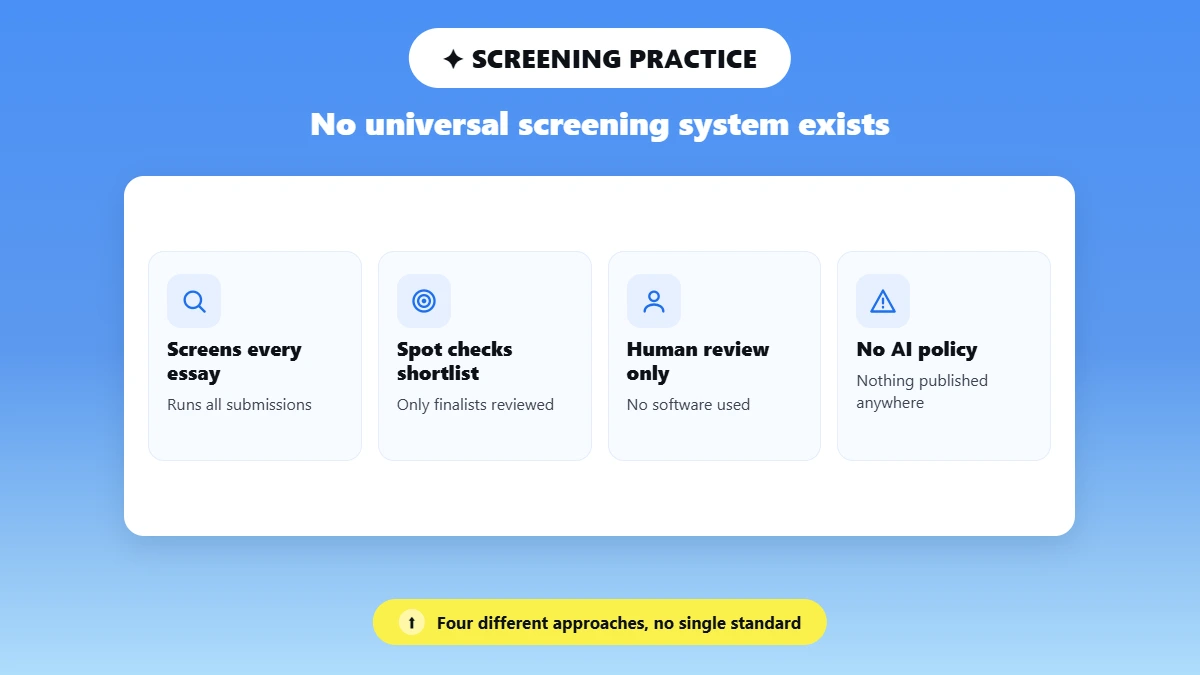
No industry-wide standard exists. Screening practice splits four ways:
🔁 Some providers screen every essay that arrives.
🎯 Some spot-check only the shortlist.
👤 Many rely on human readers and run no software at all.
🕳️ Some publish no AI policy anywhere.
🧾 How Scholarship Applications May Be Checked for AI
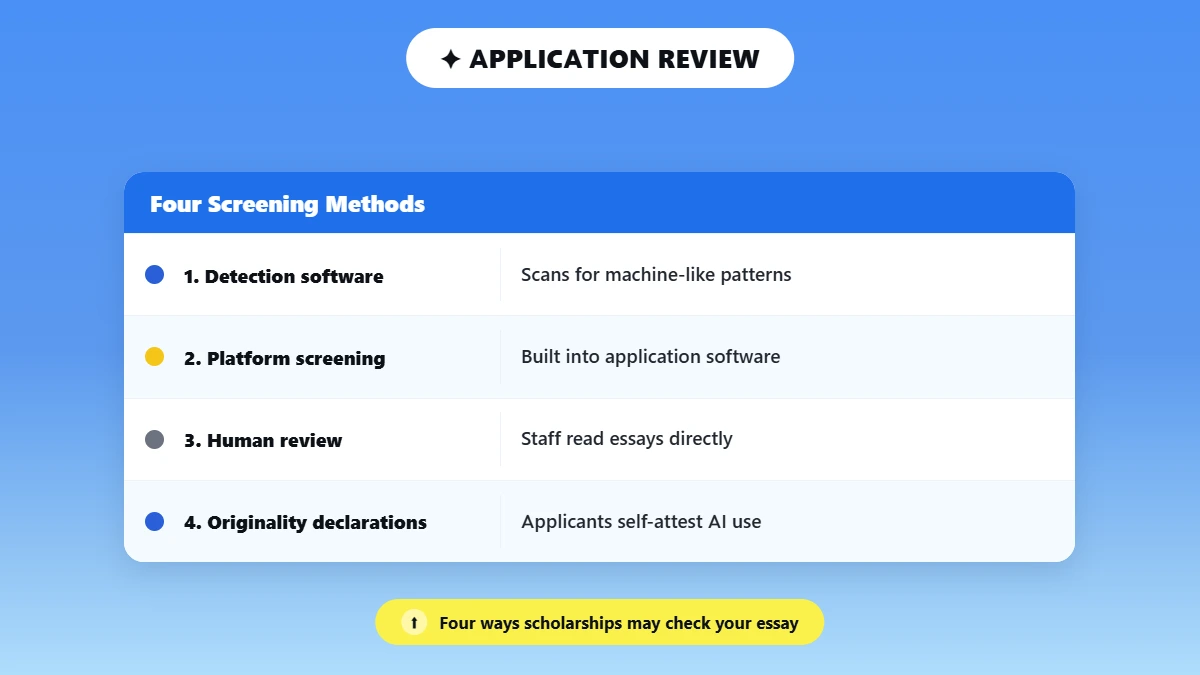
Scholarship applications get checked for AI in four ways: detection software, screening built into the application platform, human review, and originality or AI-use declarations. Which ones apply depends on the provider.
1. AI detection software 🤖
GPTZero is the only detector publicly tied to scholarship screening. Scholarships360 ran that test on essays real applicants submitted for a real scholarship.
These tools score writing for machine-like patterns: even sentence lengths, predictable word choice, and low variation between paragraphs. They don't check for copied sources. Plagiarism scanning is a separate check with a separate result.
The same class of tool is open to applicants. You can self-check with Phrasly's free AI Detector, which gives you three scans before a free account unlocks the rest.
2. Scholarship-platform screening 🖥️
Some screening happens inside the application software, before any human opens the essay. Scholarship-management platforms can ship with AI and originality checking already built in.
Kaleidoscope is one of these platforms. Its AI and plagiarism detection tool checks essay responses for AI use and copied text, then hands the results to the selection team as evaluation reporting.
⚠️ A scholarship that never mentions a detector may still run on a platform that has one.
Platforms differ on this. The Common App's position on AI screening runs the other way, with no automated detection on submissions at all.
3. Human review 👀
Human readers catch AI writing without any tool. Scholarship staff, volunteer reviewers and committee members read essays directly, and many providers rely on that reading alone, because no rule requires a detector.
What a reviewer notices:
Generic phrasing that could describe any applicant.
Recycled themes seen across dozens of submissions.
No personal detail: no names, places, dates or specifics.
A voice that changes between paragraphs.
Which words show up most in AI-flagged essays?
Scholarships360's test tracked word patterns across those 986 essays. "Cornerstone" appeared in 62% of essays scoring above 75% AI probability, against 6% of the ones below it. "Bedrock" appeared in 20% versus 1%.
Those words are signals a reader notices. A high count proves nothing on its own, because human writers reach for the same vocabulary.
4. Originality statements and AI-use disclosures 📝
Plenty of scholarships run no detection at all. They ask you to declare your AI use on the application form instead, and two of the best-known awards spell out what that means.
The Rhodes Trust asks candidates to identify which tools helped prepare their statements and to confirm the work reflects their own experiences, thinking and judgment. Material misrepresentation disqualifies an application.
The Jack Kent Cooke Foundation expects responses that are "wholly your own" and asks applicants to report any AI usage in the application.
What does an AI-use disclosure ask for?
More than a yes or no. Rhodes asks candidates to name the specific tool used, including ChatGPT, Gemini or Grammarly, and to say how they asked it to help or what prompts they gave it.
📋 Do All Scholarships Have the Same AI Rules?
No. Every scholarship writes its own AI policy, and the four below sit a long way apart.
Scholarship / provider | Public AI position (verified August 2026) | Detector confirmed? |
|---|---|---|
Scholarships360 | Warns against AI-written essays. Publicly reported testing 986 essays in GPTZero, where 410 scored 75% or higher. Recommends AI for brainstorming and proofreading only. | ✅ Yes, GPTZero in its own reported test |
Rhodes Scholarship | Does not ban AI. Permits spelling, grammar, structure and summarising help. Bans AI-generated substantive content. Requires disclosure of the tools used and an attestation that the work is your own. | ❌ Not publicly confirmed |
Jack Kent Cooke Foundation | Responses must be "wholly your own". Gen AI "could be useful in preparing some aspects", but AI use must be disclosed on the form. | ❌ Not publicly confirmed |
Gilman Scholarship | Essay guidance stresses original, personal responses, working with a study abroad advisor, and human proofreading. No AI rule or detector policy published. | ❌ Not publicly confirmed |
Policies verified August 2026. Always follow the latest official instructions for the scholarship you're applying to. Rules change, and no published detector policy does not mean AI use is unrestricted.
Your university's academic integrity policy doesn't carry over here. A school that screens coursework tells you nothing about the private foundation reading your essay, and whether colleges check applications for AI is a separate question with a separate answer.
🎓 Does the Gilman Scholarship Check for AI?
The Gilman Scholarship's applicant guidance, reviewed in August 2026, doesn't say applications are screened with an AI detector. Its guidance points applicants toward original, personal writing, a study abroad advisor, and a human proofread.
Essays are a big part of how Gilman picks winners. You write three:
📄 Statement of Purpose. 7,000-character limit.
🤝 Two Community Impact essays. 3,000 characters each.
🌏 Critical Need Language or STEM award. One extra essay, 2,000 characters. You only write this one if you apply for those awards.
🚫 Don't read silence as permission. No published detector policy is not the same as no rule. Follow the latest application instructions, and answer honestly if the form asks about AI help.
🚩 What Happens If a Scholarship Essay Is Flagged as AI?
No standard process exists. A flag may trigger human review, a request to explain your writing process, or removal from consideration where the rules prohibit AI use. A detector result alone is rarely the last word, because these tools misread human writing at measurable rates.
What can follow a flag:
👤 Human review, where a person reads the essay against the rest of your application.
💬 A request for clarification about how the essay was written.
🚫 Disqualification, where the scholarship's own rules prohibit that AI use.
😌 Nothing, because a provider with no AI policy has nothing to enforce.
No shared appeals process exists across scholarships. Each provider decides how, and whether, a flagged applicant gets to respond. Ask what the flag was based on, and offer your drafts before arguing the score.
Turnitin's AI detection guidance, updated August 18, 2026, says the AI writing indicator "should not be used as the sole basis for action". Turnitin also withholds scores between 1% and 19%, showing an asterisk instead, because false positives cluster in that range.
📊 Phrasly's ZeroGPT test ran 37,874 human-written student essays through the tool. 9,987 of them, 26.4%, came back flagged as AI.
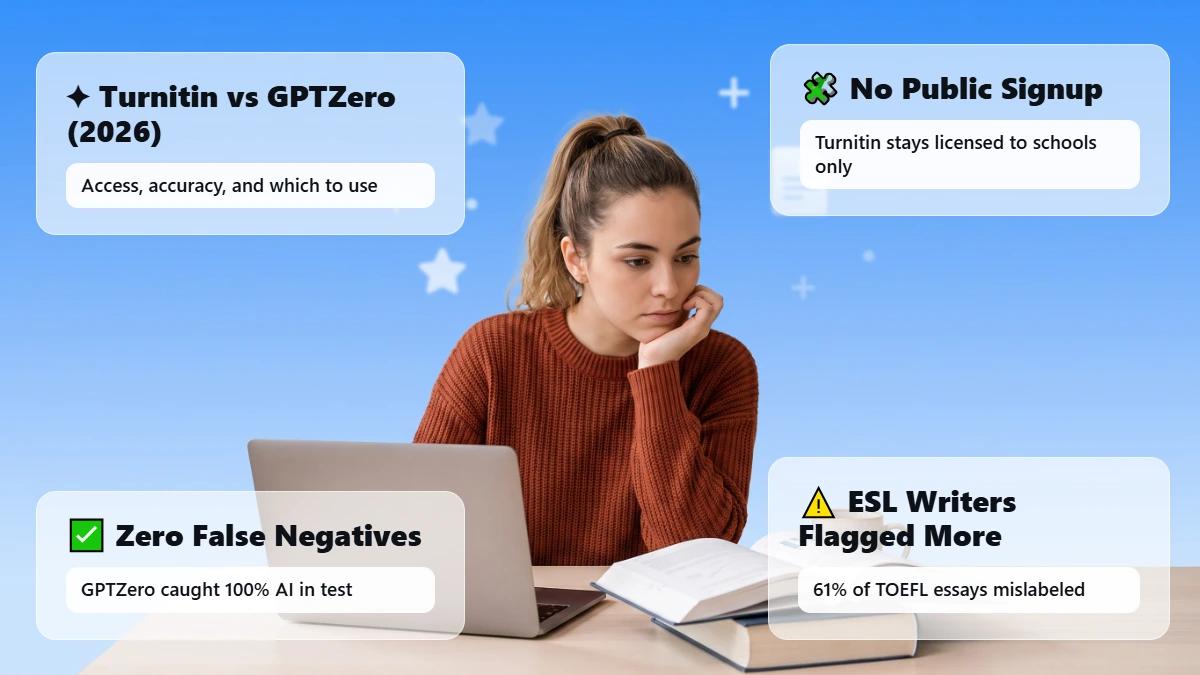
Non-native English speakers get flagged more often. A Stanford-led study ran 91 TOEFL essays through seven detectors and recorded an average false positive rate of 61.22%, against 5.19% on essays by US eighth graders. The researchers traced it to low perplexity: predictable word choice and limited sentence variety, which is why human writing gets flagged even when nobody used AI.
Curious what a reviewer's tool would show for your essay? Paste it in here 👇
✍️ Is It Okay to Use AI for a Scholarship Essay?
It depends on the scholarship's rules. The safe principle is policy compliance rather than passing a detector. Compliance means reading the rules and following them. Passing a detector means editing until a number drops, which can break a rule you never read.
AI use | Risk level | Check the individual rules |
|---|---|---|
Brainstorming ideas | ✅ Usually lower | ✓ |
Building an outline | ✅ Usually lower | ✓ |
Grammar and spelling checks | ✅ Usually lower | ✓ |
Feedback on your own draft | ✅ Usually lower | ✓ |
Rewriting large sections | ⚠️ Higher | ✓ |
Generating the whole essay | 🚫 Highest | ✓ |
Inventing achievements or stories | ❌ Never appropriate | n/a |
ChatGPT falls under the same rule as any other AI tool. Rhodes lists spelling checks, grammar help, summaries and structure help as acceptable, and generated content as unacceptable. Cooke allows Gen AI for parts of an application and asks you to report it. Read your scholarship's rules, then disclose what you used.
🛡️ How to Protect an Authentic Scholarship Essay From a False AI Flag
Keep the evidence of how you wrote it. Every draft and note you keep answers the one question a flagged applicant gets asked: how did you write this?
🗂️ Keep your drafts. Earlier versions show the essay changing over days or weeks. A generated draft can't.
🕒 Write somewhere with version history. Google Docs timestamps every edit, and you can preserve your Google Docs version history as a dated record of the essay's growth.
📓 Save your outlines. Your notes and source lists show the thinking that came before the sentences.
✋ Don't rewrite good sentences to please a scanner. Distorting real writing usually pushes the score further up.
🙋 Ask for human review if you're flagged, and bring the full set of drafts with you.
🗣️ Disclose AI help. Honesty protects you further than a clean score does.
How do you prove you didn't use AI?
You show the process. A timestamped edit history, dated outlines, notes and source lists answer what a detector score cannot. Send them as a set, because one file alone proves little.
Free and paid checkers run different models on the same essay. A 14-tool detector test found every tool scored below 80% accuracy and only five cleared 70%. Its authors called them "neither accurate nor reliable". Two AI checkers for students can read one draft and disagree.
💡 A detector can only guess how your essay was written. Your draft history can show it.
Four habits carry an honest essay through any policy, screened or not:
📖 Read the rules for the scholarship in front of you, then follow them.
✍️ Write the essay yourself, in your own voice.
🗂️ Keep the files that show how it was built.
🗣️ Declare any help the form asks about.
That's what a provider asks for when a score raises a question.
Wrote it yourself and want to know how it reads to a scanner before a committee sees it? 👇
❓ Frequently Asked Questions
Do scholarship committees use AI detectors?
Some do. Many don't. GPTZero is the one detector publicly tied to scholarship screening, through Scholarships360's test of its own 986 applicants. No rule requires any provider to use one.
Do scholarship applications check for ChatGPT?
Some screen for AI-generated text in general, not ChatGPT specifically. Screening can come from a detector, the application platform, or a human reader. Policies change from one provider to the next.
Do scholarship essays get checked for AI?
They can be. Detectors, platform screening and human readers are all in use. Whether yours gets checked depends on the scholarship and the rules it publishes.
Does the Gilman Scholarship check for AI?
No published detector policy appears in Gilman's applicant guidance as of August 2026. That guidance stresses original, personal essays and human proofreading. Follow the latest official instructions rather than assuming AI use is unrestricted.
Can you be disqualified from a scholarship for using AI?
Yes, where AI use breaks the scholarship's stated rules or misrepresents your work. Rhodes says material misrepresentation disqualifies an application, which mirrors what happens if you get caught at university. Not every scholarship prohibits limited, disclosed help.
Can a scholarship tell if you used Grammarly or ChatGPT to edit an essay?
Not reliably. AI detectors estimate probability, not proof, and they flag human writing regularly. Some scholarships skip detection and ask you to disclose the tools you used instead.
Can an AI detector falsely flag a scholarship essay?
Yes. Turnitin withholds scores between 1% and 19% because false positives cluster there, and says its score shouldn't be the sole basis for action. Non-native English writing gets flagged more often.

Written by
Alina Shah
SEO Content Specialist · Karachi, Pakistan
She writes about AI so you don't have to guess. 8+ years in content strategy and editing. Now she puts AI writing tools and detection systems through real tests and shares what actually works.