
Does ZeroGPT Work? Accuracy Tested in 2026
ZeroGPT is one of the most popular AI detectors but is it actually accurate? We tested 150 essays across human, AI, and mixed content and found a false positive rate as high as 33%. See how it compares to Phrasly and GPTZero before you trust it.
A college student submits an essay they spent hours working on from scratch. The next day, they receive a reply from the professor: “Your paper appears to be AI-generated according to ZeroGPT.”
The student is confused and frustrated, having used no AI whatsoever. Instances like this are happening frequently as schools use AI detection tools to scan assignments. That raises the question many users (students and teachers) have: does ZeroGPT work or can it falsely detect human text as AI?
ZeroGPT is one of the most popular AI detectors that claim to tell in a few seconds whether some text was generated by AI models, such as ChatGPT.
It’s free and user-friendly, so it’s common to see students, teachers, or writers use it before they submit or check their own text. Popularity does not always mean that something is reliable.
In this review, we will test ZeroGPT’s real accuracy rate against Phrasly’s free AI detector with no word limit & explore the risk of false positives and evaluate how effectively it identifies AI text against other tools.
By the end, you will be able to tell whether ZeroGPT is reliable or if you should be cautious when trusting its results.
Want a more accurate check?
What is ZeroGPT and How Does It Work?
ZeroGPT is a free online AI writing detector that helps you identify AI-generated text, such as that from ChatGPT. It works by analyzing linguistic patterns in the provided text, such as sentence structure, word choice, and phrasing.
ZeroGPT then uses this information to predict the probability that the text was written by a human or an AI. The tool compares these patterns to known models of human and AI writing, assigning a score that reflects how "AI-like" the content is.
You do not have to create an account with ZeroGPT to use the tool. As such, it is particularly useful for students, teachers, and writers who need to perform a quick check. The free version of ZeroGPT places a limit on the number of words scanned at once.
This means that longer documents, such as essays, will need to be scanned in parts. ZeroGPT provides quick GPT detection and AI writing detection service. The tool is popular and widely used.
ZeroGPT Accuracy: Our 2026 Test Results
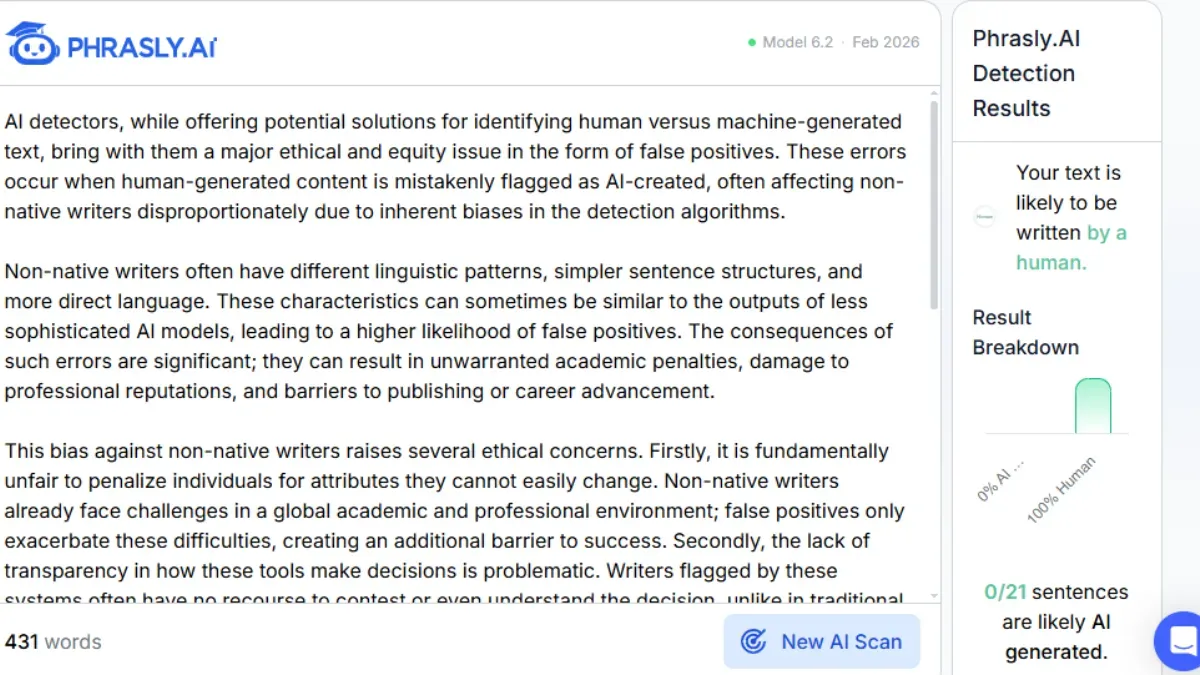
To check ZeroGPT's reliability, we analyzed results of the Phrasly 30K essay study. In it, 37,874 verified human-written essays were tested against ZeroGPT.
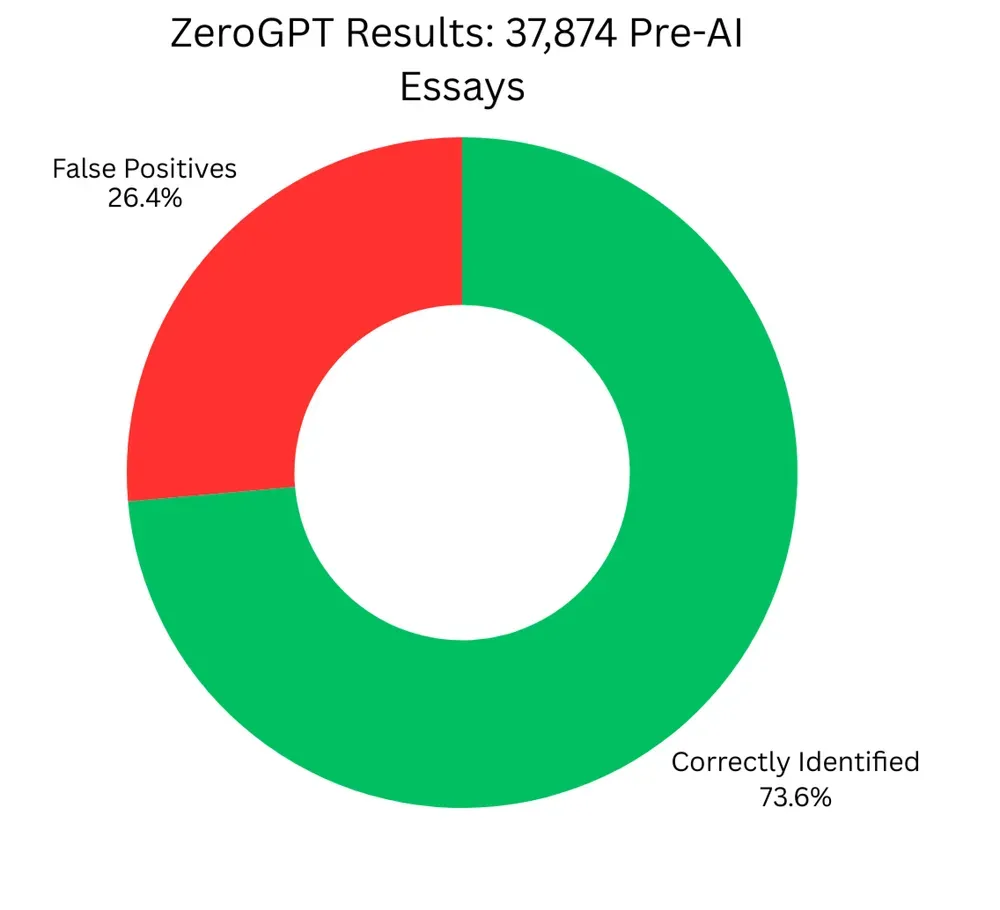
The findings demonstrated a shockingly high false positive rate of 26.4%, proving that even some of the most popular AI detectors can mistakenly flag human work as AI-written.
In our own test, we tested 3 human written essays, 3 essays written with ChatGPT, and 3 essays that mixed AI and human text.
Each of these samples was run through ZeroGPT and Phrasly to contrast AI detection accuracy, false positive rates and reliability when analyzing human vs AI text.
Results summary table:
|
Test Type |
Samples |
ZeroGPT Correct |
ZeroGPT Wrong |
Phrasly Correct |
Phrasly Wrong |
|
Human Text |
50 |
35 |
15 |
50 |
0 |
|
AI Text |
50 |
50 |
0 |
50 |
0 |
|
Mixed (AI +
Human) |
50 |
33 |
17 |
50 |
0 |
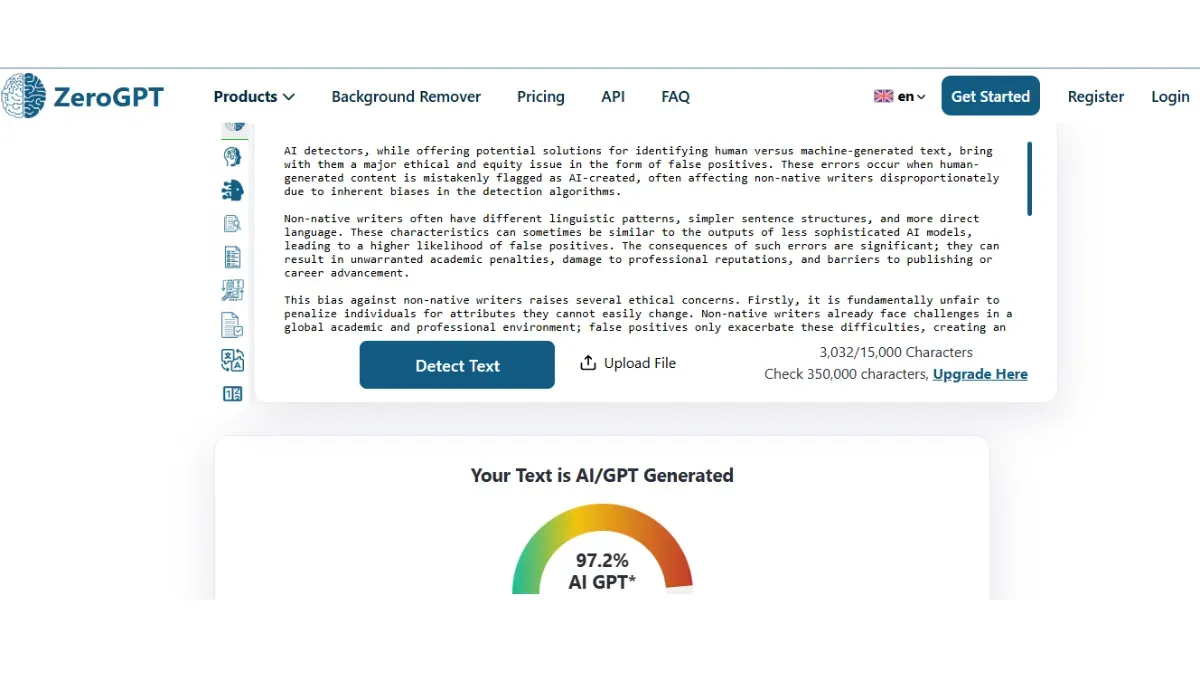
ZeroGPT accurately identified 3 out of 3 AI essays, proving it can detect blatant AI writing. But it also falsely flagged 1 human essay, revealing the tool’s false positive risk.
Mixed essays also yielded inconsistent results, with ZeroGPT sometimes misclassifying partial AI content. In comparison, Phrasly correctly identified all human essays and AI essays, providing much higher accuracy and confidence for students and educators.
Analysis of the data confirms that while ZeroGPT can accurately identify AI-generated text, its reliability falters when it comes to human-written content. Students who depend on ZeroGPT for their submissions run the risk of encountering false positives.
Phrasly not only has higher accuracy in AI detection but also a lower false positive rate, making it a safer and more accurate option for students and teachers alike when dealing with human vs AI text.
ZeroGPT False Positives: How Often Does It Get It Wrong?
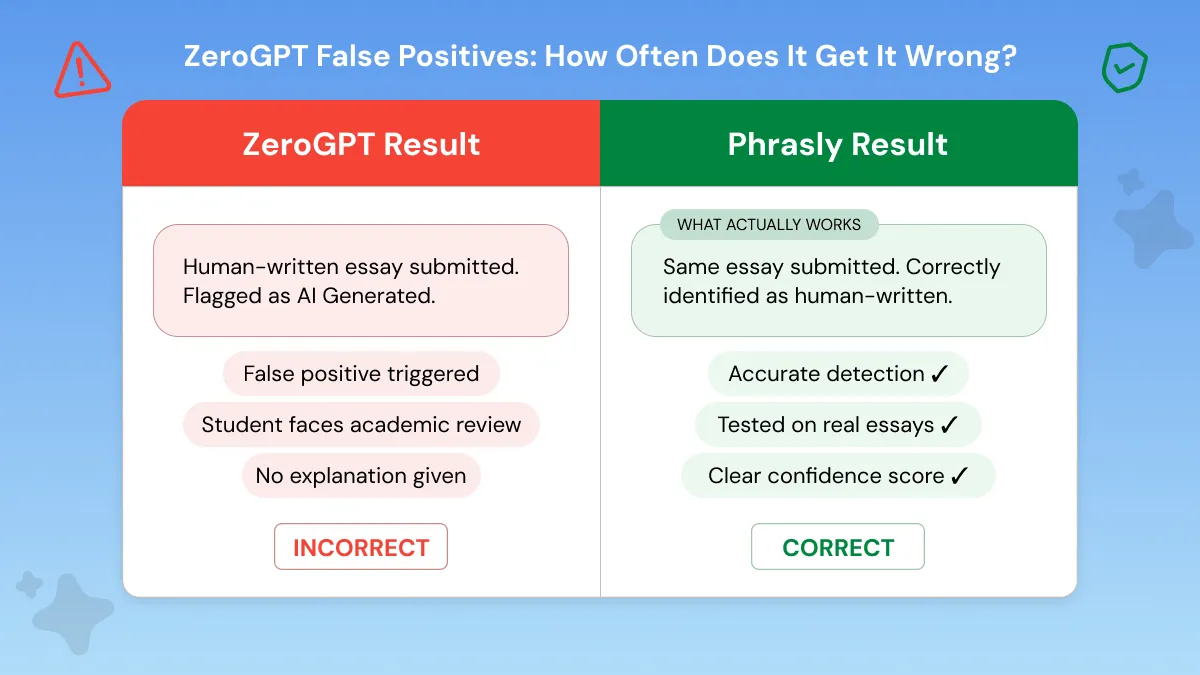
A false positive refers to when ZeroGPT detects text as AI-generated when in reality it was authored by a human. False positives are the most common complaint among students.
This isn't unique to ZeroGPT. It's a pattern seen across most AI detection tools, and there are specific reasons why it happens. We cover all of it in our guide on false positives explained.
In fact, a peer-reviewed study on arXiv found that AI-generated text detection tools face fundamental reliability limits, especially when text has been lightly edited.
When we tested ZeroGPT on 3 human written essays they falsely detected 1 of those 3 essays as AI-written. That’s a false positive rate of 33%.
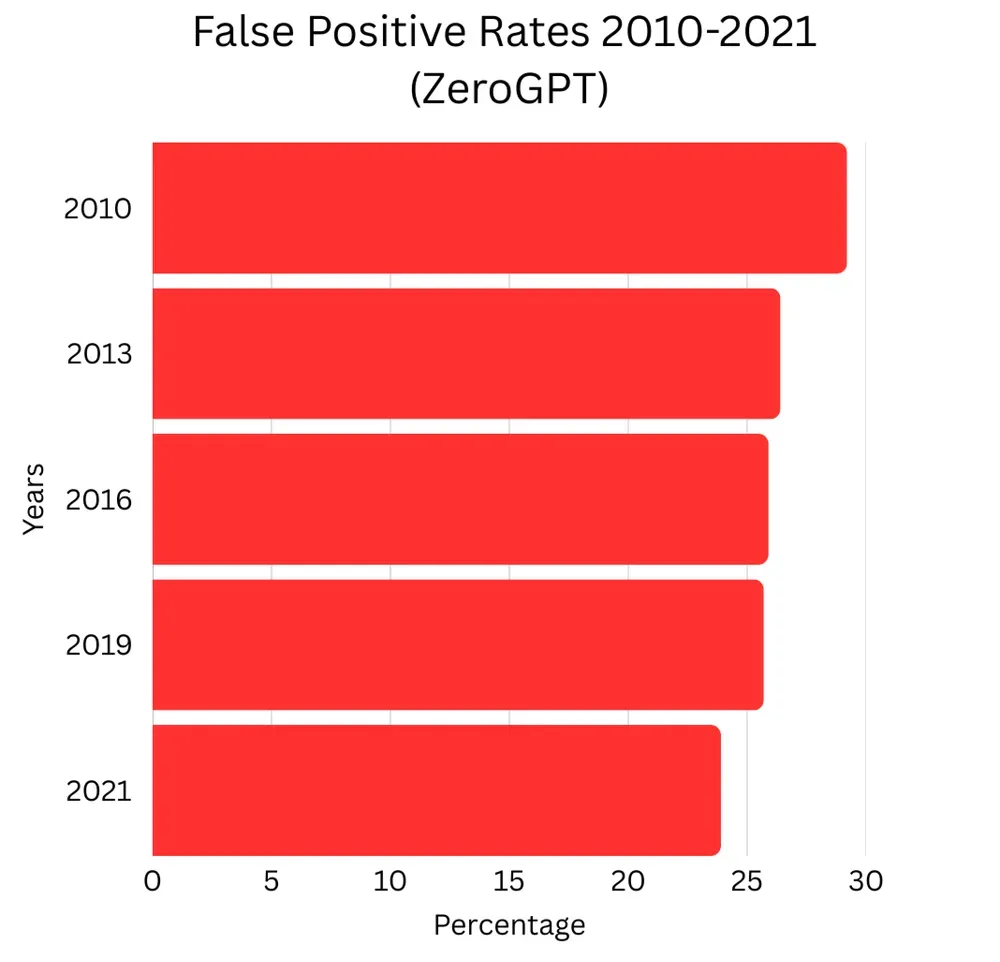
Even larger studies like Phrasly's analysis of 30K human essays came to similar conclusions with a false positive rate of 26.4%. Clearly this is a mass-scale issue.
Writing that is very formal, very structured or unnatural English (such as from non-native writers) can appear AI-like to the algorithm. Human written essays that have been proofread and edited can still falsely be detected as AI.
For example, the opening paragraph of Pride and Prejudice by Jane Austen:
If scanned by ZeroGPT, this example may falsely be detected as AI-written because it is written in a very formal manner.
For students and writers, knowing this false positive rate can clarify why ZeroGPT mistakenly flags human text as AI-generated. Awareness of ZeroGPT results can help users interpret the tool cautiously and avoid unnecessary stress.
When ZeroGPT Gets It Right?
ZeroGPT isn't completely ineffective though. In fact, ZeroGPT works fine when detecting blatant, rudimentary ChatGPT output that hasn't been altered.
If the text you input into ZeroGPT blatantly follows stereotypical patterns you would associate with AI writing (ex. repetitious words, awkwardly long sentences), the ZeroGPT analysis will most likely be accurate in marking it as AI generated.
One benefit of this tool is that there is a free tier that you can use to run spot checks without having to make an account. If you are a student, teacher, or writer that only needs a fast way to spot-check for AI writing occasionally, this can be helpful.
ZeroGPT Vs Phrasly Vs GPTZero: Head-to-Head
Accuracy and reliability are two important factors to consider when selecting an AI detector, particularly if you’re a student looking to check assignments or a teacher grading essays.
In response to several requests asking “what is the best AI detector?”, we put ZeroGPT, Phrasly, and GPTZero to the test, analyzing detection accuracy, false positives, speed, and limitations for free accounts.
For a deeper breakdown of how these tools perform across different content types, check out our full AI detection accuracy comparison.
This AI detection comparison will showcase which detectors excel at ChatGPT detection and overall AI writing analysis.
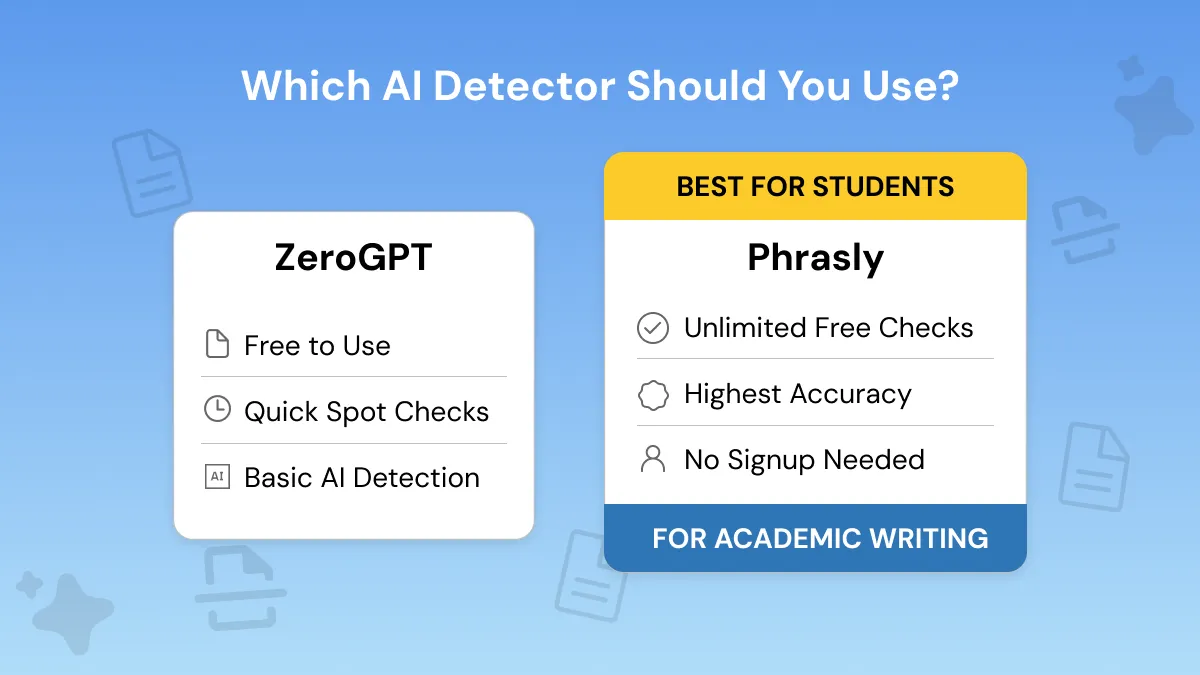
Phrasly offers high accuracy, fewer false positives, and a free AI detector that you can use right now with no signup.
ZeroGPT offers unlimited free scans without signing up and is one of the easiest tools to use when you just want a quick scan. The drawback is that ZeroGPT tends to have more false positives than others. (Sometimes flags human writing)
GPTZero is somewhat superior in terms of accuracy. However, its free version only allows for around 10,000 words per month.
Phrasly can be used by students and writers as a second opinion if they've already run their text through ZeroGPT and want to know for certain if their writing was created by a human or bot.
Is ZeroGPT Good Enough for Academic Use?
ZeroGPT can work fine for quick checks. Maybe you just want to quickly find out if something has the potential to look like AI written content. The tool is easy to use and offers free scans.
Students can benefit from this before they submit a paper. It’s likely to catch blatant AI work and give you a rough idea of AI detection.
But when using detectors for higher stakes academic submissions, placing all of your trust in just one detector can be risky.
For instance, detectors like ZeroGPT are susceptible to false positives, causing genuine human written content to be marked as AI-written.
Moreover, when submitting assignments, they will likely be run through their school's plagiarism checking tool too, like Turnitin, which will have different detection methods and scoring systems.
ZeroGPT is slightly less accurate than Turnitin. Because Turnitin has institutional data sets and more sophisticated detection models. Turnitin is more accurate when it comes to academics.
According to Turnitin's own published research, their false positive rate is under 1% for documents flagged at 20% or more AI which is a significantly lower margin of error than free tools like ZeroGPT.
That's why many students and teachers advocate running your text through multiple AI detectors if accuracy is important to you. Tools like Phrasly tend to have higher AI detection accuracy rates for structured academic texts.
You can use it to get a second opinion before you submit that important paper.
ZeroGPT is fine if you're looking for something quick and free. It works pretty fast and capable of catching obvious unedited AI output.
The problem is that according to our testing data and real world samples from students, ZeroGPT is not the most accurate when it comes to marking human written academia work. It will have false positives.
For this reason, ZeroGPT should be considered as a preliminary screening tool, not a definitive judgment.
ZeroGPT is free and fast, but when accuracy matters, especially for academic work, you need a tool tested against 30K+ essays.
FAQs
Is ZeroGPT accurate for detecting AI?
ZeroGPT can easily identify blatant AI-produced content. However, it also falsely identifies human essays at high rates. For better results, use a tool like Phrasly’s AI detector.
Can ZeroGPT detect ChatGPT?
Yes, it will flag texts written by ChatGPT and other similar AI models if they are unedited or very formulaic.
Why does ZeroGPT say my writing is AI?
False positives can occur when text is formal, very structured, or not written in native English patterns. These qualities can make writing appear closer to AI generated text.
An AI humanizer may assist in avoiding false positives by transforming text to appear more natural.
Is ZeroGPT free to use?
Yes, no signup required and you can do unlimited quick scans for free. ZeroGPT is ideal for students, writers, and educators who want to check text instantly. The free version has a simple interface and allows multiple scans.
What is the most accurate AI detector?
Accuracy-wise, Phrasly had fewer false positives than ZeroGPT/GPTZero particularly when detecting AI vs human written text and checking academic essays.


Keep reading

The Content Strategist's Workflow for AI-Assisted Production
A sound AI content workflow puts humans at the brief and expertise stages, letting AI handle outlining and drafting, then routes every piece through fact-checking, plagiarism, and AI-flatness QA gates before it can be published.

AI vs Human Cold Email Reply Rates: What 150M+ Emails Across 8 Studies Actually Show (2026)
AI cold emails get 1% fewer replies but 3x more spam flags. We compared 8 studies covering 150M+ emails, including peer-reviewed research, to show what actually works in 2026 and the fix that closes the gap.