Best AI Tool for Writing SEO-Rich Blog Content: 7 Options Compared
20 min read
Seven AI writing tools promise the same finished blog post, and each one is strongest at a different part of the job. The best AI tool for writing SEO-rich blog content depends on which step of your workflow is slow.
For turning an approved brief into a source-supported draft and then tightening tone and flow, Phrasly AI Writer with the AI Text Enhancer comes out on top. Surfer fits better when live on-page scoring is what you want, and Frase fits better when SERP research and briefs are the bottleneck.
No tool guarantees rankings. Your own expertise and your fact-checking still decide how the page performs.
Turn Your Approved Brief Into a First Draft
Paste your keyword and outline, and the AI Writer returns a first draft with its sources already attached.
What Makes an AI Writing Tool Good for SEO Content?
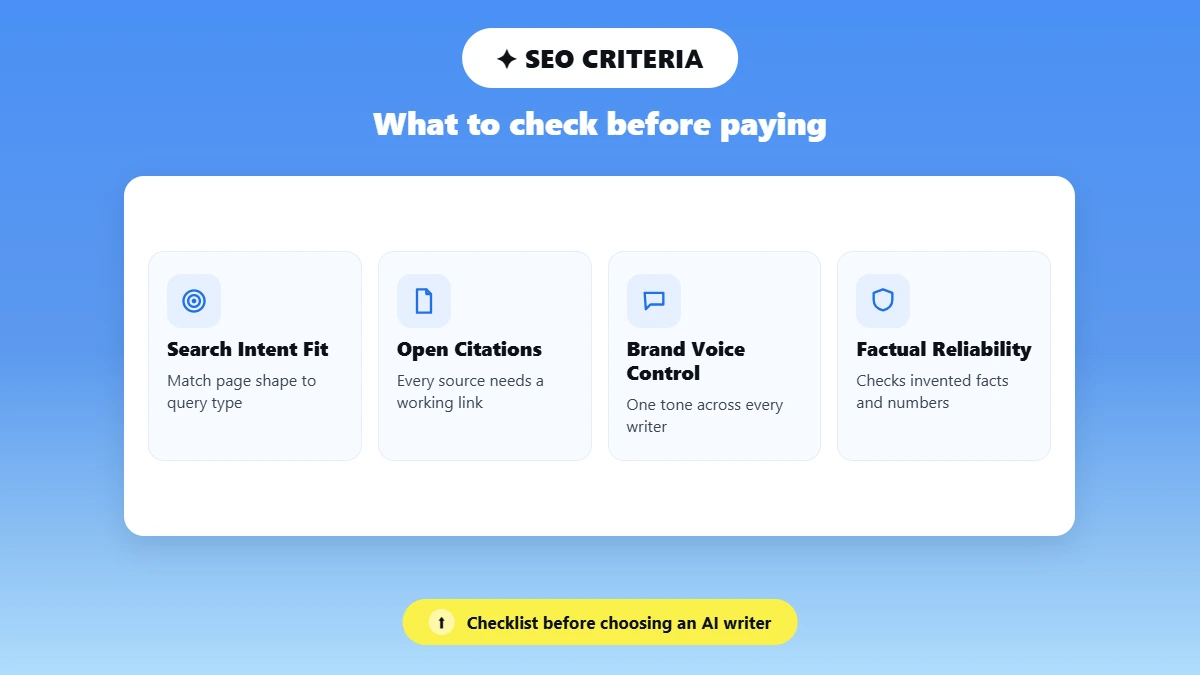
AI SEO content writing works when the tool follows your brief and gives you sources you can click and read. Content scores and keyword counts help you check a draft later, and they are not a reason to buy a tool.
Here is what to look at before you pay for one:
🎯 Search-intent fit: the tool should write the kind of page the search asks for. A comparison query needs a comparison, and a how-to query needs steps.
📋 Brief adherence: the tool should keep your outline, your required terms, and your section lengths instead of building its own structure.
🔗 Citations you can open: every source the tool inserts needs a working link you read before the draft moves anywhere.
🧱 Answer-first structure: headings should ask a real question, and the first sentence under each one should answer it. That is the part Google and AI answer engines pull from.
🗣️ Brand voice control: the tool should hold one tone across several writers, and across every document each of them opens.
✍️ Revision support: the tool should help you fix clarity, tone, and flow, because that is where most of your time goes.
📤 Export and workflow fit: the file should land in your CMS without reformatting, and in Word or Google Docs if your review happens there.
🗝️ Natural keyword integration: the tool should place your target terms where a sentence would carry them anyway, and leave them alone once they are there.
🧾 Factual reliability: check whether the tool invents specifics. A draft that names a feature you retired, or pins a real number to the wrong source, costs more time than the draft saved.
🔁 Internal-link handling: some tools suggest links from your own site and some ignore internal linking completely, which leaves that job with your editor.
💵 Transparent pricing and limits: the pricing page should tell you the per-article cap, the seat cost, and what happens when you hit a monthly limit.
👤 Human review: name the person who verifies facts and approves the page, because that role never moves to the tool.
A content score is one tool’s percentage rating of how closely your draft matches the pages already ranking for your keyword. Google states in its generative AI optimization guide that no third-party tool has access to its internal ranking or AI systems. A score of 90 tells you the tool likes your page, and it tells you nothing about how Google reads it.
Google’s guidance on generative AI content says the technology is useful for researching a topic and adding structure to original content. The same page adds the limit: generating many pages without adding value for users may violate its scaled content abuse policy. The line is value per page, not whether AI touched the draft.
💡 About 94% of marketers plan to use AI somewhere in content creation this year, according to HubSpot’s 2026 marketing data. When almost everyone drafts with AI, the editing standard is what separates one page from the next.
Research and ideation happen before the writer opens. A sharper instruction produces a sharper draft, which is why the AI prompts for marketers library exists. The AI content idea generator covers the step before that, when you still need angles rather than drafts.
How This AI Writing Tool Comparison Works
Every tool on this list got the same task and the same check against its live product pages in October 2026. The task is one section prompt with a single target keyword and three approved source links, handed to each tool unchanged. No scores, no timers, no error tallies.
Four plain things decide each tool’s notes:
✅ Brief adherence: did it write the section the brief asked for?
🔗 Sources: did it add citations you can open and read?
✂️ Editing load: how much work did the draft need before it could publish?
🗣️ Tone: did it hold the voice the brief asked for?
Phrasly is the only tool on this list with a full hands-on run and screenshots behind its notes. For every other tool, the notes come from live product pages and documentation, and they carry a vendor-claim label rather than a measured result.
⚠️ This is a working comparison you can repeat in an afternoon, not a lab study. Run the same brief through any two tools on this list and the differences show up quickly.
🏆 Best AI Tools for Writing SEO-Rich Blog Content
No single tool is the best AI writer for SEO in every situation, so the table sorts these seven by the job each one does best. The cards underneath explain what that looks like in practice.
Tool | Best for | Main strength | Main limitation | Free to start? |
|---|---|---|---|---|
Phrasly AI Writer + Text Enhancer | Source-supported drafting and editorial refinement | Drafting, citations, tone, and revision in one place | Needs external keyword and SERP research | ✅ Free account |
Surfer | Data-led on-page optimization | SERP-based guidelines and a live Content Score | Optimization-first workflow, and higher cost | ❌ Paid plans only |
Frase | Research and content briefs | SERP analysis that ends in a usable brief | Drafts still need heavy human editing | ✅ 7-day trial |
Jasper | Marketing teams and brand consistency | Brand voice and governance across a team | More than a solo writer needs | ✅ Free trial |
Writesonic | Integrated writing and AI-search workflows | Long-form pipeline with citation checks | Broad platform priced for teams | ✅ 7-day trial |
AIOSEO AI Assistant | WordPress users | Generation and optimization inside the editor | Useful mainly inside WordPress | ✅ Free Lite plugin (WordPress.org) |
ChatGPT | Flexible brainstorming and drafting | Adaptable prompts and fast iteration | SEO research and verification are on you | ✅ Free tier |
Pricing is accurate as of the date this article was written and is subject to change. Confirm the current price on the tool’s official pricing page before purchasing. Features, tiers, and access terms checked October 2026.
1. Phrasly AI Writer + AI Text Enhancer
Best for: writing the first version of a section from a finished brief, then improving it without starting over.
The AI Writer takes your prompt, a document type, and a word count, then writes the draft. You pick the tone from six options and the reading level from five. A separate toggle, Cite real sources, tells the tool to find sources and link them inside the text. Finished drafts open in Phrasly Docs and export from there.
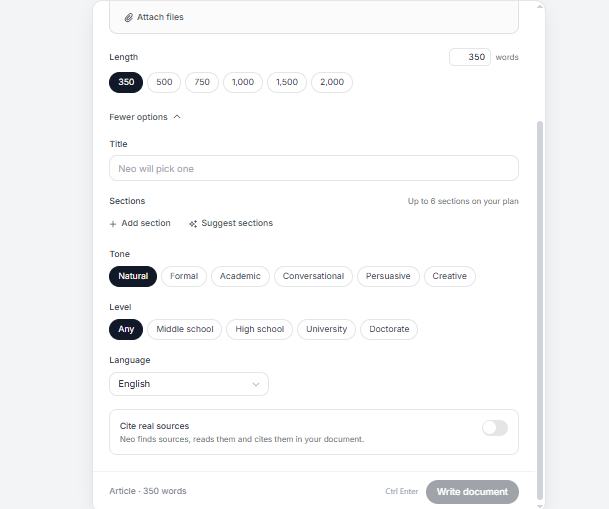
The Text Enhancer then rewrites a paragraph at three levels, Easy, Medium, and Aggressive. Each run returns one rewritten version, and the arrows under the output panel let you page back through earlier runs to compare them.
Hands-on observations: a brief carrying one target keyword, five required points, and three approved Google links went through the AI Writer at a 350-word setting. It returned 352 words covering all five points in the order the prompt asked for. All three approved links appeared inside the text as working hyperlinks, each one pointing at the page the sentence relied on.
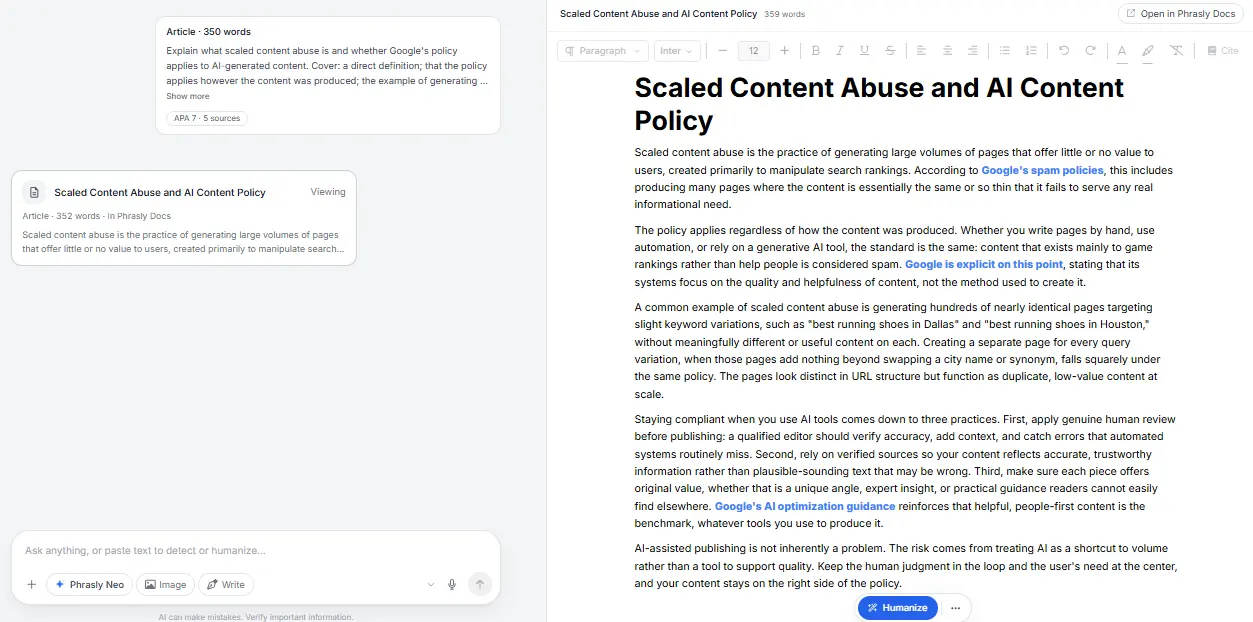
Output quality: the draft opened with a direct definition, kept one idea per paragraph, and used no em dashes. The refinement step needed a closer read, because a rewrite can turn a source’s specific examples into a general summary.
SEO strengths: citations land inside the sentences that use them, and the refinement pass leaves your target terms where you put them.
Limitations: no keyword research, no SERP scoring, and no rank tracking, so that work happens elsewhere. The prompt box caps at 100 words, a document runs from 350 to 2,000 words, and the free plan allows up to six sections per document. Every citation it generates still needs opening and checking by hand.
Pricing model: a free account covers 5 content pieces, and a paid plan raises the allowance to 15 a month with the option to buy more.
Verdict: the strongest fit here for drafting and refining, and the wrong choice if what you wanted was a score against the SERP.
2. Surfer
Best for: scoring and optimizing a page against what already ranks for the keyword.
The Content Editor gives live guidelines and a Content Score while you write, and Surfy handles in-editor drafting. The platform also carries SERP Analyzer, Topical Map, Content Audit, and an AI Tracker that watches ChatGPT, Perplexity, Gemini, and Google’s AI Overviews and AI Mode. It connects to WordPress and Google Docs.
Documented capabilities: taken from Surfer’s own live feature and plan pages in October 2026, not from a run. Surfer says it serves 150,000+ customers across 159+ countries, which is a vendor claim.
Output quality: Surfer positions Surfy as an in-editor assistant rather than a full draft generator, so the Content Editor carries most of the workload.
SEO strengths: the guidelines come from the pages currently ranking, and it tracks visibility across five answer engines.
Limitations: the Surfer pricing page lists no free plan, and document allowances are capped per tier.
Pricing model: subscription only, tiered by documents, tracked pages, and seats.
Verdict: buy it for optimization, not for drafting.
3. Frase
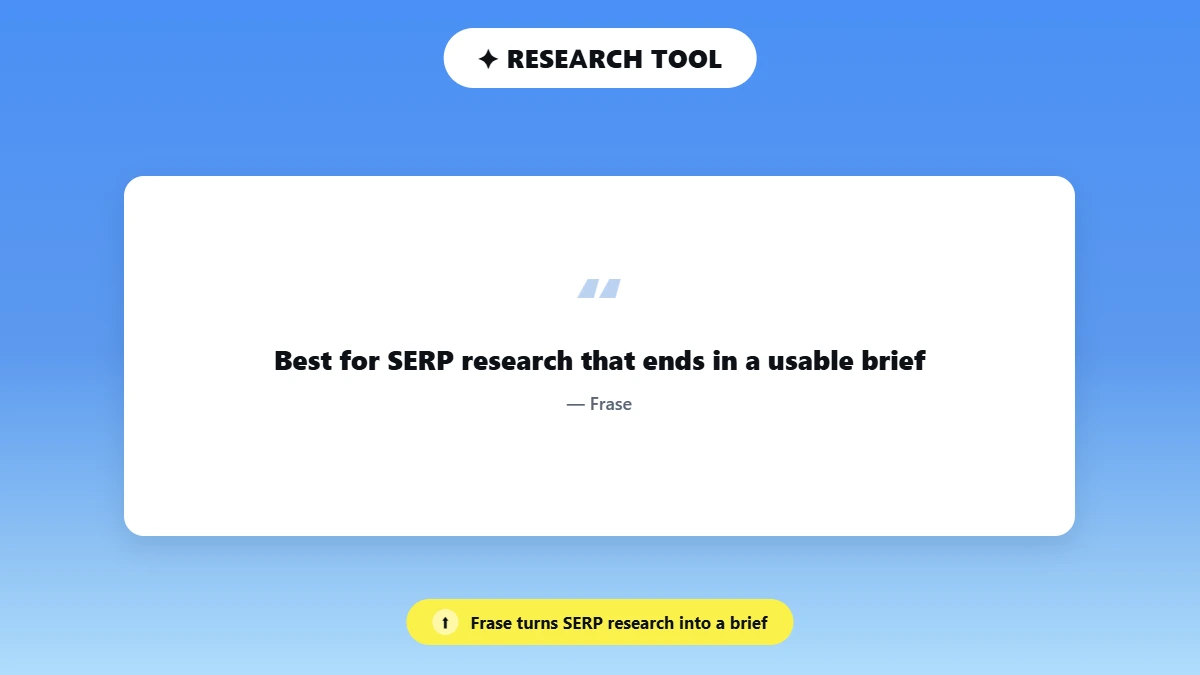
Best for: SERP research that ends in a brief you can hand to a writer.
Frase studies what already ranks, builds the brief, then drafts and optimizes against it. It scores pages for search and for AI citation visibility, audits pages you have already published, and pushes finished posts to WordPress, Webflow, Sanity, or Wix.
Documented capabilities: taken from Frase’s live pricing and feature pages. The 7-day trial takes no credit card and is capped at 5 articles, 50 audit pages, and 25 AI prompts.
Output quality: Frase states that its agent returns a finished draft rather than an outline, and its own pricing page warns that no tool ranks you inside a trial.
SEO strengths: the research step ends in a usable brief, and a published page can be re-scored in the same place after you edit it.
Limitations: drafts still need real editing, and the trial caps are low enough that a week of use will not tell you much about volume.
Pricing model: articles and audit pages set the tier, and seats and extra sites are charged on top.
Verdict: the research and briefing step is where it earns its place.
4. Jasper
Best for: marketing teams that need one voice across many writers.
Jasper IQ stores your brand voice, style guides, audience profiles, and product knowledge, then applies that context to every output across the team, with admins setting the rules once. Canvas is the working surface, purpose-built agents handle specific marketing jobs, and content pipelines make the same workflow repeatable.
Documented capabilities: read off Jasper’s live platform and pricing pages, not from a run.
Output quality: Jasper applies brand context automatically rather than asking you to prompt for it each time, so consistency is the quality it optimizes for.
SEO strengths: brand rules set once at admin level and enforced on every generation, plus agents aimed at SEO and AI-search tasks.
Limitations: Pro covers a single seat, and anything with shared governance moves to a custom contract, so a solo writer pays for team features nobody else will use.
Pricing model: per-seat subscription for one user, and a custom team contract above that.
Verdict: brand control at team scale, and more than a solo blogger needs.
5. Writesonic
Best for: teams running content production and AI-search visibility in one place.
The AI Article Writer runs each piece through a multi-step pipeline with SERP research, a verified citation bank, internal linking, and schema. Finished articles export to WordPress, Sanity, Contentful, or Notion. The platform also carries an SEO agent, an SEO checker, and GEO tracking across ChatGPT, Perplexity, and Gemini.
Documented capabilities: read off Writesonic’s live product and pricing pages. Writesonic also ships its own AI content detector, so treat its quality claims as vendor claims.
Output quality: Writesonic states that every article passes a multi-expert review and a humanizing pass before delivery, and it targets long-form depth over short posts.
SEO strengths: SERP and competitor research feed the draft, internal links are drawn from pages you already own, and FAQ and article schema ship with the piece.
Limitations: this is a platform purchase. A seven-day trial with no card lets you generate one long article before deciding.
Pricing model: a subscription priced by tracked prompts and articles, with extra users charged on top.
Verdict: worth it when AI-search visibility is a real goal, and too much when you only want drafts.
6. AIOSEO AI Assistant
Best for: people who write and publish entirely inside WordPress.
The AI Assistant is a block in the WordPress editor: you prompt it and it generates sections, headlines, FAQs, or a full post without leaving the page you are editing. It runs on AI credits attached to a paid AIOSEO plan. The separate AI Writing Assistant grades your draft against top-ranking pages and needs an SEOBoost subscription on top of the plugin.
Documented capabilities: taken from AIOSEO’s live feature pages, documentation, and pricing page.
Output quality: AIOSEO states that everything the AI Assistant generates can be reviewed and edited before it is inserted into the post, so nothing publishes unseen.
SEO strengths: TruSEO analysis, internal link suggestions, and index checks all run inside the post editor rather than in a second tab.
Limitations: the AI Assistant works only in the default WordPress block editor, so page builders are out for now, and the value drops sharply outside WordPress.
Pricing model: a free Lite plugin on WordPress.org, plus paid annual licences tiered by site count, each including AI credits.
Verdict: it is convenient where you already work and limited everywhere else.
7. ChatGPT
Best for: ideation, outlines, and drafting when you want full control of the instruction.
ChatGPT adapts to whatever you ask, which makes it useful for angles, counterarguments, and rewriting one section three different ways until the shape is right.
Documented capabilities: taken from OpenAI’s live pricing page and product documentation.
Output quality: quality tracks the instruction you give it, and no part of the product checks a fact or opens a source on your behalf.
SEO strengths: none built in. It contributes structure and phrasing, and every SEO decision stays with you.
Limitations: it does not research your SERP, score your page, or verify its own claims. Every fact, link, and keyword decision is yours.
Pricing model: a free tier, plus paid individual and team plans charged per user.
Verdict: the most flexible option here and the one that leaves the most work for you.
Why Phrasly Works Best as a Write-and-Refine Workflow
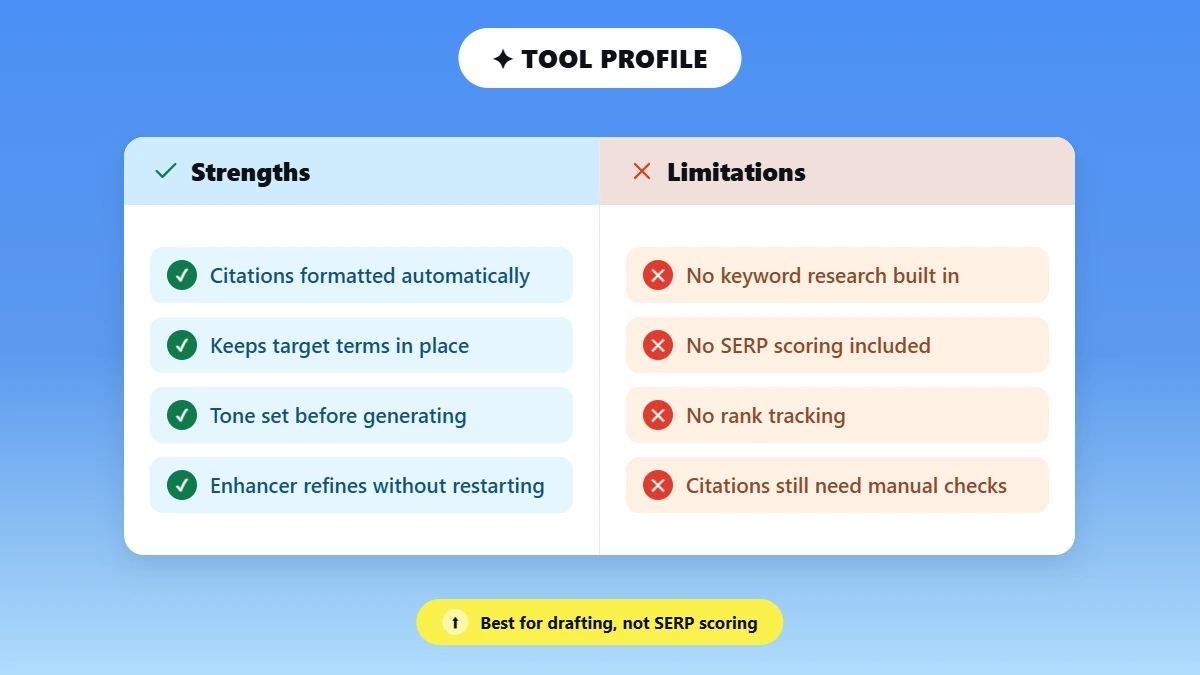
Phrasly is built for the two steps most SEO platforms treat as an afterthought: producing a first draft that cites real sources, and improving that draft without starting it again. The research happens before you open it, and the approval happens after you close it.
The honest workflow takes six steps:
Finish the research first. Keyword choice, SERP review, and the approved outline all happen outside Phrasly.
Give the AI Writer the approved inputs. Set the outline and the audience first, then pick the tone and the reading level before you generate anything.
Turn the citation toggle on. It starts off, and nothing gets cited until you switch it on.
Generate the first draft. Read it once for structure before you read it for wording, because a reorder deletes sentences you would otherwise polish.
Add what only you have. Firsthand examples, expert commentary, and original analysis go in by hand, because no model can supply them truthfully.
Run the Text Enhancer, then recheck. Pick Easy, Medium, or Aggressive, then open every link and confirm the keywords and the CTA survived the edit.
Put your target terms into the text before you enhance it, because the Text Enhancer preserves the key terms it can see while it changes the wording around them. Phrasly’s AI Text Enhancer page recommends the same order, and the walkthrough on how to write a blog post with an AI writer covers the drafting half in full.
Lock the focus keyword, the heading hierarchy, and the existing links before any edit starts. That is how you humanize AI SEO content without hurting rankings, and the rule holds whether a person or a tool wrote the first pass.
🚫 Phrasly does not analyze the live SERP, track rankings, or hold a keyword database. A tool that claims to cover research, drafting, and rank tracking at the same standard is overstating at least one of them.
Start your next SEO blog draft from an approved brief and trusted sources. 👇
Before and After: Refining an AI-Written SEO Paragraph
The same paragraph goes through three rounds here: what the AI Writer produced, what the Text Enhancer returned, and what a person approved. Read them in order and you can see which decisions a tool makes for you and which ones stay yours.
1. Raw AI Writer output
Scaled content abuse is the practice of generating large volumes of pages that offer little or no value to users, created primarily to manipulate search rankings. According to Google’s spam policies, this includes producing many pages where the content is essentially the same or so thin that it fails to serve any real informational need.
2. After the Text Enhancer (Aggressive)
Scaled content abuse refers to efforts made to create large amounts of pages with little or no user value, typically for the purposes of manipulating search rankings. This, per Google’s spam policies, can take the form of creating many pages which contain identical information or pages so “thin” that they don’t actually meet any user’s search intent.
3. Human-approved final
Scaled content abuse happens when a site publishes many pages mainly to manipulate search rankings, and those pages give users little or no value. Google’s spam policies list examples such as AI-generated pages that add nothing for users and pages that stitch together content from other sites without adding anything new.
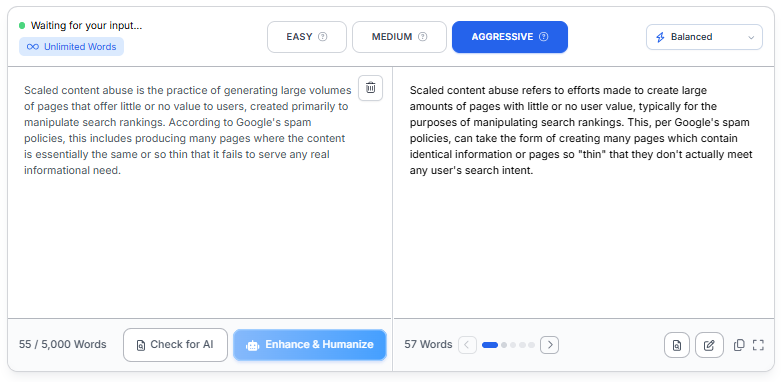
Four things changed between the first version and the last:
✅ The target keyword survived. "Scaled content abuse" stayed in place through all three rounds.
📌 The examples got specific. The enhancer gave a general restatement of the policy. The approved version names what Google actually lists: AI-generated pages that add nothing, and pages stitched together from other sites.
🔗 The source attribution held. Google’s spam policies stayed named and linked in every version.
🗣️ A person became the subject. “Refers to efforts made to create large amounts of pages” became “happens when a site publishes many pages”. The reader learns who is doing it.
💡 Check that the rewrite’s examples match the source’s examples. A refinement pass can turn a source’s specific list into a general summary that sounds right and loses the detail. Open the source and compare before you publish.
Two of those changes came from the tool and two came from editorial judgment. If you want to see how other tools handle the same pass, this roundup of the best AI text enhancers runs ten of them through one paragraph.
Phrasly also offers Ultra, a stronger model with five levels of change instead of three, on the paid plans. The standard model handles everyday polish, and Ultra suits a draft that needs a heavier rewrite.
How to Choose the Right AI SEO Writer
Pick the tool that fixes your slowest step. If drafting is slow, buy a writer. If your drafts read well but score badly, buy an optimizer. If you cannot decide what to write in the first place, buy research. Buy for the problem you actually have, and the feature list stops mattering.
Your main need | Recommended category |
|---|---|
Create a source-supported first draft | Phrasly AI Writer |
Refine an existing draft | Phrasly Text Enhancer |
Live content scoring | Surfer |
SERP research and briefing | Frase |
Brand governance across a large team | Jasper |
WordPress-native writing | AIOSEO |
Flexible ideation and prompt-based drafting | ChatGPT |
What if the Budget Covers Only One Tool?
Buy the writer and do the optimization by hand. Keyword research, SERP review, and a heading audit are all work you can complete in a browser with free data, while drafting and refining are the steps that eat hours every week. A paid writer is worth more than a paid optimizer when you have nothing written yet.
Tie-Breakers Worth Checking Before You Subscribe
Before you subscribe to any SEO blog writing tool, check seven things:
💵 Budget: set the monthly ceiling before you compare, because most of these platforms charge per seat and add cost above a usage cap.
📅 Publishing volume: count the articles you actually ship in a month and check that number against the plan’s cap.
🔎 Research needs: if you already pay for keyword and SERP data elsewhere, a writer alone is enough. If you do not, a platform that bundles research saves you a second subscription.
🖥️ CMS fit: check that the tool exports to the system you actually publish in.
👥 Team size and seats: most platforms here charge for each extra seat.
🗣️ Brand controls: one shared voice across writers only matters once you have more than one writer.
✂️ Editing burden: a draft that needs two hours of repair is more expensive than a slower tool.
⛔ Mistakes That Stop AI-Written Blog Content From Ranking
Most AI-optimized content writing fails for reasons that have nothing to do with the model. The pages skip the search-intent work, repeat what already ranks, and reach publication without anybody opening a single source. Each of the mistakes below is fixable before you hit publish.
🔍 Skipping search-intent research. A listicle written for a query that wants a definition wastes the whole page.
🪞 Copying competitor headings with nothing added. A page that mirrors the SERP structure without adding information gives nobody a reason to rank it higher.
📊 Treating a content score as a ranking guarantee. A high score means you satisfied one vendor’s formula, which is a different thing from satisfying the query.
🔗 Publishing citations nobody opened. A generated citation can point at a real URL that does not say what the sentence claims.
🧂 Stuffing semantic terms. A sentence bent around a phrase costs readability and buys nothing.
🗝️ Dropping keywords while editing. Refinement passes rewrite the wording around terms they cannot see in the draft.
📄 Building a separate page per query variation. Google names this directly: creating content for every possible search variation to manipulate rankings falls under scaled content abuse.
👤 Publishing with no firsthand experience. A page with no test, screenshot, or lived detail reads like every other page on the topic.
🏭 Using AI to scale thin, interchangeable articles. Volume without added value is the exact behaviour the spam policy targets.
🔁 Skipping internal links and human approval. An orphaned page with no named reviewer starts at a disadvantage it never recovers from.
Google’s guidance on helpful, people-first content asks for clear authorship, firsthand expertise, and a page that exists for a reason other than search traffic. This self-editing checklist for copywriters turns that into passes you can run on any draft, AI-assisted or not.
How to Measure Whether AI-Assisted SEO Content Works
Judge AI-assisted content with the same numbers you use for everything else, checked at 30, 60, and 90 days. Indexation comes first, because nothing else matters until the page is in the index, and conversions come last, because they take the longest to move.
📇 Indexation: confirm the page is indexed before you read any other number.
👁️ Impressions and clicks: the first sign real searches are finding the page.
🔢 Average position and CTR: position tells you where you stand, CTR tells you whether the title earns the click.
🆕 Queries gained: new terms the page picks up are usually a better health signal than one target keyword.
🤝 Engagement and conversions: scroll depth, assisted sign-ups, and anything you built the page to make happen.
🔗 Links earned: these come slowly, and they are the clearest evidence the page added something.
🤖 AI visibility: Search Console’s Generative AI performance report shows how your content performs in AI Overviews and AI Mode.
Set the refresh checkpoints when you publish rather than when traffic disappoints you. Read the Generative AI performance report alongside the standard performance data, and treat a flat 30-day result as normal rather than as a verdict.
Across all seven tools, the choice comes down to which step in your workflow is costing you the most time. Buy against that answer rather than against a feature list, because Phrasly covers the writing and the rewrite, Surfer covers the score, and Frase covers the brief. Whichever one you subscribe to, a person still has to verify the sources and sign off on the page, and that is the part no tool on this list takes off your hands.
Skip the tool-by-tool comparison and build your next SEO draft now. 👇
Frequently asked questions
Can AI-generated blog content rank on Google?
AI-assisted content can rank, because Google judges the page rather than the production method. Its guidance sets one condition: pages generated at volume without added value fall under the scaled content abuse policy. Verify the facts, add something the model could not supply, and have a named person approve it.
Is Phrasly an SEO tool or an AI writing tool?
Phrasly is an AI writer and editor, not a rank tracker, a SERP scorer, or a keyword database. It drafts with live citations and refines tone, clarity, and flow. Keyword research and ranking analysis belong in a dedicated SEO platform alongside it.
What is the best free AI tool for SEO blog writing?
ChatGPT’s free tier is the most capable no-cost drafting option, and AIOSEO’s Lite plugin is free inside WordPress. Phrasly gives a new signup five pieces of content. Free access covers drafting, and none of it replaces research or verification.
Can ChatGPT create SEO-optimized blog posts?
ChatGPT drafts well from a detailed instruction, and the optimization half stays manual. Give it the keyword, the outline, and the approved sources, then verify every claim and link it returns before anything publishes.
Should I use an AI writer and an SEO optimizer together?
Two tools beat one generalist here. Draft in a writer that cites sources, score the result in an optimizer built on SERP data, and keep one human decision at the end. This guide to the AI paragraph generator covers the drafting half.
Does editing AI-generated content remove important keywords?
It can, and it usually happens when nobody puts the keywords in before the editing starts. A refinement tool keeps the terms it can already see in your text and changes the words around them, so add your target keywords first and the tool will work around them instead of over them. The same goes for when you humanize marketing content.

Written by
Alina Shah
SEO Content Specialist · Karachi, Pakistan
She writes about AI so you don't have to guess. 8+ years in content strategy and editing. Now she puts AI writing tools and detection systems through real tests and shares what actually works.