9 Best AI Ad Writing Tools in 2026 (Compared for Google, Facebook, and Instagram)
17 min read
Generic AI copy is easy to spot. Twenty ads all making the same promise. Ignore a platform's character limit, or claim a stat nobody approved.
The best AI ad writing tools in 2026 aren't judged by which can write fastest. They're judged by which produces copy you actually want to run, and how much cleanup it requires before that happens.
This roundup compares nine tools on platform fit, features, pricing, editorial controls, and how much human editing each is likely to need.
Picking the right AI ad writing tool for the job at hand is what matters. And that’s exactly what someone looking for “best AI tool for writing ads” or asking “which AI ad writer should I use” needs help with.
Skip the blank page. Turn your brief into ad copy with Phrasly AI Writer.
The Best AI Ad Writing Tools at a Glance
Not every AI ad writing tool is ideal for every job. Phrasly's strongest feature is its copy-first workflow, which allows you to draft many ad angles and iterate on the winning idea into finished copy.
Anyword suits predictive copy scoring, Jasper works great with teams that require brand governance, AdCreative.ai seamlessly connects copy with static creative, and Creatify was built specifically for video ad scripts.
This table compares the 9 best AI writing tools as it relates to best AI tools for writing ads 2026, as a straightforward AI ad copy generator comparison, by use case, what output they provide, and whether or not they are free to access.
Tool | Best for | Creates | Free access | Main drawback |
Phrasly (AI Writer + Text Enhancer) | Copy-first drafting and refining | Text | Free to try | No native ad publishing, brand-voice training, or performance scoring |
Anyword | Predictive copy scoring | Text | Paid, with free trial | Predictions are guidance, not proof; still test live |
Jasper | Brand-governed team campaigns | Text | Paid, with free trial | Higher entry cost and broader platform than many solo advertisers need |
AdCreative.ai | Copy plus static creative | Text + static creative | Paid, with free trial | Credit and brand limits; a full suite can be overkill for copy only |
Copy.ai | Repeatable GTM workflows | Text + workflow | Free tier + paid | Broad GTM platform, not a dedicated ad predictor |
Canva Grow | Designing and publishing visual ads | Visual + text | Limited free | Writing is one part of a visual suite; insights gated to higher plans |
Creatify | UGC and short video scripts | Video script + video | Limited free credits | Video-first and credit-based; unneeded for text-only search ads |
HubSpot | Existing HubSpot users and beginners | Text | Free tool | Best fit tied to the wider HubSpot workflow |
ChatGPT | Flexible ad ideation | Text | Free plan + paid | No ad templates, compliance, or scoring unless the prompt supplies them |
Pricing checked September 14, 2026. Prices, plans, credits, taxes, and annual billing terms are subject to change. Check with the vendor's actual pricing page for details before purchasing.
How We Chose and Compared These AI Ad Writers
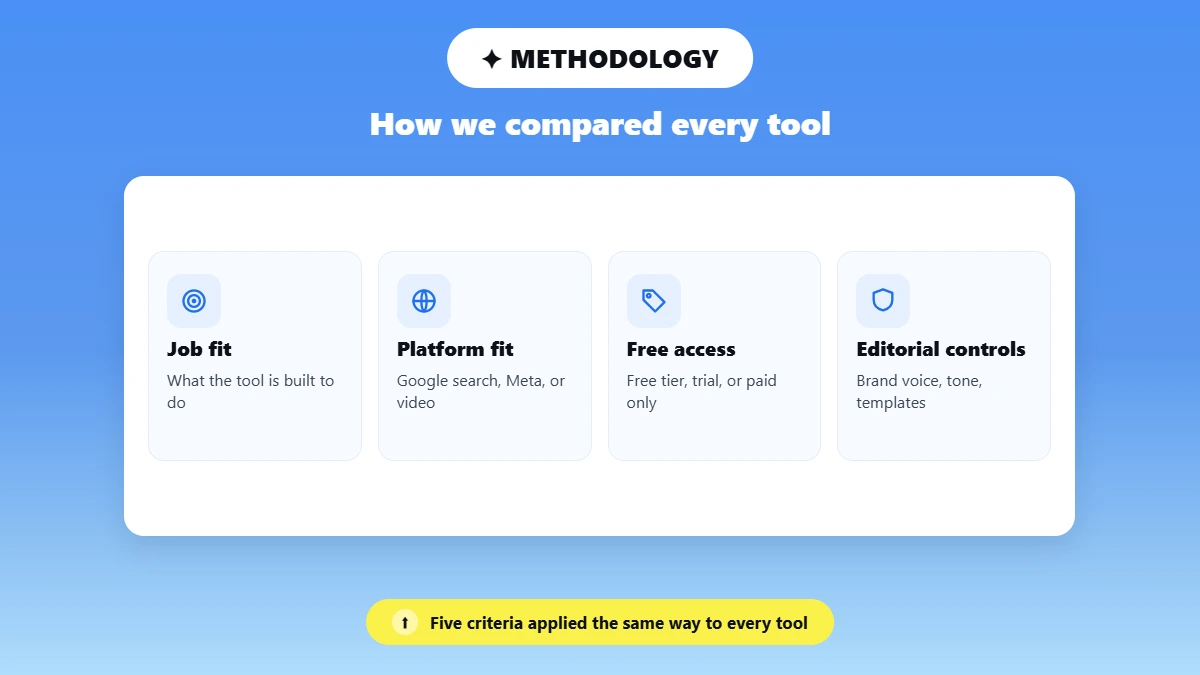
We compared these nine tools based on what each vendor documents on its official product and pricing pages, checked on the date shown above.
For each one, we looked at the job it is built for, the output it creates, its free access, its editorial controls, and how much human editing its copy is likely to need.
The numbered order below is by job, not by score. It is not a performance ranking, and no tool on this list wins outright.
Five criteria, applied the same way to every tool:
Job fit: What the tool is built to do, such as copy drafting, predictive scoring, brand governance, static creative, or video. This decides who should pay for it.
Platform fit: Whether it suits Google search ads, Meta and Instagram, or video scripts, and whether it can publish to an ad platform directly.
Free access and pricing: Free tier, free trial, or paid only. We describe pricing qualitatively because plans, credits, and limits change often.
Editorial controls: Brand voice, tone settings, templates, and refinement options that shape the copy before it ships.
Editing effort: How much a human still has to supply or fix, such as character limits, approved proof points, and claim checks.
Where a vendor publishes its own performance or accuracy figures, we label them as vendor claims. They are not independent findings, and none of them replaces a live test in your own ad account.
Disclosure: Phrasly publishes this guide, and Phrasly is one of the tools reviewed in it. Its limits are stated as plainly as every other tool's. This is a vendor-published comparison, not an independent one, so weigh it accordingly and run your own brief through any tool before you commit budget to it.
1. Phrasly: Best Copy-First Workflow for Drafting and Refining Ads
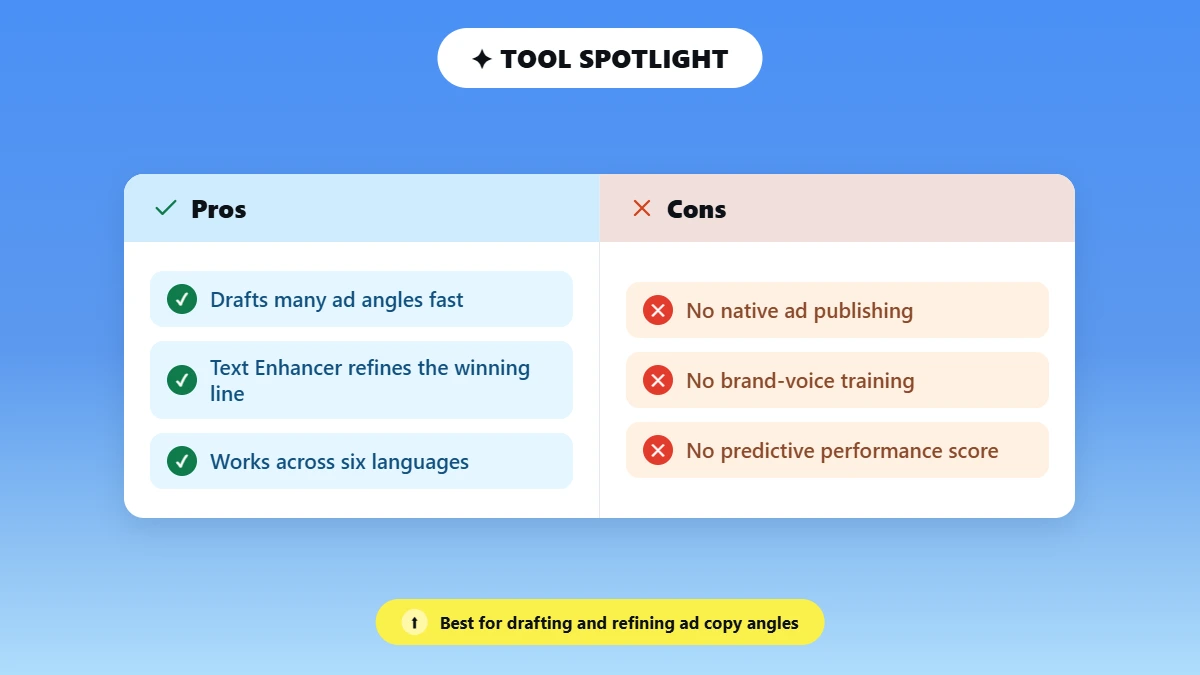
Phrasly works great for marketers who want to write a few angles for an ad, choose the strongest angle, and then polish its tone and cadence before sending it live, without having to pay for a full ad-operations solution.
Searching for a free AI ad writer or AI tools for writing ad copy? Then this two-step workflow was made for you: The AI Writer crafts a first draft from your detailed brief. The AI Text Enhancer then optimizes your winning angle into 5 polished iterations.
✅ AI Writer: Enter your audience, offer, proof points, and desired tone. Choose a writing style and citation style if your draft will contain sourced claims.
Pulls live web citations and exports directly to Word, Google Docs, or PDF so you can have a ready-to-share draft in minutes.
✅ AI Text Enhancer: The polishing step. Choose Easy, Medium, or Aggressive. It returns five enhanced versions of your strongest line. You can compare tone and phrasing side by side instead of accepting the first rewrite.
See the full breakdown in this best AI text enhancers comparison.
✅ Operate in multiple languages (Text Enhancer features English, Spanish, German, French, Portuguese, and Italian). This is beneficial when localizing one advertisement for multiple markets.
❌ Honest drawback: Phrasly's product pages do not document native publishing to Google Ads or Meta, persistent brand-voice training, or a predictive performance score.
Use it as the drafting and refinement layer. Move the finished copy into your ad platform yourself.
Draft a batch of ad angles, then keep the lines that make one clear promise.
2. Anyword: Best for Predictive Copy Scoring
Anyword shines when AI ad copy performance scoring is the most important aspect of your workflow.
It creates ad variants and provides a predicted performance score for each. Includes marketing templates to create data-informed ad copy, allows you to set your brand voice, and features a browser extension for editing pages.
✅ Predictive scoring gives you a fast way to prioritize which of twenty variants to test first, according to Anyword.
✅ Marketing templates cover search, social, and display formats, so you are not starting from a blank prompt.
✅ Plans list one brand voice and a one-click performance boost and content improver for reworking weaker lines, according to Anyword's pricing page.
❌ Claim from vendor, not independent verification: a predicted score is generated from Anyword's internal model. It is merely a tool to help you prioritize variants.
It is not indicative of an actual click-through or conversion rate. Be sure to confirm the winning variant with your own live A/B test in your ad account prior to scaling spend.
❌ Prices are charged (though there is a free trial). Please check Anyword's pricing page for current offerings, as their plans and credits offered change.
3. Jasper: Best for Brand-Governed Marketing Teams
Jasper works best for teams that require brand voice AI copywriting to be consistent across an entire cross-channel campaign, rather than a single ad set.
Jasper focuses on brand Voice settings, defined audiences, a shared knowledge base, and campaign workflows that sync multiple writers to the same messaging.
✅ Brand Voice and audience profiles allow five writers to sound like one brand. This is increasingly important as campaigns expand across multiple channels.
✅ Centralized repository: The tool can draw upon your real product attributes instead of making assumptions.
❌ Solo advertisers and small teams that only need short ad copy will likely pay for a lot of platform they never touch.
Jasper is built for AI for marketing teams running structured campaigns. Not a single freelancer writing one ad set.
❌ Costlier entry price than a copy-only tool (this is paid with a free trial option). Double-check what your current plan allows live, as voice and knowledge-asset limitations vary between plans.
4. AdCreative.ai: Best for Copy Plus Static Ad Creative
AdCreative.ai is best when you need AI ad creative tools. Produce ad copy and static visuals in the same workflow.
It works as an ad copy and image generator. Combining a text generator with competitor insight tracking and a scoring system for finished creatives.
✅ One workflow for both the headline and the static image means less back-and-forth between copywriter and designer on basic social ad sets.
✅ Knowledge of your competitors can reveal what comparable advertisers are promoting. Helpful context even if you are crafting your copy independently.
✅ Generation is unlimited. A credit is used only when you download a creative, according to AdCreative.ai. You can compare many versions. Spend credits only on the ones you keep.
Credit allowances vary by plan. Check the live pricing page.
❌ Any conversion-accuracy percentage AdCreative.ai publishes is the vendor's own claim. Not an independent finding. Treat it the same way as Anyword's prediction score. A prioritization signal, not proof.
❌ Credit limits and brand controls built for full creative production can be more than a copy-only advertiser needs. A full suite is overkill if you only want words.
It is the best fit for ecommerce and paid-social teams that need words and visuals in one place.
5. Copy.ai: Best for Repeatable GTM Workflows
Copy.ai is most useful for teams looking to standardize batches of repeatable work. Not for the sole advertiser that needs ten headlines one time. AI copywriting workflows here run through Chat.
A Brand Voice setting, a shared company Infobase, and customizable multi-step workflows with access to more than one underlying model.
✅ Reusable workflows allow you to template something like "write this week's ad set" once, then anyone on your team can run it again and again.
✅ Having multi-model access allows teams to compare results from various models on a single brief without toggling between tools.
❌ GTM content automation is the main product. Writing one-off ad copy is only a small fraction of Copy.ai capabilities, so if all you need is occasional ad copy, the marketer may see the workflow layer unnecessary.
❌ Chat plans and workflow automation sit on separate plan or credit structures (verify live). This adds pricing complexity for a simple use case.
6. Canva Grow: Best for Creating and Publishing Visual Social Ads
Canva Grow is ideal if you want a completely visual, social-first workflow. This is essentially an AI tool that writes your ad copy and creates the visual asset, and can even publish directly to social platforms.
Features include prompt-based ad creation, in-editor ad editing, direct publishing to Meta, TikTok, and LinkedIn ads manager, a performance dashboard, plus Canva's Magic Write for writing the actual copy.
✅ Quickly creating a finished ad that doesn't require switching between apps or tools is a huge time saver for one-person marketing teams handling both organic + paid social.
✅ Templates sized to fit in feeds and stories.
Helpful baseline if you check out this Meta AI for Instagram and Facebook guide first.
❌ Access to many AI generations and the performance dashboard are behind a paid plan. Check live tier limits.
❌ Writing is one tool in a visual suite and not the deepest copy-only tool on this list. If you’re looking for a tool to help you draft & refine long-form ad copy, begin with a copy-first tool.
7. Creatify: Best for UGC and Video Ad Scripts
Creatify is best suited for advertisers looking for an AI ad script generator specifically for short video ads, beyond headline copy.
They provide a scripted ad-building flow, with access to AI actors, a template library, multilingual capabilities, an ad-clone tool, and competitor tracking.
✅ The ability to flow from a product link directly into a Video script into a video ad in one continuous flow allows you to solve both the writing and the production issue simultaneously. This is impossible to do with text-only tools.
✅ Multiple language support helps a single script scale to more than one market's UGC feed.
❌ It is a UGC video ad tool first, so it is unnecessary weight for a team that only needs text-only search ad copy.
❌ The free plan includes watermarked exports and comes with capped credits (check live for current caps); higher plans are based on credits, not flat monthly seats.
8. HubSpot: Best Free Starting Point for Existing HubSpot Users
HubSpot is the best fit for a beginner, or a marketer already working inside HubSpot's CRM and content tools. It promotes a free Facebook ad copy generator as part of a much broader content and CRM platform.
This makes it a low-friction option among AI ad tools for beginners who want to test the format before paying for anything.
✅ No cost to try the ad-copy generator itself, and no new login if your team already runs on HubSpot.
✅ Copy suggestions sit next to your actual CRM and campaign data, which a standalone tool cannot see.
❌ Do not assume "unlimited" generations unless the signed-in product confirms that on the day you use it. Free tool limits change.
❌ Its best fit is tied to the wider HubSpot workflow. Outside that ecosystem, a dedicated ad-copy tool will likely go deeper.
9. ChatGPT: Best for Flexible Ad Ideation
ChatGPT is best for flexible, prompt-driven ad ideation. Used well for ChatGPT for ads, it handles varied prompts, file and context input. And fast iteration on a free plan.
This makes it a strong tool for AI brainstorming for ad copy even before you touch a dedicated ad platform.
✅ No set format. You can request anything. Ten angles for headlines, a devil's-advocate takedown of your draft, or even a rewriting of your pitch in what you think your competitor's voice would be.
✅ File & context input allow you to paste in brand guidelines or past-performing ads so your next draft has something to build off.
❌ No dedicated ad templates. No built-in platform compliance checking, and no performance scoring. Unless your prompt supplies the structure and limits yourself.
❌ It only creates content as good as your input allows.
Browse this ChatGPT prompts library if you want something better than "write me a Google ad."
Which AI Ad Writing Tool Should You Choose?
Pick the tool that works best for the job at hand, not necessarily the one with all the features.
Write and edit natural-sounding ad copy with Phrasly, prioritize winning variants with predictive insights from Anyword, manage brand compliance across your team with Jasper, generate ad copy and static graphics with AdCreative.ai.
Automate your repeatable GTM tasks with Copy.ai, create and publish social ads with Canva Grow, or storyboard user-generated-content-style videos with Creatify.
If your main need is... | Choose | Why |
Draft and refine natural ad copy | Phrasly | Copy-first, two-step workflow without a full ad-operations suite |
Prioritize variants with predictive guidance | Anyword | Performance predictions and data-informed editing |
Enforce brand rules across a team | Jasper | Structured Brand Voice, audience, and knowledge controls |
Produce text and static visuals together | AdCreative.ai | Creative generation plus copy and scoring features |
Automate repeatable GTM work | Copy.ai | Reusable workflows and shared company context |
Design and publish social ads | Canva Grow | Visual editor, platform connections, and performance insights |
Turn scripts into UGC-style videos | Creatify | Video generation and an AI-actor workflow |
Start with a free, general tool | HubSpot or ChatGPT | Low-friction ideation before moving to specialized software |
How to Get Better Ad Copy from Any AI Tool?
To get better ad copy from any AI tool, give it one audience, one offer, and one goal. Supply the proof it is allowed to use and explicitly ban invented claims. Set the platform format and character limits.
Ask for distinct persuasion angles instead of "ten variations". Then edit the winner for one clear promise and test it live. Here is how to write ad copy with AI and make AI ad copy less generic, in six steps.
What to Put in Every Prompt?
Single audience segment. Freelance designers aged 25 to 40 who procrastinate instead of "small business owners."
One offer and one conversion goal, stated exactly as your landing page states them.
The proof the tool is allowed to use, plus an explicit line banning invented stats, guarantees, or customer counts.
Platform, format, and character length requirements, including any words banned by your legal/compliance team.
Six Persuasion Angles Worth Testing
Pain point: What specifically goes wrong without the product.
Outcome: What life looks like after using it.
Proof: The one fact you were given permission to use.
Objection: The hesitation a buyer has right before converting.
Urgency without false scarcity: A real deadline, not an invented countdown.
Feature-to-benefit: What the feature does, translated into what the user gets.
Next, go back through and optimize for one specific promise per ad, natural language, and message matching with the landing page it links to.
These were some of the same editing steps we used in this roundup of copywriting examples, and this guide on how to make AI marketing copy sound human.
If you need more prompt structures before you start, this AI prompts for marketers collection is a useful reference.
In the case of search ads, Google itself has said that Responsive Search Ads can have up to 15 headlines of 30 characters and 4 descriptions of 90 characters.
Have these limits hard set in your prompt rather than trying to manually edit it later.
It's also worth feeding your AI tool enough headline and description variety to hit a strong Ad Strength rating.
Google reports that advertisers who improve Ad Strength from Poor to Excellent see 15 percent more conversions on average. This is based on its internal data. Treat that as an average across advertisers. Not a promise for your own account.
Have a draft? Tighten its tone and flow with Phrasly Text Enhancer.
Test your shortlisted variants in the ad platform itself. And treat any AI-generated score as a hypothesis, not as fact. Need help coming up with starting angles?
Check out the AI content idea generator and this list of AI creative writing prompts.
They’re good warm-up exercises before diving into any of the nine tools above.
What AI Should Never Decide for You?
AI should never make decisions about factual claims, pricing, guarantees, legal disclaimers, regulated industry language, or your brand’s approvals. Someone else must make those decisions.
The FTC expects all claims in ads to be truthful and non-deceptive.
Using an AI tool to write your copy does not shift liability away from the advertiser.
Factual claims, prices, guarantees, legal disclosures, regulated language, and final brand sign-off all belong to a human reviewer, every time, regardless of which tool drafted the first version (FTC, "Advertising and Marketing").
When it comes to consumers’ feelings about AI-generated ads there is a disconnect with adoption rates.
A recent IAB study, “The AI Ad Gap Widens”, found that by early 2026, 83 percent of ad leaders surveyed said their company had put AI into some part of the creative process, up from 60 percent in IAB’s 2024 study (IAB, 2026).
Adoption is no longer the question in advertising.
Research from IAB showed that only 45 percent of Gen Z and Millennial consumers surveyed reported feeling positive about AI-generated ads.
This is happening while the vast majority of ad executives say they are using AI at some stage of the creative process (IAB, 2026).
That disconnect isn't an argument for eliminating the use of AI, but for being more conscientious about its uses.
With regard to disclosure in particular, it depends on platform, creative vertical, jurisdiction, and regulated vertical, so look up guidelines that pertain to your platform/vertical of choice rather than applying one broad rule of thumb.
For example, Google's political content policy and Meta's rules for social issue, election, and political ads both require disclosure when certain ads use synthetic or digitally altered images, video, or audio.
Final Verdict
Pick the tool based on the task you need to do. Phrasly is the copy-first draft-and-refine pick. Anyword is best for predictive guidance. Jasper for brand governance and AdCreative.ai or Canva Grow for copy plus design.
And Creatify for video production.
✅ The practical rule that matters more than any feature list: Shortlist two. Run one true brief through both. Choose the tool that gives you the most usable output with the least editing, not necessarily the most words.
FAQs
What Is the Best AI Tool for Writing Ads?
It depends on what you want to use it for. Phrasly for creating and editing copy, Anyword for predictive assistance, Jasper for brand consistency, AdCreative.ai for copy and visual creative.
Pick the tool that works best for your channel and your workflow rather than trying to find a single solution to every "what's the best AI tool for writing ads" question.
Can AI Write Effective Ad Copy?
AI can produce angles, headlines, descriptions, and scripts rapidly. "Effective" still has to be determined by human editing and live campaign testing. AI excels at first drafts and variance. Results will vary based on offer, targeting, landing page, etc.
What Is the Best AI Tool for Facebook and Instagram Ad Copy?
Great choices for copy-first solutions are Phrasly or Anyword. If you need visuals in the workflow too, along with the ability to publish directly, consider Canva Grow or AdCreative.ai.
Be sure to double check latest Meta character/format limits before going live with a batch.
Can ChatGPT Write Google Ads?
Yes, if you feed it the offer, audience, proof, keywords, and your current 30-character headline and 90-character description lengths.
It won't auto-write it in those formats/guarantee compliance/performance, so make sure you count all characters and edit before uploading.
Is There a Free AI Ad Copy Generator?
A few of these have free access. Phrasly is free to use with their trial. ChatGPT has a free plan you can sign up for. HubSpot mentions a free Facebook ad-copy tool.
Canva has limited free AI access. Creatify lists some limited free credits. Check current limitations before using any of them for an actual campaign.
Can AI-Generated Ad Copy Improve Conversion Rates?
AI can accelerate variant creation, but no tool can promise conversions. Success will vary based on offer, targeting, creative, landing page, measurement, and properly running A/B tests.
Treat any predictive score as a hypothesis to validate. Not a result to trust outright.
How Do I Make AI Ad Copy Sound Less Generic?
Give them your target audience language/cliches, true objections allowed, proof allowed, examples of your brand voice, forbidden phrases, then ask them for unique angles of persuasion rather than different versions.
A focused refinement pass on one clear promise beats generating another batch of drafts. ✅ This makes AI marketing copy sound human guide walks through this editing pass in more detail.

Written by
Muhammad Usman Ali
Pakistan
Muhammad Usman Ali is an experienced SEO content writer with 3+ years of professional writing experience. He specializes in AI tools, AI detection technologies, and search engine optimized content.