
What Triggers an AI Detector on Human-Written Copy
Wrote it yourself and still got flagged? These 6 patterns raise AI scores on human copy. Here's why each triggers detectors and how to fix it.
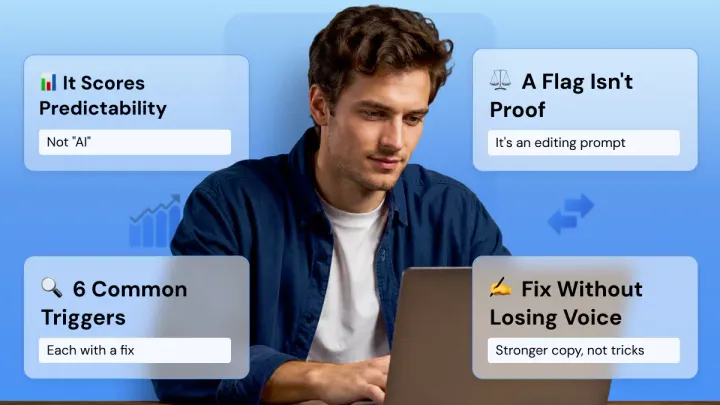
AI detectors are triggered by predictability, not by AI. Uniform sentence length, common word choices, hedged phrasing, and recycled transition words all raise the AI score, even on writing you did yourself.
In fact, the Patterns study by Liang et al. found detectors misflagged 61% of human essays by non-native English writers as AI-generated. Detectors measure perplexity (how predictable each next word is) and burstiness (how much sentence length varies), so the flatter your writing reads, the more AI-like it scores.
This guide catalogs the exact patterns that trigger AI detectors, plus a concrete fix for each one.
How Detectors Decide: Perplexity and Burstiness in Plain English
Detectors don't recognize "AI." They estimate how predictable your text is (perplexity) and how much your sentence lengths vary (burstiness). Predictable, evenly paced writing scores as AI-like no matter who wrote it.
Perplexity measures how surprised a language model is by each next word. Take this line: "Content marketing is a powerful way to grow your business." Every word is the safest possible choice, so perplexity is low and the AI score climbs. Now compare: "Content marketing is less a funnel and more a garden you overwater for months before anything grows." Harder to predict. Higher perplexity. Lower score.
Burstiness is the rhythm of your sentences. Humans naturally mix a five-word sentence with a thirty-word one. AI tends to produce medium-length sentences, one after another, at the same cadence. When your copy holds one steady rhythm from start to finish, burstiness is low and the detector reads that flatness as machine-like.
Now for the counterintuitive part: editing often makes copy more predictable. You smooth the rhythm, standardize the phrasing, cut the quirks. Every pass makes it cleaner, and also statistically flatter. That's why your most polished piece can score "more AI" than the rough draft it came from.
The Triggers: 6 Patterns That Spike Your AI Score
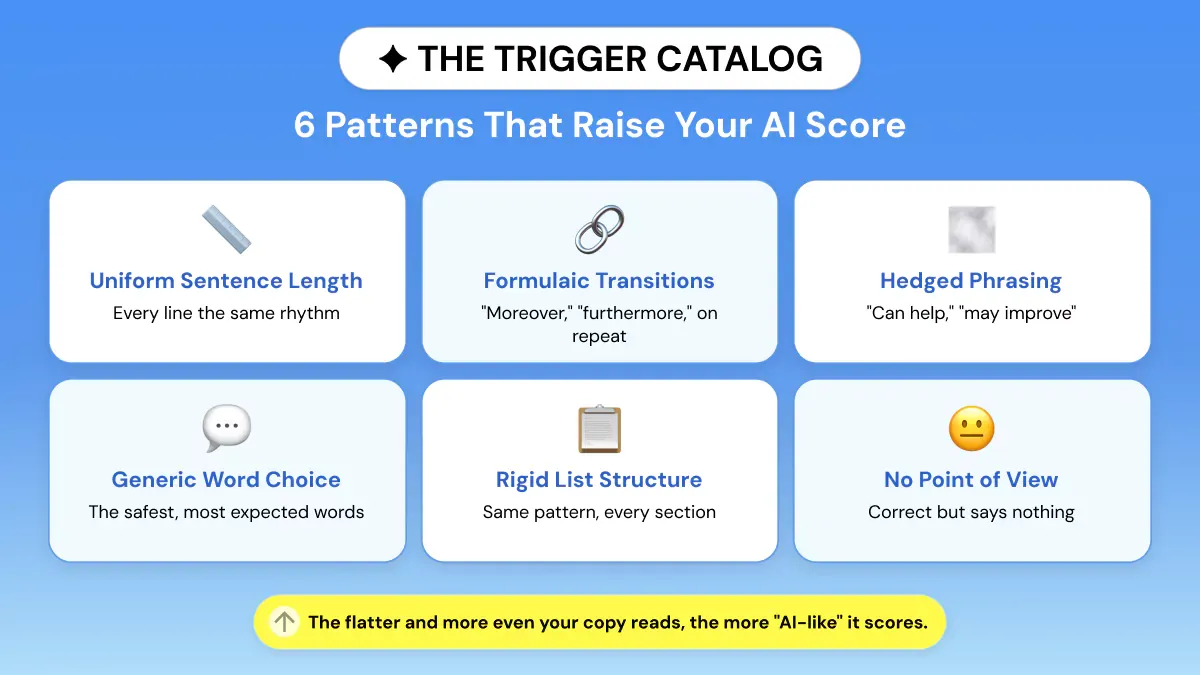
The most common AI detector triggers are uniform sentence length, over-smooth transitions, hedged or generic phrasing, predictable word choices, and rigid list-heavy structure. Each one either lowers perplexity or flattens burstiness, the two signals detectors score.
1. Uniform Sentence Length
Sentence structure can absolutely trigger an AI detector, and sentence uniformity is one of the strongest triggers there is. When every sentence lands between 15 and 20 words, your burstiness flatlines and the text reads as machine-paced.
Why it triggers: AI models default to medium, evenly weighted sentences. If your copy does too, it matches the pattern.
The fix: Vary length on purpose. Follow a long, winding sentence with a short one. Like this. The contrast is what reads as human.
2. Formulaic Transitions
Moreover. Furthermore. Additionally. In conclusion. If your paragraphs are stitched together with the same transition words an essay template would use, you're feeding the detector exactly what it was trained to expect.
Why it triggers: These connectors are among the most statistically predictable words in English, which makes them classic low-perplexity territory.
The fix: Connect ideas with logic instead of glue words. If two paragraphs genuinely follow each other, you often don't need a transition at all. When you do, make it specific: "That backfired in testing" beats "Moreover" every time.
3. Hedged Phrasing and Qualifiers
Can help. May improve. It's important to note that. Hedging feels safe and professional. To a detector, it looks generated.
Why it triggers: AI models hedge constantly because it's the lowest-risk phrasing available, so qualifiers cluster heavily in AI training patterns. Predictable phrasing is the trigger; hedging is its most common costume.
The fix: Commit. "This works for service businesses" is stronger, and scores as more human, than "this may potentially work for some service businesses." Cut qualifiers unless the uncertainty is real and worth stating.
4. Generic Word Choice
Robust. Seamless. Comprehensive. In today's digital landscape. When every noun gets the most expected adjective, perplexity drops line by line.
Why it triggers: Detectors score word-level predictability, and generic business vocabulary is the most predictable vocabulary there is.
The fix: Swap the abstract for the concrete. Not "improves efficiency significantly" but "cuts the review round from three days to one." Specific detail is almost impossible for a detector to read as generated, because it's genuinely surprising.
5. Rigid, List-Heavy Structure
Intro line, three bullets, mini-conclusion. Repeat for every section. A list-heavy structure with identical scaffolding builds a rhythm no human sustains naturally for 1,500 words.
Why it triggers: Structural repetition flattens burstiness at the paragraph level, not just the sentence level. Detectors notice the template.
The fix: Keep lists where they truly help the reader, then break the pattern. Let one section run as pure prose. Give another a single-sentence paragraph. Structure should follow the ideas, not a mold.
6. Tone With No Point of View
Copy that's correct, balanced, inoffensive, and says nothing is a trigger. Neutral tone with zero opinion is precisely how AI writes when nobody tells it what to think.
Why it triggers: A point of view creates unexpected word choices and asymmetric arguments. Remove it, and what's left is the statistical average of everything ever written on the topic.
The fix: Say what you actually think. Recommend one option over another. Admit a trade-off. Even one clearly opinionated line per section changes how the whole passage scores, and it makes the copy worth reading.
One more thing, because it matters: these triggers punish some writers unfairly. The Patterns study found that plain, correct, simply structured English, exactly what many non-native English writers produce and what many style guides teach, is itself a trigger.
How to Fix a Flagged Draft Without Losing Your Voice
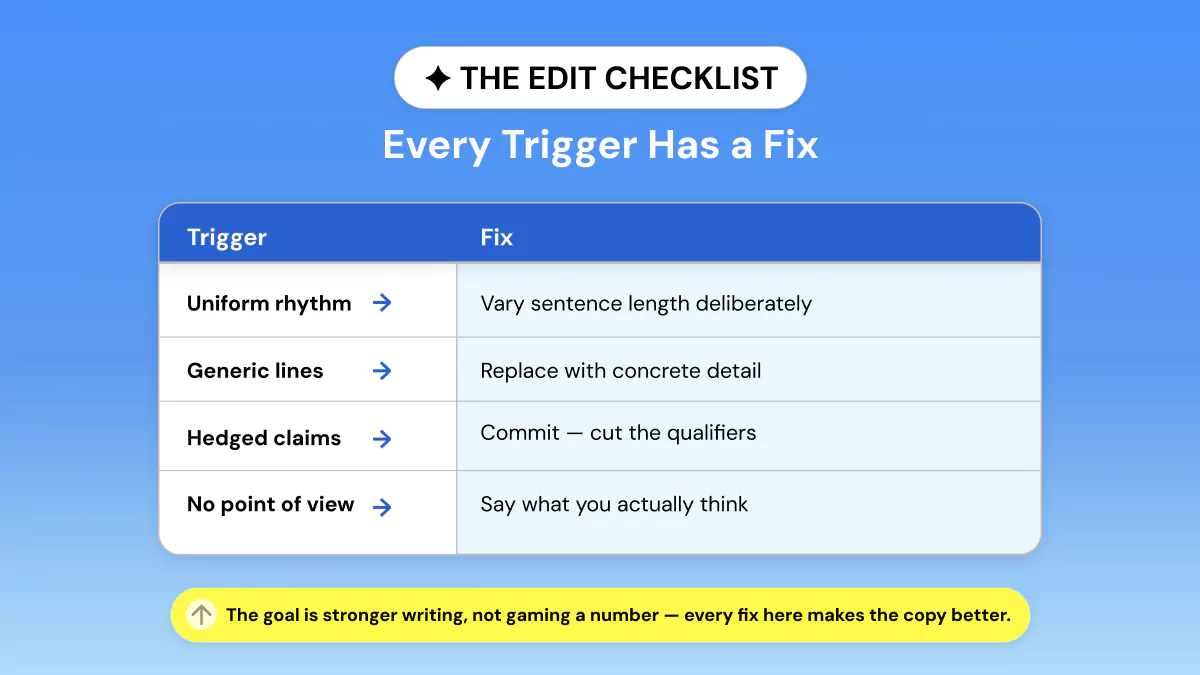
To lower an AI score on your own writing, add variation and specificity: vary sentence length deliberately, replace generic lines with concrete detail, cut the hedging, and let a clear point of view show. The goal is stronger writing, not gaming a number.
Here's the full edit checklist, mapped trigger by trigger:
Notice what's not on that list: adding typos, inserting weird synonyms, or mangling grammar to move a number. If a "fix" makes your copy worse, it isn't a fix. Every edit above works because it improves the writing first. The score follows.
The practical workflow looks like this. Run your draft through the Phrasly AI Detector, which highlights the specific passages that read as AI-like rather than handing you one opaque percentage.
Trusted by 3,000,000+ users, it works as a diagnostic. Treat each highlighted passage as an editing prompt: ask which trigger it matches, apply the fix from the checklist, and check again.
Paste a draft, see which passages read as AI-like, and treat each one as an editing prompt.
If a flagged section resists rewriting and the rhythm stays flat no matter what you do, Phrasly's AI Humanizer can help you add variation and voice, which you can then shape in your own words.
A Trigger Isn't Proof, So Keep Perspective
A high AI score means your writing is predictable, not that it's AI or low quality. Detectors produce false positives constantly, so treat the score as a signal to review specific lines, never as a verdict. That's also why clean, well-edited copy so often scores high: polish makes text statistically flatter, and flat is what detectors flag.
The evidence here is solid and worth repeating. Liang et al. (2023) showed detectors misflagging the majority of human-written TOEFL essays. RAID (2024) showed the same detectors wobbling under light edits and unfamiliar models. A tool that behaves that way can inform your editing. It cannot prove authorship, in either direction.
So don't over-edit. If your copy scores high but reads well, converts, and sounds like you, resist the urge to sand it down further. Chasing a number past the point of better writing is how good copy turns weird. Use the trigger catalog when a flag points at genuinely flat writing, and close the tab when it doesn't.
FAQs
What triggers an AI detector on human writing?
Predictability. Detectors score how expected your word choices are (perplexity) and how much your sentence lengths vary (burstiness). Uniform rhythm, generic vocabulary, formulaic transitions, hedged phrasing, rigid structure, and a neutral tone with no point of view all raise the score, even on fully human writing.
Does sentence length affect an AI score?
Yes, strongly. When every sentence runs roughly the same length, burstiness drops and the text reads as machine-paced. Deliberately mixing short, punchy sentences with longer ones is one of the fastest ways to make human copy score as human. Check the effect with the Phrasly AI Detector.
Why does my clean copy get flagged?
Because editing makes writing more predictable. Smooth rhythm, standardized phrasing, and safe word choices are what detectors associate with AI. The Patterns study (2023) found detectors misflagged 61% of clean, simply written human essays. Our guide on why writing gets detected as AI covers what to do next.
Can I lower my AI score without making my writing worse?
Yes, and that's the only approach worth taking. Vary sentence rhythm, swap generic lines for concrete detail, cut qualifiers, and let opinion show. Each of those fixes improves the copy and lowers predictability at the same time. Never add errors or awkward synonyms just to move a number.
Do transitions and filler words trigger detectors?
The formulaic ones do. "Moreover," "furthermore," "additionally," and "in conclusion" are among the most statistically predictable words in English, so they lower perplexity when they stack up. Replace them with specific connections between ideas, or cut them entirely.
Is a high AI score proof my copy is AI-generated?
No. Peer-reviewed research (Patterns 2023; RAID, ACL 2024) shows detectors misflag human writing and shift under light edits. A high score proves your text is predictable, nothing more. Treat it as an editing prompt for specific passages, never as evidence of authorship.


Keep reading

What Are Common Phrases That AI Uses? We Tested 50 Pieces to Find Out
We ran 50 pieces of content through Phrasly's AI Detector to find out what are the common phrases that AI uses.


The Content Strategist's Workflow for AI-Assisted Production
A sound AI content workflow puts humans at the brief and expertise stages, letting AI handle outlining and drafting, then routes every piece through fact-checking, plagiarism, and AI-flatness QA gates before it can be published.