
Choosing an AI Content Detector for a Small Agencies
Pick the right AI detector for your agency. Compare team seats, API access, real cost per 1,000 words, false positives, and client reporting.
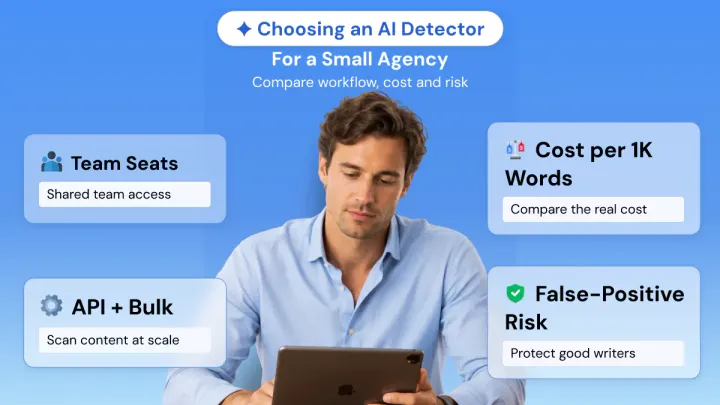
For a small agency, the best AI content detector is the one that fits your team's workflow: enough seats, an API or bulk mode for volume, a low false-positive rate for global freelancers, and predictable cost per 1,000 words, not the flashiest accuracy claim. The 2026 shortlist is Originality.ai, Copyleaks, Winston AI, GPTZero, Pangram, and Phrasly.
A wrong flag on a good writer costs you more than a slightly lower accuracy score. So this is a team buyer's guide, not a generic ranking. Here is what it covers:
- The six criteria that matter when buying for a team
- What detector accuracy claims are really worth
- Real cost per 1,000 words for every tool
- A clear recommendation by agency size
What Small Agencies Should Prioritize (Not Just Accuracy)
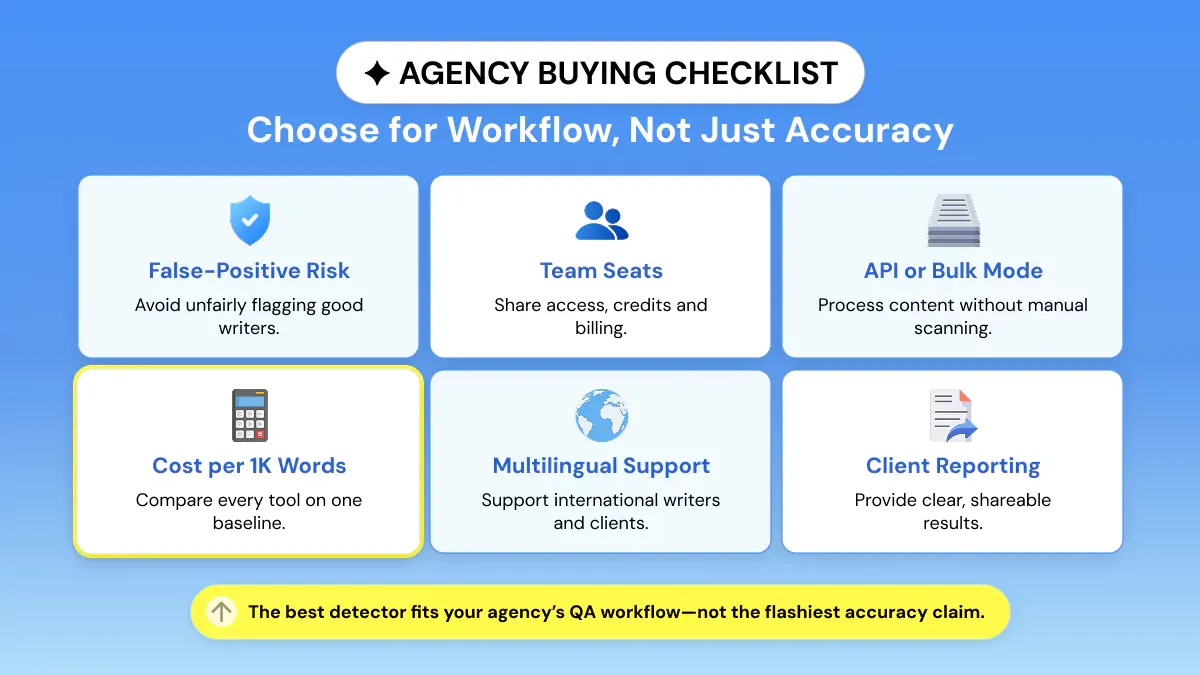
Prioritize false-positive rate, team seats and access, API or bulk scanning, cost per volume, multilingual support, and how easily results fit your QA and client reporting. A tool that wrongly flags a good freelancer's work costs you more than a slightly lower accuracy number.
Accuracy gets all the marketing attention, but at team scale the operational features decide whether a tool works for you. Here are the six criteria that matter, ordered by how much they affect an agency.
1. False-positive rate (your biggest liability)
A false positive is when a detector labels genuinely human writing as AI. For an agency, that is not a rounding error, it is a client relationship and a freelancer relationship on the line. The exposure is worse if you work with non-native English writers.
A peer-reviewed study, "GPT detectors are biased against non-native English writers" (Liang et al., Patterns), found detectors disproportionately misclassify text from writers whose first language is not English. If your freelance bench is global, this is your single biggest risk.
2. Team seats and shared access
You need more than one login. Look at how a tool prices additional members and whether it pools credits across the team, so one busy writer is not blocked while another sits idle. Seat models vary widely: some tools charge per seat, others bundle a fixed number into a plan.
3. API and bulk scanning
Pasting drafts one at a time is fine for a solo writer and painful for an agency pushing dozens of pieces a week. An API or bulk mode lets you check in batches or wire detection into your existing workflow, which is what makes checking scale.
4. Cost per 1,000 words
This is the honest way to compare price once volume is involved. Sticker prices hide wildly different word allowances, so normalize everything to a per-1,000-word number before you decide. We do that math for every tool further down.
5. Multilingual support
If you or your clients publish in more than one language, detector reliability varies a lot by language. Confirm the languages you actually work in are supported well, not just listed.
6. Client reporting
A shareable PDF report or a clean dashboard you can put in front of a client is worth real money at an agency, because it turns a raw score into something presentable and professional.
Why a repeatable check matters now
The Accuracy Reality (Set Client Expectations Honestly)
No detector is reliable enough to treat as proof, and every "99%" accuracy claim is vendor-reported. The peer-reviewed RAID benchmark (Dugan et al., ACL) shows detectors fail under light edits, so use detection as a QA signal and set client expectations accordingly.
Almost every detector homepage advertises a number in the high-90s. Treat those as self-reported marketing figures, not independent test results.
What independent research actually found
The RAID benchmark found detectors are "easily fooled by adversarial attacks, variations in sampling strategies, repetition penalties, and unseen generative models." In plain terms: a light paraphrase, an unusual prompt, or a newer model than the detector was trained on can flip the result.
There is a vendor counter-point worth presenting for balance. Turnitin reports a false-positive rate under 1% on documents over 300 words and says it found "no statistically significant bias" against English-language-learner writers (Turnitin, 2024 to 2025, vendor-reported). This is the vendor's own claim, set against the independent Patterns finding above. As an agency, you weigh both rather than taking either at face value.
How to use detection without getting burned
- Do not promise a client "guaranteed AI detection." No tool can back that promise, and RAID shows why.
- Treat a score as one layer of QA, paired with human editorial review, not as a verdict.
- Use a flag to start a conversation with a writer, not to end one. A flag is a prompt to look closer, not proof of anything.
- Run two detectors on the same piece and only escalate when both agree. That two-detector rule reduces the chance that a single tool's quirk burns a good writer. It costs a little more, which is another reason per-volume pricing matters.
What AI Detection Actually Costs a Team
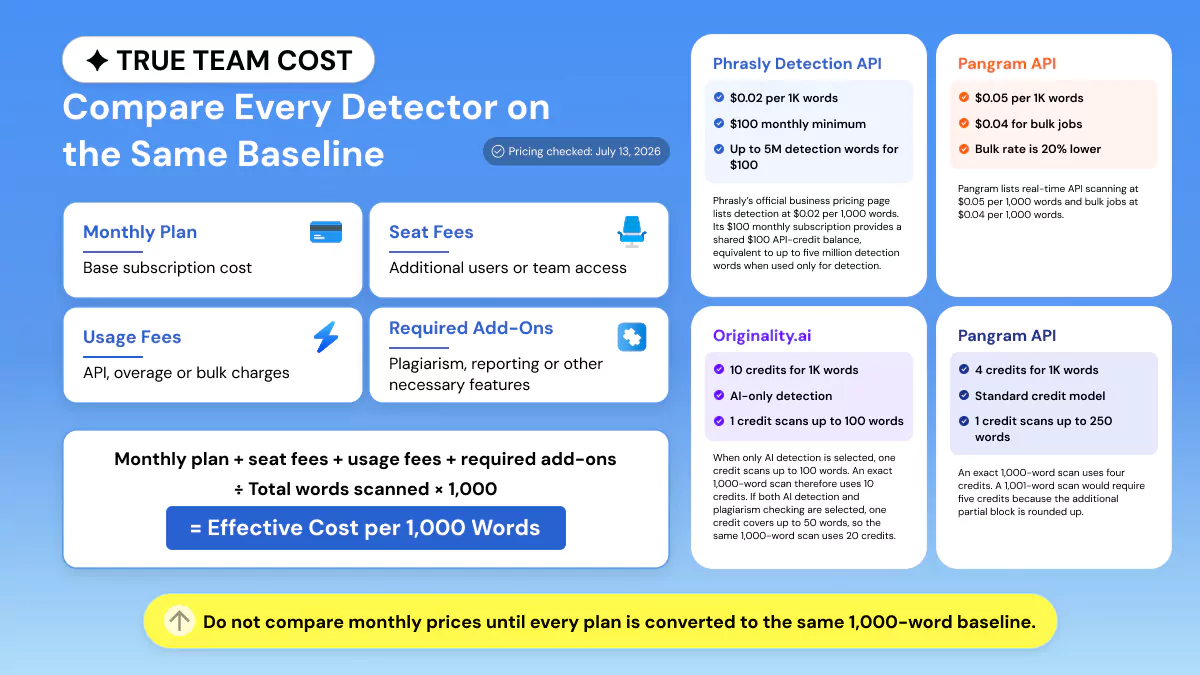
Once you normalize to cost per 1,000 words, the spread is large: Pangram's API runs about $0.05 per 1,000 words and Winston's API about $0.07 per 1,000, while some entry desktop plans work out to $0.60 or more per 1,000 once you divide price by words included. This is the math no ranking competitor puts in front of agencies, and it is where volume buyers save real money.
Sticker prices mislead because each vendor bundles a different number of words. A $17 plan with 25,000 words is far more expensive per unit than an $18 plan with 80,000 words.
Cost per 1,000 words, entry plans compared
Figures were verified from vendor pricing pages on July 13, 2026, and should be re-pulled on your writing day, since a few prices render dynamically.
Cost tier at a glance: 🟢 cheapest · 🟡 mid · 🔴 premium.
| Tool | Entry plan | Words included | Cost per 1,000 words |
|---|---|---|---|
| 🟢 Pangram (API) | API credits | Priced directly | ~$0.05 |
| 🟢 Winston AI (API) | API credits | Priced directly | ~$0.07 |
| 🟢 Originality.ai | Pro $14.95/mo | ~200,000 | ~$0.07 to $0.08 |
| 🟡 Winston AI (plan) | Essential $18/mo | 80,000 | ~$0.23 |
| 🔴 Copyleaks | Personal $16.99/mo | 25,000 | ~$0.68 |
| ⚪ GPTZero | From $12.99/mo | Verify live (free 10k/mo) | Verify on writing day |
| 🟢 Phrasly | Free detector checks | Free/unlimited checks | Free to check |
How to calculate your own cost per 1,000 words
The formula is simple: monthly price divided by (words included in thousands). For example, Copyleaks Personal at $16.99 for 25,000 words is 16.99 divided by 25, which is about $0.68 per 1,000 words.
Winston Essential at $18 for 80,000 words is 18 divided by 80, or about $0.23 per 1,000. Run this on your own expected monthly volume before you sign up, because the cheapest sticker price is rarely the cheapest per word.
Reading the numbers
The Originality.ai, Winston, and Pangram APIs cluster at the low end, which makes them attractive for high-volume scanning. Copyleaks looks pricier per word at the entry tier, but its Pro plan bundles 25 seats, so the per-seat math changes completely for a bigger team. GPTZero and Phrasly prices render client-side, so confirm them live before you commit.
Detectors Compared for Small-Agency Use
Originality.ai suits bulk site scanning and editorial workflows; Copyleaks bundles plagiarism with 25-seat Pro plans; Winston AI offers credit pooling and shareable PDF client reports; GPTZero has accessible team pricing and a free API tier.
Pangram leads recent third-party tests with per-seat team plans and 20+ language support; and Phrasly combines detection and humanization so flagged-but-good copy can be fixed in one place.
Below is a quick summary, then a full breakdown of each tool.
Pricing was verified on July 13, 2026 and should be re-checked live before publishing.
At a glance
Phrasly
Best for: agencies that want to detect and fix flagged copy in one platform. Entry price: free detector checks; a paid Unlimited plan adds humanization and higher limits (price renders client-side, verify at phrasly.ai/pricing). A 3-day trial is available, and annual billing saves 45%. Free tier: free detector checks on the site. Team seats: Business and enterprise access is handled via API sales.
API and bulk: a Business API for programmatic detection (business.phrasly.ai, integration docs at /integrate). Plagiarism: yes, 20,000 words per month. Multilingual: multiple languages per the product FAQ. Client reports: detailed reports.
Why it works for agencies:
- Detect and fix in one place. The standout feature is pairing an AI detector with an AI humanizer under one login (see Phrasly's AI detector), so flagged-but-good copy can be revised and re-checked without switching tools.
- Free checks lower the cost of a team habit. Everyone can run a detector check without a per-seat license, which makes consistent, team-wide QA easy to adopt.
- Business API for integration. Programmatic access suits agencies wiring detection into an existing workflow through the Business API noted above.
- Proven scale. Phrasly reports serving 3,000,000+ students and writers, a sign of a maintained, widely used platform. If a detector flags outsourced work you believe is human, the AI humanizer fixes and re-checks it in the same place, and our guide on humanizing AI SEO content without hurting rankings shows how to do it without losing keywords or E-E-A-T signals.
Try Phrasly AI Detector Free
Originality.ai
Best for: high-volume bulk scanning and full-site scans, editorial and SEO teams. Entry price: Pro $14.95/mo monthly, or $12.95/mo on annual billing. Free tier: none prominent; access is credit-based. Credits and volume: 2,000 credits per month, where 1 credit equals 100 words, roughly 200,000 words. Team seats: extra seats are $9.95/mo on Pro and $24.95/mo on Enterprise.
API and bulk: the pricing page shows API access on the Enterprise tier ($179/mo, 15,000 credits); confirm whether a pay-as-you-go API still exists. Full-site and bulk scanning are supported. Plagiarism: yes, combined at 2 credits per 100 words. Multilingual: not prominently featured. Client reports: shareable reports.
Why it works for agencies:
- Scans at scale. Full-site scanning lets you audit an entire client site or content backlog in one pass instead of pasting page by page, which is a real time-saver for SEO agencies inheriting a large library.
- Built around editorial workflows. It is designed for teams with a publishing calendar rather than one-off checks, so it slots into an agency's existing editing process.
- Budget for the API tier. API access shows up on the Enterprise plan ($179/mo), and the pay-as-you-go path is unclear, so confirm current options before you build detection into an automated workflow.
- Watch the language gap. Multilingual coverage is not a headline feature, so if you publish in many languages, Copyleaks or Pangram will serve you better.
Copyleaks
Best for: teams that want plagiarism and AI detection in one report, and larger teams needing many seats. Entry price: Personal $16.99/mo monthly, or $13.99/mo annual. Free tier: limited trial only. Credits and volume: 1 credit equals 250 words; Personal includes 100 credits (25,000 words), and the annual Personal plan includes 1,200 credits (300,000 words per year). Team seats: the Pro plan at $99.99/mo ($74.99 annual) includes 25 seats, which makes per-seat cost very low for a growing team.
API and bulk: API is enterprise/sales only; multi-file upload and sitemap site scanning on Pro. Plagiarism: yes, in the same report as AI detection. Multilingual: 30+ languages for AI detection and 100+ for plagiarism, the broadest coverage here. Client reports: analytics dashboard on Pro.
Why it works for agencies:
- Best per-seat value at scale. The Pro plan bundles 25 seats for $99.99/mo, roughly $4 a seat, which undercuts per-seat tools once you have a real team.
- Plagiarism and AI in one pass. You check both at once in a single report, saving a step for agencies that promise original, human work to clients. If plagiarism is your priority, weigh it against the field in our roundup of the best plagiarism checkers in 2026.
- Widest language support here. 30+ languages for AI detection and 100+ for plagiarism make it the top choice for multilingual agencies and international clients.
- Skip the entry plan if you are tiny. The Personal plan is expensive per word (~$0.68/1k), and the value only appears at the Pro tier, so it is overkill for a 2-person shop.
Winston AI
Best for: agencies that send client-ready PDF reports and want credit pooling across the team. Entry price: Essential $18/mo monthly, or $10/mo annual. Free tier: trial credits. Credits and volume: 80,000 credits per month, where AI detection is 1 credit per word and plagiarism is 2 credits per word. Team seats: Advanced ($29/mo, $16 annual) covers up to 5 members; Elite ($49/mo, $26 annual) is unlimited, both with credit pooling.
API and bulk: a separate API priced around $0.07 per 1,000 words (observed via Eden AI); document and OCR uploads supported. Plagiarism: yes. Multilingual: 9+ languages listed. Client reports: shareable PDF, a genuine agency advantage.
Why it works for agencies:
- Client-ready proof. Shareable PDF reports are the cleanest way to hand a client evidence of a QA check, which turns detection into a visible part of your service.
- Credit pooling smooths uneven weeks. The whole team draws from one 80,000-credit pool, so a writer's heavy week does not exhaust an individual allowance.
- Team tiers that grow with you. Advanced covers 5 members and Elite is unlimited, so you can scale headcount without switching tools.
- Affordable API for volume. A separate API around $0.07/1k makes bulk scanning cheap once you outgrow the plan credits.
GPTZero
Best for: teams that want accessible pricing and a free API tier to test an integration. Entry price: premium from $12.99/mo per its own blog; note that prices render client-side, so verify live at gptzero.me/pricing. Free tier: 10,000 words per month free, plus a free API tier at 10,000 words per month. Team seats: a team plan exists with shared team credits, unified billing, and per-seat purchase.
API and bulk: a developer API with code samples in 17 languages and a free tier; batch and bulk file upload supported. Plagiarism: yes. Multilingual: yes. Client reports: sentence-level reports.
Why it works for agencies:
- Lowest barrier to start. 10,000 free words a month plus a free API tier let you test both detection and an integration before you pay anything.
- Simple team admin. Shared team credits and unified billing suit a small agency that wants one bill and no seat juggling.
- Sentence-level reports guide edits. You see exactly which sentences triggered a flag, so writers revise precisely instead of guessing.
- Weigh the marketing. GPTZero's own roundups rank it #1 and lean toward education use cases, so cross-check its claims against independent tests before you commit.
Pangram
Best for: agencies that want top independent-test accuracy, per-seat team plans, and strong multilingual coverage. Entry price: Individual $20/mo (600 credits; 1 credit per 1,000 words over the first 1,000); Professional $65/mo for 3,000 credits. Free tier: no standing free tier. Team seats: Teams at $20 per seat per month, minimum 2 seats, with admin controls and unified billing.
API and bulk: API credits at $0.05 per 1,000 words with auto-refill; bulk jobs supported. Plagiarism: yes, on every scan. Multilingual: 20+ languages. Client reports: a supporting-evidence view.
Why it works for agencies:
- Third-party accuracy reputation. Pangram ranked at or near #1 in several 2026 reviews, including the agency-authored Siege Media test, so its accuracy standing comes from independent testers, not its own marketing.
- Cheapest API per word. At $0.05/1k with auto-refill, it is the lowest here, which matters most for high-volume SEO agencies scanning in bulk.
- Strong multilingual coverage. 20+ languages match Copyleaks, making it a fit for agencies with international clients.
- Commit from day one. Per-seat Teams pricing (minimum 2 seats) with admin controls is clean, but there is no standing free tier, so you pay to try it.
A note on Turnitin
Turnitin appears in many of these comparisons, but it is licensed to institutions only with no self-serve option, which makes it a non-option for a small agency. Know it as context only. For a sense of the ongoing reliability debate, some institutions have stepped back from AI detection entirely, with Curtin University disabling Turnitin's AI detection in 2026 (reported by EdTech Innovation Hub, via GPTZero's blog).
Recommendation by Agency Size
A 2 to 3 person shop can run detection on individual plans; agencies scaling past a handful of writers or reporting to clients should choose a tool with API or bulk access and predictable per-volume pricing. The right pick depends less on which tool is "best" and more on how many people touch content and whether clients see the results.
| Agency size | What to prioritize | Sensible picks |
|---|---|---|
| 🌱 Micro shop (2 to 3) | Low false positives, free or cheap checking | Phrasly free checks, GPTZero free tier |
| 📈 Scaling agency (5+) | Seats, client reporting, API/bulk | Copyleaks Pro (25 seats), Winston Advanced/Elite, Pangram Teams |
| ⚡ Volume / SEO agency | Lowest cost per 1,000 words | Pangram API (~$0.05/1k), Winston API (~$0.07/1k), Originality.ai |
Micro shop, 2 to 3 people
Individual plans or free tiers are enough. You are not managing seats yet, so optimize for a low false-positive rate and a clean interface. Phrasly's free detector checks or GPTZero's free tier let you validate your process before spending. Add a paid plan only when volume or client reporting demands it.
Scaling agency, 5+ writers with client reporting
Move to a seat-based team plan with API or bulk access. Copyleaks Pro (25 seats) or Winston's Advanced and Elite tiers (with credit pooling and shareable PDFs) fit teams that report to clients. Pangram's per-seat model works well if you want top-ranked detection and multilingual coverage. If your writers sometimes get flagged unfairly, Phrasly's detect-and-humanize combination keeps the fix in one place.
Volume or SEO agency
Lead with per-1,000-word API pricing. Pangram (~$0.05/1k) and Winston's API (~$0.07/1k) are the efficient options for scanning large batches, and Originality.ai suits full-site editorial sweeps. At this scale the cost math from the section above is your main lever.
Whichever tier you are in, the criteria are the same ones we opened with: keep false positives low, make sure the whole team can access the tool, confirm the real cost per 1,000 words, and check that results are presentable to a client. That is what earns the pick.
Frequently Asked Questions
What is the best AI detector for a small agency?
There is no single best tool. The right choice fits your team's workflow: enough seats, API or bulk scanning for volume, a low false-positive rate, and a clear cost per 1,000 words. For small teams that also want to fix flagged copy, a combined detect-and-humanize platform like Phrasly keeps checking and revising in one place.
Do I need a detector with an API?
If you check content in volume or want detection wired into your existing tools, then yes, an API saves significant time over pasting drafts one by one. Smaller shops can start without one. When you are ready to integrate, Phrasly's Business API is documented at /integrate.
How do agencies handle false positives on freelance work?
Never treat a flag as proof. Research shows detectors are biased against non-native English writers, so use a score to open a conversation, not to accuse. Many agencies run two detectors and only escalate when both agree, then let the writer revise before any client sees the work. Our guide to QA-ing outsourced content before client delivery walks through that workflow step by step.
Can I rely on a detector to prove content is not AI?
No. The peer-reviewed RAID benchmark (ACL 2024) shows detectors are easily fooled by light edits and unseen models, and every "99%" figure is vendor-reported. Use detection as a QA signal alongside human review, and never promise a client "guaranteed" detection.
How much does team AI detection cost?
Normalize to cost per 1,000 words. API options run low, around $0.05 per 1,000 (Pangram) to $0.07 per 1,000 (Winston), while some entry desktop plans work out to $0.60 or more per 1,000 once you divide price by words included. Team plans add seats, so factor per-seat cost too.
Does Phrasly offer an API for agencies?
Yes. Phrasly offers a Business API for programmatic detection at business.phrasly.ai, and its detector and humanizer live in one platform (see Phrasly's AI detector). That lets an agency detect flagged copy and fix flagged-but-good writing without switching tools.


Keep reading

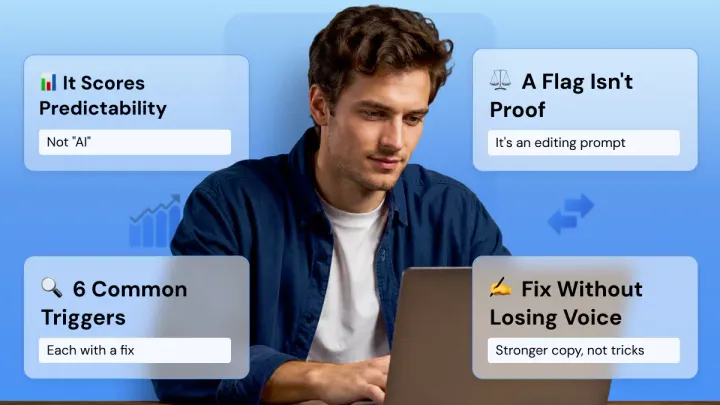
What Triggers an AI Detector on Human-Written Copy
Wrote it yourself and still got flagged? These 6 patterns raise AI scores on human copy. Here's why each triggers detectors and how to fix it.

Top 20 Reasons Your Content is Getting Penalized by Google
This practical guide breaks down the top 20 reasons your content is getting penalized by Google, organized into clear categories.