
Is Copyleaks Accurate? We Tested It So You Don't Have To
Copyleaks claims 99% AI detection accuracy, but does it hold up in real-world use? We tested it on raw, edited, and humanized AI content. The results reveal a major reliability gap you need to know before trusting any single detector.
Copyleaks is one of the most widely used AI and plagiarism detectors in 2026, but how reliable is it in real-world use? If you've ever had your writing flagged, or you're about to run a submission through it, you probably want a straight answer before trusting the result.
In this article, we break down how Copyleaks works, test its accuracy on both raw and edited AI content, and show exactly where it performs well and where it falls short.
What Is Copyleaks and How Does It Work?
Copyleaks is a plagiarism and AI content detection platform founded in 2015. Universities, enterprises, and publishers use it across 30+ languages, integrate with LMS platforms like Moodle and Canvas, and added AI detection capabilities in 2022 to flag content generated by models like ChatGPT, Claude, and Gemini.
It doesn't read your writing the way a human would. Instead, it runs your text through machine-learning models trained on large datasets of human and AI-generated writing, looking for statistical and linguistic patterns that signal AI authorship.
The Four Signals Copyleaks Uses to Flag AI Text
- Perplexity scoring: Measures how predictable the text is. AI tends to choose statistically safe, expected word sequences; humans don't. Edit the phrasing enough, and this signal weakens.
- Burstiness analysis: Looks at variation in sentence length and structure. Human writing is naturally irregular; AI writing isn't. Restructure a few sentences, and the pattern shifts.
- Linguistic fingerprinting: Flags repetitive tone, consistent formality, and missing personal style, all common in AI output. Light humanization disrupts this almost immediately.
- Database comparison: Cross-checks text against known sources and datasets for overlap. Useful for plagiarism, but less effective against original AI-generated content.
Here's the problem: every single one of these signals degrades once content is edited. That's not a minor issue; it's the core limitation this article keeps coming back to.
How Accurate Is Copyleaks in 2026?
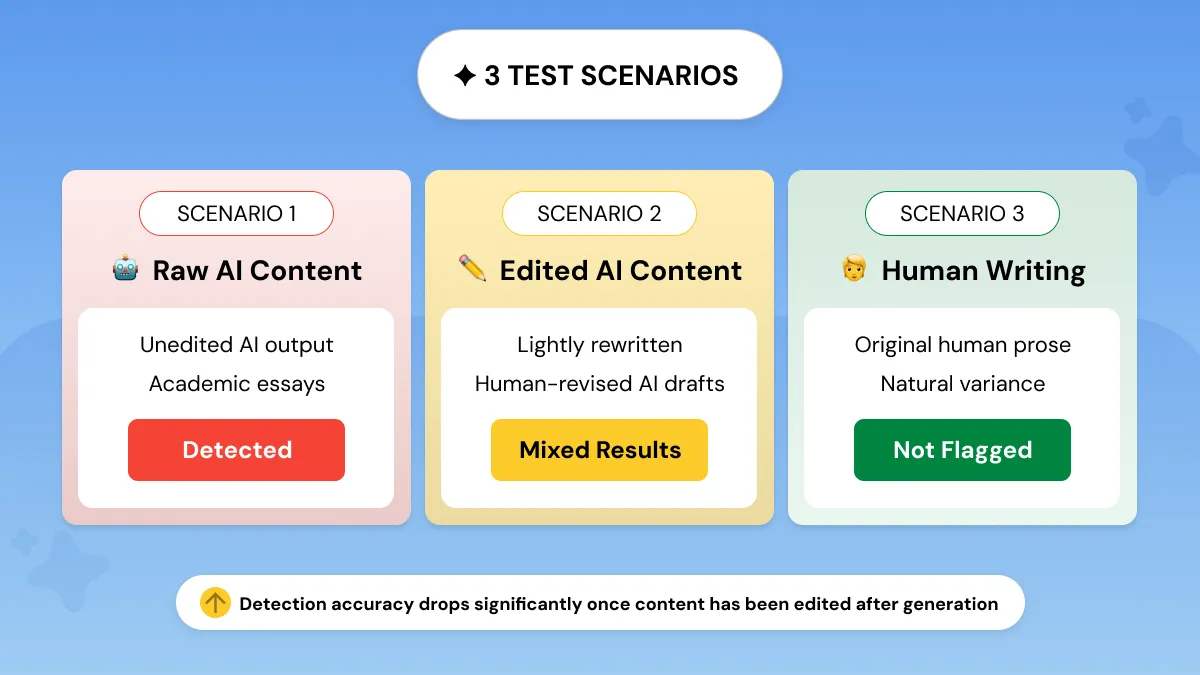
Copyleaks officially reports a 99% AI detection rate and a 99.4% human confirmation rate, figures pulled from their internally controlled testing. On paper, that's impressive. But if you're asking whether Copyleaks is accurate in real-world use, those numbers only tell half the story.
The gap between lab performance and practical performance is where things get complicated.
Official Accuracy Claims vs. Real-World Results
In controlled benchmarks, Copyleaks holds up well. A third-party study by GPTZero puts their own accuracy at ~99.3% on raw AI content, placing both tools in the same performance tier when evaluating clean, unedited outputs.
Every benchmark in that tier tests AI content that was generated in a single pass and never touched again. That's not how most people use AI. Real-world writing gets edited, sentences get reordered, phrasing gets adjusted, and personal input gets added. Those edits directly disrupt the statistical signals Copyleaks depends on.
Raw AI Content
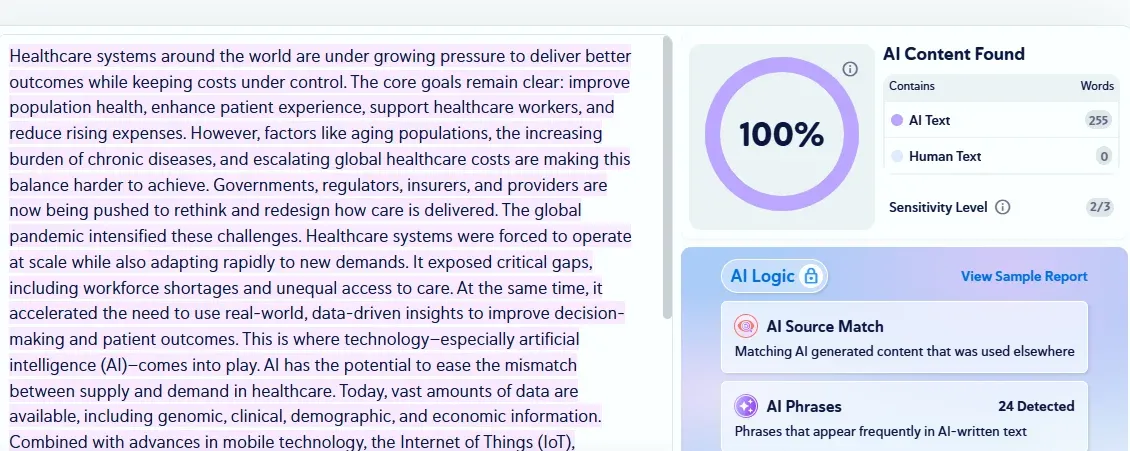
To test this ourselves, we generated an academic essay on "How Artificial Intelligence Is Reshaping Healthcare Delivery" using ChatGPT, no edits, straight output. We ran it through Copyleaks immediately.
Lightly Edited AI Content
Next, we took the same essay and made targeted edits, rephrasing a few sentences, swapping some word choices, and adjusting transitions, while deliberately leaving large sections untouched. The goal was to simulate how most people actually use AI: a quick polish, not a full rewrite.
We ran multiple drafts through Copyleaks, each with slightly different edit depths. The pattern was consistent: even modest edits were enough to throw off detection. In most of our test runs, Copyleaks failed to flag the content as AI-generated despite the majority of the text remaining in its original, unedited form. The detector's reliance on statistical patterns means that once even a portion of the text is disrupted, the overall signal weakens enough to slip through.
Humanized AI Content
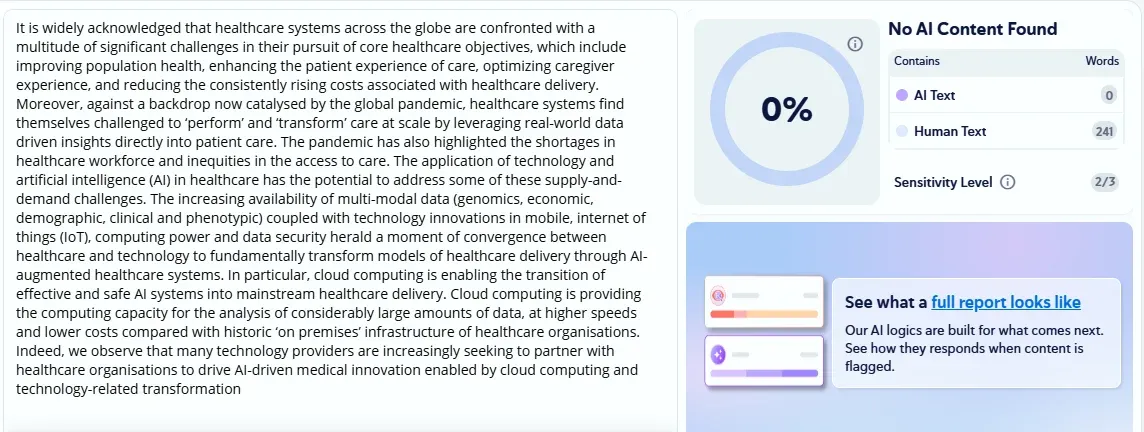
Next, we had an expert writer in the healthcare niche manually rewrite the same essay, restructuring arguments, adjusting tone, and adding human phrasing throughout. Then ran through Copyleaks AI detector again.
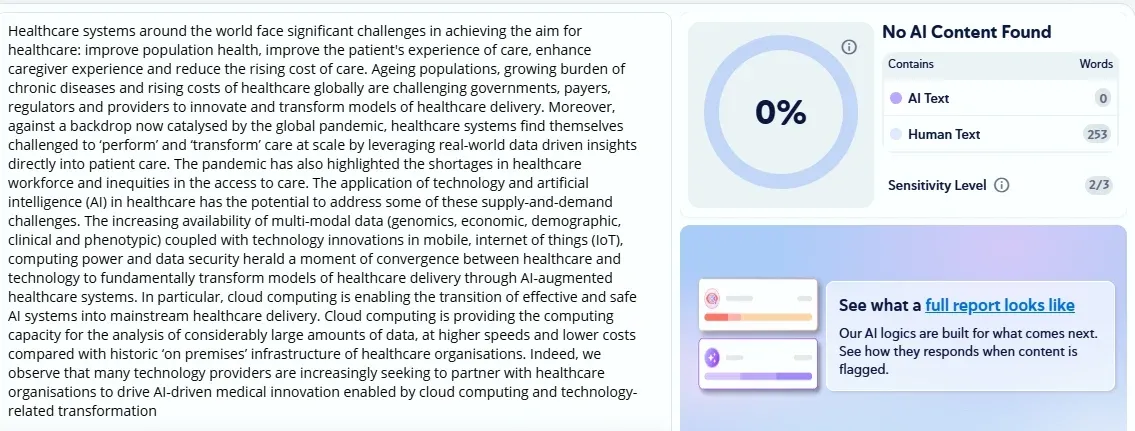
The same content, now edited, passed cleanly. Copyleaks had no signal left to catch. This is the real-world accuracy gap, and it matters because most AI-assisted writing in academic and professional settings is at least lightly edited before submission.
What Copyleaks Catches — and What It Misses
Can Copyleaks catch ChatGPT content that has been lightly edited? In our test, it couldn't. Once a human writer revised the AI-generated text, Copyleaks returned a 0% AI score, classifying it as fully human-written.
Is Copyleaks Accurate Enough? Test Your Content with Phrasly.AI Free AI detector
Our test used a clean, controlled sample. Your writing is different, a different topic, a different editing depth, a different tool. Copyleaks may flag it when it shouldn't, or miss it when it should catch it. The only way to know is to run it yourself, through a detector that actually holds up on edited content.
Phrasly's AI Detector takes under 10 seconds for free. No signup required. Check it here 👇
Copyleaks False Positives — When It Gets It Wrong
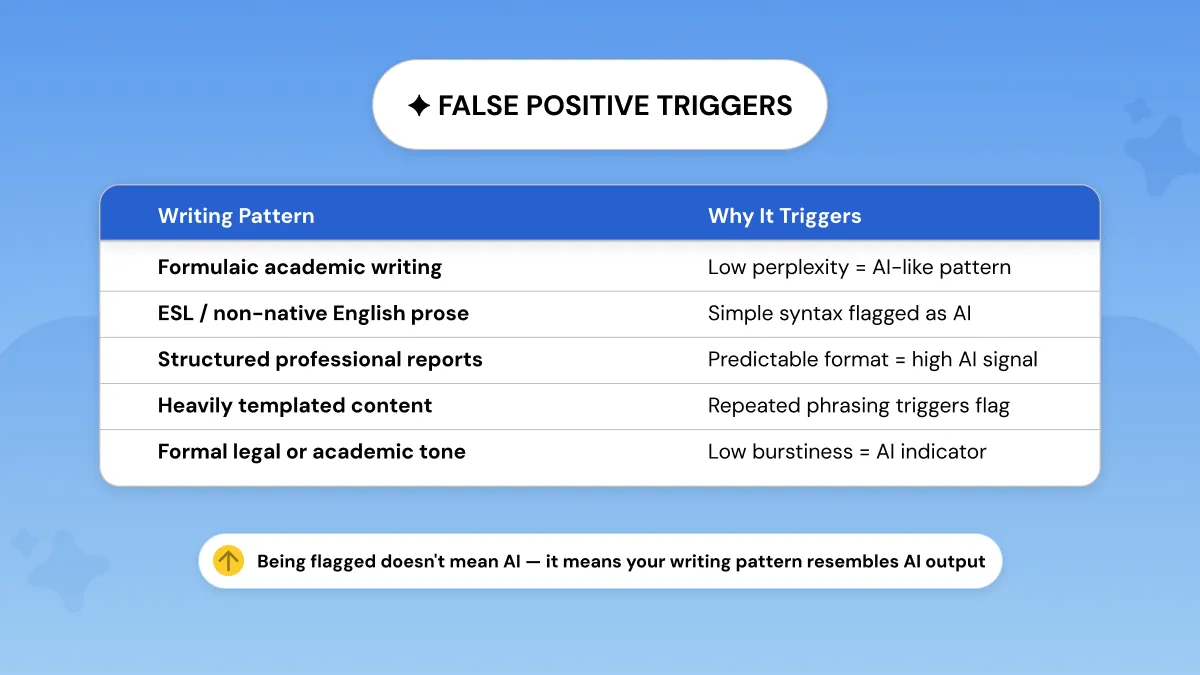
Copyleaks acknowledges false positives in its own FAQ. Human-written text can be flagged, particularly when writing is mechanical or highly structured. Independent research reinforces this: non-native English writing and other texts with lower linguistic variability consistently produce lower perplexity scores, which pushes it toward the AI-flagged end of the scale.
The writers most at risk aren't doing anything wrong. They're just writing in ways that happen to look statistically predictable to a machine. If your work keeps getting flagged, the issue is usually the writing pattern, not an error in the system. Learn more about how AI detector false positives happen and who is most at risk.
What Writing Patterns Trigger False Flags
Formulaic writing: Repeated sentence structures and predictable transitions mimic the consistency detectors associated with AI. Example: "This study examines X, discusses Y, and concludes with Z" repeated across sections.
ESL writing with low perplexity: Simpler vocabulary and narrower sentence variety reduce linguistic diversity, which detectors read as AI-like. Example: "The results show the method is useful and gives clear improvement."
Heavily structured professional reports: Concise, repeating formats optimized for clarity over stylistic variation can score high for AI probability. Example: objective, method, findings, and recommendation listed in identical order across every section.
If your fully human-written work keeps getting flagged, the writing itself is likely the trigger, not an error in the system. Highly predictable, formally structured, or stylistically uniform prose matches the same statistical patterns detectors associate with AI authorship. This is a documented limitation, not a judgment on writing quality, and it falls disproportionately on non-native English writers whose lower linguistic variability directly reduces perplexity scores.
For student essays specifically, Copyleaks is useful as one signal among several, but treating any single detector result as definitive evidence is the wrong standard. When academic consequences are involved, a dual-tool or tool-plus-human-review workflow is the only defensible approach.
What to Do If Copyleaks Flags Your Work
If Copyleaks flags your work, you do not have to panic. It means the detector found a statistical pattern worth questioning.The process is as follows:
- Request a re-scan with context: Provide assignment details, writing conditions, or any relevant background that helps frame the submission.
- Document your writing process: Drafts, notes, outlines, browser history, and version timestamps all demonstrate human authorship in ways a score can't. Beyond documentation, the way you write and edit AI-assisted content in the first place makes a significant difference. These seven techniques reduce detection risk before you ever hit submit.
- Ask for human review: No detector output should be treated as final. Request that an instructor or evaluator read the work directly.
- Cross-check with a second detector: Run the same content through Phrasly AI Detector to see whether the result holds across tools. A single flagged result from one tool is not a consensus.
No detector is error-free. AI detection scores are probabilistic; they indicate likelihood, not certainty.
How Copyleaks Compares to Other AI Detectors
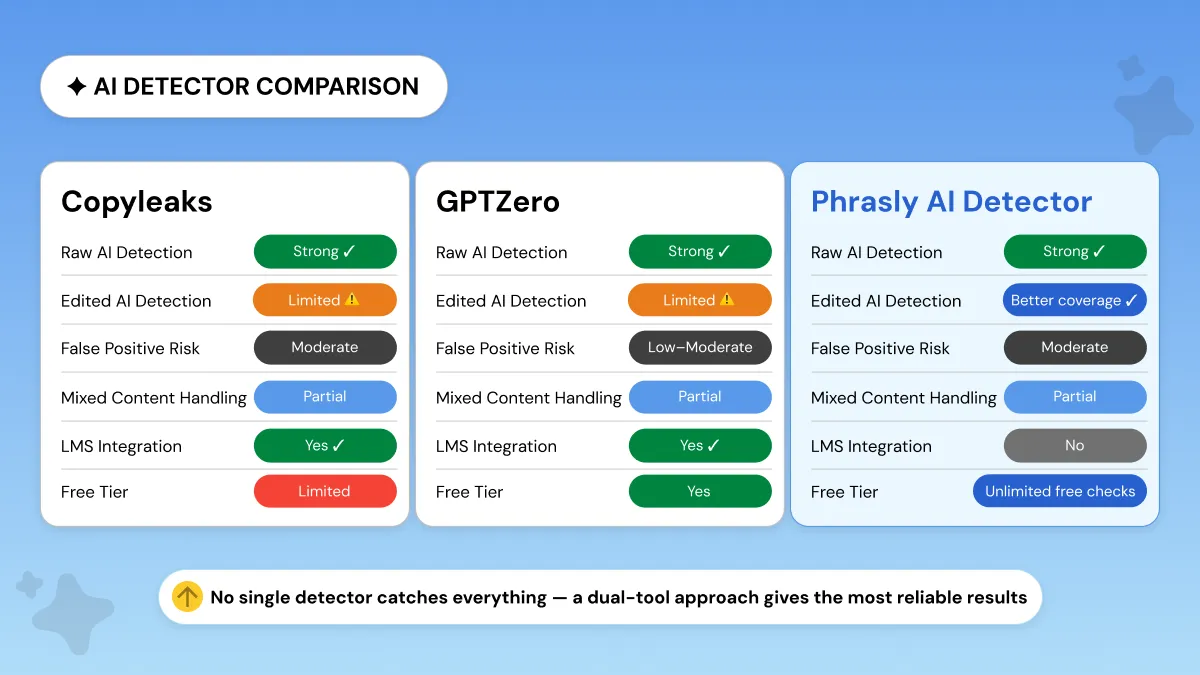
On raw, unedited AI content, the gap between Copyleaks and GPTZero is narrow. Copyleaks sits at 99.1% and GPTZero at 99.3% in their respective benchmarks. But the 2026 CorpIdentIA hybrid-text study, which tested all three detectors on edited and mixed-authorship content, tells a different story.
GPTZero maintained the lowest false positive profile across both its own benchmarks and independent testing. Copyleaks ranked weakest of the three on hybrid authorship, with repeated misclassifications on human and partially-edited text. For a full breakdown, see our separate guide on how accurate GPTZero actually is.
What neither benchmark fully captures is detection performance on lightly humanized content, the exact scenario our test exposed. Copyleaks returned 0% AI on manually edited ChatGPT content. Phrasly flagged the AI influence. For anyone evaluating tools on real-world writing rather than clean lab outputs, that distinction is what actually matters.
Who Should — and Shouldn't — Use Copyleaks
Copyleaks works best in controlled, high-volume environments where content arrives unedited. Outside that context, its limitations start to outweigh its strengths.
Use Copyleaks if you are:
- An educator reviewing raw submissions: Detection signals stay intact on unedited AI content, where Copyleaks performs closest to its stated accuracy.
- An institution needing LMS integration: Native integration with Canvas and Moodle makes it practical for automated academic workflows and compliance checks.
- Scanning large volumes across languages: Bulk processing, API access, and 30+ language support make it well-suited for universities, publishers, and certification bodies operating at scale.
Don't rely on Copyleaks alone if you are:
- Evaluating polished or edited content: Our test confirmed what benchmarks show: AI signals degrade after human editing, and Copyleaks misses them.
- A content marketer or SEO writer: Professionally optimized content often produces low-perplexity patterns that trigger false positives.
- A writer who uses AI as a drafting tool: Hybrid content is where every detector is least consistent, and Copyleaks ranks weakest on this in independent testing.
Copyleaks is a capable tool for what it was built to do: detecting raw, unedited AI content at scale. But our test and independent benchmarks both confirm the same gap: once content is edited, its reliability drops sharply. No single detector should carry the full weight of that judgment.
FAQs
Is Copyleaks as reliable as Turnitin?
Both tools are widely used in academia, but they serve slightly different roles. Turnitin is deeply embedded in academic workflows, while Copyleaks offers comparable AI detection with broader language support, neither is fully reliable on edited AI text. If Turnitin is what your institution uses, here is how Turnitin's AI detector handles false positives in practice.
Is Copyleaks more accurate than GPTZero?
Benchmarks show very similar performance on raw AI content (Copyleaks ~99.1%, GPTZero ~99.3%). In practice, both struggle with edited or hybrid text, where accuracy drops significantly.
Which AI detector is 100% accurate?
No AI detector is 100% accurate as of 2026. All current tools rely on probabilistic signals, which can be disrupted by human editing, paraphrasing, or writing style variations.
Is Copyleaks free?
Copyleaks offers limited free access (e.g., trial credits), but full use requires a paid plan. Pricing varies based on usage volume, API access, and institutional features.
Does Copyleaks detect ChatGPT?
Yes, Copyleaks is designed to detect content generated by models like ChatGPT. It performs well on unedited outputs but becomes less reliable once the text is rewritten or humanized.
Is Copyleaks AI detector accurate?
Copyleaks reports high accuracy in controlled testing (around 99% for both AI and human classification). However, real-world performance varies, especially with edited or mixed AI content, where detection reliability drops.