What Is a Text Quality Enhancer? (And How to Use One Effectively)
17 min read
You ran your text through a grammar checker. It came back clean. No errors, no red lines, nothing to fix. So why does it still read like something is off?
Maybe it feels stiff. Maybe people skim past it. Maybe you read it back and just think, this doesn't sound right, but you can't figure out why.
A grammar checker tells you what's wrong. A text quality enhancer tells you what's not working and actually fixes it. Readability, word choice, sentence flow, logical structure. All of it, in one pass.
This article breaks down exactly what text quality means, how it's measured, and how to improve it step by step.
If you want to skip straight to better writing, paste your text into Phrasly's AI Text Enhancer and see the difference in seconds 👇
What Is a Text Quality Enhancer?
A text quality enhancer is a tool that analyzes your writing across multiple quality dimensions (readability, grammar, word choice, sentence structure, and coherence) and improves them automatically in one pass.
A grammar checker catches errors. A text quality enhancer improves performance. Grammar accuracy is just one layer of writing quality.
A text improvement tool looks at whether your sentences are clear, your vocabulary is precise, and your ideas flow logically, then fixes all of it together.
So what actually makes text high quality?
It needs to be readable, structurally sound, precise in word choice, and coherent from start to finish. Error-free text is just the starting point, quality goes much further than that.
That gap matters more than most writers realize. A 2025 corpus study at the American University of Sharjah found that AI-generated essays were often more lexically rich than student writing, yet significantly harder to read. Better vocabulary, worse quality. That's exactly the problem a text quality enhancer is built to solve.
Paste your text into Phrasly AI Text Enhancer below and see the difference yourself 👇
Text enhancer:
Text Quality vs Grammar: Why They Are Not the Same Thing
If your grammar tool says everything looks fine, but your text still doesn't read well, grammar was never the problem.
How does Grammar Checker work?
Grammar checkers work by comparing your text against a fixed set of linguistic rules (punctuation placement, subject-verb agreement, spelling). They flag deviations from those rules.
What they cannot do is evaluate whether a sentence actually communicates something clearly, whether a paragraph earns the reader's attention, or whether the structure makes sense from one idea to the next.
Grammar covers correctness: spelling, punctuation, and subject-verb agreement. Text quality covers effectiveness: is the writing clear, readable, precise, and coherent? The distinction matters because the two problems require completely different solutions. Fixing grammar is binary.
How does Text Quality Enhancer work?
Improving text quality is measured on a spectrum, using signals like Flesch-Kincaid readability scores, sentence length distribution, vocabulary precision, and logical flow between paragraphs.
You can score 100% on grammar and still score 38 on readability. Both numbers are real. Only one of them predicts whether a reader stays or leaves.
Those are two different things.
AI-generated content makes this obvious.
It's almost always grammatically flawless, and often reads terribly. Flat structure, weak sentence clarity, and no coherence between ideas. The reason is structural. Large language models generate text by predicting statistically probable word sequences.
The result passes every grammar check while failing at the things that actually drive comprehension: sentence-to-sentence transitions, paragraph focus, and word choices precise enough to make an idea land rather than just appear on the page.
That's a 100% text quality problem that a grammar tool cannot fix.
Grammar | Text Quality | |
What it checks | Errors and correctness | Clarity, structure, and effectiveness |
What it fixes | Spelling, punctuation, agreement | Readability, coherence, word precision |
What it misses | Flow, sentence clarity, text structure | Surface-level typos |
Output | Error-free text | Text that actually works |
The 5 Dimensions of Text Quality (What AI Actually Measures)
Text quality is a composite of five measurable dimensions.
When an AI text quality enhancer analyzes your writing, it's scanning all five simultaneously instead of just flagging typos. That's how it decides what to improve and in what order.
Most grammar tools stop at the surface.
A text quality enhancer goes deeper by evaluating how your writing performs across structure, vocabulary, flow, and readability.
Each dimension affects how a reader experiences your text, and weaknesses in any one of them can undermine the others.
1. Readability
Readability measures how easily a reader can move through your text. It's calculated using sentence length and word complexity, the basis of the Flesch-Kincaid score.
For a full breakdown of how the scoring works, see our Flesch Reading Ease Score guide.
For online content, the target readability score is 60–70 (Grade 7–8 level). Below that range, readers slow down, skim, or leave.
2. Grammar Accuracy
Grammar accuracy covers spelling, punctuation, tense consistency, and subject-verb agreement. It's the foundation of quality writing, but not the ceiling.
Error-free writing can still be flat, unclear, or hard to follow. Clean grammar means the writing isn't broken. That's not the same thing as the writing actually working.
3. Word Precision
Word precision is choosing the most exact word instead of a vague or padded one. "Use" instead of "utilize." "Do" instead of "implement." Longer, more formal words feel more professional but actually obscure meaning.
Precise writing picks the word that transfers the idea fastest, instead of the one that sounds most impressive.
These stylistic preferences affect how clearly your text communicates. Vocabulary strength and word choice are what separate writing that sounds competent from writing that actually lands.
4. Sentence Clarity
Each sentence should carry one idea. When sentences stack subordinate clauses or rely on passive constructions, meaning gets buried.
Active voice, shorter sentences, and direct phrasing keep the reader moving without friction. Readers don't debug sentences. If it doesn't land the first time, they move on.
Sentence clarity is one of the most common gaps in AI-generated content. The grammar is fine, but every sentence is doing too much.
If that sounds familiar, this guide on enhancing your sentences with AI walks through exactly how to fix it.
5. Structural Coherence
Structural coherence is whether your ideas connect logically from one paragraph to the next.
Most writers feel their structure when they're writing it, but readers experience it cold, with no context for what's coming next. That gap is where coherence breaks down.
Does paragraph two follow naturally from paragraph one? If it doesn't, the reader hits a small moment of confusion that breaks their flow. Enough of those and they stop reading.
Are transitions doing their job? Not decorative transitions. Not "furthermore" dropped in to sound formal. Actual logical bridges that show the reader why the next idea follows from the last one.
This is text structure at the macro level, and it's the hardest dimension to catch when you're editing your own work.
Measuring your text quality starts with a readability score to establish a baseline, then working through grammar accuracy, word precision, sentence clarity, and structural coherence in sequence.
The order matters.
Fixing word choice in a sentence that's too long just gives you a shorter bad sentence.
Fixing structure in a paragraph with unclear sentences just rearranges the confusion. Each layer needs the one before it to be solid first.
A 2025 study at the School of Medicine at IMU University found that writing quality was being assessed through readability, lexical diversity, lexical density, and sophistication, exactly the metrics a text quality enhancer is built to improve.
Text Quality Dimensions at a Glance
Dimension | What it measures | How to improve it |
Readability | Sentence length and word complexity | Shorten sentences, simplify wording |
Grammar Accuracy | Errors in punctuation, tense, and agreement | Run a grammar pass after readability |
Word Precision | Specificity and vocabulary strength | Replace vague words with exact ones |
Sentence Clarity | One idea per sentence | Break long, stacked sentences |
Structural Coherence | Flow across paragraphs and sections | Improve transitions and ordering |
How to Improve Text Quality (Step by Step)
You don't need to rewrite everything from scratch. Most text quality problems are fixable in layers.
The same draft you're frustrated with right now is probably one or two targeted fixes away from working. You just need to know what to fix first and in what order.
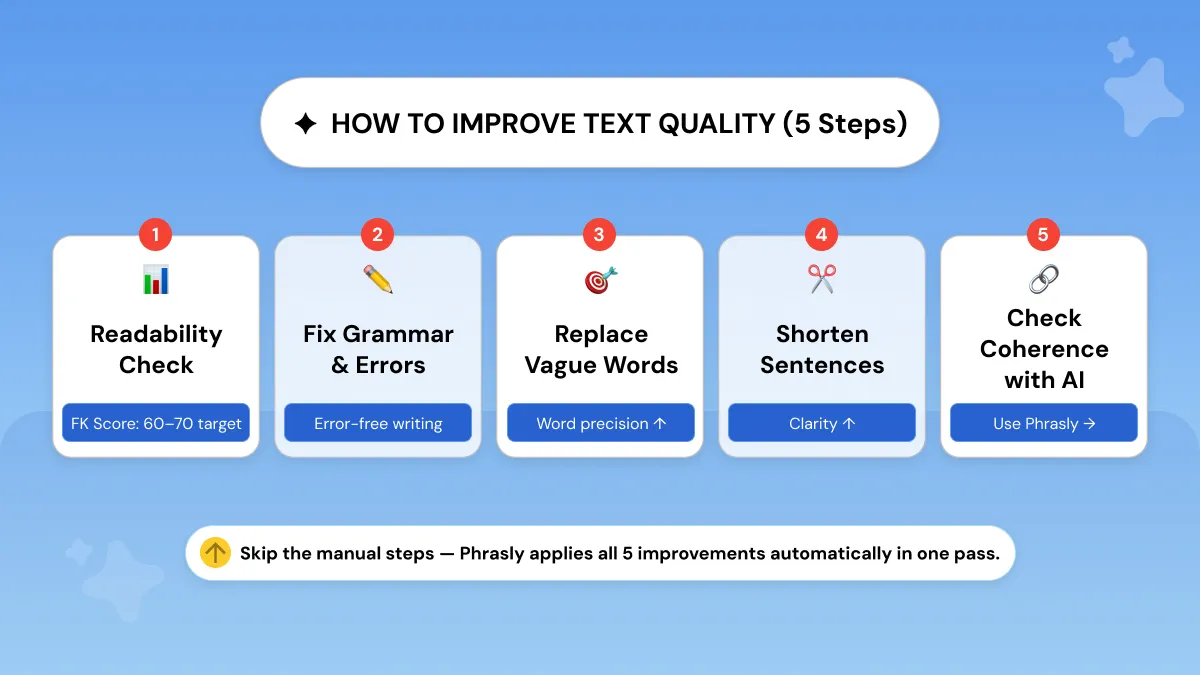
Start with readability, then work through grammar, word precision, sentence clarity, and structural coherence in that order. You will see measurable improvement on the same draft you already have.
Here's a real example. We'll run this paragraph through all five steps:
"The company wants to improve its online presence and make sure that more people know about its products. They also want their website to be easier to use and more interesting for visitors. Right now, some parts of the website are confusing and the writing is not very clear, which makes it hard for people to understand what the company offers."
Step 1: Run a Readability Check First
Before fixing anything, establish a baseline. Paste your text into a readability tool and get your Flesch-Kincaid score.
Don't skip this step. Without a baseline score, you're editing by feel, and that's how fixable problems stay unfixed.
The target for online content is 60–70, roughly Grade 7–8. It's the range where most readers, regardless of education level, can move through text without slowing down.
The example paragraph above falls below that range, which means the sentences are too long and the words too complex for comfortable reading online. That's your starting point. Fix readability first, before anything else.
Example after Step 1:
"The company wants more people to notice its products online. It also wants the website to be easier to use and more engaging. Right now, some sections are confusing, and the writing is hard to follow."
With shorter sentences and simpler words, the readability score improves immediately.
Step 2: Fix Grammar and Structural Errors
Grammar is the foundation, not the finish line. Once your text is readable, clean up punctuation, tense consistency, and subject-verb agreement. In this example, grammar was already clean, which proves the point.
The original paragraph had no grammatical errors. It was still low quality.
Example after Step 2:
"The company wants more people to notice its products online. It also wants the website to be easier to use and more engaging. Right now, some sections are confusing, and the writing is hard to follow."
Since the grammar was already correct, the text remains unchanged after this step.
A clean grammar check doesn't mean your writing is good. It just means the foundation is solid enough to build on.
Step 3: Replace Vague Words with Precise Ones
This is where most writers lose readers without realizing it. "Improve its online presence" means nothing. "Increase organic visibility" means something. "More interesting for visitors" is filler.
"More engaging" is marginally better, but "easier to navigate" is precise.
Example after Step 3:
"The company wants to increase organic visibility so more people can find its products. It also wants the website to be easier to navigate and more engaging. Right now, some sections are unclear, which makes it harder for visitors to understand the offer."
Word precision is what separates writing that sounds competent from writing that actually communicates.
Step 4: Shorten Sentences and Break Up Complexity
One sentence, one idea. Passive constructions and stacked clauses are the main offenders, cut them. If a sentence is doing two things, split it into two sentences.
Example after Step 4:
"The company wants to increase organic visibility so more people can find its products. It also wants to make the website easier to navigate. At the moment, unclear writing is making the offer harder to understand."
Keep it clean and more direct so that the reader doesn't have to work.
Step 5: Check Structural Coherence (Then Let AI Handle It)
This is the step most writers skip, and the one that matters most for overall text quality. Most editing stops at the sentence level.
Structural coherence is about the whole thing, whether the piece moves the reader from one idea to the next in a way that feels natural and earned.
Does each sentence lead logically into the next? Does the paragraph move from problem to solution in a way that makes sense? This is also where manual editing has real limits. You can reread a paragraph ten times and still miss a coherence gap because you're not reading it, you're remembering it.
You're too close to your own writing to reliably catch coherence gaps.
How can you automatically improve source text quality? This is exactly what AI does well. A Text Quality Enhancer evaluates logical flow from an outside perspective, analyzing whether ideas connect rather than just whether sentences are correct.
Final example after all five steps:
"The company wants to increase organic visibility so more people can find its products. It also wants the website to be easier to navigate and more engaging. To make that happen, it needs clearer writing and better structure, so visitors can immediately understand what the company offers."
That's the same paragraph you started with.
Every change was targeted: one dimension at a time, applied in the right order. That's the part most writers miss.
They try to fix everything at once and end up going in circles. Working in layers gives each problem its own moment to get solved properly.
The original had no grammar errors, yet it still needed four rounds of improvement before it actually worked. That's what text quality means in practice.
Why Manual Editing Misses Coherence (And AI Doesn't)
When you edit your own writing, you already know what you meant to say.
Your brain fills in the gaps automatically, the missing transitions, the logical leaps, the connections that exist in your head but not on the page. This is not a skill problem. It happens to experienced writers just as often.
The closer you are to the work, the harder it is to see what's actually on the page versus what you intended to put there.
Readers don't have that context. What feels coherent to you reads as disjointed to them.
AI text quality enhancers don't have that cognitive bias.
They evaluate structural coherence from the outside, analyzing whether ideas follow each other logically based on what's actually written, not what was intended.
NLP-powered tools catch coherence issues that even careful self-editors miss. That outside perspective is the actual value.
Not faster editing, not grammar checking at scale. Just an evaluation of your writing based on what it says, not what you meant.
It's not that you're a bad editor. It's that you're the wrong editor for your own work. That's where rewriting at the sentence level becomes part of the fix.
This guide on how an AI humanizer helps you rewrite sentences walks through exactly how that works in practice.
If you'd rather skip the steps and improve text quality instantly, Phrasly handles the whole thing for you.
Phrasly AI Text Enhancer runs all five steps in a single pass. No manual process, no working through dimensions one by one. Paste your draft and it comes back with better readability, sharper word choice, cleaner sentences, and stronger flow. All at once 👇.
Who Needs a Text Quality Enhancer?
A text quality enhancer is most useful when your writing needs to perform across measurable signals like readability, coherence, and word precision, not just pass a grammar check.
Content writers and bloggers publishing at volume need consistent quality across every piece. A readability score that drops to 45 on post three is a problem a grammar tool will never flag.
If you're also using AI to generate ideas before drafting, these AI creative writing prompts are worth keeping in your workflow.
AI content users are the clearest use case. A 2025 corpus study found ChatGPT-generated essays scored higher on lexical richness but lower on readability than student writing. The grammar looks fine. The quality score doesn't.
Professionals drafting reports or proposals need structural coherence above everything else. A well-argued proposal with poor logical flow loses credibility before the reader reaches the conclusion.
The same applies to everyday workplace communication. If that's where your writing shows up most, this guide on AI message enhancement covers exactly how to fix it.
Non-native English writers often hit a wall that grammar tools can't fix. Errors get corrected, but word precision and sentence flow stay weak.
Those are quality problems, not grammar problems, and they need a different kind of tool. It's a frustrating place to be.
The errors are gone but the writing still doesn't feel right, and a grammar checker has nothing left to offer at that point.
A 2025 Springer Nature study found that AI and digital tools improved readability and structure in writing, especially for non‑native English authors, helping close historical quality gaps.
How Phrasly AI Text Quality Enhancer Works
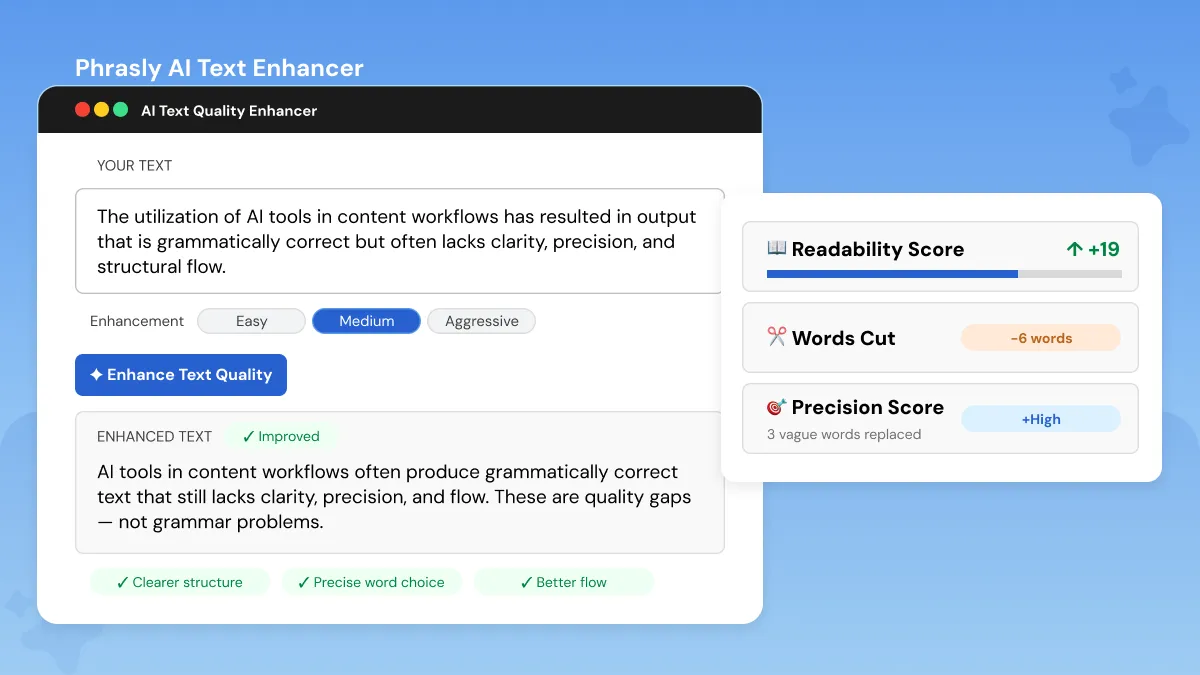
There is a way to automatically improve your text quality before publishing, without scoring it manually or working through fixes one by one.
Most tools make you do the work yourself.
You check readability in one place, grammar in another, and hope you caught everything. Phrasly runs all of it together so you get one improved version back, not five separate problems to manage.
Phrasly analyzes your writing across all five quality dimensions, readability, grammar accuracy, word precision, sentence clarity, and structural coherence, simultaneously, not one at a time.
That's what separates a purpose-built text improvement tool from a basic grammar checker. Not all text enhancement tools are built the same way.
If you want a full breakdown of how Phrasly compares to other options on the market, this Phrasly.AI vs Originality.ai comparison covers it in detail.
Here's how it works. Paste your text, choose an enhancement level, and get back a quality-improved version in seconds. The three levels map to different use cases:
Easy: Light improvements to readability and word choice. Best for text that's mostly solid but needs polish
Medium: Deeper restructuring of sentences and vocabulary. Best for first drafts with clarity and flow issues
Aggressive: Full quality overhaul across all five dimensions. Best for AI-generated content or writing that scores below 50 on readability
It works on AI-generated text and human-written drafts equally well. Quality problems don't discriminate, a weak FK score and vague word choice show up in both. For focused sentence-level improvements, see our sentence enhancer guide.
Here's a real before/after. Same topic, same information, just run through Phrasly. (Flesch-Kincaid scores calculated using Good Calculator.)
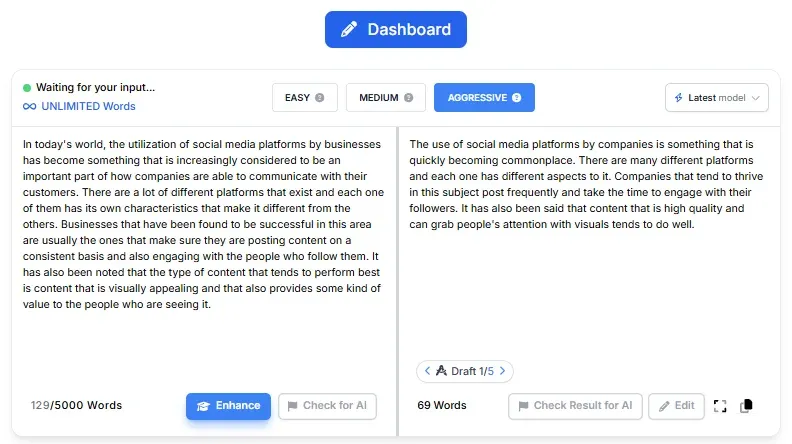
Before : "In today's world, the utilization of social media platforms by businesses has become something that is increasingly considered to be an important part of how companies are able to communicate with their customers. There are a lot of different platforms that exist and each one of them has its own characteristics that make it different from the others. Businesses that have been found to be successful in this area are usually the ones that make sure they are posting content on a consistent basis and also engaging with the people who follow them. It has also been noted that the type of content that tends to perform best is content that is visually appealing and that also provides some kind of value to the people who are seeing it."
Flesch Kincaid score: 38
After: "The use of social media platforms by companies is something that is quickly becoming commonplace. There are many different platforms and each one has different aspects to it. Companies that tend to thrive in this subject post frequently and take the time to engage with their followers. It has also been said that content that is high quality and can grab people's attention with visuals tends to do well.”
Flesch Kincaid score: 53
The “before” version is full of passive constructions and filler, it buries the point in every sentence.
The “after" version says the same thing in half the words, with more precision and better flow.
The FK score jumped from 38 to 53, a direct result of cleaner sentences, stronger word choice, and better structure.
That's what text quality improvement actually looks like in practice. For a deeper look at how readability and tone work together, read our readability and tone guide.
If you also want to improve your text readability and get a better Flesch-Kincaid score, Phrasly's AI Text Enhancer is free to try. Paste anything and see the difference in seconds 👇.
FAQs
How do I know if my AI-generated text is high quality?
Run it through a readability tool and check the Flesch-Kincaid score, most AI-generated text scores below 50 despite having zero grammar errors. If the score is low and the sentences feel mechanical, you have a quality problem, not a grammar problem. You can also read our full guide on what a good readability score looks like and what to aim for.
Does improving text quality help with SEO?
Yes, directly. Google's ranking signals include time on page, bounce rate, and content clarity, all of which improve when your text is more readable and better structured. Higher quality text keeps readers engaged longer, which sends positive signals to search engines.
What is the difference between text quality and writing style?
Writing style is about voice, tone, and personality, how a piece sounds. Text quality is about performance, how clearly it communicates, how readable it is, and how logically it flows. You can have a strong, distinctive style and still have poor text quality if the structure or readability is weak.
Does grammar checking improve text quality?
Only partially. Grammar checking fixes errors, but text quality covers five dimensions: readability, grammar accuracy, word precision, sentence clarity, and structural coherence. A grammar checker handles one of the five. As covered in this article, you can have perfectly clean grammar and still have low-quality text.
What tools are best for improving text quality automatically?
Tools built specifically for quality improvement, like Phrasly's AI Text Enhancer, analyze readability, structure, and word precision together in one pass. Basic grammar checkers like Grammarly handle errors but miss the broader quality picture

Written by
Obaid Ahsan
Content Lead · Pakistan
Obaid Ahsan is a Content Lead with 5+ years of experience in SEO, content strategy, and AI-focused publishing. At Phrasly, he leads content development with a focus on accurate research, search performance, and useful, trustworthy information for readers.