Does Purdue OWL Have a Plagiarism Checker? What It Offers (and What Students Actually Need)
Purdue OWL does not have a plagiarism checker. Here's what the writing lab actually offers, and what students should use to check their papers before submitting.
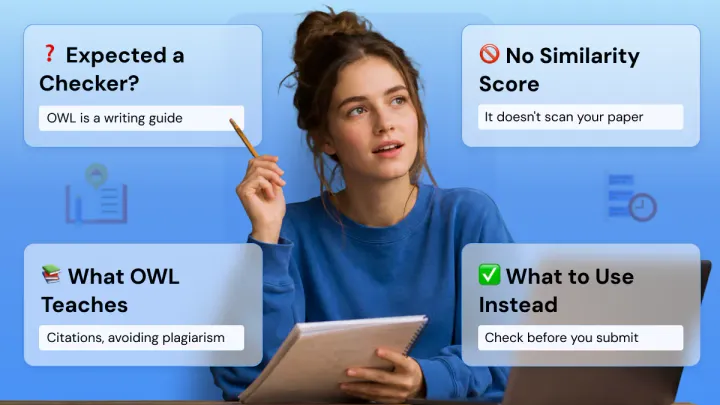
You searched for a Purdue OWL plagiarism checker, clicked a promising result, and ended up on a page full of citation guides instead of a scan button. That happens to thousands of students every semester.
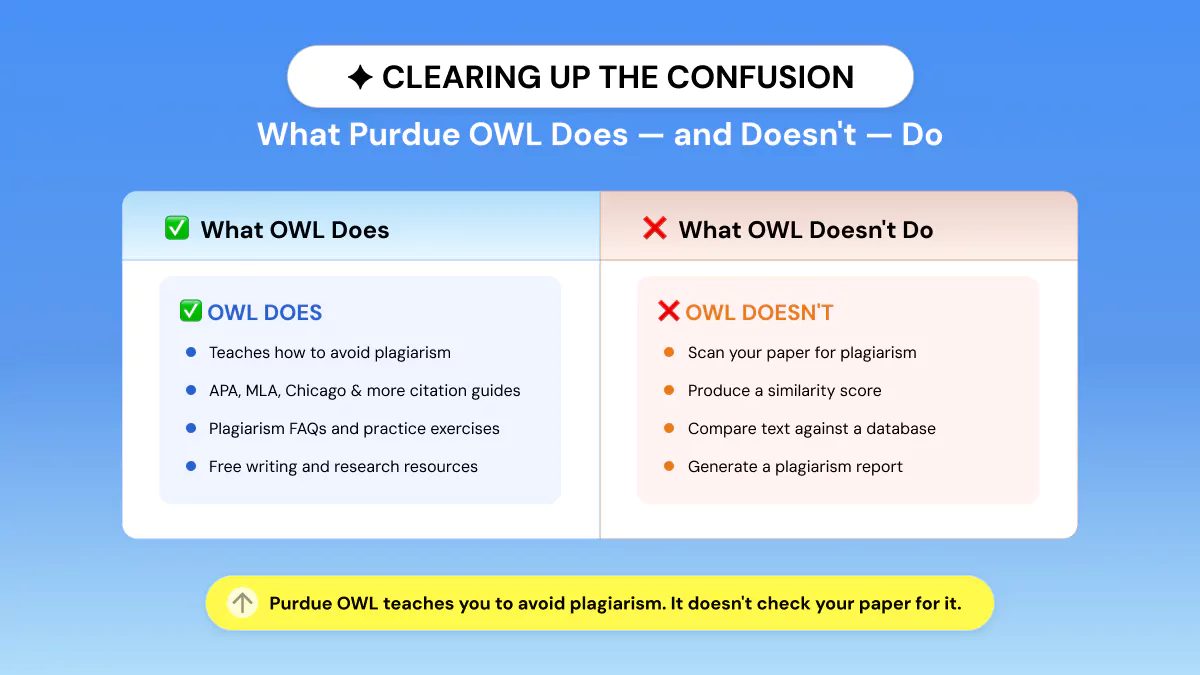
So let's clear it up right away: Purdue OWL is not a plagiarism detection tool. It cannot scan your paper, and it never could.
It is still one of the best free writing resources available, though. This article breaks down what OWL actually offers, where it stops, and what to use for checking your paper before you submit it.
What Is Purdue OWL and What Does It Actually Do?
Purdue OWL stands for the Purdue Online Writing Lab, a free academic writing resource that Purdue University has maintained since 1993.
The easiest way to picture it: a huge reference library for college writing. Purdue calls it a free service built for students, teachers, and writers around the world.
Most students land on OWL for help with the writing itself. That usually means one of these:
- Shaping a thesis or organizing a messy draft
- Fixing grammar and sentence-level issues
- Formatting citations in APA, MLA, Chicago, or AMA
- Learning how to quote and paraphrase sources without slipping up
The word "lab" is where the confusion starts. There is no software running behind OWL. You cannot upload a paper, and nothing gets compared against a database.
So if you got here searching for Purdue online writing lab plagiarism, what you will actually find on OWL is teaching material.
The avoiding plagiarism section explains what counts as plagiarism, why attribution matters, and how accidental plagiarism happens in the first place. Similarity scores and originality reports come from plagiarism detection software, and OWL has never offered that.
What Subjects Does Purdue OWL Cover?
Six main areas, all free to use:
- Writing Process: Prewriting, thesis statements, outlining, revision, and proofreading
- Grammar: Articles, prepositions, subject-verb agreement, verb tense, common errors
- Citation guides: If citation help is what brought you here, this is OWL at its absolute best. The Research and Citation section covers all major citation styles, including APA, MLA, Chicago, AMA, and IEEE.
- Research and source integration: Quoting, paraphrasing, summarizing, and evaluating sources
- Avoiding plagiarism: Guidance on attribution, common knowledge, and proper source use
- ESL writing resources: Support for multilingual and English-language learners
Does Purdue OWL Have a Plagiarism Checker?
There is no scanning feature anywhere on the site. Nothing on OWL compares your document against a database, and no page will hand you a similarity score.
Purdue's own plagiarism overview defines plagiarism as using someone else's words or ideas without proper credit, and the entire section is built around prevention through quoting, paraphrasing, summarizing, and citation.
The mix-up makes sense. OWL ranks highly for searches like Purdue OWL plagiarism checker because its plagiarism and citation guides are some of the best available. Ranking for the term is where the resemblance ends, though.
Outside sources back this up. A widely referenced Brainly answer confirms that OWL supports writing and citation help but offers no plagiarism checker, citation generator, or essay evaluation tool.
Its guides even break down the types of plagiarism, including direct, mosaic, and self-plagiarism, without ever checking a single paper for them.
What Purdue OWL Does Offer for Plagiarism
When a professor tells you to use Purdue OWL for plagiarism, they mean to study its guides on citing, quoting, and paraphrasing before you write. They are pointing you to learning material, since there is nothing on OWL to run your paper through.
Where OWL genuinely shines is plagiarism education. Its resources are some of the most thorough you will find for free, and they cover the exact situations that get students in trouble.
Here is what is actually available:
- The Avoiding Plagiarism Guide. The Purdue OWL avoiding plagiarism section explains what plagiarism is, how it can be intentional or unintentional, and why crediting other people's words and ideas sits at the core of academic integrity.
- Plagiarism FAQs. The FAQ page tackles real student questions: when something counts as plagiarism, what happens if you plagiarize, and even what to do if you are accused unfairly. It also covers self-plagiarism and other types of plagiarism like poor paraphrasing and misattributed quotes.
- Citation guides. The Research and Citation section covers all major citation styles, including APA, MLA, Chicago, AMA, and IEEE. This matters more than it sounds, since most unintentional plagiarism starts with citing, quoting, or paraphrasing incorrectly.
- Exercises and best practices. OWL includes practice activities plus a Best Practices guide covering note-taking, summaries, and direct quotations.
One more page worth knowing about: Using Paper Checkers Responsibly. It explains how paper-checking apps work and how to use them wisely, though access to it is currently restricted. Even when available, it discusses other tools rather than offering a scanner of its own.
Why Students Confuse Purdue OWL With a Plagiarism Scanner?
OWL shows up in search results right next to actual plagiarism checkers because it ranks for so much plagiarism-related content. The name does not help either, since "OWL" sounds like software. In reality, you are browsing a reference library, and detection simply is not part of what it was built to do.
Purdue OWL Alternatives
Everything OWL teaches happens before you write. Once the paper is done, you still need something that can look at your actual text, and that means a plagiarism checker for academic papers.
A real checker does four things OWL was never designed for:
- Scans your text against web pages, academic sources, and published content
- Returns a similarity score showing how much of your paper matches existing material
- Highlights the exact matched passages so you can fix them
- Lists the overlapping sources, so you know what to cite
On checking a paper for plagiarism for free: limited free scans exist for short drafts, but full academic papers usually need a paid plan, a per-document check, or access through your school.
A genuinely unlimited free plagiarism checker for students does not really exist, and independent research backs up the idea of being careful here.
A 2025 systematic survey in Frontiers in Computer Science found that even advanced detection systems struggle with paraphrased and restructured text, which is why the tool you pick matters.
Here are the options students actually compare:
Phrasly Plagiarism Checker
Phrasly's Plagiarism Checker is the natural pairing with OWL's citation guidance because it goes beyond word-for-word matching. Its AI-based scanning catches paraphrased and mosaic plagiarism, the exact types OWL warns students about.
Here is what a scan gives you:
- Similarity percentage with highlighted matches, so you see exactly which lines need fixing
- Direct source URLs plus a downloadable source-by-source report for your records
- A database of 10B+ web pages and academic papers, with multi-language coverage
- Upload support for PDF, DOCX, and TXT files, or just paste your text in
- Privacy by default: documents are never stored or indexed after scanning
It fits students who submit papers regularly and want originality checks living alongside their writing tools.
Phrasly Plagiarism Checker Pricing
A full report costs $5.00 per scan, or $20.00/month with a subscription that covers 20,000 plagiarism-check words per month. If you already use Phrasly's AI Humanizer, the checker comes as a free add-on with your plan.
Does Phrasly's Plagiarism Checker Include AI Detection?
No, and that is intentional. Plagiarism checking and AI-generated content detection are separate jobs, so Phrasly keeps them as separate tools. The plagiarism checker handles originality, while the standalone AI Detector covers the AI side, and that one is completely free to use.
Quetext
Quetext is built around its DeepSearch technology and works well for shorter assignments.
- Free limit: up to 1,000 words of plagiarism checking, enough for a short essay
- Paid: the plagiarism-only plan starts at $9.99/month for 50,000 words, and the Essential plan at $19.99/month adds 100,000 words plus an AI detector
- Best at: downloadable originality reports and citation support on paid plans
- Ideal for: students on a budget who check one or two short papers a month
Scribbr Plagiarism Check
Scribbr uses detection software similar to what most universities run, which makes results feel closest to what your school will see.
- Free option: a risk indication plus your top 5 matching sources, without a full report
- Paid: per-document pricing rather than a subscription, at $19.95 for papers up to 7,499 words, $29.95 up to 49,999, and $39.95 beyond that
- Database: 99B+ web pages and 8M+ academic publications across 20 languages
- Ideal for: thesis and dissertation writers who need one thorough check, plus a self-plagiarism upload option
Turnitin
Turnitin is the checker most universities use behind the scenes, but students cannot buy it directly. Access comes only through your institution, usually when you submit through your course portal. That is exactly why students run a pre-check with one of the tools above first.
One honest caveat on all of these: a 2025 study in the journal Information evaluating detection tools in higher education concluded they work best as a supplement to human judgment, since false positives happen. Treat any similarity score as a review checklist, and fix flagged passages yourself.
Quick Comparison
| Tool | Free Option | Paid Pricing | Word Limit | Best For |
|---|---|---|---|---|
| PhraslyBest pairing with OWL | Free add-on for AI Humanizer users | $5.00 per scanor $20.00/mo subscription | 20,000 words/mo on subscription | Catching paraphrased and mosaic plagiarism |
| Quetext | Up to 1,000 words | From $9.99/mo | 50,000 words/mo | Budget checks on short essays |
| Scribbr | Risk indication only | $19.95–$39.95per document | Per document, no subscription | Theses and one-time deep checks |
| Turnitin | None for individuals | Institutional only | Set by your school | The official check your school runs |
The workflow that works: learn citation styles and source habits from Purdue OWL, then run the finished paper through plagiarism detection before you hit submit.
Using Purdue OWL and a Plagiarism Checker Together
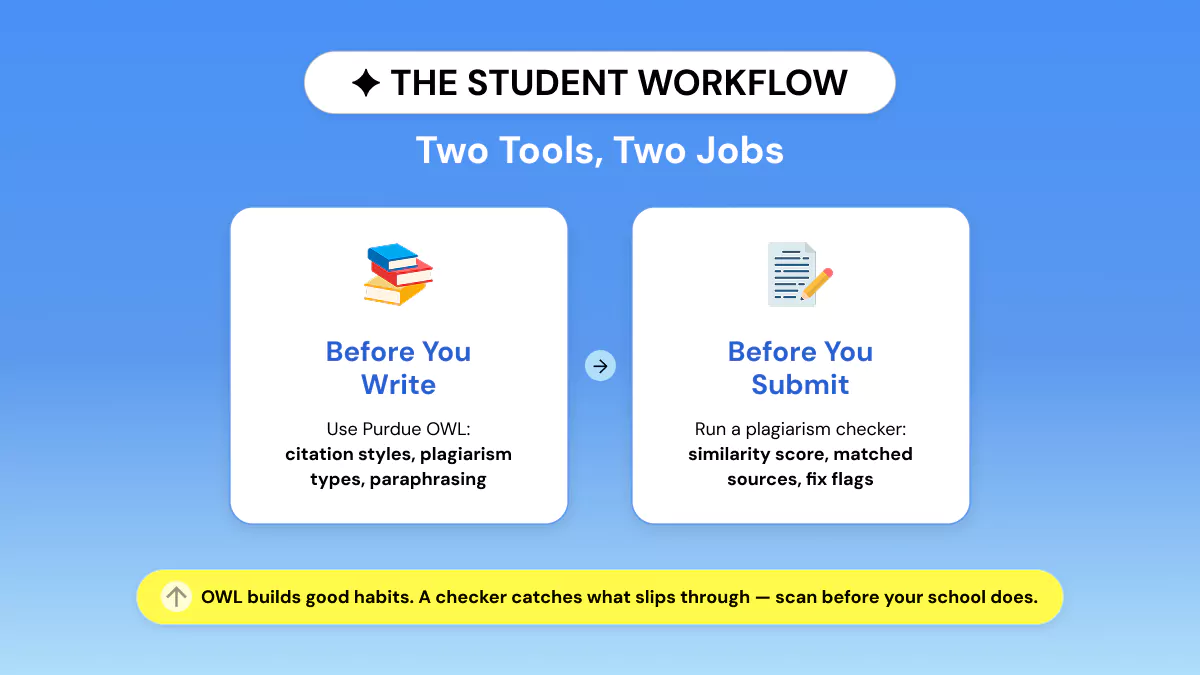
Here is the aha moment: you never had to choose between them. Purdue OWL and an originality checker solve different halves of the same problem, and the students who stay out of trouble use both.
The numbers explain why this matters. According to the International Center for Academic Integrity, McCabe's research found that more than 60% of university students admit to cheating in some form.
Most academic integrity cases are far less dramatic, though. They come from sloppy paraphrasing and missed citations, and the consequences of plagiarism hit just as hard either way.
The workflow splits cleanly into two stages:
| Stage | Tool | What to Do |
|---|---|---|
| 1Before Writing | Purdue OWL | Learn citation styles, understand plagiarism types, and study OWL's guidance on quoting, summarizing, and paraphrasing sources correctly. |
| 2Before Submitting | Phrasly | Upload your draft to a plagiarism checker built for academic papers, review the similarity score, open the highlighted matches, and fix any missing citations. |
OWL builds the habits that prevent plagiarism while you write. Phrasly catches whatever slipped through anyway, before your professor or your university's checker sees the final paper.
Learn with OWL first. Verify with Phrasly last. That order keeps your writing honest and your submissions clean.
FAQs
Does Purdue OWL have a plagiarism checker?
No. Purdue OWL does not have a plagiarism checker. It is an academic writing resource that teaches students how to avoid plagiarism, cite sources, paraphrase correctly, and understand academic integrity. It does not scan your paper, compare it with databases, or produce a similarity report.
What is Purdue OWL actually used for?
Purdue OWL is used for writing help, research guidance, grammar support, and citation style rules. Students use it to understand APA, MLA, Chicago, and AMA formatting, learn how to quote or paraphrase sources, and avoid accidental plagiarism before submitting academic work.
What’s the best free plagiarism checker for students?
The best free plagiarism checker for students depends on word limit, source coverage, and report detail. Free tools usually work for short checks, but full academic papers often need a stronger checker. For deeper pre-submission review, students can use Phrasly’s Plagiarism Checker.
How is a plagiarism checker different from Purdue OWL?
A plagiarism checker scans your paper against online sources, academic databases, or published content and returns matched text, source links, and a similarity score. Purdue OWL does not scan papers. It teaches citation, paraphrasing, and plagiarism prevention. For tool comparisons, see Phrasly’s Turnitin alternatives guide.
Can I use Purdue OWL to check my citations?
Yes, you can use Purdue OWL to check citation formatting rules, examples, and style guidance. It is useful for reviewing APA, MLA, Chicago, and AMA citations manually. However, it does not automatically verify every source, generate a plagiarism report, or confirm originality before submission.


Keep reading

Copyleaks Plagiarism Checker: Tested, Rated & Compared
Copyleaks Plagiarism Checker review: we tested verbatim, minor-change, and paraphrased content to see how its 3-layer detection performs. See pricing, AI-detection accuracy (77%-96%), free plan limits, and how it compares to Phrasly in a head-to-head scan before you subscribe.
Does Canvas Have a Plagiarism Checker? What It Uses, How It Works & What Students Should Do
Canvas has no built-in plagiarism checker. It relies on instructor-enabled tools like Turnitin or Copyleaks. Learn how scanning actually works, whether Canvas detects AI writing (ChatGPT, Claude, Gemini), and how to check your paper for plagiarism and AI content before you submit.