How to Write a Great Paragraph: Steps and Examples
14 min read
Have you ever opened a blank Word document and thought to yourself, "How to write a great paragraph?" You're not really asking that question.
What you're really asking is: How do I take one idea and form it into a few sentences that make sense together?
You'll receive a repeatable system, a completed work example, a weak paragraph turned strong, and a quick checklist you can use on any paragraph before calling it complete. Paragraphs are built around a single idea.
Whether you are drafting an essay or a blog post, how to write a paragraph comes down to the same repeatable process explained below.
The short version: A great paragraph develops one clear idea. It usually opens with a focused topic sentence. It backs that idea with relevant supporting details, explains why those details matter, and stops once the point is complete. Everything below builds that process step by step.
Quick formula: main point → supporting detail → explanation → example or evidence → closing or connecting sentence.
Got your main idea already? Enter a short instruction into the AI Paragraph Generator to create an outline-based starting draft.
You can develop using the instructions below. That tool is completely optional. You can do all of this with pen and paper as well.
Got your main idea? Turn it into a full paragraph in seconds.
✅What Makes a Paragraph Great?
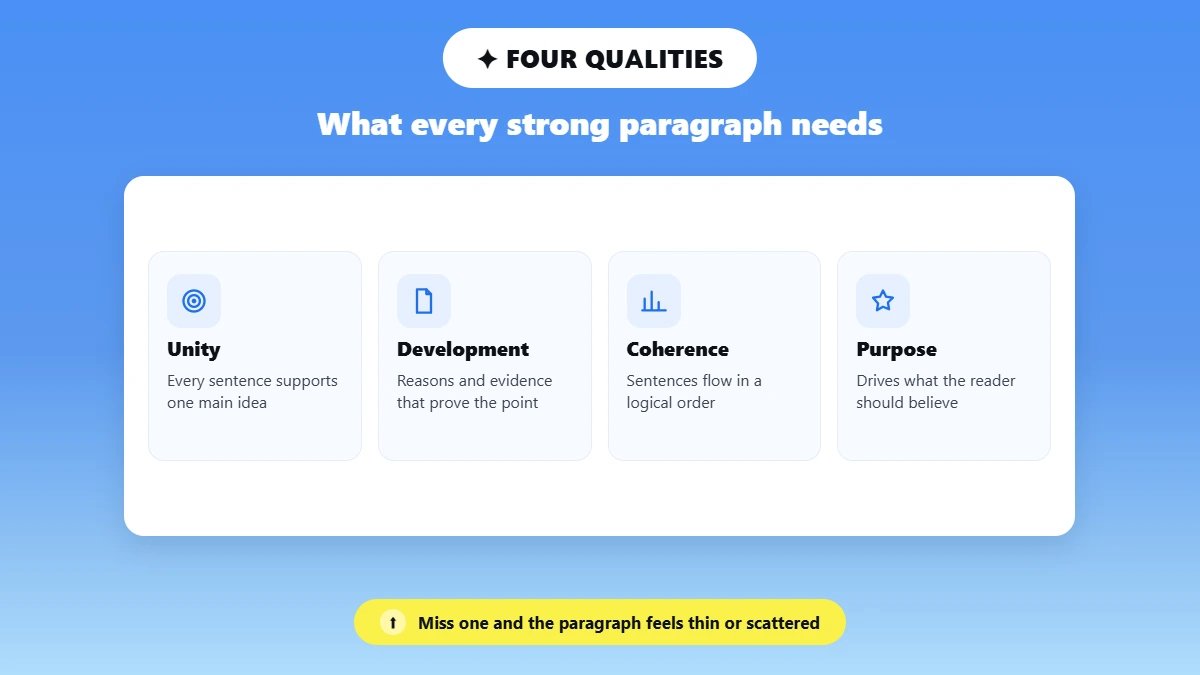
Four qualities define strong paragraph writing. Unity: One clear main idea, enough development to prove or explain the idea, logical order for the reader to follow (coherence), and a purpose.
Without one of these four, paragraphs can feel thin, scattered, or pointless even if the sentences sound well written.
One Clear Main Idea
All of the sentences in a paragraph should refer back to the same idea. This idea is sometimes known as the paragraph's main idea or controlling idea.
If a sentence in a paragraph doesn't refer back to that controlling idea, it should be in another paragraph, or it doesn't belong at all.
Enough Development
An idea needs support to land. Reasons, evidence, examples, description, comparison, analysis. These are all forms of development.
Strong paragraph development means every one of these tools is doing real work. Not just padding out the word count.
Underdeveloped paragraphs (you know, the ones that just state a claim and move on) are the number one most common mistake beginners make.
Logical Flow
Sentences should flow in an order that allows the reader to proceed without having to backtrack.
This is called coherence: when each sentence follows logically from the one before it.
A Clear Purpose
A paragraph may inform, persuade, describe, compare, narrate, or analyze. Determine what you want the reader to know or believe when he or she reads your paragraph.
That is your paragraph's purpose, and it should drive every sentence you write. Naming your paragraph purpose before you start writing makes every sentence that follows easier to choose.
Quality | Question to ask yourself |
Unity | Does every sentence support the same main idea? |
Development | Have I explained or supported the idea enough? |
Coherence | Can the reader follow the order of my thoughts? |
Purpose | What should the reader understand or believe afterward? |
The Basic Structure of a Strong Paragraph
Lots of resources write about paragraph format and body paragraph structure as if there is a rigid formula you must follow. Think of it instead as a loose template you can customize: Point, Support, Explain, Connect.
Point: State the main idea in one focused sentence.
Support: Add a reason, fact, example, description, or short quotation.
Explain: Show the reader how the support actually proves the point.
Connect: Close the idea or link it to what comes next.
It's not a one-size-fits-all paragraph form. The topic sentence most often comes near the start, and the final linking sentence isn't always necessary. Adapt the order whenever your writing process suggests it.
How to Write a Great Paragraph in 6 Steps
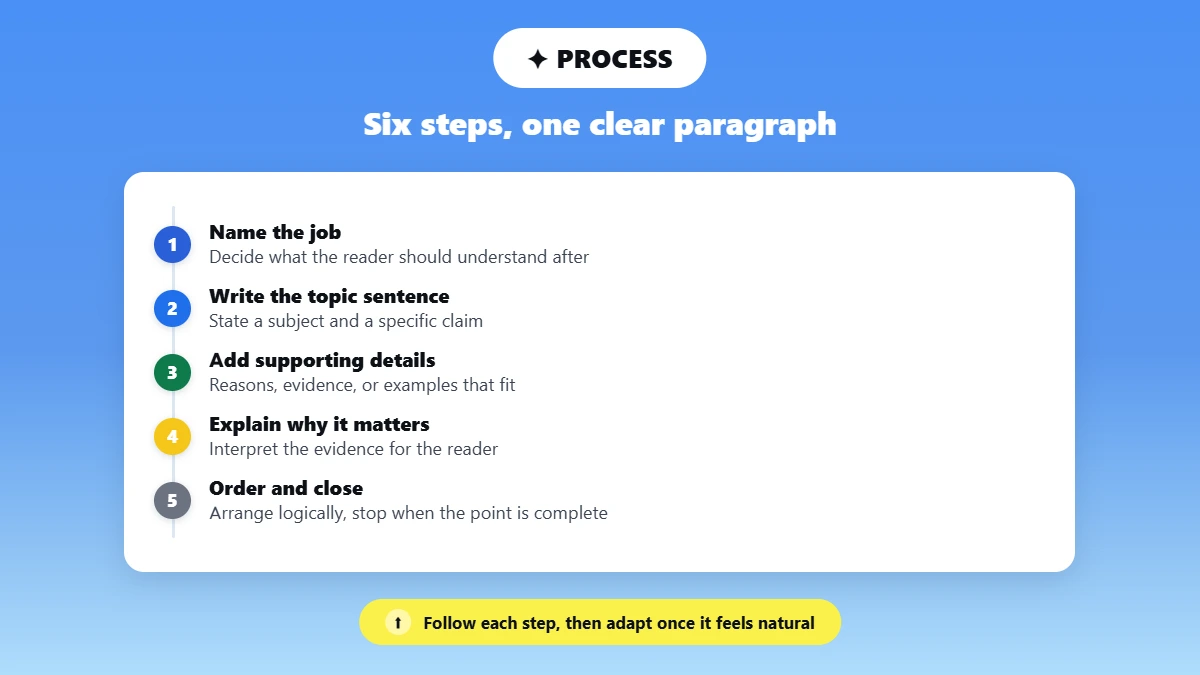
Got to the good part? It’s how to answer the question people are really searching for. How to write a good paragraph step by step. Follow each step sequentially at first, then tweak the process after it feels natural.
Step 1: Decide What the Paragraph Needs to Do
Complete this sentence before you write anything else: "After reading this paragraph, my reader should understand that ______." Then, write your paragraph.
An academic paragraph might finish as follows: Evidence clearly supports my claim. A blog paragraph might complete it with a practical takeaway. A business paragraph might end with a recommendation.
Giving the paragraph a job title tells every sentence that follows what task it needs to perform.
Step 2: Write One Focused Topic Sentence
A topic sentence requires two components: a subject and a specific claim about that subject. And there you have it.
That's how to write a topic sentence and what is a topic sentence in a paragraph. It's the sentence that tells your reader precisely what your paragraph will show.
❌ Weak: "Exercise is good."
✅ Improved: "Regular aerobic exercise keeps students more focused during lengthy study sessions."
This improved version also includes a specific topic and specific claim so the reader knows what to expect from the paragraph.
If your sentence feels bland, try using an AI sentence enhancer.
It can help you figure out a crisper way to word your sentence. However, the direction of your claim still needs to come from you.
This is also how to start a body paragraph. With one focused sentence that names your subject and your specific claim about it.
Step 3: Add Relevant Supporting Details
Once the topic sentence is set, gather your supporting details. Common forms of support include:
A reason that backs up the claim.
A concrete example.
Evidence, a fact, or a statistic.
A description, comparison, or short quotation.
Quantity does not matter here. If a sentence only somewhat relates to the general topic, it will harm the paragraph even if the sentence in itself is intriguing.
Stick to relevant details that clearly connect to your topic sentence. Cut anything that only loosely fits.
Step 4: Explain Why the Support Matters
This is the step most novice authors skip, which leaves the largest gap in less-thorough how-to guides. Inserting evidence doesn't mean you've explained it.
❌ Evidence dropped in: "Regular exercise improves concentration. One study found active students performed better on attention tasks."
✅ Evidence interpreted: "This suggests that short bouts of movement help students return to demanding work with sharper focus."
The second version explains to the reader what the evidence means, rather than just stating that it exists. The interpretation is where the actual analysis takes place.
Step 5: Arrange the Sentences in a Logical Order
A paragraph developed well but ordered poorly still confuses the reader. Choose a pattern that fits the content and hold to it:
General to specific.
Cause and effect.
Problem and solution.
Chronological order.
Claim, evidence, explanation.
Most important to least important.
Step 6: End or Transition When the Idea is Complete
Not every paragraph needs a formal concluding sentence. When you do close one out, draw a conclusion, reinforce the point, show why it matters, or lead into the next idea.
So does every paragraph need a concluding sentence? No. When the point is already clear, it is fine to stop and move on.
A Great Paragraph Example, Explained Sentence by Sentence
Here is a full paragraph example you can study line by line.
The topic: why schools should provide quiet study spaces.
Schools should set aside dedicated quiet study spaces for students who need a break from noisy common areas. Many students report that background chatter and constant movement make it difficult to concentrate on complex assignments. A 2023 survey of secondary students found that nearly two-thirds preferred a silent room over a general library area when preparing for exams. That preference suggests concentration, not just comfort, drives the demand for quiet space. Providing even one dedicated room per building would give students a reliable option instead of forcing them to search for a free corner. In short, a small facilities change could meaningfully support how well students study.
This is also a body paragraph example because it follows the claim, evidence, explanation structure typical of academic body paragraphs.
For more worked examples broken down sentence by sentence, Monash University's paragraph structure guide walks through similar annotated samples. The table below labels each sentence's job.
Sentence | Function | Why it works |
1 | Topic sentence | States one clear, arguable point |
2 | Supporting reason | Develops the point |
3 | Concrete evidence | Makes the reason specific |
4 | Explanation | Shows why the evidence matters |
5 | Additional support | Strengthens the development |
6 | Concluding sentence | Connects the evidence back to the main idea |
Weak Paragraph Vs. Improved Paragraph
Students learn revision by seeing examples far more effectively than through lists of rules. Below is a poorly constructed paragraph followed by a revised version.
❌ Weak version:
Working from home is popular now. A lot of companies let people do it. It has some good points and some bad points. My cousin works from home, and she likes her cat. Overall, it depends on the person and the job.
✅ Improved version:
Remote work gives employees more control over their schedules, which is why adoption has grown steadily since 2020. Employees who set their own hours report fewer conflicts between work tasks and family responsibilities. This flexibility also cuts commuting time, freeing up hours that many workers redirect toward rest or focused, uninterrupted work. The arrangement is not universal: roles that depend on hands-on collaboration or physical equipment still benefit from in-person structure. For most desk-based jobs, though, remote work now offers a practical way to balance productivity and personal time.
What changed:
Narrowed a vague opening claim into a specific, arguable topic sentence.
Removed the unrelated detail about a cousin's cat.
Added a concrete example and explained what it shows.
Fixed the sentence order so ideas build instead of repeating.
This is the same process you can use anytime you need to revise a paragraph that feels flat or unfocused.
If your sentence remains clunky after manual editing, run it through a sentence rewriter to see what an alternative pops out that you can compare with your version.
Keep the final judgment call with the writer since the tool cannot know your intended tone.
How to Write Different Types of Paragraphs?
You can apply the Point, Support, Explain, Connect strategy to many genres. Let's look at the differences between how to write a body paragraph and other types of paragraphs.
Academic (Body) Paragraphs
The structure of a body paragraph in an academic essay often looks like this. Claim, evidence, explanation, connection. Each claim should be paired with evidence.
Each piece of evidence should be followed by an explanation of why that piece of evidence proves your claim.
Once you have a full draft, an essay rewriter can help you polish tone and flow across the whole piece rather than sentence by sentence for readers interested in expanding from a paragraph to a complete assignment.
Readers moving from a single paragraph to a full assignment can find more detail in this guide to writing an informative essay, along with this piece on keeping AI-assisted academic writing sounding like your own voice.
Persuasive Paragraphs
A persuasive paragraph claims a position, provides support, responds to an anticipated objection, and describes the benefit or consequence of agreement.
You need to explain why to readers who may disagree with you, not just tell them what to think. Descriptive paragraphs convey one dominant impression created by specific details that appeal to the senses.
Narrative paragraphs contain events in chronological order, focusing on a single scene or turning point. Professional or web paragraphs start with the most important info followed by short sentences that can be easily scanned on a phone screen.
This lines up with Google Search Central's guidance on people-first content, which emphasizes writing clearly for the reader's needs first rather than optimizing purely for search engines.
📏 How Long Should a Paragraph Be?
There is no fixed number. A paragraph should be as long as it takes to develop one idea and no longer than that. Academic paragraphs run longer because they are more developed.
Online content paragraphs run shorter to aid readability. Journalism will occasionally throw in a one-sentence paragraph for emphasis. Your assignment guidelines override any of these rules.
Knowing when to start a new paragraph matters just as much as length. Start a new one as soon as you shift to a new controlling idea.
The UNC Writing Center explicitly rejects defining a paragraph by a fixed sentence count, arguing that unity and development matter more than length.
Purdue's Online Writing Lab makes a related point. Very short paragraphs can often be a sign of underdevelopment rather than concision.
If your paragraphs regularly run long and repetitive, a guide on strategies to make writing shorter and more concise can help you cut without losing the point.
How to Make a Paragraph Flow?
Sentence flow is created by cohesion: Logical connections between sentences. Maintain logical order, repeat important words if necessary for clarity, use synonyms judiciously, and maintain pronoun reference.
Insert transitions only if they make an explicit relationship between sentences clearer.
Example: "Remote work gives employees more scheduling flexibility. This flexibility can cut commuting pressure and make family responsibilities easier to manage."
The second sentence repeats "flexibility" instead of introducing a new idea, which keeps the reader oriented. Coherence does not come from sprinkling "however" or "therefore" into every sentence.
Flow happens because of the relationship between your ideas. The Harvard College Writing Center frames this as signposting using sentences to show the reader how one idea leads to the next rather than just announcing a transition.
Once you have your ideas in a good order, a fluency enhancer can help with sentence-to-sentence coherence.
💪 How to Use Phrasly to Draft a Better Paragraph?
But suppose you already have a topic and just can't get it going. Or you want a first draft to respond to. Or you want to experiment with a different tone of voice. You can use an AI drafting tool to jump-start your writing process.
Enter a specific topic or instruction, not a vague subject.
Choose how many paragraphs you need.
Pick a Detailed or Precise style, depending on how much explanation you want.
Set the language and tone.
Generate the draft.
Check every claim, example, and detail for accuracy and relevance.
Rewrite and personalize the draft before you use it anywhere.
These configuration options, paragraph count, style, language, and tone, reflect Phrasly's stated feature set at the time of writing. Confirm current functionality on the live product page before relying on it.
Try a prompt like this one: "Write one 120-word paragraph explaining why schools should provide quiet study spaces. Begin with a clear topic sentence. Include two supporting reasons and one practical example. Explain why the example matters, and use a professional but easy-to-understand tone."
A drafting tool can help propose organization and a starting point. It can't fact-check you, analyze your audience, or ensure the finished piece sounds natural. So treat whatever it gives you as something to edit, not a completed paragraph.
Start a first draft with the AI Paragraph Generator, or reshape a paragraph you already wrote with the AI Paragraph Rewriter.
✅ A 7-Question Paragraph Revision Checklist
Before you consider a paragraph finished, use this checklist to revise a paragraph with a critical eye:
Does the paragraph develop one clear idea?
Can I identify the topic sentence?
Does every sentence support that sentence?
Have I included enough explanation or evidence?
Are the ideas arranged in a logical order?
Are all transitions necessary and accurate?
Should I end here, split the paragraph, or add more development?
Now that you understand what you should have in your paragraph, you can try using the AI paragraph generator to create a different version and compare its topic sentence, supporting sentences, and flow to yours.
❌Common Paragraph-Writing Mistakes
Starting with a statement that is too broad to support.
Cramming multiple main ideas into a single paragraph.
Listing evidence without explaining what it means.
Repeating the topic sentence in different words instead of developing it.
Overusing vague pronouns or forcing a transition word into every sentence.
Assuming every paragraph needs exactly five sentences.
Writing one large block that actually contains several ideas.
Using AI-generated claims without checking them. If your paragraph leans on AI-drafted content, run it through an AI humanizer so the tone still sounds like yours before you submit it.
Ending before the idea is fully developed.
Bringing It All Together
Learning how to write a great paragraph comes down to one habit: construct the paragraph carefully, then review it with a quick checklist.
Begin with a concise topic sentence, add relevant support, include a sentence explaining significance, organize logically, and end. Put your main point in your first sentence.
💪 Do that consistently, and every paragraph you write, whether it is an essay, a blog post, or a work email, will hold together on its own.
Ready to put this into practice? Let Phrasly draft your first paragraph for free.
FAQ: How to Write a Great Paragraph
How do you write a great paragraph?
Write one paragraph around a single topic sentence. Add supporting details that relate to the topic. Include explanation, organization, and a concluding/linking sentence if you want.
Get your main concept down first, then run it through the quick checklist.
What are the main parts of a paragraph?
A topic sentence followed by one or more supporting sentences; explanation or analysis. A concluding sentence or link sentence when the paragraph requires it.
How many sentences are in a paragraph?
Paragraphs have no set number of sentences. Write enough sentences to completely explain one thought without starting another. Most paragraphs are between three and eight sentences, but let the idea be your guide.
How many words is a paragraph, and when should I start a new one?
Word count depends on the genre and intent. Whenever you start thinking about a new topic, even if it's just a small detail of what you're talking about, start a new paragraph. Also, if your paragraph has more than one controlling idea.
Can a paragraph be three sentences, or even one?
Yes! If it makes a point, supports it, and explains it, a paragraph of three sentences is a finished idea.
One-sentence paragraphs work sometimes, mainly in newspaper or web copy where brevity is needed for emphasis, but academic concepts generally require more.
Does every paragraph need a topic sentence or a concluding sentence?
No, not necessarily. Beginners and academic writers benefit from having an explicit topic sentence near the beginning to help them stay on topic. You only need a concluding sentence if it summarizes/concludes or transitions to the next point.
How can AI help me write a paragraph?
AI can create an outline for you to start from, offer bullet points of supporting information, or draft in a different tone. You still fact-check and ensure the paragraph communicates what you actually mean.
For a closer look at the process, see how to use a paragraph generator to streamline your writing, or browse a comparison of free paragraph generators if you want to see what other tools offer.

Written by
Muhammad Usman Ali
Pakistan
Muhammad Usman Ali is an experienced SEO content writer with 3+ years of professional writing experience. He specializes in AI tools, AI detection technologies, and search engine optimized content.