Does Packback Detect AI? How It Works & Accuracy (2026)
10 min read
Yes. Packback detects AI-generated content through its AI Risk indicator, part of the Originality Fingerprint report attached to Discussion and Writing assignments. It reads word choice and word order, then rates the text Low, Moderate, or High risk. It covers text from ChatGPT, Claude, Gemini, and other commercial models.
Are you a student about to post in Packback and wondering what your instructor sees on the other side? We went through Packback's own help documentation and product pages to find out what its detector measures and where it gets things wrong.
This guide covers how the AI Risk indicator works, which tools it catches, where it runs, how accurate Packback says it is, and what to do if your own writing gets flagged.
👀 Tip: You can check your own text with Phrasly's free AI Detector before you hand it in.
Curious what a detector would say about your own draft? Run it here first 👇
What is Packback's AI detection? (The Originality Fingerprint)
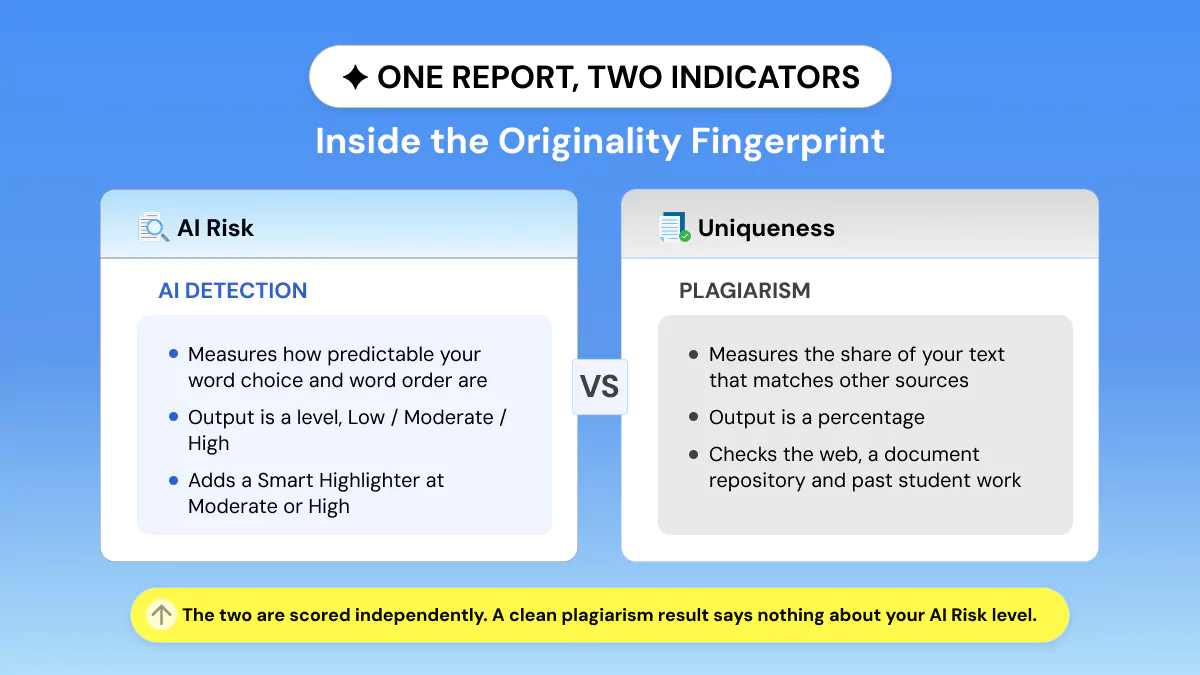
Packback's AI detection lives inside a report called the Originality Fingerprint, which Discussion and Writing assignments generate. The report holds two indicators, and they measure different things.
The AI Risk indicator estimates how likely it is that generative AI wrote your text. The Uniqueness indicator shows the percentage of your content that doesn't match other sources, which is the plagiarism side of the report.
Packback calculates them independently. Your post can score high on Uniqueness and still come back Moderate or High on AI Risk, because AI-generated text isn't published anywhere for a source scan to match against. A clean plagiarism result tells you nothing about your AI Risk level.
How does Packback detect AI writing?
Packback's algorithm examines your word choice and the sequence you put words in, then measures how predictable that pattern is. Human writers reach for more surprising words. AI follows a statistical pattern when it generates text, and that predictability is the signal Packback picks up.
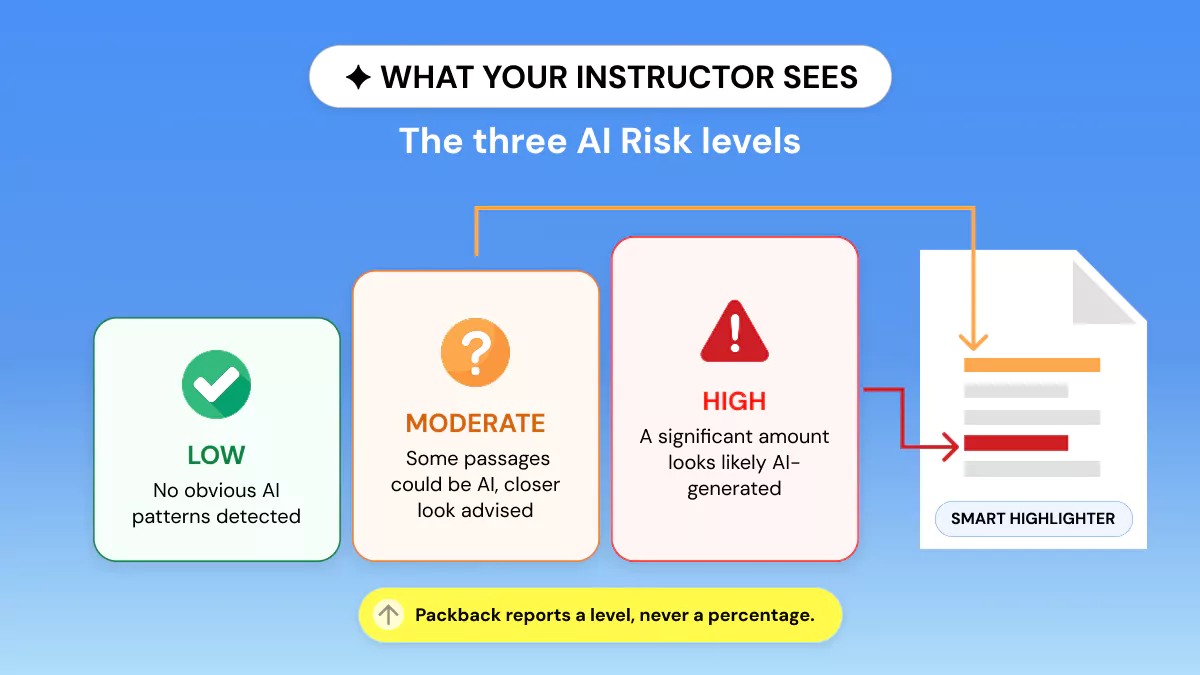
The output is a level, never a percentage. Packback reports Low, Moderate, or High AI Risk. Its student-facing pages label the middle level Medium, and the two mean the same thing.
When a submission comes back Moderate or High, a Smart Highlighter panel opens inside the report and marks the passages most likely to contain AI text. Educators click through them one section at a time.
Packback describes the engine behind this as more than 50 AI models and rules matured over a six-year period. It moved to a new AI writing detection model in January 2025, and reports generated under the previous model can be regenerated to show the newer result.
💡 Packback gives you a risk level, not a score. There is no "Packback says my essay is 40% AI", because the tool never produces that number.
For the mechanics shared by every tool in this category, our guide to how AI detectors work covers the same ideas in more depth.
Does Packback detect ChatGPT, Claude, and Gemini?
Yes. Packback states that its detection covers AI generated content from any commercially available AI model, and it names ChatGPT, Claude, and Gemini on its Originality product page. Raw copy-paste from a chatbot is the easiest case for it to catch, because nothing has disturbed the model's own pattern.
Can Packback detect Grammarly or QuillBot edits?
QuillBot, yes. Grammarly, usually no.
Heavy paraphrasing rewrites whole sentences, which smooths your word choice and evens out your rhythm. That is the exact pattern the AI Risk indicator scores, so a QuillBot pass can register even on work you wrote yourself. Pushing AI text through a paraphraser to disguise it carries the same risk.
Grammar and spelling corrections change commas, tense, and word forms. Edits that small leave your sentence shapes where they were, and Packback says feedback from its own grammar and clarity assistant should not affect your AI Risk indicator.
Paraphrasing can cost you twice. Rewording a source while keeping its structure can also show up as a match in Packback's Match Comparison view, which pulls down your Uniqueness score at the same time.
Where does Packback check for AI? (Discussions vs Deep Dives)
AI Risk runs on discussion posts and written assignments alike, so your two-line forum reply gets checked the same way your essay does. The two categories cover everything you submit inside the platform.
Discussion posts
Questions
Responses
Counterpoints
Supporting Points
Writing assignments
Deep Dives
Originality Reviews
Where your instructor finds the report
Deep Dives: a snapshot sits on the Submissions tab, and the full report opens through the Instructor Evaluation panel.
Discussion posts: your instructor opens the Options tab beneath your post and clicks Check Originality.
A two-sentence discussion reply gives a detector very little to work with. In University of Chicago Booth research published in December 2025, three commercial detectors handled medium and long writing well and lost accuracy on passages under 50 words.
Your instructor controls whether you ever see an AI Risk report at all. Two settings sit on their side of the assignment:
They can switch the AI Risk report off per assignment, so its presence varies from class to class.
They can also let you generate your own Fingerprint while you draft, which is how most students meet the feature at all.
Does Packback also detect plagiarism?
Yes, through the Uniqueness indicator, which reports the percentage of your content that doesn't match anything Packback can find. It compares your text against:
Live web sources and open-access journals
A saved repository of web documents
Work previously submitted to Packback by other students
Packback puts that repository at more than 100 million web documents and over 50 million student submissions. Its Match Comparison view shows additions, deletions, and replacements side by side, so edited copying still surfaces as a match.
Packback's scan does not currently exclude quoted content or in-text citations, so a heavily quoted paper reads as less unique than it really is. It also does not yet reach paywalled journal articles, which means a source your professor can see may be invisible to the scan.
Indicator | What it measures |
|---|---|
AI Risk | Likelihood the text was AI-generated. Low, Moderate or High, plus Smart Highlighter. |
Uniqueness | Share of content not matched to other sources. Lower means more overlap. |
How accurate is Packback's AI detection?
Packback claims a false positive rate of 0.005%, which is about 1 wrong flag in every 20,000 submissions. That figure comes from Packback, and no independent test has checked it.
Human writing that is very concise, formulaic, or repetitive can come back Moderate or even High, according to Packback's own AI Risk help documentation. Highly structured academic prose fits that description, which is why careful writers sometimes get the worst result.
What Packback claims
Packback tuned its model to that rate deliberately, and its product page states a rate below 0.01%. Both figures come from Packback's FAQ, set against the roughly 1% it says rival tools accept in exchange for their "99% accurate" marketing.
What independent research shows
False flags are becoming rarer across the category. A peer-reviewed 2026 study in the International Journal for Educational Integrity ran 160 papers through four detection tools. All four classified the fully human-written papers correctly, and three of the four produced zero false positives.
Phrasly's study of 37,874 human-written essays returned a 26.4% false positive rate for ZeroGPT. Results swing that far between tools, so the number you see depends a great deal on which detector your class happens to run.
What happens if Packback flags your work
On a written assignment, a flag opens a conversation. Packback tells educators to read the work, talk to the student, and use their own judgment, and it states plainly that a High level does not mean a student deliberately used AI.
Packback says it warns and coaches students before they submit, and students report posts being pulled down after an AI flag on a discussion post. Packback's moderation documentation confirms the mechanism: a moderated post is hidden and earns no credit until the student edits and republishes it, the notice arrives by email and in the app, and a person reviews every flag first.
If your work gets flagged, collect evidence. Our explainer on AI detector false positives covers who gets caught most often, and the guide for students wrongly flagged as AI walks through what to gather and who to approach first.
Packback vs Turnitin, GPTZero, and Originality.ai
Packback is a teaching platform where detection is one feature among many, while the other three are built as detectors first. That difference shapes what each one gives you.
Tool | Primary purpose | AI output | Where used |
|---|---|---|---|
Packback | Discussion and writing platform | Risk level: Low, Moderate, High | Inside Packback courses |
Turnitin | Plagiarism and AI detection | AI percentage score | LMS, school-wide |
GPTZero | Dedicated AI detector | AI probability percentage | Standalone or API |
AI and plagiarism for creators | AI percentage with confidence | Standalone |
Packback only runs inside Packback courses, so you cannot paste an essay into it for a second opinion. That gap is why students check somewhere else before submitting.
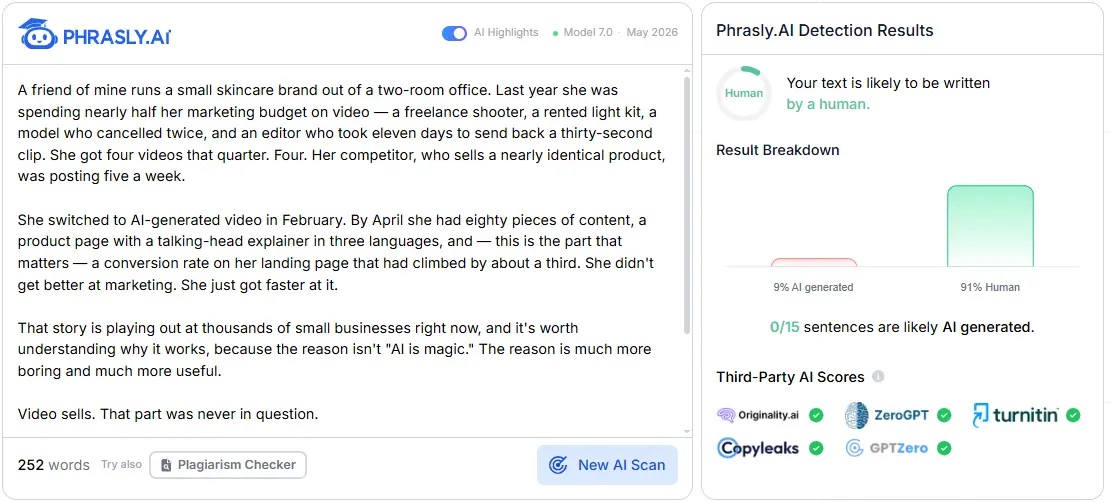
Phrasly's free AI detector returns a probability score with sentence-level highlights on any text you paste, and our comparison of the best AI checker tools covers the wider field, including where each tool falls short.
What students say about Packback AI detection on Reddit
Students report two very different experiences, and which one you get depends on the assignment.
On discussion posts, several describe the platform pulling a post down and asking them to edit and resubmit it.
On written work, they describe a professor raising it with them first.
The discussion-post route is the one that upsets people. In a 2025 r/CollegeRant thread with over a thousand upvotes, a student described one response being removed as AI and their assignment grade dropping from 100% to 66% until they edited and resubmitted it.
A student in r/PennStateUniversity reported the same pattern on work they had written by hand. Packback's moderation documentation matches both accounts.
A student flagged in February 2026 said their professor emailed to say he would hold off grading until they could talk it through and explain their writing process. That is the conversation Packback tells educators to have, and it is the calmer of the two routes by a distance.
Students who typed straight into Packback had no draft history to point to when they wanted to defend themselves. That gap shows up in every thread, and the ones who wrote in Google Docs or Word first had version history ready.
The r/GPT3 thread that still ranks for this question is from 2022, so read it with the date in mind. The student verdicts in it were formed on a detection model Packback replaced in January 2025.
How to keep your own writing from being flagged
Light rewording of AI text can still be flagged, because paraphrasing keeps the statistical pattern underneath. Swapping individual words leaves the sentence shapes intact, and those shapes are what the algorithm reads.
Naming the course readings you actually used does more for you than any rewording trick. Four habits keep genuine work reading as genuine:
Get specific. Cite the readings from your own syllabus and bring in examples from your own experience.
Vary your sentence length. Let sentence lengths move the way they do when you talk. Evenly paced, transition-heavy prose is what pushes real work toward Moderate.
Keep your process visible. Packback's Engagement Insights builds a Writing Process Report covering planning, drafting, and revision, and version history in Google Docs or Word does the same job for assignments outside Packback.
Check before you submit. If your class allows the student-side Fingerprint, run it while you draft. If it doesn't, run your text through a free detector so the result is never a surprise.
If you used AI to help and the draft still reads like a machine, rewrite it in your own voice. Phrasly's AI Humanizer is built for that pass, and our roundup of the best AI humanizer tools compares the alternatives.
Packback detects AI through its AI Risk indicator and plagiarism through Uniqueness, and both sit inside the same Originality Fingerprint report. It is dependable on raw chatbot text and less certain on short posts and heavily edited drafts, and Packback itself admits genuine student writing can come back Moderate.
Check your text with the free AI Detector before you submit, and if you used AI along the way, humanize it into your own voice first with the AI Humanizer.
Frequently Asked Questions
Can Packback detect AI?
Yes. Packback's AI Risk indicator flags likely AI-generated text and rates it Low, Moderate, or High. It runs on discussion posts and writing assignments alike.
Does Packback have AI detection?
Yes, built into its Originality Fingerprint report alongside a Uniqueness score for plagiarism. Educators review the full report after you submit.
Can Packback detect ChatGPT?
Yes. Packback says it detects text from any commercial AI model, including ChatGPT, Claude, and Gemini. Raw, unedited chatbot output is caught most reliably. The same question comes up about other platforms, including does Turnitin detect ChatGPT.
Does Packback tell students their AI Risk before they submit?
Often, yes. You can run an Originality Report on a discussion post while drafting, and generate one on a Deep Dive after 100 words. Educators control the setting and can disable the report.
Can Packback be wrong?
Yes. Packback admits concise, formulaic, or repetitive human writing can be flagged, and no detector is perfect. Treat a flag as the start of a conversation with your instructor, and read our explainer on whether AI detectors can be wrong before you reply to one.
Does Packback detect plagiarism too?
Yes, through its Uniqueness indicator, which checks your text against web sources and Packback's own database. It does not currently exclude quotes or citations from the scan.

Written by
Alina Shah
SEO Content Specialist · Karachi, Pakistan
She writes about AI so you don't have to guess. 8+ years in content strategy and editing. Now she puts AI writing tools and detection systems through real tests and shares what actually works.