
How to Prompt Claude Fable 5 (With Copy-Paste Prompts)
Claude Fable 5 doesn't respond like older Claude models. Get 7 prompting rules from Anthropic's own docs, copy-paste templates for writing, research, and work, plus current pricing and plan access after the July 20 change.
Claude Fable 5 doesn't respond like the Claude you're used to. Prompts that worked well on Opus 4.8 can fall flat here. It's a different model, and it needs different prompts from you.
Learning this skill now can put you ahead of a very large crowd. Generative AI reached 53% of the global population in just three years, according to Stanford's 2026 AI Index report, which is faster than the PC spread and the internet. With access that universal, the edge comes from knowing how to prompt well.
This Claude Fable 5 prompting guide walks you through what actually changed, 7 rules pulled straight from Anthropic's own documentation. You'll also get copy-paste prompts for writing, research, and everyday work, so you can put the rules to use in your next chat.
What Is Claude Fable 5? Quick Facts Before You Prompt
Claude Fable 5 is Anthropic's most capable AI model, the first in its new Mythos-class tier that sits above the Opus models, released on June 9, 2026. It's built for long, complex, end-to-end tasks: the kind of work that takes a person hours or days, handled in one run.
Before you write a single prompt, get the practical facts straight.
• Released June 9, 2026, alongside Claude Mythos 5, the same model offered to approved organizations with fewer safeguards
• Runs in the Claude web, mobile, and desktop apps, Claude Code, and the API. There is no download
• API price: $10 per million input tokens and $50 per million output tokens, double Opus 4.8's rate (official model and pricing details)
• Included on Max plans and premium Team and Enterprise seats for up to 50% of weekly usage limits, as of July 20, 2026
• On Pro plans and standard Team and Enterprise seats, it runs on pay-as-you-go usage credits
• Not available on the free plan
Is Claude Fable 5 Free Right Now?
No. As of July 21, 2026, Fable 5 requires a paid Claude plan. Anthropic's promotional window that included it on all paid plans ended July 19, 2026. Since July 20, it's a standard part of Max plans and premium Team and Enterprise seats. Pro and standard seats pay through usage credits, with a one-time credit offered to ease the change.
Why Your Old Claude Prompts Underperform on Fable 5
Claude Fable 5 follows instructions more literally and plans better on its own, so over-prescriptive, step-by-step prompts written for older models can actively degrade its output.
Anthropic's documentation is direct about this: instructions that helped prior models can now get in the way, and old prompts should be simplified or rewritten rather than reused.
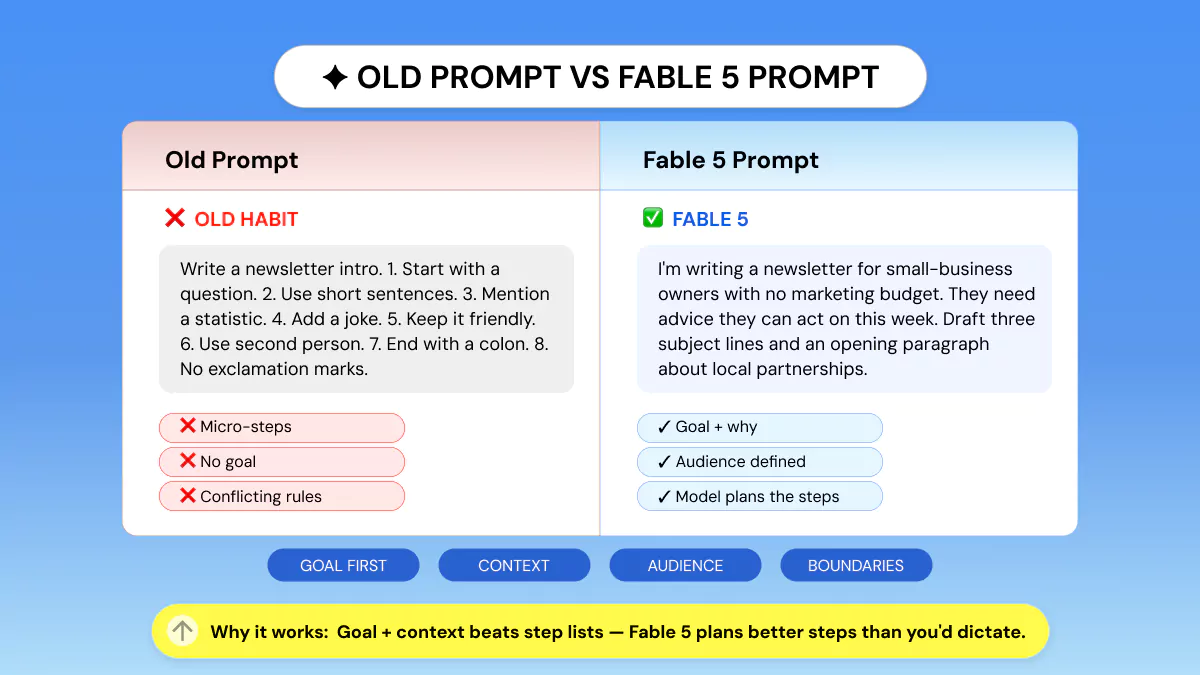
Three behavior changes explain most of the surprise:
First, Fable 5 works in longer turns by default; on hard tasks it can run for minutes rather than seconds, so a quiet pause is it working, not stalling.
Second, it uses adaptive thinking, deciding for itself how much reasoning a task needs instead of applying the same depth everywhere.
Third, its instruction following is stronger. One short, clear instruction now does the work that used to take a list of ten, and a list of ten can pull the model in conflicting directions.
If your Opus 4.8 prompts perform worse on Fable 5, this is why: you're steering harder than the model needs, and it's obeying the extra steering at the cost of its own judgment.
How to Prompt Claude Fable 5: 7 Rules That Actually Work
Give Fable 5 the goal and the why instead of a step list, set boundaries by saying what not to do, ask for the outcome first, pick the right effort level and let it finish, make it show evidence for its claims, give it a memory for repeat work, and never ask it to reveal its hidden reasoning.
The seven rules below expand each one, with a copy-paste snippet you can use today. These rules are grounded in Anthropic's official Fable 5 prompting guide, translated for chat use rather than API system prompts. If you want the general craft that applies to every model, our prompt optimization techniques guide covers it.
Rule 1: Give the goal and the why, not a step list
Context beats choreography on this model. Tell Fable 5 what you're trying to achieve and who it's for, and it will usually plan better steps than the ones you'd have dictated.
no marketing budget. They need advice they can act on this week.
With that in mind: draft three subject lines and an opening
paragraph for an issue about local partnerships.
Rule 2: Set the boundaries: say what NOT to do
Fable 5 is proactive and may go further than you asked, like fixing problems it was only meant to find. A one-line boundary keeps its initiative pointed where you want it.
structural, and tone. Don't rewrite anything until I ask.
Rule 3: Ask for the outcome first
One brevity instruction replaces ten formatting rules. Because instruction following is stronger, a single line about how to open the answer shapes the entire response.
caveats, and options after that.
Rule 4: Pick the right effort and let it finish
Effort levels are Fable 5's main quality control. In the API and Claude Code they're named low, medium, high, and xhigh; in the chat apps, you set the same dial with plain language. High-stakes work deserves a "take your time" instruction, routine work deserves a "keep this quick" one, and either way, don't interrupt a long run.
and check your answer before you respond.
Rule 5: Make it show evidence
On long tasks, ask Fable 5 to audit its own progress claims against what it actually produced. Anthropic reports that this pattern nearly eliminated unsupported status reports in its testing.
actually completed in this conversation. Only report what you
can point to; if something isn't verified yet, say so plainly.
Rule 6: Give it a memory for repeat work
Fable 5 works best across sessions when you give it a memory file: a simple running document of lessons and decisions. Paste it at the start of each session and ask for an updated version at the end.
Use them as context. At the end of this session, give me an
updated version with any new lessons added.
Rule 7: Don't ask it to reveal its hidden reasoning
Fable 5 keeps its internal reasoning private, and prompts demanding it can trigger a refusal, because reasoning extraction is one of the things its safeguards watch for. You lose nothing by asking differently.
strongest argument against it.
Claude Fable 5 Prompt Examples You Can Copy (Writing, Research, Work)
What prompt should you give to Claude? One that states the goal, the context, the audience, the format, and the boundaries, in that spirit if not in that order. The four templates below do exactly that; replace the bracketed parts and paste.
Blog or article draft with sources:
Research the topic first and only use claims you can tie to a
real, checkable source; list every source at the end. Draft the
full piece in a direct, plain style. Flag anything you couldn't
verify instead of including it.
Research digest from links or PDFs:
of what it all says together, then the five most important
findings with where each one came from. Note where the sources
disagree. Don't add outside information.
Report or spreadsheet from raw notes:
spreadsheet] for [audience]. Organize by [theme / date / owner],
keep every number exactly as I wrote it, and list anything
unclear as an open question at the end instead of guessing.
Study plan from a syllabus:
to the exam on [date]. I can study [hours] per week. Weight the
plan toward the highest-mark topics, and end each week with one
self-test I can do without notes.
The Role–Task–Audience–Format Pattern Still Works
Every template above is the role–task–audience–format pattern wearing plain clothes, and it remains the most reliable skeleton for a Claude prompt. If you want to go deeper on the pattern itself, our guide to prompt techniques for Claude breaks it down with examples.
How to Use Fable 5 in Claude Code (Developer Corner)
To use Fable 5 in Claude Code, select it from the model picker, keep effort at high by default, and give it end-to-end tasks instead of micro-steps. The model is built for long-horizon work, so a whole feature with a clear goal beats a sequence of small instructions.
Four migration points matter most:
- Refactor CLAUDE.md files and Claude Code skills written for prior models; Anthropic's guidance is that overly prescriptive instructions from older setups can degrade Fable 5's output.
- Let it use subagents for parallel work; independent verifier subagents checking the main line of work tend to outperform self-critique.
- Add a memory file to the project so lessons persist between sessions.
- Schedule verification runs at intervals on long autonomous tasks rather than trusting end-of-run summaries.
Skills still work in prompts; reference the skill and state the goal, and let the model decide how to apply it. For full configuration depth, Anthropic's official documentation is the source; this section is the summary, they hold the specifics.
What About the Claude Fable 5 System Prompt Leak?
Within about 24 hours of launch, a text file of roughly 1,585 lines claiming to be Fable 5's system prompt appeared on GitHub, and Anthropic has not confirmed it, so nobody outside the company can verify it's complete or unmodified. Treat it as unverified news.
Here's the point that matters for you: even if it were real, a leaked system prompt is not a prompting strategy. It would tell you how the model is configured, not how to get better output from your own chats. The official prompting patterns in this guide are what actually change your results.
Why Did Claude Fable 5 Refuse My Prompt?
Fable 5 ships with extra safety classifiers covering offensive cybersecurity, certain biology and life-sciences methods, and attempts to extract its hidden reasoning. Benign requests near those areas can occasionally trip them, and in the API this surfaces as a stop_reason of refusal rather than an error.
What to do: rephrase toward your actual goal in plain terms, or run that task on Opus 4.8, which is Anthropic's own recommended fallback for classifier-sensitive domains.
One trending confusion is worth clearing up. Fable 5 "leaving subscriptions" in July was an access and billing change, not a ban, and account suspensions are a separate terms-of-service matter unrelated to the model's safeguards.
The Fastest Way to Get a Good Claude Fable 5 Prompt (6 Techniques)
The 7 rules are learnable AI chatbots have become an everyday tool: 49% of US adults now use them, and most people about a quarter use them daily, according to Pew Research Center's 2026 survey.
Most of that daily use still won't runs on one-line prompts. The 7 rules close that gap by hand-craft a goal-context-audience-format prompt every time they open a chat. These; these six shortcuts get you a strong prompt close it in seconds, ordered easiest first.
1. Use a free AI prompt generator
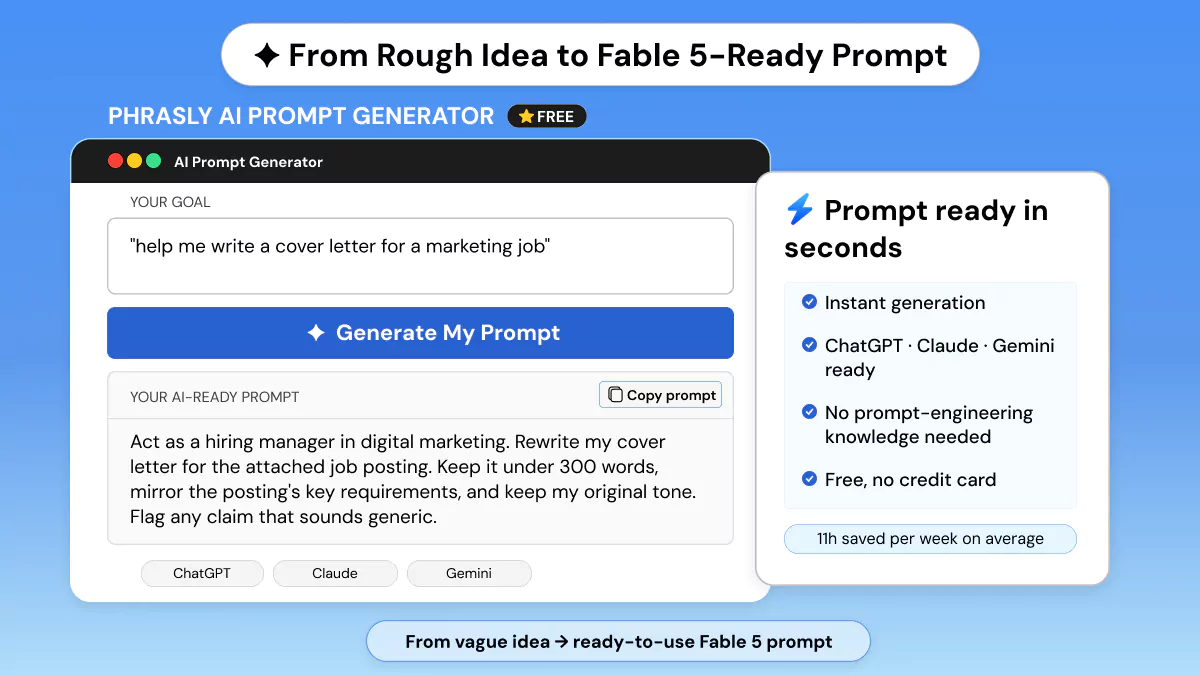
Type a rough idea into Phrasly's free AI prompt generator, mention in your description that the prompt is for Claude Fable 5, and get a structured prompt to paste into your chat. It's free with no credit card required; you can try it once without an account, and a free account unlocks unlimited generation. It writes the prompt, and you run it in Claude yourself.
Three steps: describe your goal in plain language and note it's for Claude, choose the tone and any constraints, copy the generated prompt into your Fable 5 chat.
Before:
After the generator:
The second prompt gets a usable answer on the first try.
For how this compares across tools, see our roundup of the best AI prompt generators.
2. Try Anthropic's prompt improver in the Claude Console
If you're a developer, Anthropic's Console includes a prompt improver that rewrites API system prompts against its own best practices. It's built for people shipping prompts inside applications, and it's good at that job. The practical split: the Console serves developers building on the API, while a generator like Phrasly's serves everyday chat prompts you paste straight into the apps.
3. Ask Claude to write its own prompt (meta-prompting)
Paste your goal into Fable 5 and ask it to write a reusable prompt for that task, then save the result. This works on any plan and any model, and it teaches you the patterns as a side effect.
4. Start from a proven template
Adapt the four templates in this guide rather than starting blank; a working Claude prompt template only needs your specifics swapped in. Our library of examples of AI prompts has 50+ more across writing, work, and study.
5. Show 1–2 examples of what good looks like
Paste one example of the output you want and say "match this format and quality." That's few-shot prompting in plain English, and it outperforms long descriptions of the format; our few-shot prompt examples guide shows the pattern in action.
6. Keep a personal prompt library
Save every prompt that produced a great result in one document, tagged by task. This ties back to Rule 6: the same memory habit that helps Fable 5 across sessions helps you across projects.
Paste your next rough idea into Phrasly's free AI prompt generator and compare the output against what you'd have typed by hand.
FAQs
Is Claude Fable 5 free to use?
No. As of July 21, 2026, Fable 5 requires a paid plan. It's included on Max plans and premium Team and Enterprise seats for up to 50% of weekly usage limits; Pro plans and standard seats access it through pay-as-you-go usage credits. It isn't available on the free plan.
What prompt should I give Claude Fable 5?
State your goal, the context behind it, who the output is for, the format you want, and any boundaries. That one structure covers most tasks. Skip step-by-step instructions; Fable 5 plans well on its own. The templates in this guide and our AI prompt examples library give you ready starting points.
Can I download Claude Fable 5?
No, there's no download. Fable 5 runs in Claude's web app, the mobile and desktop apps, Claude Code, and through the API. Anything offering a Fable 5 download or installer isn't from Anthropic and should be treated as unsafe.
Is the leaked Claude Fable 5 system prompt real?
Unverified. A file claiming to be the system prompt appeared on GitHub shortly after launch, and Anthropic hasn't confirmed it. Even if genuine, it wouldn't change how you should prompt; Anthropic's official prompting guidance is what improves your results, and it's public.
Do my old Claude prompts still work on Fable 5?
Mostly, but simplify them. Fable 5 follows instructions more literally, so over-specified prompts written for older models can degrade output. Keep the goal, context, and boundaries; cut long step lists and stacked formatting rules. One clear instruction now does the work of ten.
Is there a free prompt generator for Claude?
Yes. Phrasly's prompt generator for Claude is free with no credit card required: describe your task, note that it's for Claude, and paste the structured prompt it writes into any Claude model, including Fable 5.


Keep reading

Claude Prompt Generator: Build Better Prompts for Claude AI (Free Tool)
Learn how a Claude prompt generator builds better prompts for every Claude model, from Sonnet 4.6 to Fable 5. Includes ready-to-use XML templates, effort levels, and a free tool.


50 Highest-Engagement AI Prompts for LinkedIn, Instagram, and X for marketers
Learn the prompt frameworks behind top-performing social posts, avoid common AI prompting mistakes, and use proven templates to scale your content creation across every platform.