
How to Humanize AI Ad Copy So It Actually Converts?
AI ad copy is everywhere and that's the problem. Learn how to humanize AI-generated ads with real insight, channel-specific rewrites, and a workflow that keeps AI's speed without the sameness that's killing your conversions.
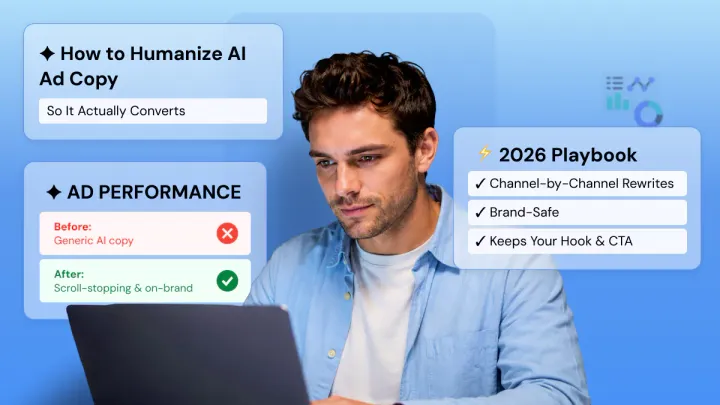
To humanize AI ad copy so it converts, write from a specific human insight rather than a generic benefit. Match the voice and format of each channel, and cut the safe, hedged phrasing AI defaults to.
With 86% of advertisers now using or planning generative AI for creative (IAB, 2025), volume is commoditized. Resonance is the only edge left.
This is also supported by how advertising works in reality. Nielsen discovered that creative quality attributed to approximately 49% of brand lift over targeting/media.
With AI, everyone can produce copy that's fast and skilled but lacks substance. Ultimately, agencies that stand out are those that add layers of human connection and distinctiveness.
This guide is written for performance marketing teams and media buyers. They need AI ad copy that converts, not just copy that sounds fine in a review doc.
It covers why AI ad copy underperforms and how to make AI ad copy sound human around a real insight.
Channel-specific rewriting (search headlines vs. Meta primary text vs. CTV scripts), and a workflow keeps AI's speed without its sameness, plus the brand safety reason off-voice AI gets spend cut.
Why AI-Generated Ad Copy Underperforms?
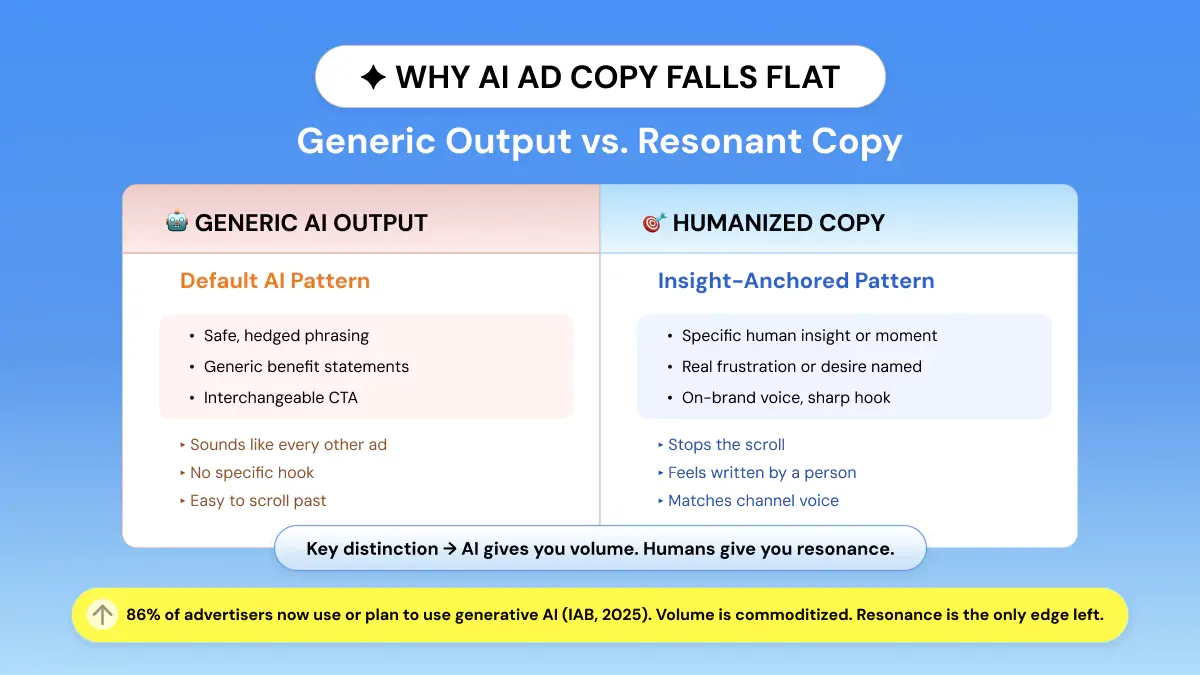
AI copy sounds bad because it falls back on vague benefits and noncommittal language that every other advertiser uses.
And everywhere isn’t getting you clicks.
Some red flags that your ad copy was written by AI:
- Generic benefit statements ("save time," "boost productivity") that could belong to any brand in any category
- Hedged claims that soften every promise instead of committing to one
- No specific hook. The ad opens with a category statement instead of a moment when a reader recognizes
- Interchangeable CTAs like "Learn More" or "Get Started" that carry no urgency or context
Volume without differentiation just creates more noise. Channels are already saturated with noise. With close to 90% of advertisers relying on tools from this same category.
The only variable AI ad copy that converts is audience resonance. And that's the concept we're exploring with the rest of this guide. Teaching you how to humanize AI-generated ads isn't just another “nice-to-have” polish step.
It's the only way to stand out when everyone is pulling their originals from the same model.
Start from a Human Insight, Not a Generic Benefit
Humanized ad copy starts with a specific customer insight. A real frustration, desire, or moment, not a feature list.
So the insight is the highest-leverage thing to get right before a single headline gets written.
Turning a Feature into a Hook
The majority of AI drafts starts at the feature and doesn’t go any deeper. Adding humanization to your copy means going one layer deeper, right at the moment the feature actually solves:
|
Feature (AI
draft) |
Generic Benefit |
Human Insight
(Hook) |
|
Automatic invoice reminders |
Save time on billing |
"Stop being the one who
has to ask for money." |
|
Meal-prep delivery |
Eat healthier, easier |
"You didn't plan
dinner. Good, we already did." |
|
Noise-cancelling earbuds |
Block out distractions |
"The office is loud.
Your focus doesn't have to be." |
None of these rewrites required new product information. Only a sharper sense of who's reading and what they already feel. That's the real mechanism behind humanizing a draft.
Swap the category statement for the moment, and the rest of the line tends to follow on its own.
If you're starting from a blank feature list rather than finished ad copy, a product description generator can get you from raw specs to a structured first draft faster. It gives you more of that hook-writing layer to work on instead of starting from nothing.
Copy that reads as one-of-kind, versus templated, is due to a specific human insight.
Use AI for Volume, Not for the Insight
AI only becomes helpful at coming up with variations. Variations of hooks, lengths, and angles all stemming off the same idea. The error comes when you try to get AI to come up with the idea itself.
Which is how your copy is becoming cliché all over again. Anchor every AI ad copy tips workflow in one human insight, then multiply that.
Humanize by Channel (Search Vs. Social Vs. CTV)
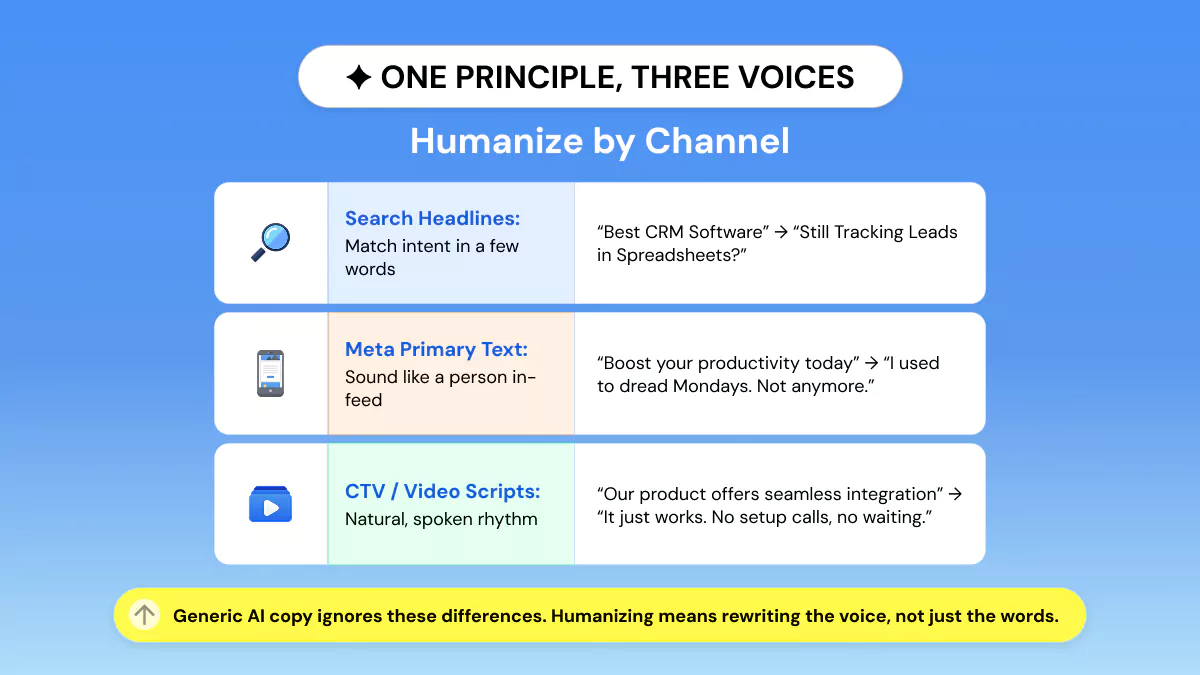
Each channel needs a different human voice. Search headlines must match intent in a few words. Meta ads’ primary text should sound like a person in-feed. CTV/video scripts need spoken, natural rhythm.
Generic AI copy doesn't care about these nuances and runs the same flat messaging everywhere it appears, no matter the context of where the ad is placed or what a reader is doing when they see it.
A search headline competes against intent. Someone already typed a question, so the copy needs to answer it in a handful of words.
A Meta primary text competes against a friend's vacation photos and a meme. So it has to sound like a person talking, not a brand announcing. A CTV or short-form video script is read aloud. So it has to sound natural when spoken, not just when skimmed.
Search headline: before/after:
Meta primary text: before/after:
Short video / CTV script: before/after:
Keep in mind that these are cross-industry averages. You shouldn't aim for these. Your actual metrics will vary greatly depending on your category.
A Workflow That Keeps Speed Without the Sameness
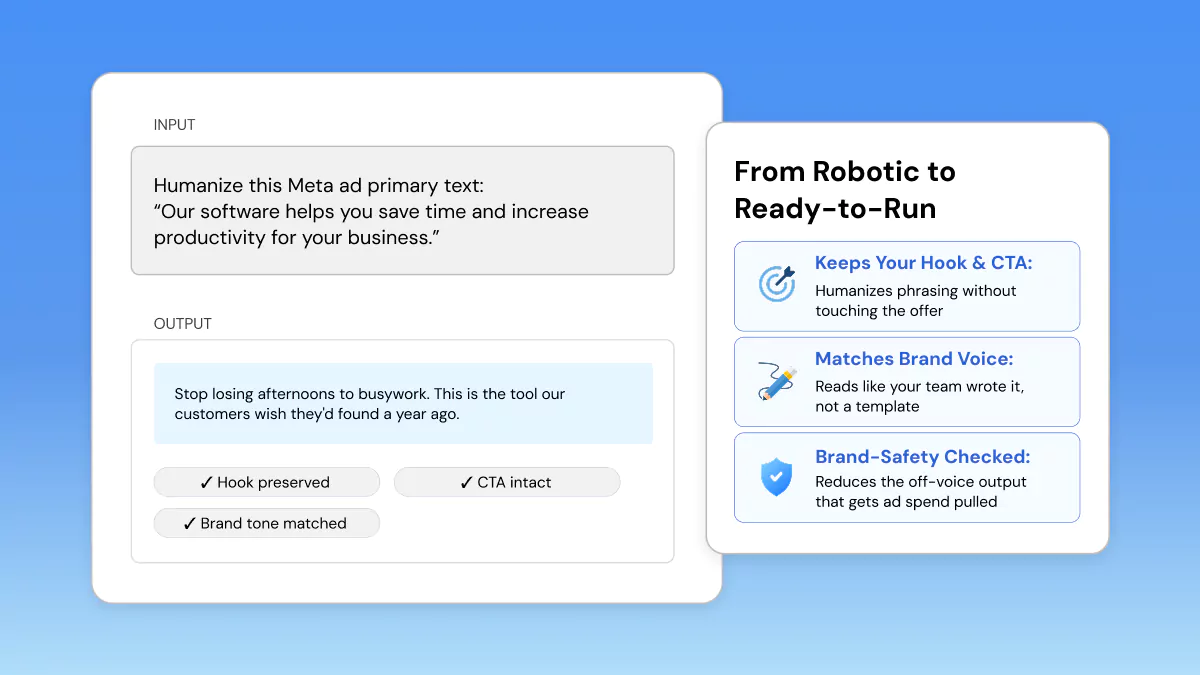
Have AI churn out multiple versions. Anchor those ideas with your human intuition. Human rewrite until it sounds natural and brand-consistent. Then, see how it holds up against your brand's voice before hitting publish.
While AI can certainly craft copy that converts, it's only effective after we've handled these initial stages.
The Four-Step Loop
- Insight first. Identify the exact human experience the ad is addressing before you open any AI.
- AI variations. Generate variations of drafts and angles off that one insight. This is where AI's speed earns its place.
- Humanize phrasing. Clean up robotic cadence and hedged claims with a humanizer, but leave the hook and CTA intact.
- Brand-voice check. Test it against your brand guidelines and know your audience/channel before publishing.
But there's also a budget-side rationale for caring about step 3, beyond quality.
Buyers are most likely to pull their investment from a partner when they don't see business outcomes, and the IAB's 2025 study highlights that this often stems from easily identifiable AI creative, which quickly leads to missed targets.
This is the brand safety argument for humanizing. It's not just about sounding better; it's about safeguarding the budget a buyer allocated to that channel.
That’s where Phrasly’s AI Humanizer tool can come in at step 3. It’s specifically designed to humanize ad copy so it reads naturally and on-brand while preserving the hook and CTA you’ve already chosen, not recreate your entire strategy behind the words.
Phrasly is used by 3,000,000+ writers and marketers (4.7/5), has a free tier, and offers both monthly and annual Unlimited plans for teams running high volumes.
FAQs
How do I make AI ad copy convert better?
Start from a specific human insight instead of a generic benefit. Then use AI to generate variations of that insight. Humanize the phrasing so it sounds natural and on-brand. Check it against your brand voice before launch.
Why does my AI ad copy underperform?
It likely relies on generic benefit statements, hedged claims, and interchangeable CTAs. The same patterns are showing up in everyone else's AI-generated ads. With 86% of advertisers using generative AI (IAB, 2025), that sameness no longer stands out.
Does authentic ad copy really convert better?
Creative quality accounts for approximately 49% of brand advertising lift in sales (Nielsen, 2017). That's higher than targeting or media.
Additionally, 86% of customers indicate authenticity is important when selecting brands (Stackla, 2019). So yes, authentic copy does matter.
How do I adapt AI ad copy for different platforms?
Voice match for each channel: short copy that matches searcher intent for search headlines, human-curated conversational tone for Meta descriptive (primary) text, and spoken word patterns that sound natural for CTV or short video scripts.
The same flat tone used for all three is typically AI-generated.
Can AI write good ad copy?
Absolutely, provided it's tied to a human understanding you've already pinpointed. AI can churn out quick variants on a great idea really well, but it just can't be depended on to come up with that great idea by itself.
Will humanizing my ad copy change the hook or CTA?
No, you want to remove robotic language and hedged statements, while retaining your original hook and call-to-action. The strategy behind the copy should not change, only how natural the copy reads.
Phrasly's AI Humanizer is built to work this way. It smooths out the phrasing without touching the strategy behind the copy.


Keep reading

Best AI Humanizer for SEO Content Teams in 2026
Comparing AI humanizers for SEO content teams? Phrasly, Undetectable AI, and Humbot lead for bulk use, but keyword preservation is the real risk. Learn what to test before running your content calendar through any tool, plus true cost-per-word at scale and picks by team size.
Rewriting AI Drafts for Client Deliverables Without Losing Your Voice
AI can draft your client copy in minutes, but that's not what clients pay for. Learn how to treat AI drafts as scaffolding, not final copy, rewrite for both your voice and your client's brand guidelines, cut hedge words, vary rhythm, and proofread before delivery so nothing generic ships.