
How to Humanize AI-Generated Client Reports (Before They Read as Robotic)
AI reports default to describing the numbers. They default to describing 'traffic increased 12% month over month' without explaining why it happened or what to do about it. That's dumping data and calling it deliverable; spoken in a professional voice.
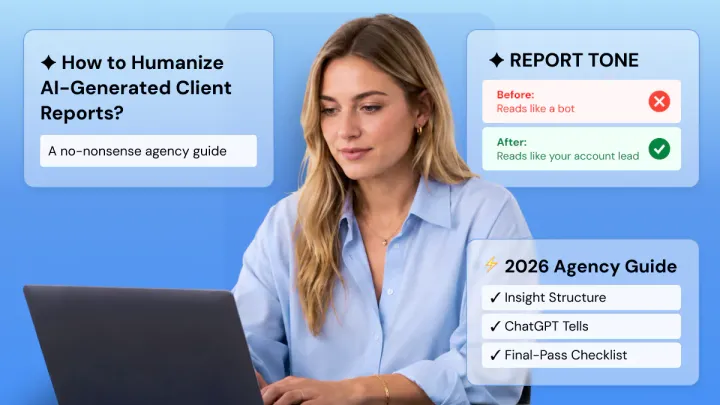
AI-generated client reports sound robotic because AI excels at repeating back what you tell it.
To humanize AI report writing, replace "summary" with your "judgment" about what changed, why, and what you recommend from the voice of the professional who actually handles the account.
The stakes are high. Reports are one of the few client deliverables they read word for word. A generic one signals nobody thought hard about their business.
We break down why AI reports sound so hollow, the insight structure that’ll solve them, the 2026 ChatGPT tells to skip, how tweaking tone can bring back your voice, and the final check to perform before you click send.
An entire list of agency report writing tips you can apply to this month’s wrap-up.
Why AI-Written Client Reports Feel Hollow
AI reports default to describing the numbers. They default to describing “traffic increased 12% month over month” without explaining why it happened or what to do about it.
That’s dumping data and calling it deliverable; spoken in a professional voice. It reads effort-free to the person who has to do something with it. This is the core problem AI report writing has to solve before anything else.
- Restated metrics with no interpretation attached.
- Hedged explanations that commit to nothing.
- No recommendation attached to the data.
- No visible account management judgment or ownership.
What’s lacking isn’t more data. It’s causal reasoning, prioritization, and a worldview. That’s the insight vs data gap, and it can’t be synthesized by an algorithm independently.
Can an AI write me a client report? Yes, a first draft. It can assemble the numbers and structure the sections. It can't know why performance moved or what you'd actually do next. This is the part the client is paying you for.
Clients scrutinize reports more than anything else you send them. Trust is gained or lost quietly here.
Restructure Around Insight, Not Data
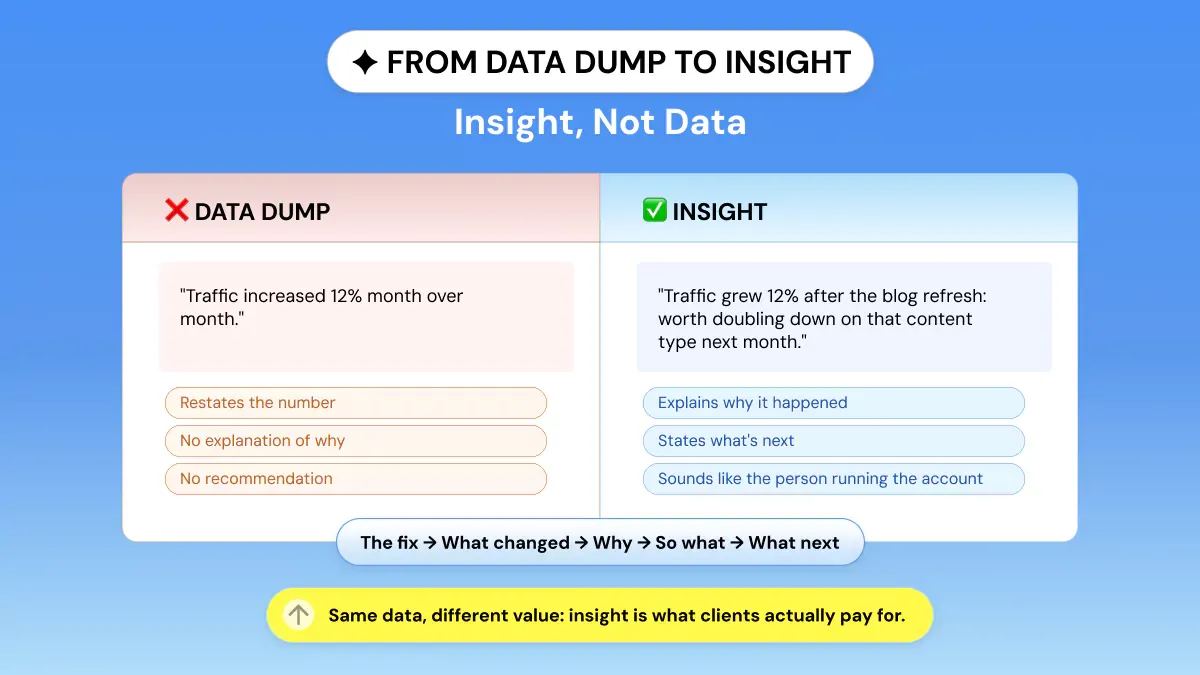
Lead with judgment before the number. Follow the logical order of answering these four questions per section: what changed, why it changed, what that means for the client's goal, what you're doing next.
Data should illustrate your point, not be the point itself. Data storytelling isn't data listing.
|
Step |
What It Answers |
Example |
|
What changed |
The single most important shift this period |
Organic sessions grew 12% month over month |
|
Why |
The cause behind the number |
Two blog posts targeting the priority cluster hit page
one |
|
So what |
What it means for the client's actual goal |
Content is compounding faster than paid right now |
|
What next |
The recommendation you're standing behind |
Shift 15% of paid budget into content for Q3 |
Before (AI, data dump):
After (insight-led, human):
Do this rewrite in the executive summary first. It's the most-read section of any monthly recap. And the highest-value place to prove the report was actually thought through, not just generated.
Prompt the First Draft Better
A better prompt still won't lead you to judgment, but it does come closer. Here are two developed for use in marketing reports:
- "Draft an executive summary for [Client]'s June report. Goal: increase qualified leads. Context: organic traffic up 12%, two blog posts ranking top 5. Last month we recommended shifting budget toward content — note whether that's paying off."
- "Summarize this month's paid performance for [Client] against last month's recommendation to cut underperforming ad groups. State plainly whether the cut worked."
Agencies typically combine a rough draft created with a general model and specialized AI reporting tools for dashboard work, then use a best AI tool for writing reports for the humanizing pass.
Consider it two distinct roles: one which gathers data, the other builds judgment and readability.
Cut the ChatGPT Tells Clients Notice
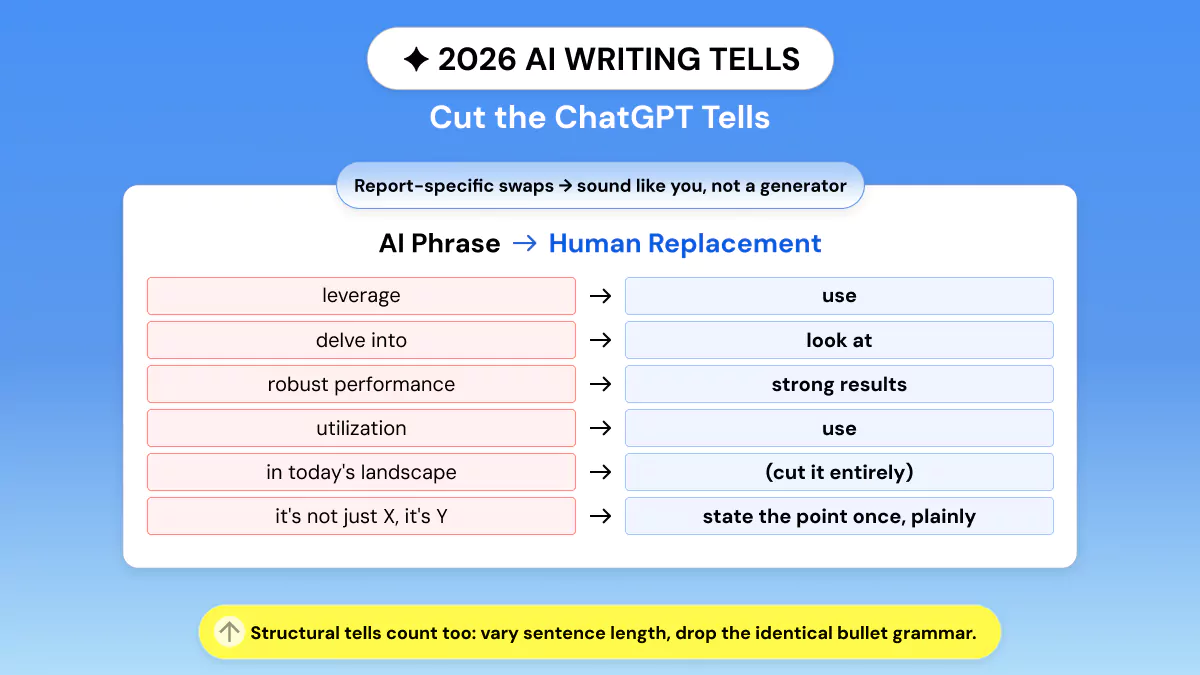
Overused ChatGPT words ("delve," "leverage," "robust," "in today's landscape"), "It's not X, it's Y" construction, rule-of-three sentences, em-dash overload, and bold-header listicles where every bullet is shaped the same.
The Word-Level Tells
A report-specific blacklist, swapped for language your client actually talks in:
|
❌ AI
Word / Phrase |
✅
Human Replacement |
|
Delve into |
Look at |
|
Leverage |
Use |
|
Robust |
Solid |
|
In today's landscape |
Drop it: say
nothing instead |
|
Utilization |
Use |
|
Demonstrates strong performance |
Worked |
|
Navigate |
Handle |
|
Seamless |
Smooth |
|
Unlock |
Find |
|
Foster |
Build |
The Structural Tells
- Uniform sentence length, paragraph after paragraph.
- Identical bullet grammar in every single list.
- A closing summary that just re-summarizes the summary.
- Heavy em-dash tell usage in nearly every sentence.
- The "it's not just X, it's Y" pattern repeated more than once.
- Bold-header listicle formatting stacked on top of already-formatted data.
How do I prevent my reports from sounding like ChatGPT? Use sentences of different lengths. Delete the cliches. Express only one opinion per paragraph. Then run a humanizer pass to find the patterns you no longer see.
This is the practical version of AI writing awareness: know the list, then check your own draft against it. Clients now have a word for this: AI slop and once they've spotted it in one report, they start looking for it in every report after.
The Tone Edits That Make It Sound Human
Acting as the account lead here, not a report generator. Write in first person where appropriate. Be direct about what underperformed. Don't hedge. Allow a clear recommendation to stand on its own without three qualifiers wrapped around it.
That question of how to make AI write like a human has a boring answer: give it less summarizing to do and more opinions to state.
- Write in first person where it fits: "we recommend," not "it is recommended".
- Be direct about what underperformed instead of softening it.
- Let a decisive recommendation stand without three hedges around it.
- Cut filler transitions that exist only to sound formal.
Client reporting tone is nothing more than your agency’s voice.
Think of your report as sounding like the voice of the person on the client call, rather than some report generator, and that will be the difference between client reporting that gets read and one that gets skimmed through.
There's also another benefit in the long run. Learning how to make reports sound less robotic one section at a time.
Transparency and the Final Pass
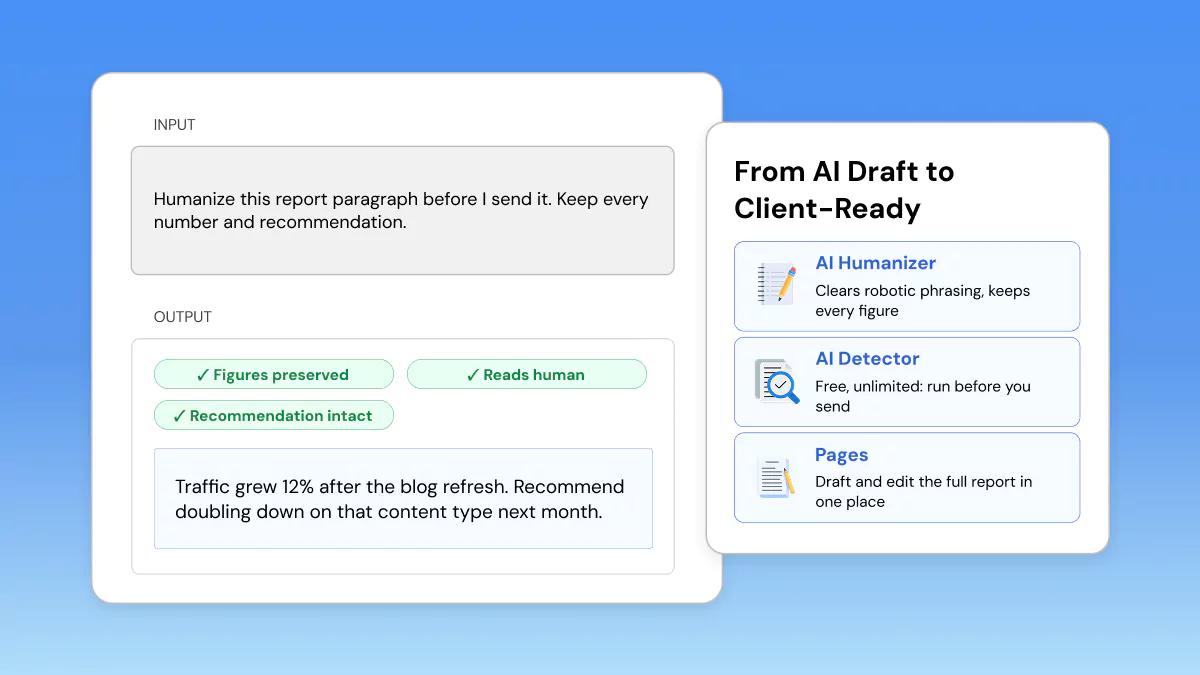
AI can write your report, but don't send it without editing. Triple-check every stat, run a voice pass, and own your workflow if questioned by a client.
- Fact-check every number against your source data.
- Do a read-aloud voice pass before sending.
- Be straightforward about your process if a client asks.
- Never let "AI-assisted" quietly become "unedited".
Treat AI-written report editing as its own step, separate from drafting. Verify, don't just glance. A humanizer preserves your figures. But confirming they're correct is still on you.
FAQs
Why do AI-written client reports sound robotic?
They tend to regurgitate metrics rather than interpreting them. Introduce causal analysis, prioritization, and a prescriptive recommendation, and you have a report that people will read.
Should my agency use AI to write client reports?
Yes, on the first draft. AI can write stuff quickly when it comes to putting information/data together along with structure. The judgment, recommendations, and account context still need to come from the person running the account.
Can clients tell when a report is AI-written?
Often, yes! 65% of marketers say consumers are getting better at identifying and ignoring AI content (HubSpot, 2026 State of Marketing Report). So it's safest to assume the same is true of your clients.
If you want to check before they do, picking the right detection tool matters more than people think.
What should a client report actually include?
What happened, why it happened, what it means for the client's goal, and exactly what to do next. Ordered by what the client cares about, not by which data source it came from.
What words make a report sound AI-generated?
Overused terms like "delve," "leverage," and "robust,". Plus, structural patterns like the "it's not just X, it's Y" construction and heavy em-dash use. Swap them for plainer, report-flavored language.
Should I tell clients AI drafted the report?
Keeping things transparent about your process builds trust instead of breaking it. Most clients don't care if AI was used; they care if the analysis/recommendations make sense.
Will a humanizer change my data or figures?
No! The Phrasly AI Humanizer is designed to rewrite phrasing and tone. It does not change any figures or recommendations in your draft that you want to keep.


Keep reading

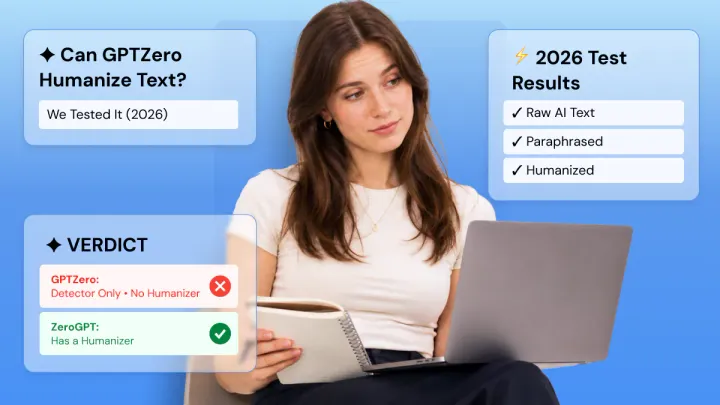
Can GPTZero Humanize Text (+ Can It Detect Humanized Text)
GPTZero doesn't have a humanizer and never has. We tested 5 AI samples raw, paraphrased, and humanized to see what actually beats its detector. Paraphrasing failed almost every time. Properly humanized text scored 98–100% human across the board. Here's exactly what worked.
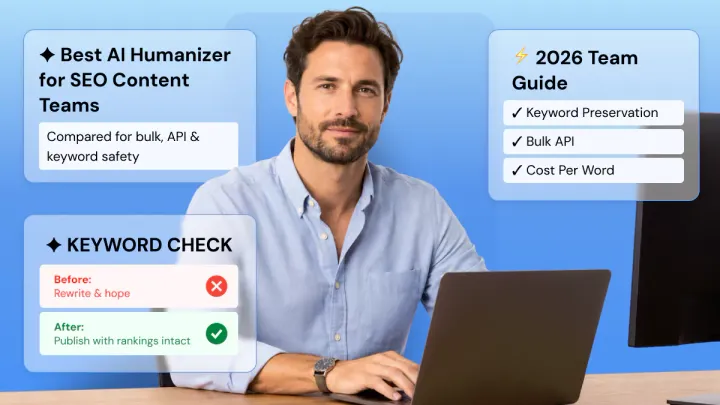
Best AI Humanizer for SEO Content Teams in 2026
Comparing AI humanizers for SEO content teams? Phrasly, Undetectable AI, and Humbot lead for bulk use, but keyword preservation is the real risk. Learn what to test before running your content calendar through any tool, plus true cost-per-word at scale and picks by team size.