
Can GPTZero Humanize Text (+ Can It Detect Humanized Text)
GPTZero doesn't have a humanizer and never has. We tested 5 AI samples raw, paraphrased, and humanized to see what actually beats its detector. Paraphrasing failed almost every time. Properly humanized text scored 98–100% human across the board. Here's exactly what worked.
No! GPTZero does not humanize text. It's a detector, not a rewriter. It has no feature anywhere in its product line that lowers your AI score. And in our July 2026 tests, GPTZero's detector caught lightly paraphrased AI text almost every time.
But it consistently scored properly humanized text as human.
Here we explain how GPTZero works, whether GPTZero can detect humanized text, and what occurred when we tested real AI-created samples raw, paraphrased, and humanized, with the scores included to back it up.
Does GPTZero Have a Humanizer?
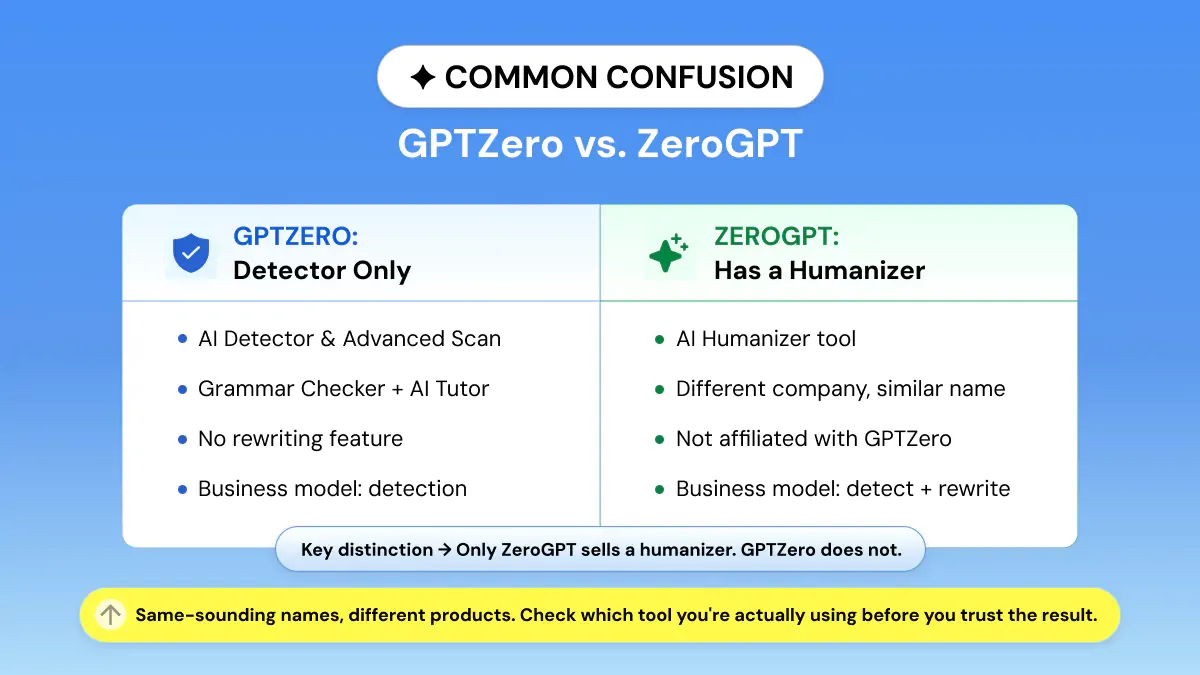
No! Contrary to what some search snippets suggest, GPTZero has never offered a GPTZero humanizer or other tool to rewrite AI text to beat detection. We verified by checking its entire product catalog against gptzero.me:
- AI Detector
- Advanced AI Scan
- AI Vocabulary
- Hallucination Detector
- Plagiarism Checker
- Grammar Checker
- Authorship Verification
- AI Reviewer
- Expert Feedback
- AI Vision
Its Chrome extension, Google Docs, Canvas, Google Classroom, Zapier, and API all integrate with the same detection and writing integrity tools. None of them rewrite AI text to improve a score.
It is also reportedly going to be joining Superhuman; the company says so on its own homepage. Naturally, a business that thrives on spotting AI-generated content wouldn't then offer a solution to evade detection.
GPTZero does include a Grammar Checker and an AI Tutor writing-feedback tool. Both will help improve the quality and clarity of your writing. Neither one tries to rewrite AI-generated text so as to reduce an AI-detection score.
That would be a meaningfully different tool than a humanizer.
Where the Confusion Comes from: GPTZero Vs. ZeroGPT
Most of the confusion results from a naming collision. ZeroGPT and GPTZero are two separate companies, and ZeroGPT actually does sell an AI humanizer tool.
Searchers attempting to find information on GPTZero have ended up on ZeroGPT’s humanizer page in the past, and some AI-generated answers online have conflated the two companies.
Can GPTZero Detect Humanized Text?
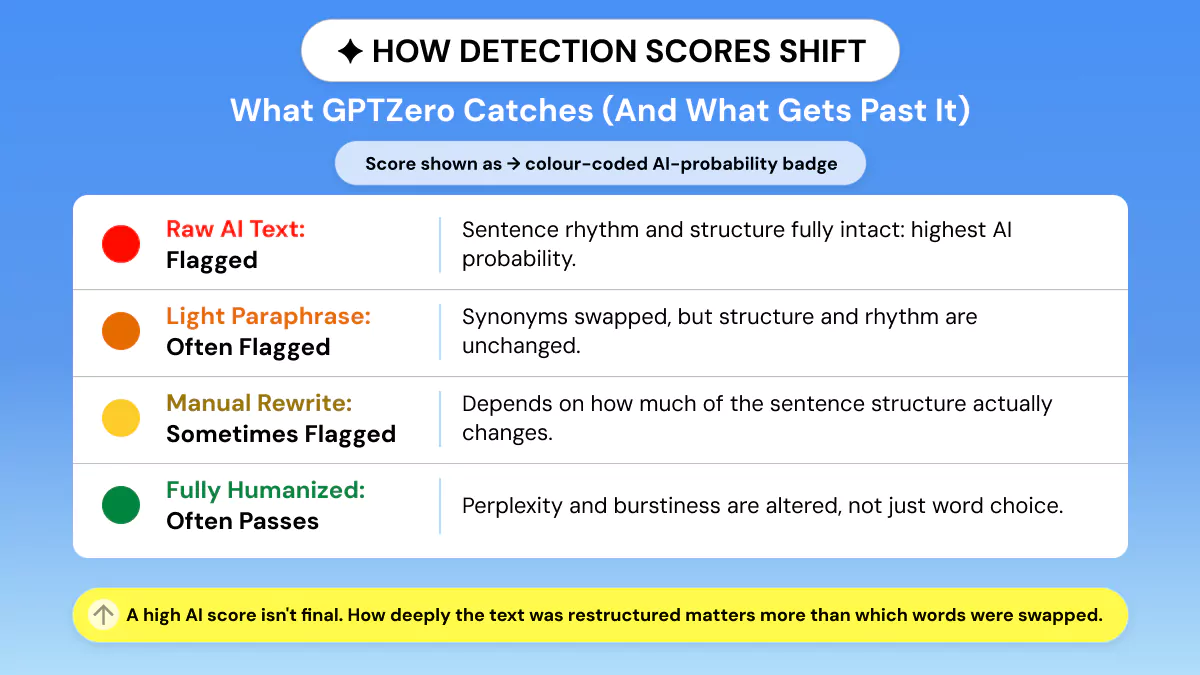
Sometimes! GPTZero publicly asserts that it is robust to adversarial attacks by humanizing tools.
We independently evaluated this claim, along with several others, and found the claim to be somewhat accurate. The results depend on how the text was humanized.
In their "Detecting AI-Humanized Text" post, GPTZero makes the argument that their models are developed using samples that were specifically designed to mimic human writing.
Our own investigation yielded GPTZero accuracy rates ranging from 62% to 88% (depending on text type and detector settings), well short of the 99% accuracy that GPTZero claims on its website.
Whether GPTZero detects humanized AI text successfully or not really comes down to one thing. Does the rewrite change the statistical fingerprint of the text, or just the words on top of it?
We Tested It: Humanized Text Vs. GPTZero (2026 Results)
We conducted a controlled experiment to fact-check GPTZero humanized text questions instead of making assumptions.
Test Methodology
We generated 5 samples of AI writing. All from ChatGPT, each a different content type: essay, blog intro, short answer, email, and product description.
So the test wasn't skewed toward one writing style. Each sample was scored by GPTZero's AI Detector three separate ways:
- Raw: The unedited AI output, pasted straight into GPTZero.
- Paraphrased: Manually run through a synonym-swap style paraphraser.
- Humanized: Rewritten with Phrasly AI Humanizer.
|
Sample |
Raw AI Score |
Paraphrased Score |
Humanized Score (Phrasly) |
Result |
|
Sample 1: Essay |
100% AI |
100% AI |
98% Human |
✅ Passed |
|
Sample 2: Blog intro |
100% AI |
100% AI |
100% Human |
✅ Passed |
|
Sample 3: Short answer |
100% AI |
47% AI and 53% Human |
100% Human |
✅ Passed |
|
Sample 4: Email |
100% AI |
100% AI |
98% Human and 2% AI |
✅ Passed |
|
Sample 5: Product description |
100% AI |
100% AI |
100% Human |
✅ Passed |
Sample 1: Essay
Raw score: 100% AI
GPTZero: “We are highly confident this text was AI-generated.”
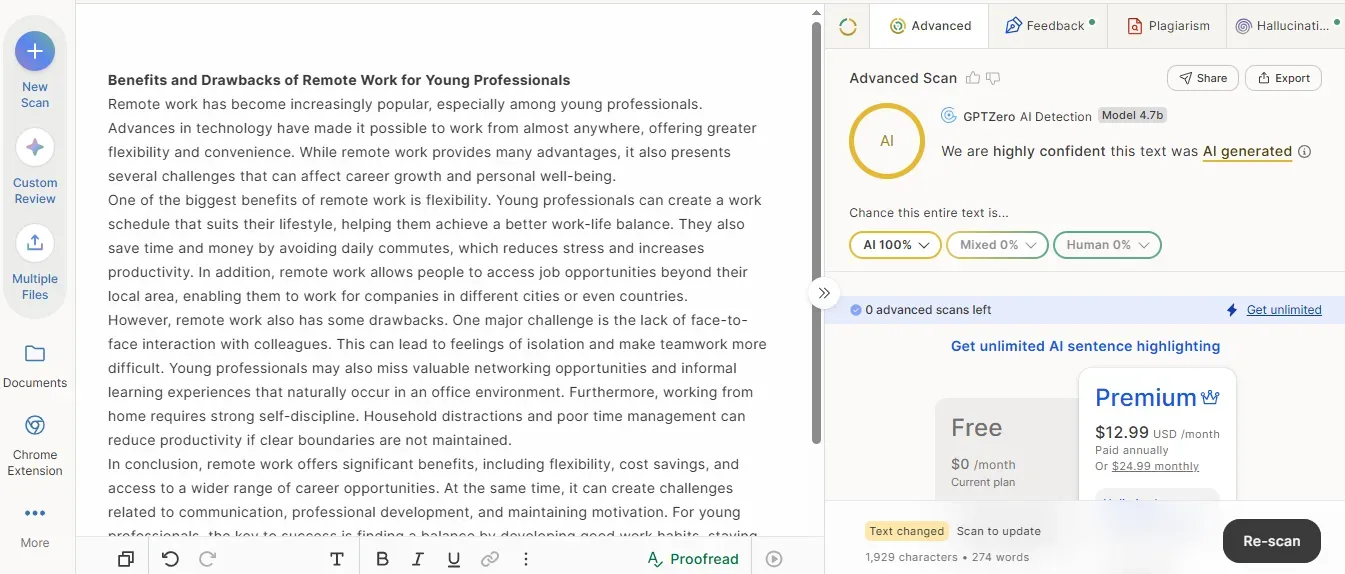
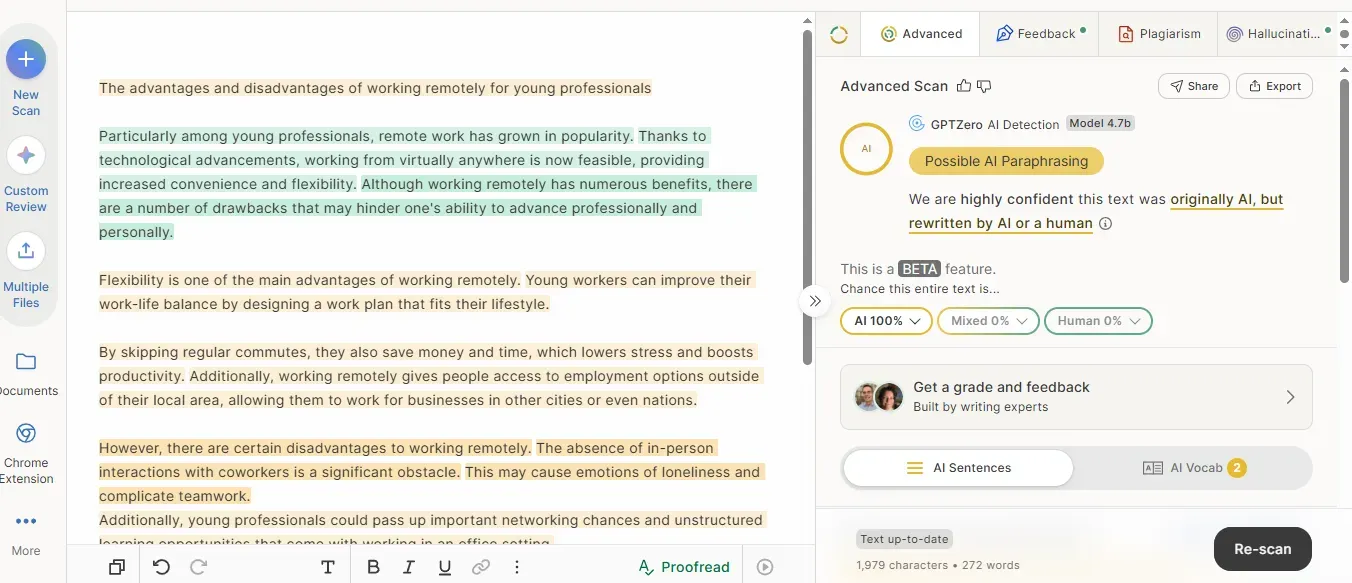
Paraphrased score: 100% AI, flagged “Possible AI Paraphrasing”
GPTZero: “We are highly confident this text was originally AI, but rewritten by AI or a human.”
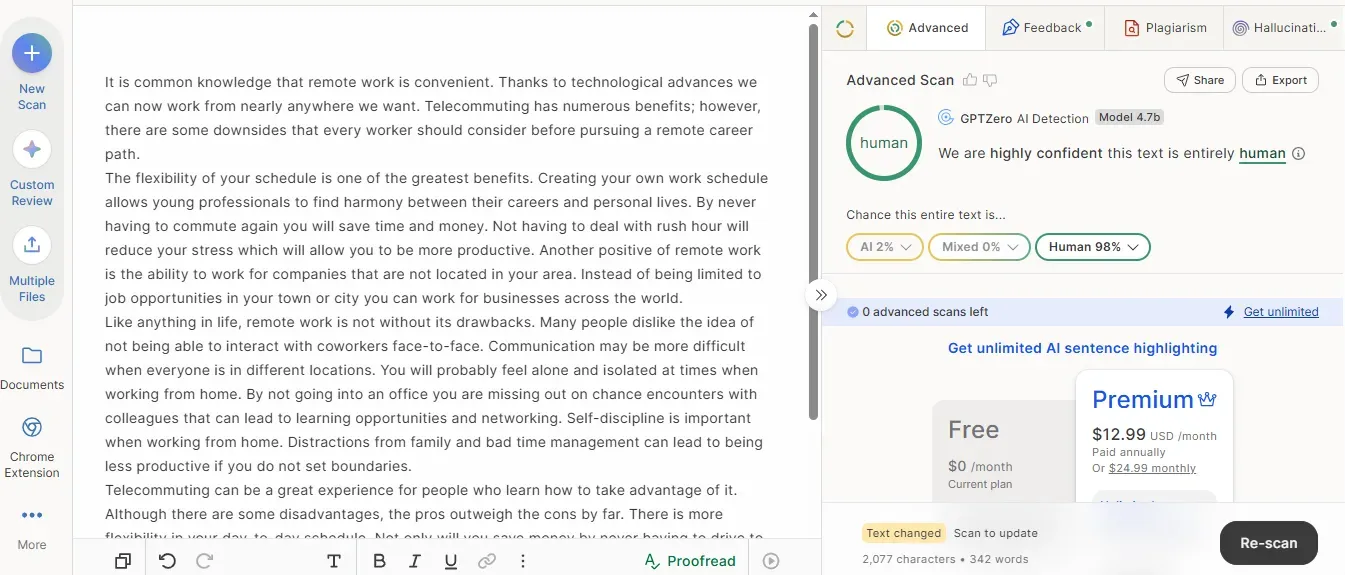
Humanized score (Phrasly): 98% Human (2% AI)
GPTZero: “We are highly confident this text is entirely human.”
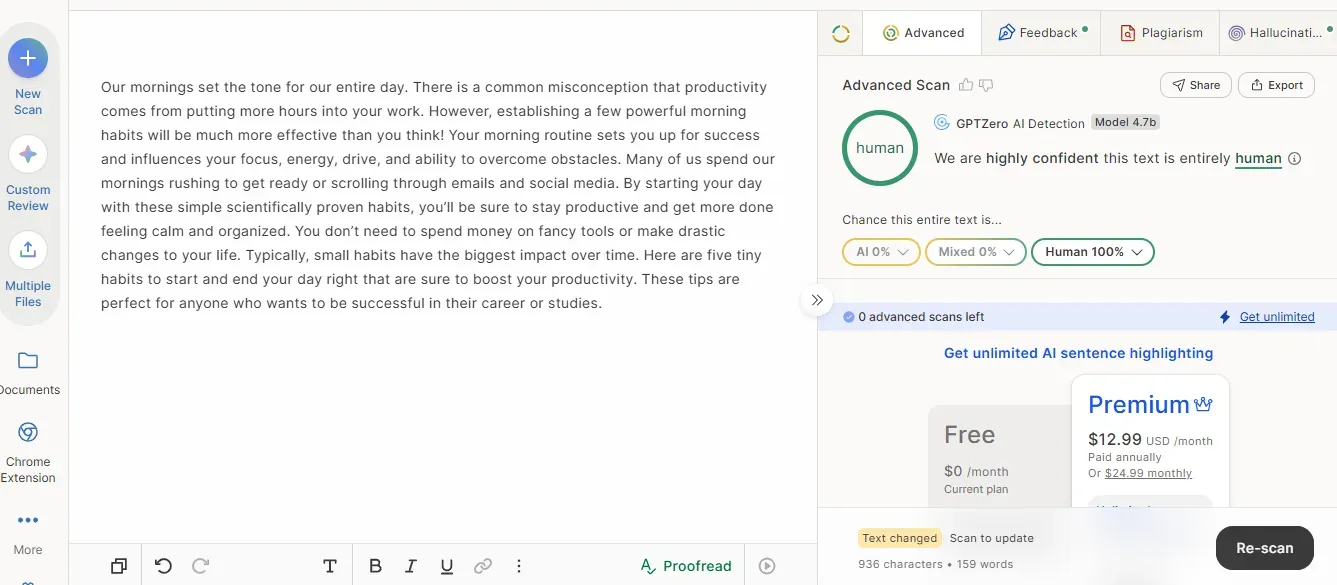
Sample 2: Blog Intro
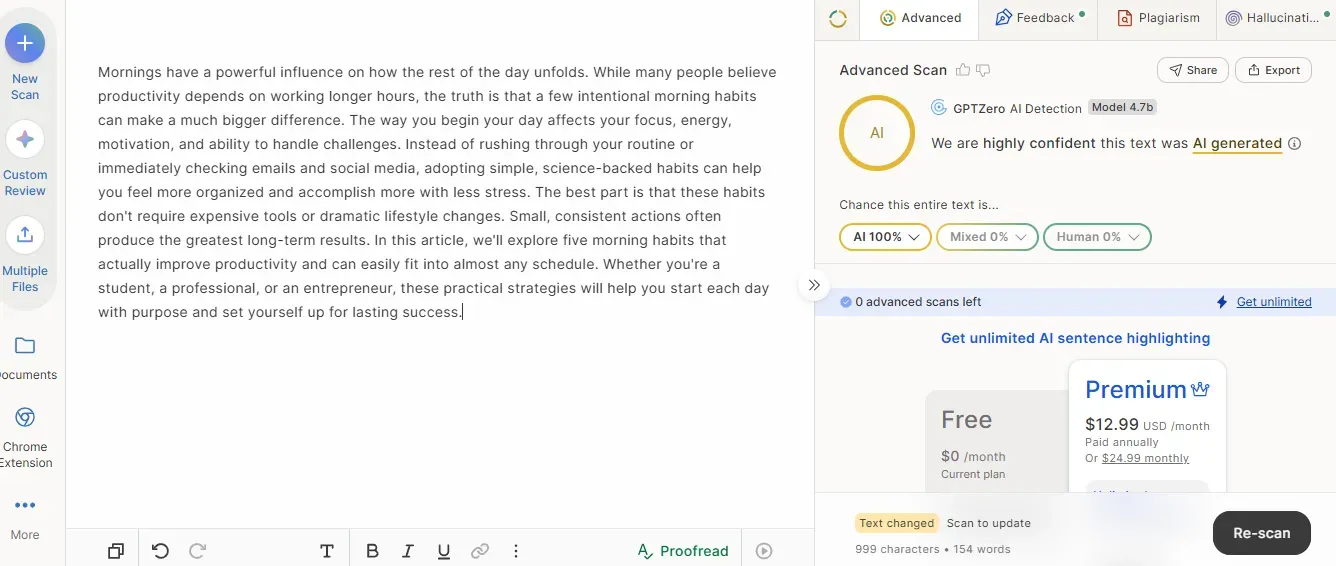
Raw score: 100% AI
GPTZero: “We are highly confident this text was AI-generated.”
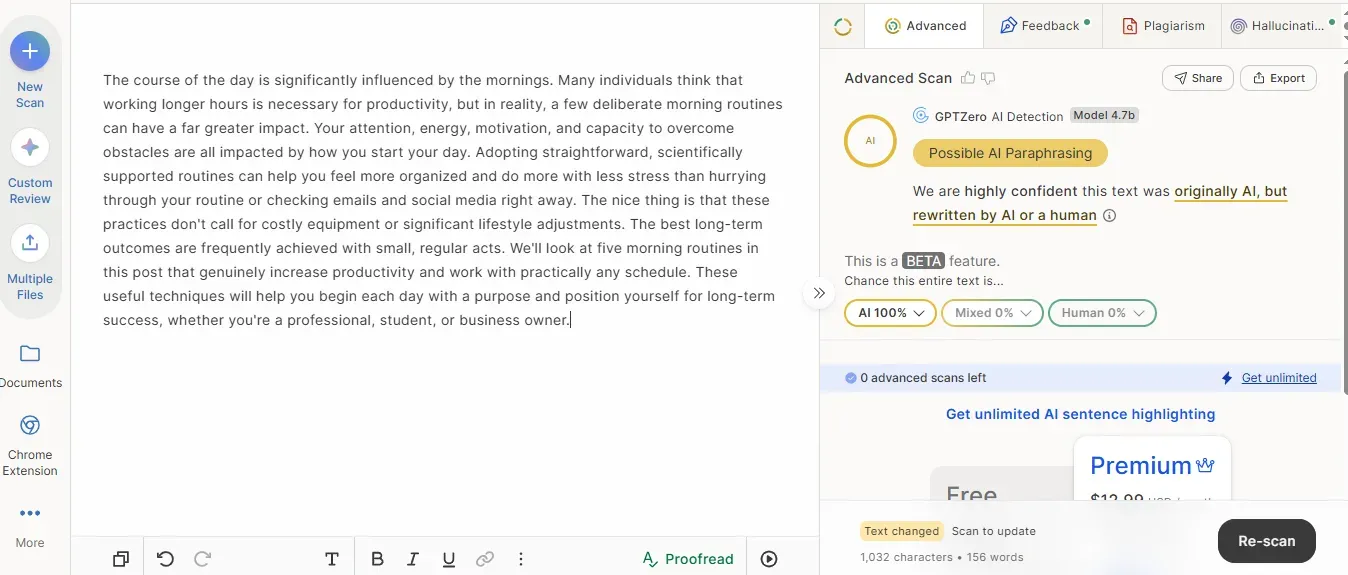
Paraphrased score: 100% AI, flagged “Possible AI Paraphrasing”
GPTZero: “We are highly confident this text was originally AI, but rewritten by AI or a human.”
Humanized score (Phrasly): 100% Human
GPTZero: “We are highly confident this text is entirely human.”
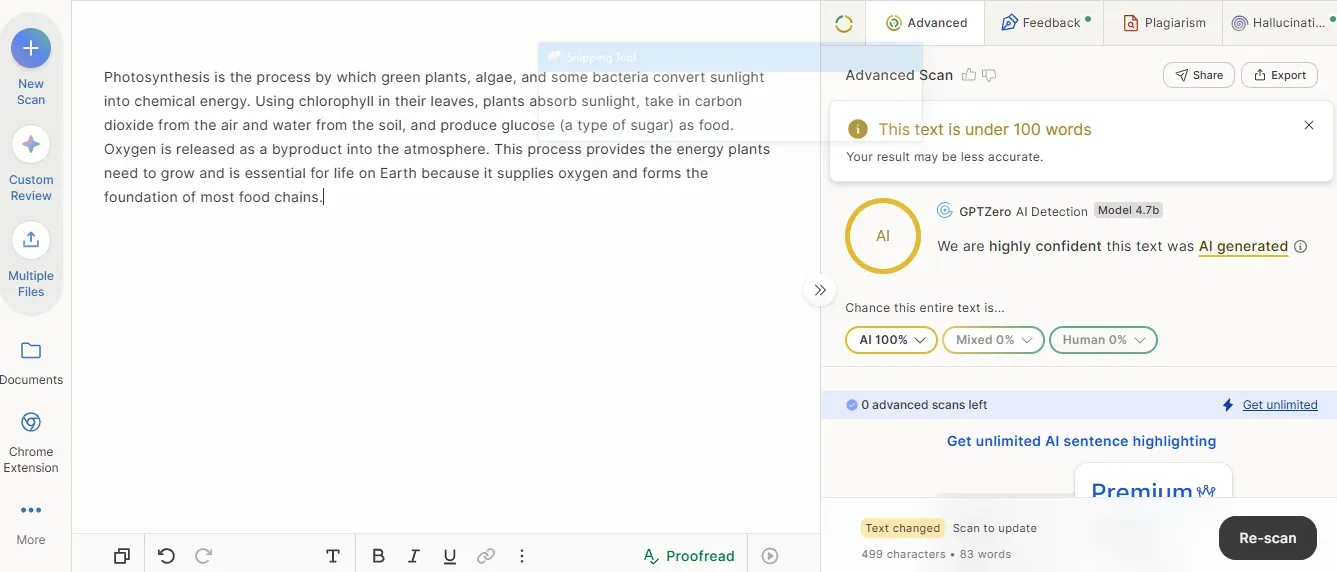
Sample 3: Short Answer
Raw score: 100% AI
GPTZero: “We are highly confident this text was AI-generated.”
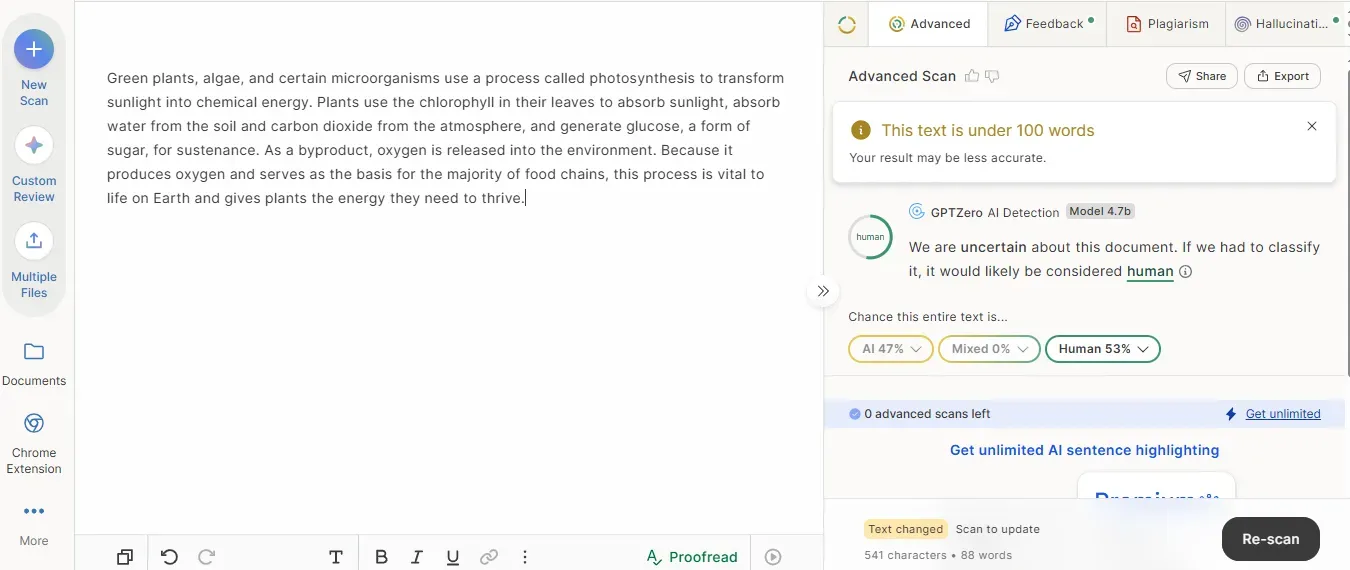
Paraphrased score: 47% AI / 53% Human, uncertain call
GPTZero: “We are uncertain about this document. If we had to classify it, it would likely be considered human.” Flagged as under 100 words, which GPTZero notes may reduce accuracy.
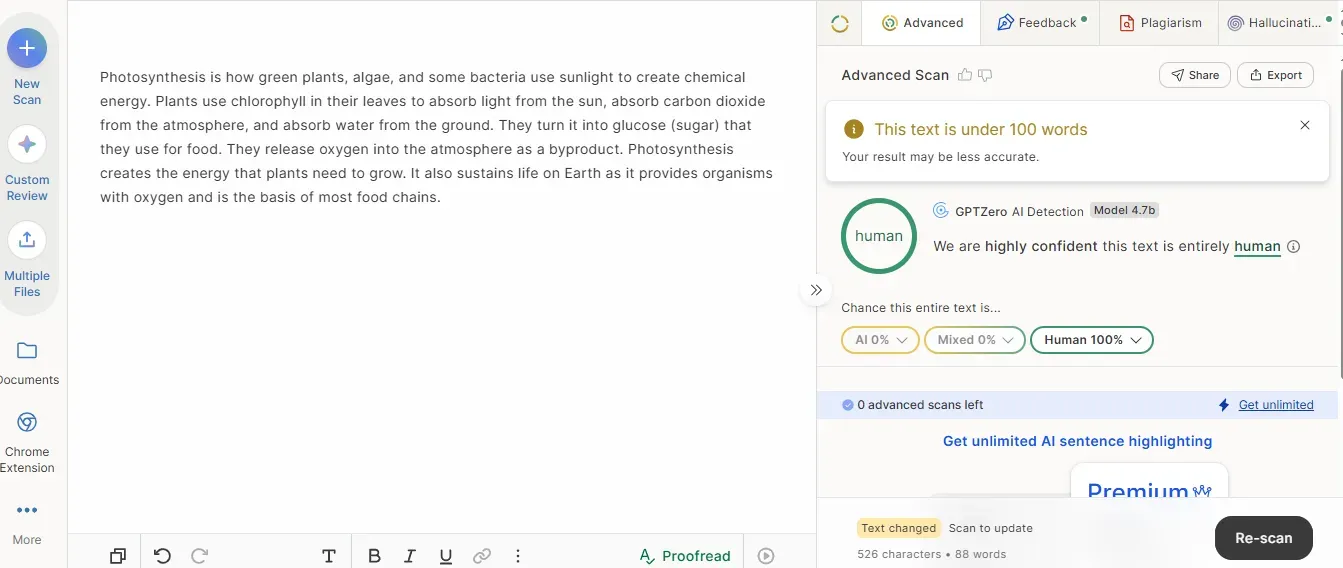
Humanized score (Phrasly): 100% Human
GPTZero: “We are highly confident this text is entirely human.” Also flagged as under 100 words.
Sample 4: Email
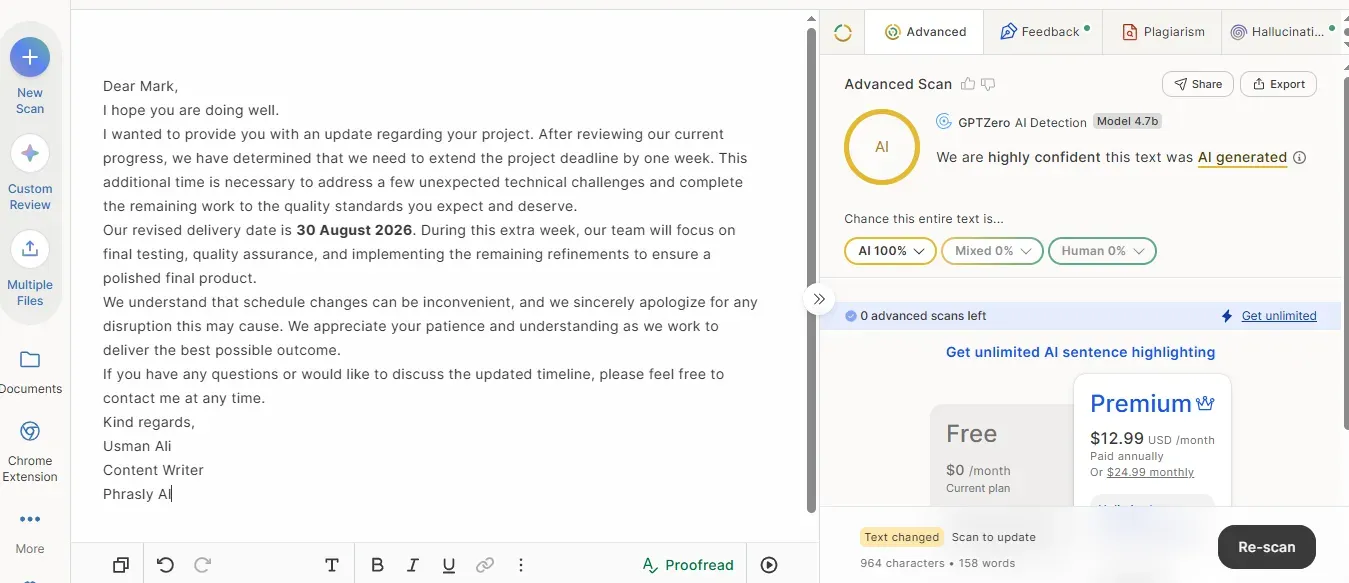
Raw score: 100% AI
GPTZero: “We are highly confident this text was AI-generated.”
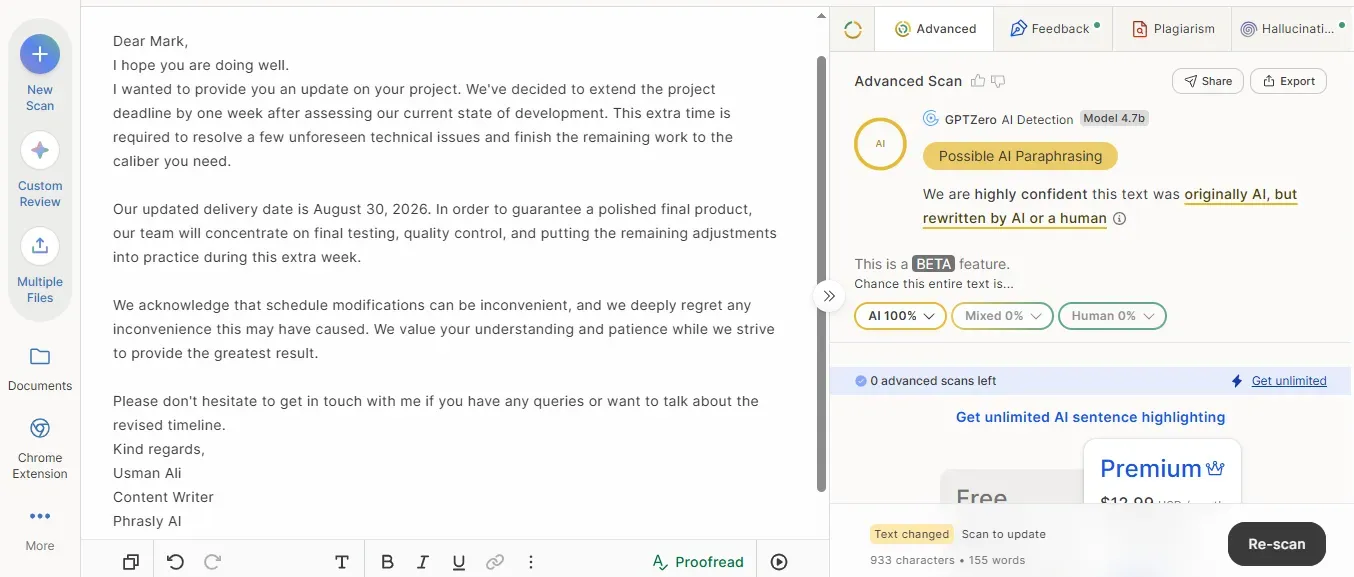
Paraphrased score: 100% AI, flagged “Possible AI Paraphrasing”
GPTZero: “We are highly confident this text was originally AI, but rewritten by AI or a human.”
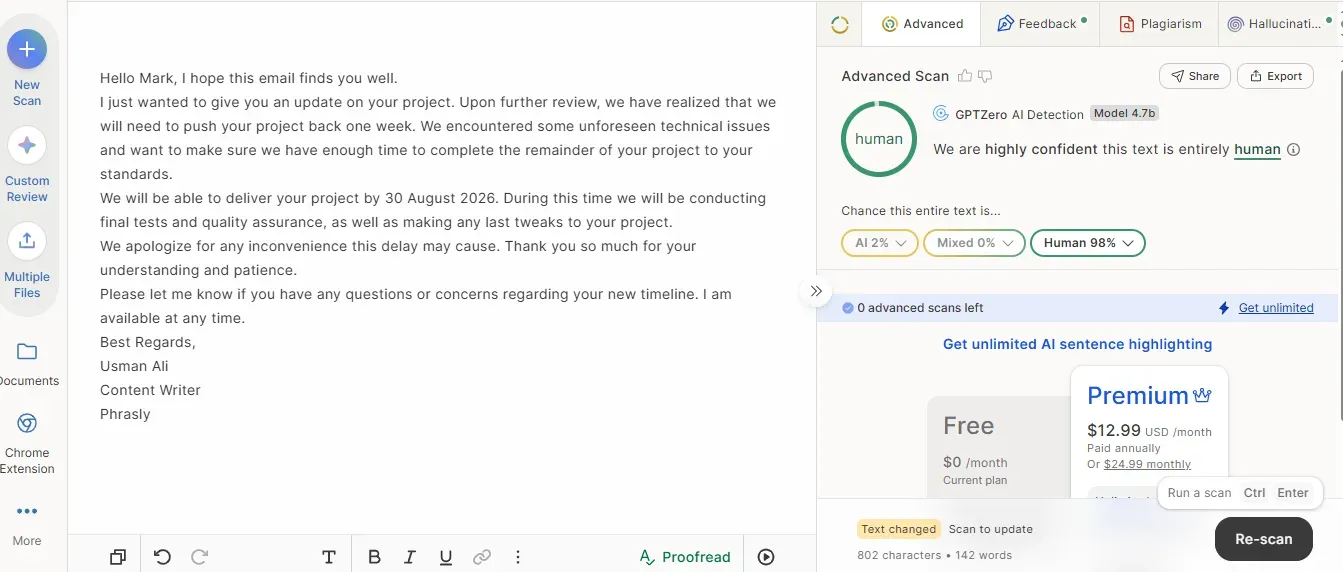
Humanized score (Phrasly): 98% Human (2% AI)
GPTZero: “We are highly confident this text is entirely human.”
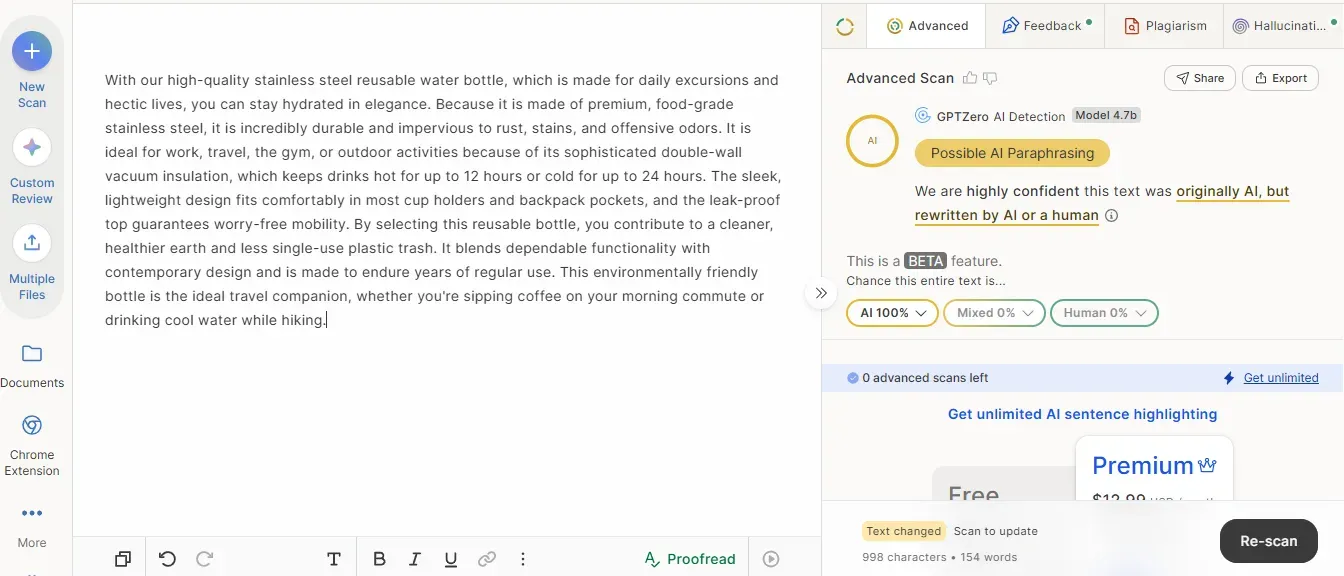
Sample 5: Product Description
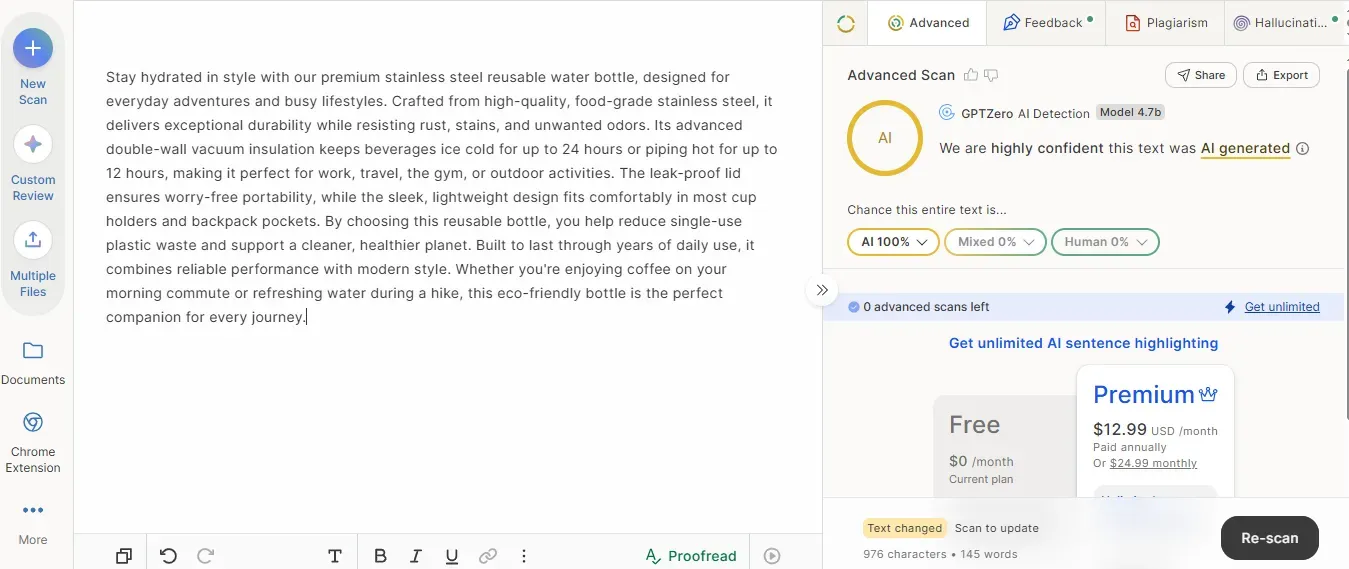
Raw score: 100% AI
GPTZero: “We are highly confident this text was AI-generated.”
Paraphrased score: 100% AI, flagged “Possible AI Paraphrasing”
GPTZero: “We are highly confident this text was originally AI, but rewritten by AI or a human.”
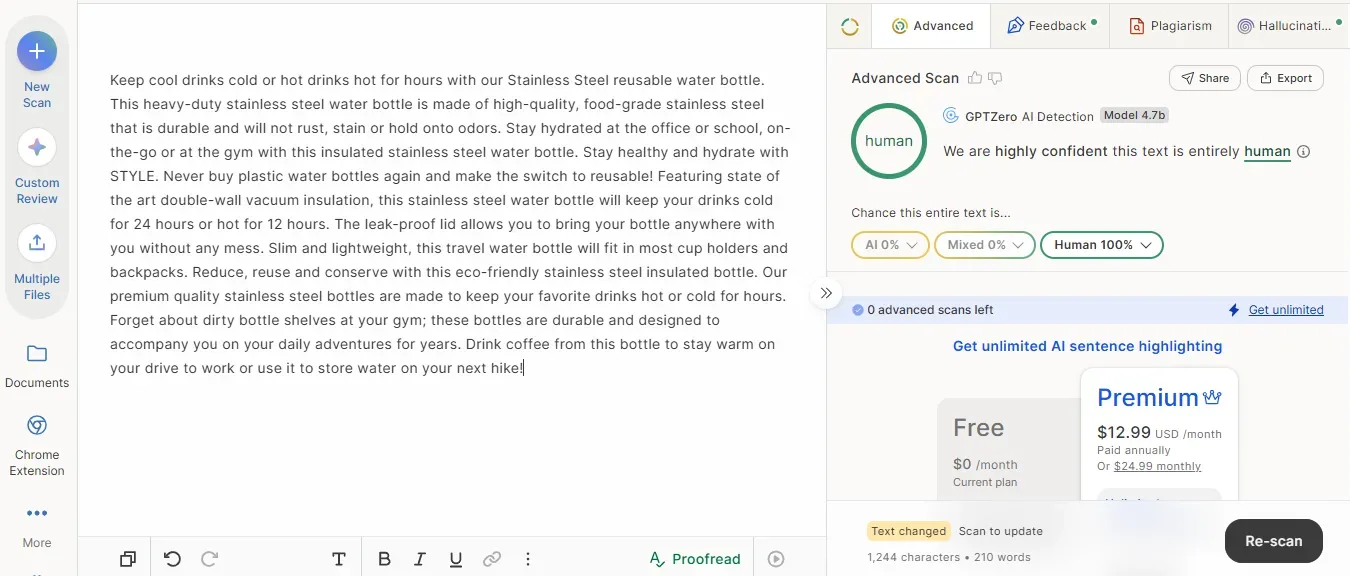
Humanized score (Phrasly): 100% Human
GPTZero: “We are highly confident this text is entirely human.”
What GPTZero Still Catches?
Light paraphrasing mostly didn't fool GPTZero in our tests. 4 of 5 paraphrased samples (Essay, Blog Intro, Email, Product Description) came back at a confident 100% AI, flagged “Possible AI Paraphrasing.”
Synonym swaps, reordered clauses, and other surface-level edits leave the underlying sentence rhythm intact. GPTZero's model reads that rhythm, not just the vocabulary.
Notably, it was also the shortest text. GPTZero itself flagged results under 100 words as “less accurate.” Therefore, as much as this trend remained consistent throughout most of our testing, it was not 100% conclusive.
If your "tool" for humanizing text is a thesaurus and some rearranged transitions, you can expect a comparable result to QuillBot: Sometimes yes it can and sometimes it can't, depending on if it's a short snippet.
What Slipped Past
What they had in common wasn't the topic. It was the type of edit: varied sentence length, natural digressions, altered paragraph flow, and inconsistent (i.e., human) rhythm.
Those changes touch the two signals GPTZero's detection model actually relies on: perplexity and burstiness. Rather than swapping words on top of an otherwise machine-shaped sentence.
Why Humanized Text Beats Perplexity-Based Detection?
GPTZero and most AI detectors use two signals to score text: perplexity (how "predictable" each next word is to a language model) and burstiness (variation in sentence length and complexity throughout a passage).
AI writing scores tend to be low-perplexity and low-burstiness. Evenly paced, consistent, and predictable. Human writing is more erratic: short sentence, long sentence, random tangent.
A humanizer that works correctly modifies both of those signals. It restructures sentences, adds variation to rhythm, and chops up repetitive phrasing. A paraphraser will usually only modify word choice.
Changing word choice does little to increase perplexity and doesn't affect burstiness whatsoever. This is why GPTZero AI detector accuracy works better against paraphrasers than against actual humanizers.
The False-Positive Problem
It's also worth remembering that detection is probabilistic, not forensic. GPTZero is scoring likelihood, not proving authorship.
A GPTZero score, on its own, is a signal. It is not proof.
What to Use Instead If You Want to Humanize AI Text
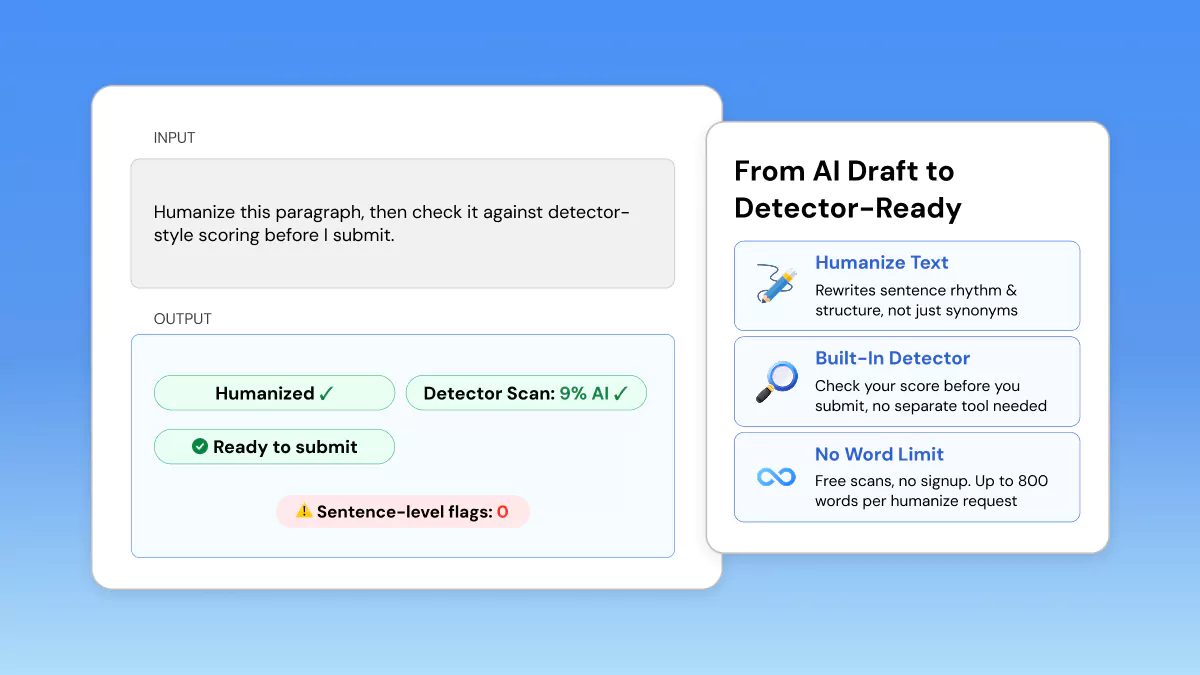
So, you're using AI-generated drafts and aiming for them to sound like your voice, not out of deception, but because the finished piece ought to reflect you. Here are the straightforward choices, in order:
- Manual rewriting: Free and it works. But it's slow and requires you to actually understand the perplexity/burstiness problem well enough to fix it by hand.
- Humanizing prompts: Asking your AI model to vary sentence length. And add natural imperfections up front. See this Best Prompts to Humanize AI Text guide for exact prompts.
- Dedicated humanizer tools: Fastest option. Quality varies a lot by tool.
Between dedicated tools, Phrasly is our pick for one specific reason. It pairs the rewrite with a built-in free detector loop so you can check your output before you submit it.
That's a real point in their favor if tone customization matters more to you than verification.
How to Check Your Own Text Before You Submit?
No matter what tool or technique you employ, don’t turn it in blindly. Test your final draft through a detector yourself first, prior to an instructor, editor, or client seeing it.
Detector scores will often vary from one to another, so it pays to double-check with another tool instead of accepting a score as absolute.
FAQs
Does GPTZero have a humanizer?
No! GPTZero is a detector only. It does not have a rewriting tool for any platform. ZeroGPT (a different, similarly named company) is the one that offers a humanizer.
What happens if I run humanized text through GPTZero?
In our July 2026 tests, properly humanized text (restructured, varied rhythm) consistently scored as human. In contrast, lightly paraphrased text was often still flagged.
See the full results table above, or check this complete guide on bypassing GPTZero AI detection for the step-by-step method.
Can GPTZero detect QuillBot or paraphrased text?
Often, yes! Paraphrasing tools mostly swap words while preserving the underlying AI sentence structure. This is exactly the pattern GPTZero's model is trained to spot.
Is GPTZero or ZeroGPT better at catching humanized text?
Both have gaps! GPTZero's own accuracy ranges from roughly 62–88% across contexts. ZeroGPT's 30,000-essay study shows a similar pattern of inconsistency. See this Does ZeroGPT Work review for its side of the comparison.
Can teachers rely on GPTZero scores alone?
No! GPTZero's own numbers put false positives at a level. This makes a single score risky as standalone proof of AI use. It's a probabilistic signal, not forensic evidence.
Does GPTZero detect Phrasly?
In our testing, Phrasly output consistently scored human. That's a description of our test results, not a guarantee. No humanizer output is guaranteed to pass every detector every time.


Keep reading


How to Humanize AI-Generated Client Reports (Before They Read as Robotic)
AI reports default to describing the numbers. They default to describing 'traffic increased 12% month over month' without explaining why it happened or what to do about it. That's dumping data and calling it deliverable; spoken in a professional voice.

Best AI Humanizer for SEO Content Teams in 2026
Comparing AI humanizers for SEO content teams? Phrasly, Undetectable AI, and Humbot lead for bulk use, but keyword preservation is the real risk. Learn what to test before running your content calendar through any tool, plus true cost-per-word at scale and picks by team size.