Do Humanizers Actually Work? The Marketer's Guide to AI Humanization in 2026
8 min read
We use AI for automation, content creation, email replies, reports, and many other daily tasks, and research has shown that 90% of marketing teams now use AI agents for decision-making (The Stacc).
So, when you’re using it, whether in professional or educational environments, how are you making your writing sound like an actual human?
Poor-quality AI-assisted content can hurt a site’s performance in search engines like Google and even false positives in AI detection can affect your work or grade.
So, to better understand the impact of Humanizer on content that is AI-generated sentences/phrases, we scanned 50 marketing assets.
We ran each sample through the Phrasly AI detector before and after running it through the Phrasly Humanizer, recording detection scores at each stage.
See what we found out in our study.
Humanize your AI text naturally now.👇
How AI Detection Impacts Marketing and Academic Content
AI detection was, for a while, a bigger issue in academia, where professors ran essays through Turnitin, and students got flagged for submissions that read a little too clean and structured.
In agencies, AI-detection checks are part of their own quality assurance process, the same way they'd check for plagiarism or broken links before a delivery.
This helps agencies protect their reputation with clients and maintain content quality.
🔍Google doesn’t penalize AI content just for being AI-generated. Its own guidance says it rewards quality “however it is produced.” Learn more in AI Detector for SEO Content: What to Check Before Publishing.
How AI Humanization Works
An AI humanizer is a tool designed to make AI-generated content sound more natural and human-written.
It analyzes common characteristics of machine-generated text, including sentence patterns, vocabulary, tone, and overall writing style.
Also, identify patterns such as repetitive sentence structures, predictable transitions, overly formal language, and unnatural phrasing.
Rather than simply swapping words with synonyms, an AI humanizer restructures the content to create a more natural flow and a distinctly different writing style.
They then adjust elements to produce writing that feels smoother, more conversational, and closer to the way a person would naturally express an idea.
So instead of manual editing or prompt-based writing, a humanizer tool can help you save a lot of time.
✅This self-editing checklist for copywriters will help your writing read human.
How AI Content Detectors Work (And What They're Really Flagging)
AI detectors primarily analyze statistical and linguistic patterns rather than evaluating meaning, intent, or factual accuracy. It reads for statistical patterns that tend to show up more often in machine-generated text than in human writing.
AI detectors read for statistical patterns that tend to show up more often in machine-generated text than in human writing. Two concepts do most of the work.
AI Detectors
Measures of how predictable each word is, given the words before it.
Large language models (LLMs) tend to generate text that's statistically "smooth": each next word is a highly likely continuation of what came before, because that's literally how the model is choosing it.
Human writing tends to be less predictable at the word level, use unexpected phrasing, or occasionally write something a probability model wouldn't rank as most likely.
It computes variation in sentence length and structure across a piece.
Human writing tends to have shorter sentences. Sentence openers can change, and paragraph rhythm tends to shift based on what the writer is trying to emphasize. AI-generated text, left unedited, tends to be more uniform.
Flags specific sentences individually, not just the piece as a whole.
That's why you'll often see a document score, say, "52% AI-generated," alongside a breakdown like "28 of 45 sentences flagged as likely AI."
The overall score is an average; the sentence-level flags show you exactly where the pattern is strongest.
Where Marketers Are Most at Risk of Getting Flagged According to Our Study
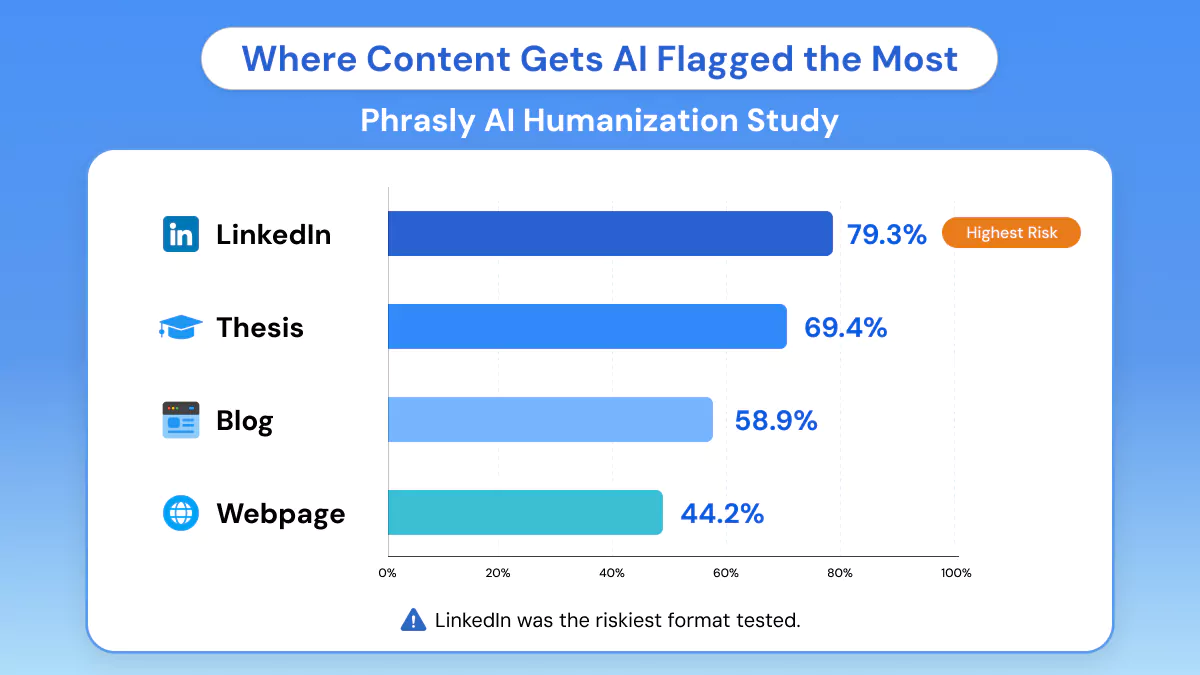
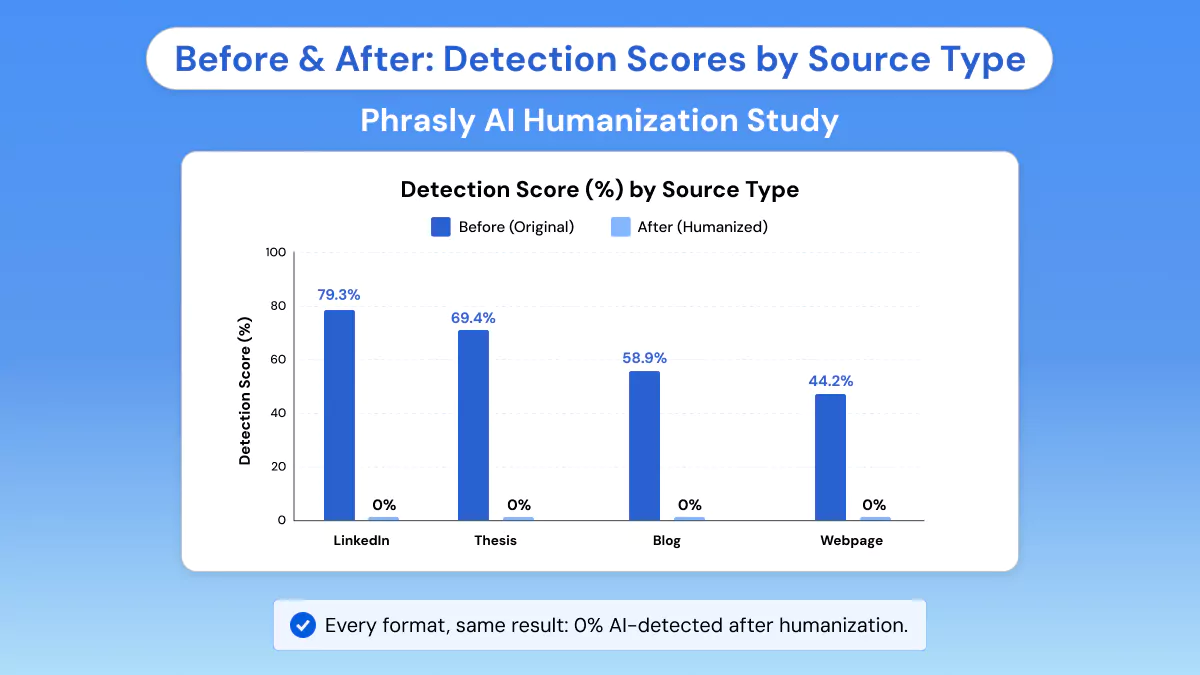
Our study found that LinkedIn content had the highest AI-detection rate of any format tested, both at the overall-score level and at the sentence level. That was well above the rates for blog posts, thesis-style long-form writing, and general web pages.
The likely explanation is more about the structure than style. LinkedIn's dominant format - hook line, short punchy paragraphs, and a call-to-engage close - is the kind of patterned structure that AI models default to when prompted for "a LinkedIn post."
Even the casual tone that LinkedIn usually has doesn't offset the patterns, regardless of how conversational the sentences sound out loud.
Standard web pages (product pages, service pages, about pages) came out lowest-risk in our data, likely because they tend to mix short functional copy with more varied structural elements (headers, bullet specs, CTAs) that naturally break up predictable sentence rhythm.
✍️When writing for clients, preserve both your natural writing style and the client’s brand voice, replace generic or hedged language with concrete details, vary sentence length, and make calls to action sound natural.
Learn more about Rewriting AI Drafts for Client Deliverables Without Losing Your Voice.
What "Humanizing" AI Content Actually Means (Beyond Just Rewriting)
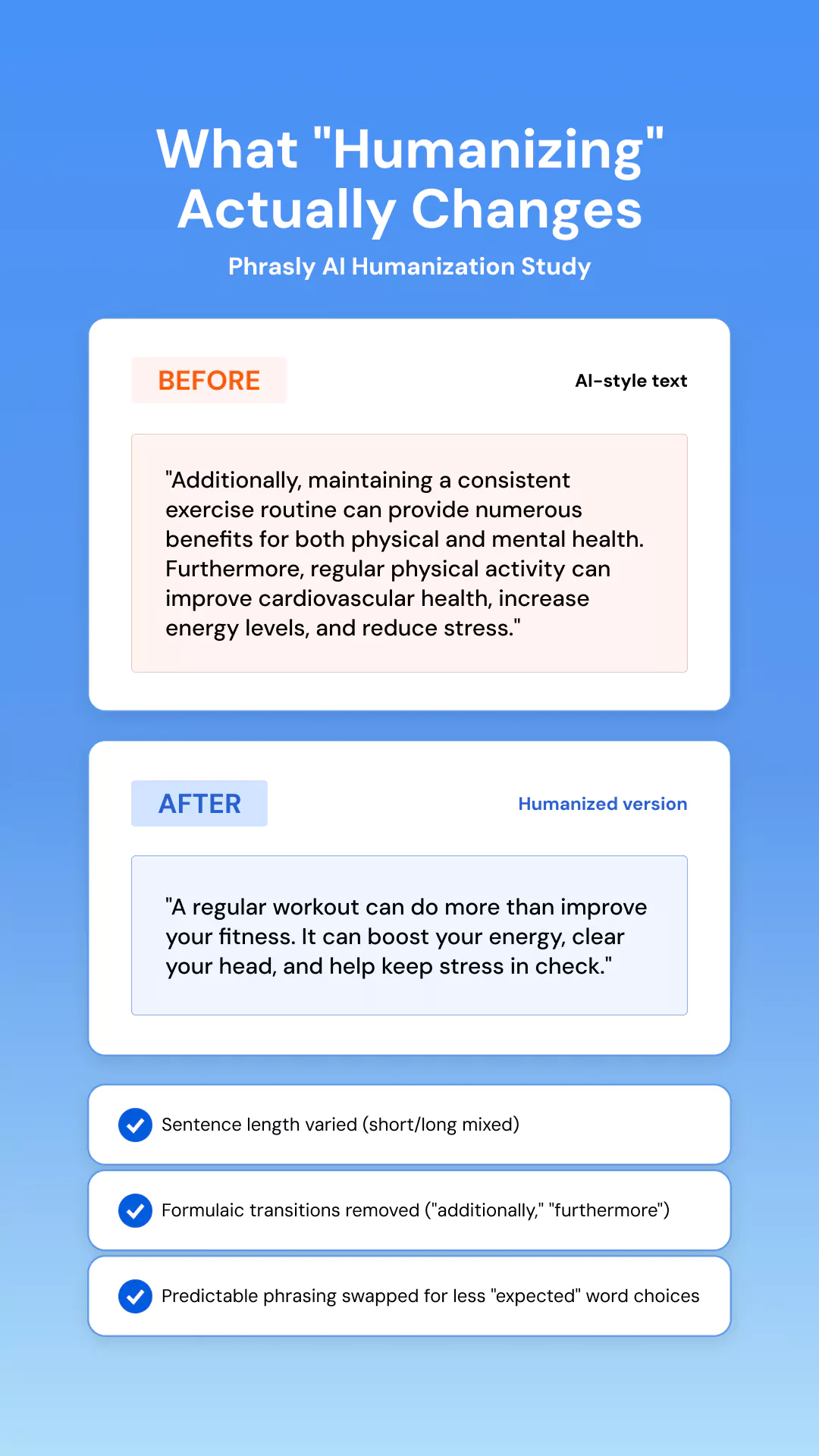
Real humanization works at the structural level:
It varies sentence length, so a document isn't a uniform run of similarly-sized sentences.
It breaks up predictable transition patterns, such as "additionally," "furthermore," "in conclusion," that AI models love.
It introduces sentence structures that are less predictable for a language model.
It mixes up the paragraph-level symmetry that comes from asking an AI model for "five tips" or "three benefits," where every point gets the same shape and the same length.
A well-humanized paragraph carries the same facts and arguments, but changes the rhythm, the variance, and the wording that make writing read as robotic.
This is also the point where it's worth being honest about the limits of humanization. It doesn't change facts, doesn't add expertise the underlying draft didn't have, and isn't a substitute for actual editorial judgment about whether the content has quality.
Does Running Content Through Humanizer Really Work?
According to the Phrasly AI Humanization Study, yes.
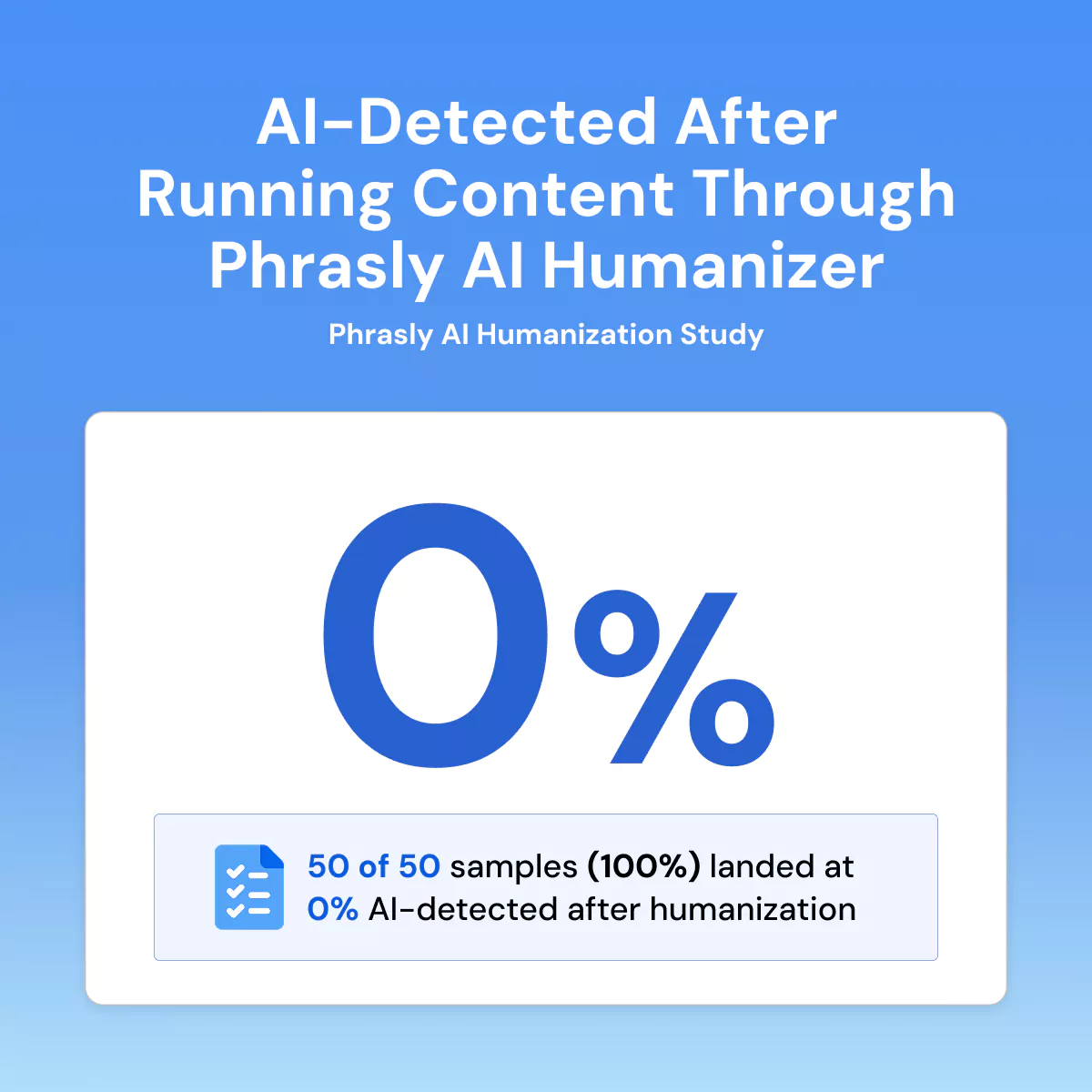
Across the entire 50-sample set, every blog post, thesis, LinkedIn post, and webpage tested, regardless of how AI-detectable it started out, running the content through the Phrasly Humanizer brought every single sample down to 0% AI-detected.
In our study, content that started as low as 20% AI-detected reached zero, and so did content that started at 100%.
Every sample for this round was processed through the Humanizer at the same "easy" intensity setting. Phrasly has 3 options for humanizing: easy, medium, and aggressive.
📘AI marketing copy sounding genuinely human requires more than better prompts. Learn more in the article How to Make AI Marketing Copy Sound Human, Not Robotic.
Best Writing Practice: Drafting with AI, Then Humanizing for Publish
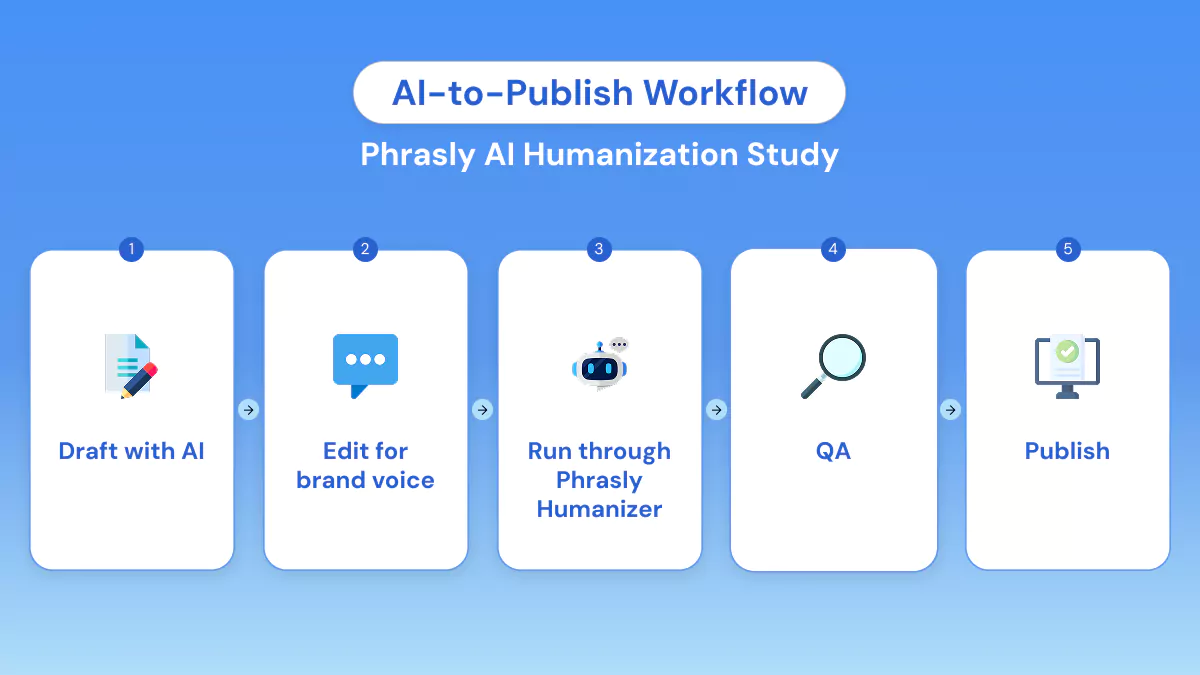
For a marketing team producing content, humanization can be a step in the pipeline, just like this:
1. Draft with the AI tool of choice
Whatever model or tool your team already uses for first drafts, no change needed here. Speed at this stage is the whole point of using AI in the first place, and there's no reason to sacrifice it.
2. Edit for brand voice and accuracy
Before anything else, a human editor should still be doing what human editors always did: checking facts, tightening arguments, making sure the piece actually sounds like the brand and says something worth saying. Humanization isn't a substitute for this step; it works on top of it.
3. Run the edited draft through the Phrasly AI Humanizer
This is the step that specifically targets the structural patterns detectors are scanning for without requiring a manual, line-by-line rewrite.
4. QA the humanized version
Do a quick pass to confirm that the content remains coherent and logical before publishing.
💡Copywriters can be flagged by AI detectors because these tools judge statistical patterns. Reviewing flagged passages for genuinely generic language is one way to avoid any false AI positives.
Learn more about how to check your content before delivery.
Inside the Study: How We Tested 50 Pieces of Content for AI Detection
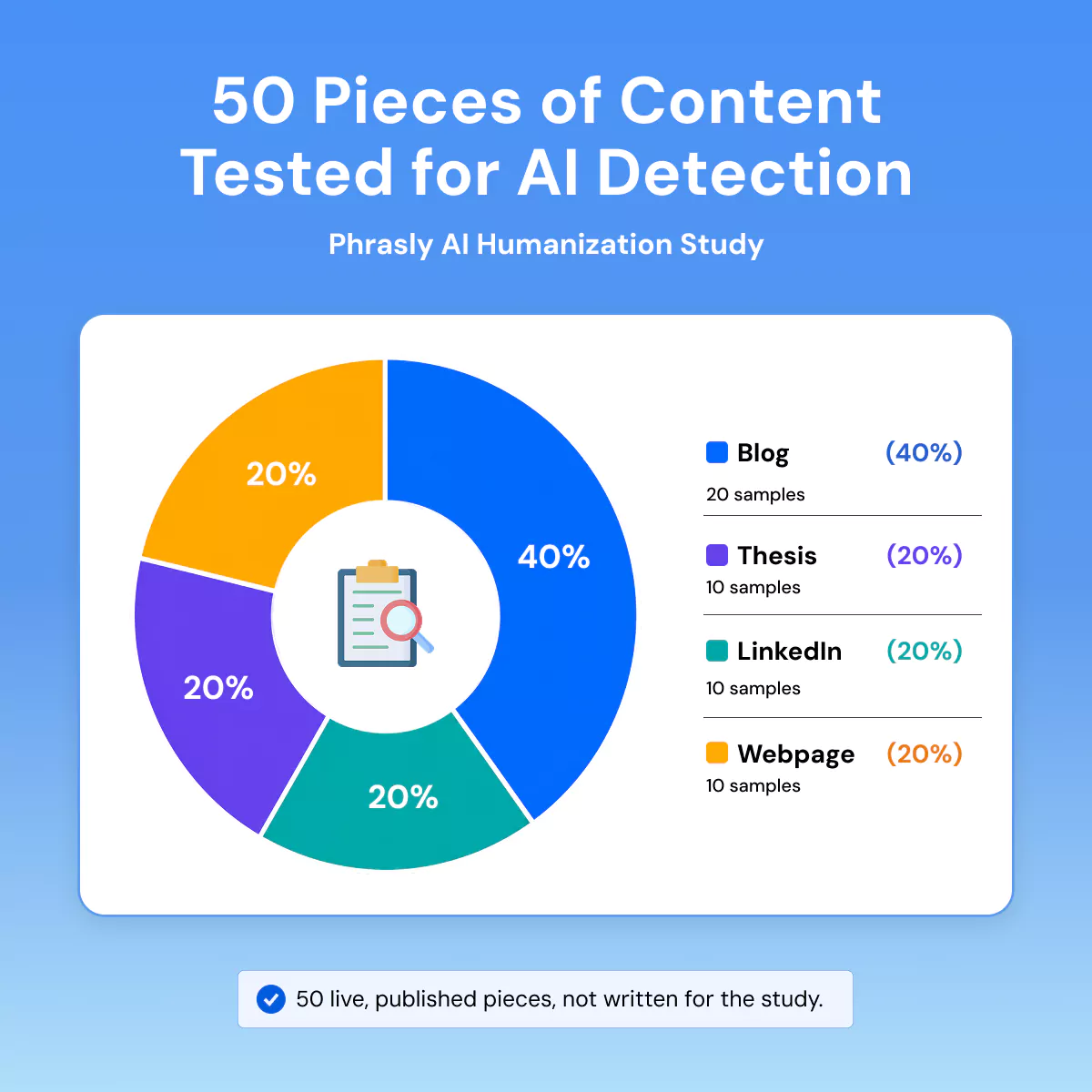
Most of the claims in this piece are grounded in an original study we ran specifically to answer the question marketers keep asking: how detectable is real content, and does humanization actually close the gap? Here's exactly how it was built.
We assembled 50 samples of AI-assisted writing across four source types: 20 blog posts, 10 academic theses, 10 LinkedIn posts, and 10 general webpages.
Each sample was pulled from a live, published source, not written from scratch for the study, so the dataset reflects content that's actually out in the world rather than a controlled writing exercise.
Every sample went through the same two-stage process:
First, it was scanned by the Phrasly AI detector, which returned a word count, an AI-generated percentage, a human-generated percentage, and a ratio of individual sentences flagged as likely AI-written (for example, "40 of 121 sentences").
Second, the same sample was run through the Phrasly AI Humanizer, then rescanned by the identical detector, capturing the same four data points after humanization. That before-and-after structure is what makes the comparison meaningful, each sample served as its own control.
Every sample was processed at the same Humanizer intensity, the "easy" setting.
We didn't test whether a lighter or more aggressive setting would change the outcome, because at this setting, the outcome was already about as strong as a result can be.
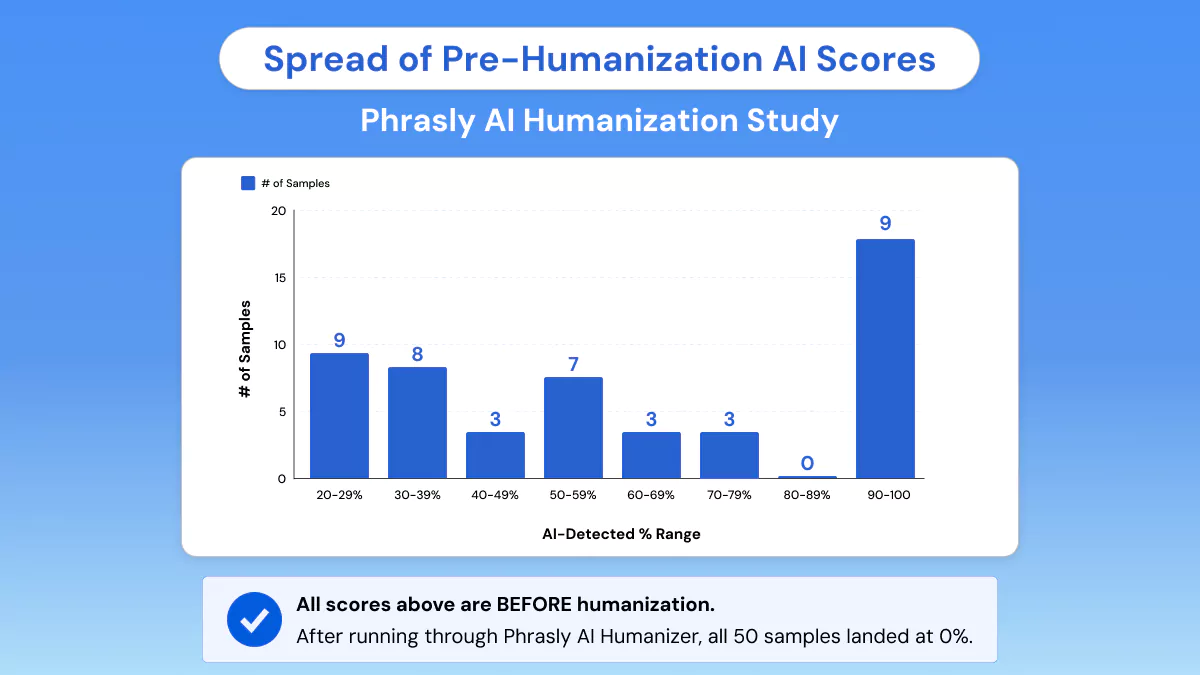
We can also point out that content length showed little relationship to detection risk. The correlation between word count and AI-detection score across the full sample was just 0.14, close to no correlation at all.
Longer pieces weren't meaningfully more or less likely to get flagged than shorter ones.
Where Humanization Fits From Here
As you know, using AI is about producing content faster, but it should read naturally and authentically. For teams using AI in their content workflows, humanization is increasingly a practical step between drafting and publishing.
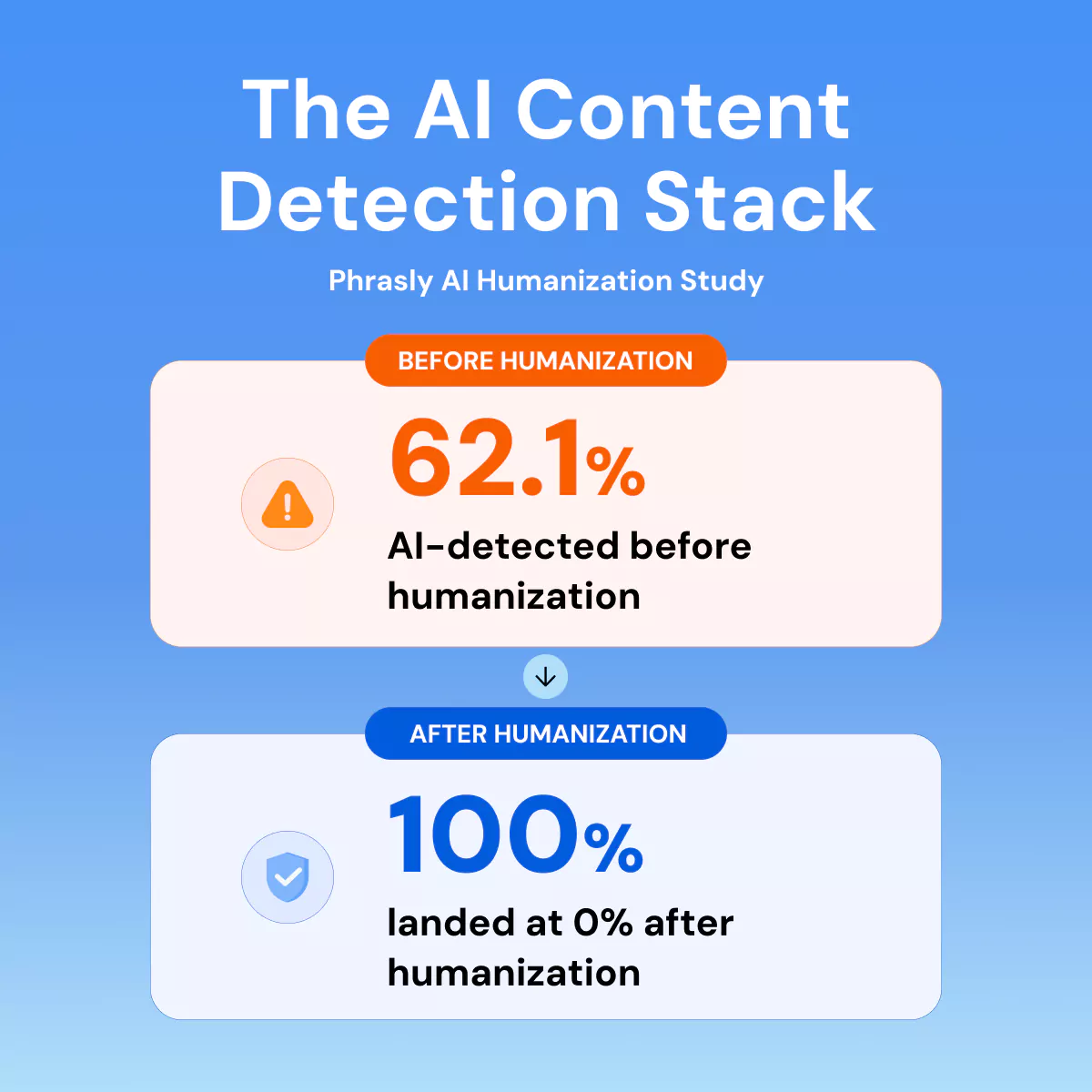
Our study illustrates why. Across 50 samples, AI detection averaged 62.1% before humanization, while every humanized sample returned a 0% detection score in our testing.
The samples ranged from casual LinkedIn posts to formal academic writing, suggesting that the gap between AI-assisted drafting and writing that reads as human can be narrowed through a repeatable workflow step.
The Phrasly AI Humanizer is built to be part of the publishing process. It won't fix a weak argument, introduce missing expertise, or correct a factual error.
What it can do is address the AI-detection gap measured in our study, helping AI-assisted drafts read more naturally before they reach the final publishing stage.
Frequently asked questions
Why are marketers using AI humanization tools?
Marketers use AI humanization to make AI-assisted content sound more natural, varied, and aligned with a brand's voice. It can be useful when AI-generated drafts feel repetitive, overly formal, or predictable. Humanization is typically one step in a broader workflow that includes editing, fact-checking, and quality assurance.
Does Google penalize AI-generated content?
No. Google does not penalize content simply because it was created with AI. Its guidance focuses on whether content is helpful, original, reliable, and created for people rather than primarily to manipulate search rankings. The bigger concern for marketers is low-quality or unhelpful content, regardless of how it was produced.
What does an AI humanizer actually change?
An AI humanizer can change sentence structure, vocabulary, transitions, paragraph rhythm, and other patterns associated with AI-generated writing. For example, it may vary sentence lengths, remove formulaic transitions such as “additionally” and “furthermore,” and replace predictable phrasing with more natural alternatives.
Can AI humanization guarantee that content won't be flagged?
No detection result should be treated as a permanent guarantee. AI detectors rely on statistical and linguistic patterns and can produce both false positives and false negatives. In the Phrasly AI Humanization Study, all 50 tested samples returned a 0% AI-detected score after humanization, but those results describe that specific test set and detector rather than guaranteeing the same result everywhere.
Which types of marketing content are most likely to be flagged?
In the 50-sample study, LinkedIn content had the highest average AI-detection score at 79.3%, followed by thesis-style content at 69.4%, blog content at 58.9%, and general webpages at 44.2%. The study suggests that LinkedIn's highly structured hook-and-short-paragraph format may contribute to its higher detection rate.

Written by
Gabriela Cofre
Gabriela Cofre is a content strategist and writer specializing in SEO, inbound marketing, and B2B, B2C content with +7 years of experience.