How to Expand a Sentence: 8 Techniques with Examples
8 min read
Learning how to expand a sentence means adding real meaning. Detail, reason, example, or result. Never empty padding that only inflates a word count.
This guide is for teachers planning lessons. Students and essay writers chasing a word count and ESL/EFL learners building confidence.
You get 8 practical techniques. Each with a before/after example, plus a padded "what not to do" table. And an argumentative essay example set.
Expand Your Sentences with AI Sentence Expander
Try the techniques below instantly with the AI Sentence Expander.
What Does It Mean to Expand a Sentence?
To expand a sentence means adding words, phrases, or clauses that give the reader new information. Who, what, when, where, why, or how. Repeating what the sentence already implies doesn't count.
Compare lengthening with deepening. "The dog ran very, very fast" is longer. While "The dog ran across the muddy yard" says more. Only the second one is expansion.
Every technique here starts from a simple sentence. Has one independent clause: a subject and verb that can stand alone. A dependent clause has a subject and verb too.
But it can't stand alone, as Purdue OWL's guide to clauses explains.
A compound sentence joins two independent clauses. In contrast, a complex sentence adds a dependent clause. Both come up in the techniques below.
Sentence Expansion Vs Sentence Combining: What Is the Difference?
Sentence combining merges two sentences you've already written into one. Usually to fix choppy writing, without adding new information. Sentence expansion adds new detail.
It adds a reason, example, or result to a single sentence.
That's the core of sentence combining vs sentence expansion.
The two overlap because coordinating and subordinating conjunctions can do either job. What decides it is whether new content appears:
Combined: "The dog ran. The dog barked." becomes "The dog ran and barked." Nothing new was added.
Expanded: "The dog ran and barked at the mail truck." The mail truck is new information.
Both are worth practicing.
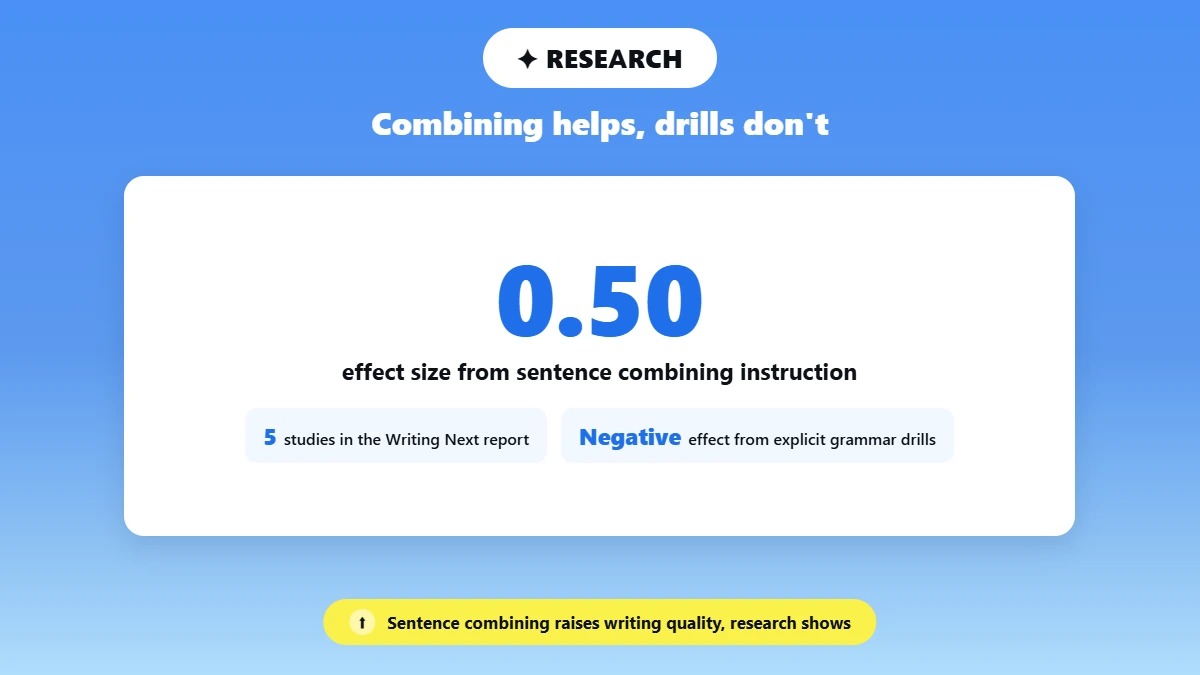
In the landmark Writing Next report, sentence-combining instruction improved student writing quality with an effect size of 0.50 across 5 studies.
Explicit grammar drills had a negative effect.
8 Techniques to Expand a Sentence Without Fluff
Work through these in order, from simplest to most complex. Each one adds a specific kind of meaning. And these expanding sentence examples all build on the same base sentence so you can see the change clearly.
1. Add Adjectives and Adverbs for Precise Detail
To expand a simple sentence using adjectives and adverbs, choose words that show something the reader couldn't otherwise picture, such as speed, size, condition, or manner.
This is adjectival modification and adverbial modification at its most basic.
Before: "The dog ran."
After: "The exhausted dog ran clumsily across the muddy yard."
Avoid stacking adjectives that repeat the same idea.
2. Add Prepositional Phrases for Place, Time, or Manner
Prepositional phrases answer where, when, or how something happened.
Before: "The dog ran."
After: "The dog ran through the park before sunrise."
You can layer two or three prepositional phrases for richer detail without changing the sentence structure at all.
3. Add a New Idea with Coordinating Conjunctions
Coordinating conjunctions (FANBOYS: for, and, nor, but, or, yet, so) join two independent clauses of equal weight, as Purdue OWL's ESL guide to conjunctions shows.
Before: "The dog ran."
After: "The dog ran, but it stopped at the gate."
The second clause adds a new event. This is what makes this an expansion rather than combining.
4. Show Reason with Subordinating Conjunctions
Subordinating conjunctions such as because, since, and although add a dependent clause. These explain reason, cause, or contrast.
Before: "The dog ran."
After: "The dog ran because it heard the mail truck."
This is the clearest way to add a reason. This is why reason clauses matter so much in essays.
5. Balance Two Ideas with Correlative Conjunctions
Correlative conjunctions work in pairs (not only/but also, either/or, both/and) to link two balanced ideas.
Before: "The dog ran."
After: "The dog not only ran but also barked at the mail truck."
These pairs suit comparison and emphasis. They work well in argumentative writing.
6. Link Ideas with Transitional Phrases
Transitional phrases such as as a result, for example, and in contrast connect an added detail to the sentence's logic.
Before: "The dog ran."
After: "The dog ran; as a result, it knocked over the mailbox."
Use a transition only when it signals a real relationship. Such as result, example, or contrast. Not as connective filler.
7. Add Relative Clauses or Appositives for Extra Information
Relative clauses (who, which, that) and appositives add identifying detail about a noun.
Before: "The dog ran."
After: "The dog, a three-year-old retriever, ran toward the fence."
Reach for this technique when the new detail is about identity or description rather than action.
8. Expand a Simple Sentence into a Compound or Complex Sentence
This is the culmination step. And it covers expanding simple sentences into compound sentences and complex ones. Use the conjunctions and clauses from techniques 3, 4, and 7 to upgrade the sentence structure. Not just its length.
Before: "The dog ran."
After: "Although it was raining, the dog ran because it heard the mail truck arrive."
How do you turn a short, simple sentence into a longer one without fluff? Let every structural change come from added meaning.
What Not to Do: Padded Sentences Vs Real Detail
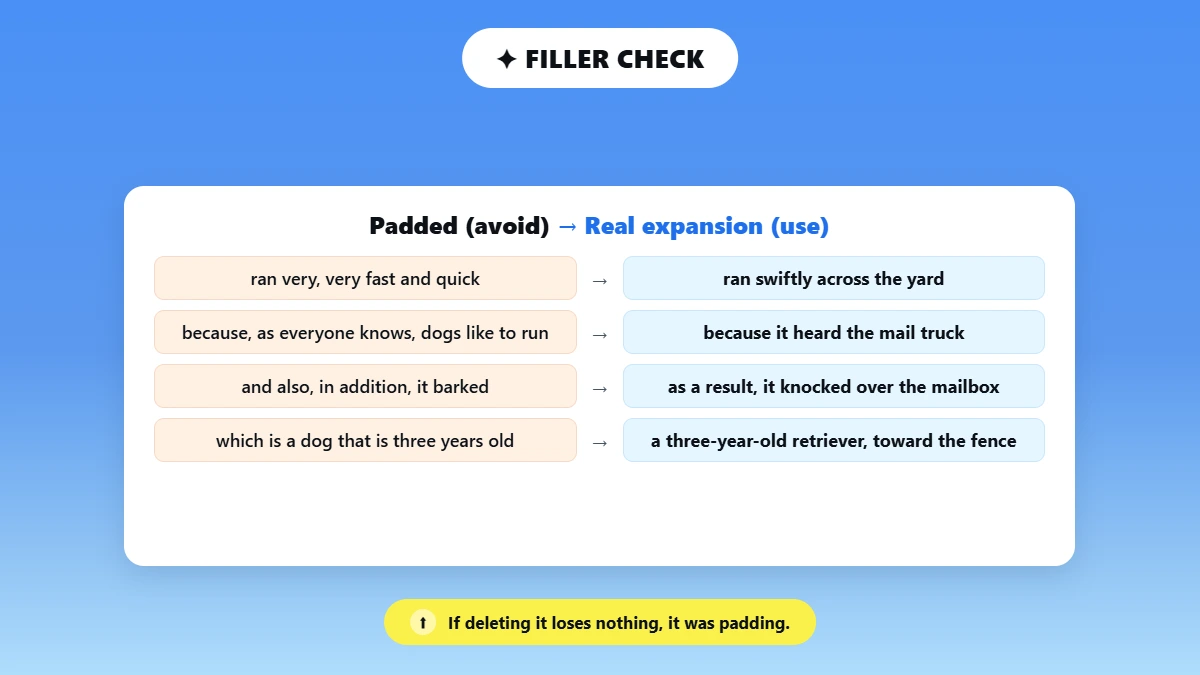
Here's how to make sentences longer without fluff: if you can delete the added words and lose no meaning. They were padding. Not expansion. Watch for these filler patterns:
Redundant adjectives: "big, large, huge" all say the same thing.
Throat-clearing openers: "It is important to note that..." delays the point.
Vague intensifiers: "very," "really," and "extremely" rarely add information.
Technique used | ❌ Padded version (avoid) | ✅ Real expansion (use) |
Adjectives/adverbs | "The dog ran very, very fast and quick." | "The dog ran swiftly across the yard." |
Prepositional phrase | "The dog ran, which is a thing dogs often do, in the park." | "The dog ran through the park before sunrise." |
Subordinating conjunction | "The dog ran because, as everyone knows, dogs like to run." | "The dog ran because it heard the mail truck." |
Transitional phrase | "The dog ran, and also, in addition, it barked." | "The dog ran; as a result, it knocked over the mailbox." |
Relative clause | "The dog, which is a dog that is three years old, ran." | "The dog, a three-year-old retriever, ran toward the fence." |
Once your additions carry real meaning, use an essay rewriter to polish your draft.
How to Expand a Sentence for an Argumentative Essay?
To learn how to expand a sentence for an essay, add a reason. Then evidence. A bare claim such as "Social media harms teenagers" is grammatically fine. But it gives the reader nothing to evaluate.
That matters: College instructors estimate 50% of high school graduates aren't prepared for college-level writing.
Add a reason: "Social media harms teenagers because constant comparison to curated images damages self-esteem." The reason answers "why should I believe this?"
Add evidence: "...damages self-esteem, a pattern reflected in rising rates of body-image anxiety among frequent users." In a real essay, cite a source here.
Padded counterexample: "Social media, which is a very popular and widely used form of technology today, harms teenagers in many different ways." It's longer. But it adds no reason or evidence.
For more, see how to increase your essay word count without fluff.
Sentence Expansion Worksheets and Practice Ideas
The best sentence expansion worksheets use one short base sentence. And a set of question prompts. This sentence expansion strategy for teaching works for young students, ESL learners, and self-taught writers.
And it builds sentence fluency and descriptive writing skills over time.
📝 Base Sentence Plus Prompts
Give students "The dog ran." And ask them to add who, when, where, why, and how in separate rounds.
Then they combine the answers into one sentence.
📈 The Three-Round Progression
Students expand the same sentence three times. Adding one detail type per round. So length and richness grow together. For kids, keep the vocabulary short and familiar.
Printable versions in this format often shared as an expanding sentences worksheet PDF. These are common in classrooms and ESL workbooks.
For essay-level practice, see these tips for making an essay longer without losing quality.
Can an AI Tool Help You Expand a Sentence?
Yes! A sentence expander AI tool applies the same moves covered above. Adding reasons, examples, sensory detail, or results, in seconds instead of through manual revision.
Paste a short sentence into an expand sentence generator. Compare several expanded versions and keep the one that matches your voice.
On AI detection: Expansion built on real detail tends to read naturally. Because it adds substance a human writer would plausibly include. No tool guarantees undetectable output, though. And a paraphrasing tool that only swaps words won't add meaning.
The safest approach is to keep your original meaning and revise for substance. Not length.
Phrasly's AI Sentence Expander expands text you've already written.
It doesn't write the content for you.
You can get started for free with a Phrasly account. And the tool takes up to 250 words at a time.
Before you try it, see how to rewrite a sentence for clarity and impact.
Frequently Asked Questions
How Do You Expand a Sentence in Writing?
Start with a base sentence. Then add modifiers, phrases, or clauses that answer who, what, when, where, why, or how. Add one element at a time. And check that each addition brings new meaning rather than extra length.
If removing a phrase changes nothing, cut it.
What Are the 5 Ways to Expand Sentences?
Five common methods are adding adjectives or adverbs, inserting prepositional phrases, attaching subordinate clauses, using appositives, and joining related ideas with a conjunction.
These overlap with the 8 techniques in this guide. They represent the core categories most teachers use.
What Is an Example of Sentence Expansion?
"The dog barked" can become "The small brown dog barked loudly at the mail carrier because it heard footsteps on the porch." "Small brown" answers which dog. "Loudly" answers how.
And the because clause answers why. Each addition gives the reader something new. For essays, see how to increase your essay word count without fluff.
How Do You Teach Students to Expand Sentences?
Start with a short base sentence. And ask guided questions: Who, what, where, when, why, and how. Students add one answer at a time. Then combine them.
Repeated practice with feedback helps them internalize the pattern far more than worksheets alone.
What Is the Difference Between a Simple Sentence and an Expanded Sentence?
A simple sentence has one independent clause with minimal detail. An expanded sentence keeps the same core idea. But adds modifiers, phrases, or clauses.
To go further, enhance your sentences with AI. Then revise the result in your own voice.

Written by
Muhammad Usman Ali
Pakistan
Muhammad Usman Ali is an experienced SEO content writer with 3+ years of professional writing experience. He specializes in AI tools, AI detection technologies, and search engine optimized content.