
Does the Global Reference Database Check for AI? (2026 Answer)
The Global Reference Database doesn't detect AI. It's SafeAssign's archive of 15M+ student papers, and it only matches stored text. See what it actually catches, the 0% score trap, and how instructors really check for AI.
No. The Global Reference Database does not check for or detect AI-generated writing. It is a plagiarism database: an archive of millions of student papers that Blackboard's SafeAssign compares your text against for copied content. A fully AI-written essay that copies nothing will usually score near 0%.
If you're reading this the night before a deadline because you used ChatGPT and SafeAssign is waiting, that answer probably brings relief. Hold that feeling for a minute, because the full picture has a catch worth knowing.
What Is the Global Reference Database?
The Global Reference Database is a cross-institutional archive of student papers run by Anthology, the company behind Blackboard. Students at Blackboard schools volunteer copies of their papers to it, and SafeAssign then compares new submissions from any member school against that shared pool. Blackboard's own documentation puts it at more than 15 million papers.
You meet it as a checkbox. On a SafeAssign submission page, a small option asks whether to add your paper to the Global Reference Database, and most students click past it without reading.
Three details matter.
- It is separate from your school's own archive, which stores every SafeAssign submission at your institution automatically.
- You join it voluntarily: at submission you can tick or skip the option to add your paper.
- And yes, it includes papers from other schools; cross-institutional matching is its entire purpose.
When you do opt in, Anthology's student documentation is clear about the terms: you agree not to delete the paper later, and Blackboard claims no ownership of it. The copy simply sits in the archive so future submissions can be checked against it.
The database exists because copying moved between schools long before AI arrived. A purchased essay could be submitted at one university, then resold and submitted at another, and neither school's private archive would ever see the overlap. Essay mills counted on exactly that blind spot.
A shared pool closes it. Once one copy of a recycled essay lands in the archive, every member school's future submissions get checked against it, which is why the database keeps growing paper by paper, semester after semester.
How SafeAssign Uses the Global Reference Database
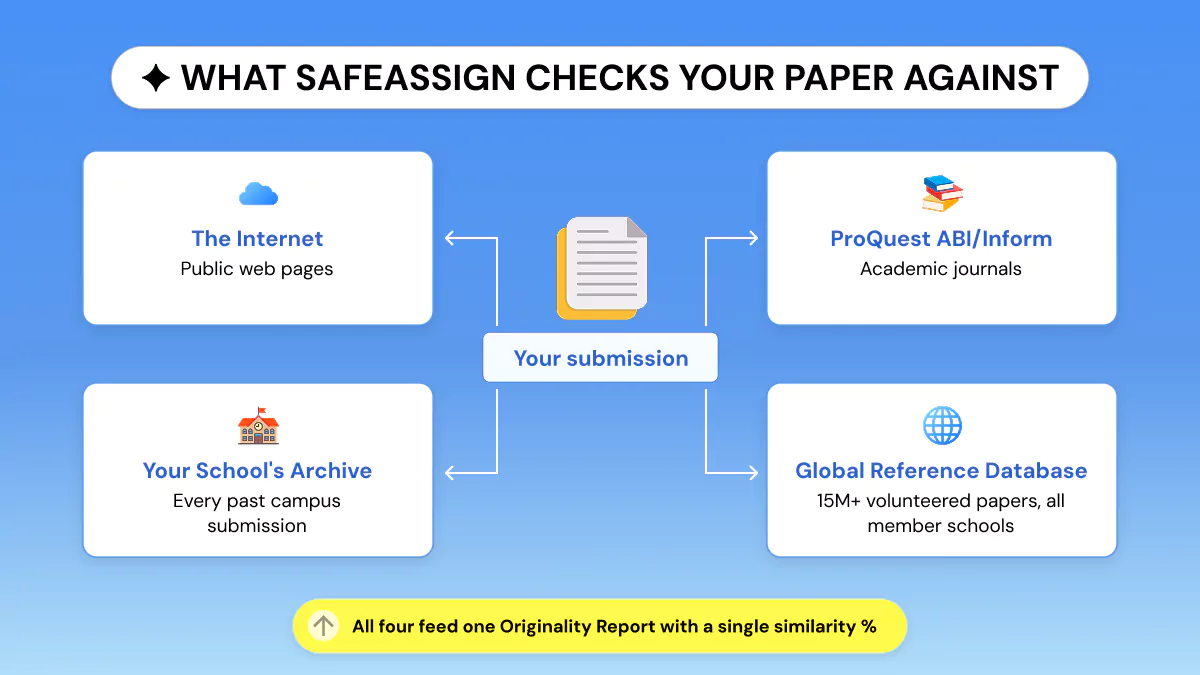
The Global Reference Database is one of four sources SafeAssign checks every submission against. Your paper is compared to all of them in a single scan, and the matches feed one report.
Each source covers a different kind of copying. The internet catches text lifted from websites, ProQuest catches journal content, your school's archive catches campus recycling, and the global database catches everything that crossed between schools.
- The internet, through SafeAssign's own search index of public web pages
- The ProQuest ABI/Inform journal database of academic publications
- Your institution's own archive of every paper previously submitted at your school
- The Global Reference Database of volunteered papers from schools worldwide
Matches from all four combine into the Originality Report: your text with matched passages highlighted, each linked to its source, and an overall similarity percentage. A match from the Global Reference Database shows up the same way an internet match does, so students rarely notice which source caught them. Your instructor always sees it; whether you see it is their setting. Our guide to how SafeAssign checks for plagiarism walks through the full report.
So, Does the Global Reference Database Check for AI? (No, and Here's Why)
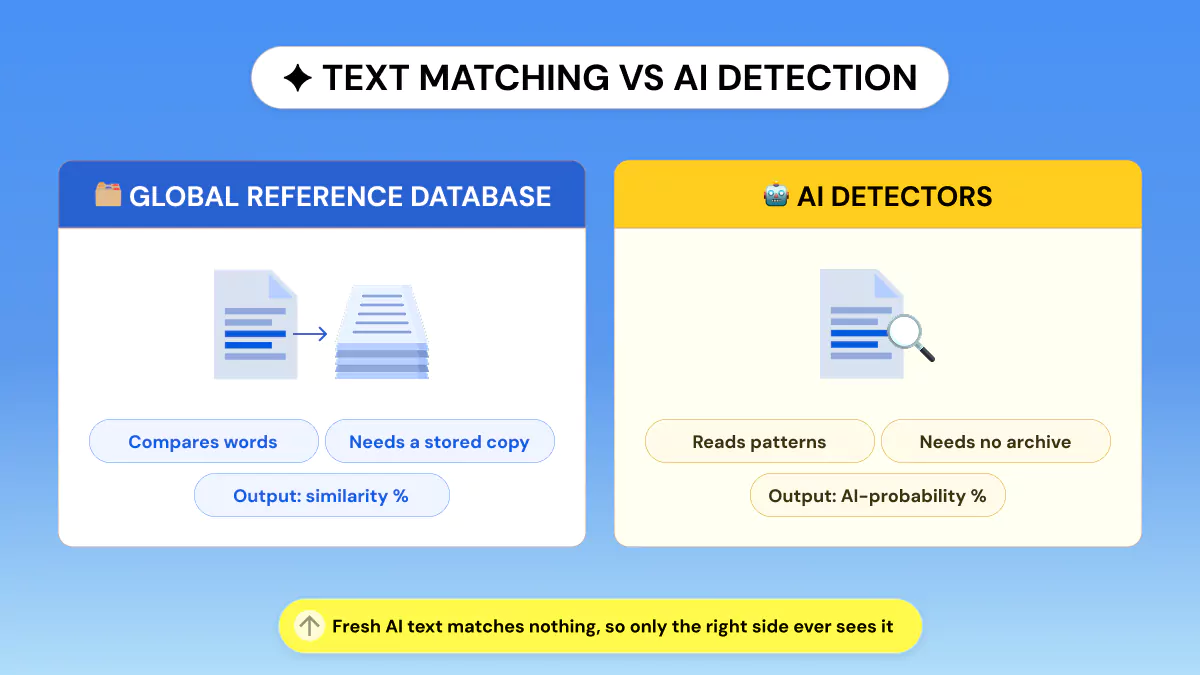
The database matches text; it doesn't analyze it. It compares the words in your paper against words already stored or indexed elsewhere, and flags overlap. AI detection asks a different question entirely: not "have these words appeared before," but "how were these words likely produced." That's a pattern-level judgment the database was never built to make.
This gap is why the question keeps coming up. 4 in 5 university students now use generative AI, per Stanford's 2026 AI Index, and every one of them submitting through Blackboard eventually wonders what the database can actually see.
What AI Detectors Read That the Database Can't
Real AI detectors read for two patterns the database ignores. Perplexity measures how predictable each next word is: AI text runs unusually predictable. Burstiness measures how much sentence length and rhythm vary: humans vary far more than models do.
Neither pattern shows up as a "match," so a text-matching tool has nothing to catch.
Does ChatGPT Text Come Up in the Global Reference Database?
No. ChatGPT's output is generated fresh each time, so it matches nothing in an archive of past student papers. It moves through the Global Reference Database untouched, and the score comes back low, not because the writing passed some AI check, but because there was never an AI check to fail.
The only exception is when the exact same output already sits in the archive because someone submitted it before you.
Does SafeAssign Have Any AI Detection at All?
No, none, as of July 2026, unlike Turnitin with its AI indicator. Our full breakdown of whether SafeAssign detects AI covers that side in depth. Students comparing notes in the Reddit threads that rank for this exact question have reached the same conclusion from experience: SafeAssign scores stay low on pure AI text.
For that answer to change, Anthology would have to ship an actual AI-analysis feature inside SafeAssign, and nothing in its current documentation or roadmap announcements shows one. Until that day, the database stays blind to how your text was made.
A 0% SafeAssign score is not the all-clear. Many instructors copy suspicious passages into a separate AI checker. See what they'd see: paste your draft into Phrasly's free AI Detector. No signup, no word limit.
What the Global Reference Database CAN Catch (Even in AI Work)
The "no" above has four real exceptions, and every one of them has caught students who thought AI made them invisible. The database still flags:
Recycled or purchased essays. An essay bought from a mill was usually sold before. If any earlier buyer's version was archived at any member school, yours matches it. Picture buying a philosophy essay in March that a student in another state submitted in January: your report lights up against a paper you never saw.
Self-plagiarism. Resubmitting your own earlier paper matches the archived copy of it, whether in your school's database or the global one you opted into last year. Reusing your first-year sociology essay in a third-year course reads as a near-100% match to a paper with your own name on it.
Verbatim boilerplate inside AI output. AI often reproduces famous quotes, standard definitions, and textbook phrasing word for word, and those strings live in thousands of archived papers and web pages. Ask ChatGPT to define photosynthesis and the sentence it returns has been submitted a thousand times before.
Classmates using the same prompt. When two students in one course give ChatGPT near-identical prompts, the outputs overlap. Whoever submits second matches whoever submitted first, the moment the first paper hits the archive. Half a seminar pasting the same essay question into the same chatbot ends with a cluster of flagged twins.
The pattern across all four: the database catches text that already exists somewhere, whoever or whatever wrote it. Newness is the only shield it can't see through, and newness is exactly what the next section takes away.
Should You Add Your Paper to the Global Reference Database?
Add it if you want your work protected from being copied; skip it if permanence bothers you. The choice is voluntary either way, and checking your paper works identically whether you opt in or not.
The case for opting in: once archived, anyone at any member school who copies your paper gets flagged against it. That protection is the database's founding purpose, and it costs you nothing at submission time.
It matters most for work worth stealing. A strong capstone paper or a thesis chapter circulating through a shared drive can resurface at another school years later, and the archived copy is what proves you wrote it first.
A quick way to decide: original work you're proud of leans toward yes, anything you might reuse in a later course leans toward no, since your own resubmission would match it.
The honest downside is permanence. You agree at submission not to delete the paper, and there is no self-serve removal; getting a paper out requires a support request to Blackboard, with no guarantee. Treat opting in as a one-way door and decide accordingly.
How Do Instructors Actually Check for AI, Then?
Yes, your instructor can tell you used AI even when SafeAssign shows 0%, because none of their real AI checks run through SafeAssign. Four methods do the work instead.
Separate AI detectors come first: Turnitin's AI indicator where the school licenses it, or standalone tools like GPTZero and Copyleaks that instructors paste passages into. These run outside Blackboard entirely, which is why SafeAssign's silence on AI proves nothing about what happens after.
Second is version history in Google Docs or Word. A document that grew over three evenings of edits looks nothing like a 2,000-word essay appearing in one paste, and instructors know how to open that history.
Third, oral follow-ups: a five-minute conversation about your own argument exposes a ghostwritten paper faster than any software. A student who wrote the essay can defend its weakest claim; a student who pasted it usually can't say why paragraph four exists.
Fourth, voice comparison against your past work, and this one is getting heavy use, because 12% of students now include AI-generated text directly in assessed work, up from 8% in 2025, per HEPI's 2026 Student Generative AI Survey. Instructors know the base rate has changed, so sudden style shifts get noticed.
Our guide to whether schools can detect ChatGPT covers each method in detail, and the same playbook runs outside Blackboard too; students on Canvas face its own version, covered in whether Canvas can detect ChatGPT.
Global Reference Database vs. AI Detectors
One table settles the two jobs side by side. If your worry is copied text, the left column is your tool; if your worry is AI, only the right column ever sees it.
The Global Reference Database does not check for AI, and it never has. It matches your paper against millions of archived documents, so it catches copying, recycling, and repeated AI outputs, while fresh AI text passes straight through.
The trap is reading a low similarity score as full clearance. Plagiarism-clear and AI-clear are different tests, and your instructor has tools for the second one that never touch SafeAssign at all.
The safest work remains writing that is genuinely yours, with AI as drafting help rather than a ghostwriter. Everything in this guide gets easier when the voice on the page is actually you.
Check your paper the way your instructor might: free, unlimited AI detection at Phrasly's AI Detector. And if your AI-assisted draft needs to sound more like you, the Humanizer is one click away.
FAQs
Does SafeAssign check the Global Reference Database automatically?
Only when that source is enabled for the assignment. The internet and your institution's own archive are the standard sources; instructors can also exclude submissions from the institutional and global databases entirely, a setting made before students submit.
Does ChatGPT text show up in the Global Reference Database?
No. ChatGPT generates new text that matches nothing in the archive. The one exception: if someone already submitted the same output and it was archived, later identical submissions match it.
Can I remove my paper from the Global Reference Database?
Not on your own. Opting in includes agreeing not to delete the paper, so removal requires a support request to Blackboard, and it's intended to be permanent. Think before ticking the box.
What SafeAssign score is considered plagiarism?
There's no universal cutoff. As a rough guide, under 15% is typically fine, 15 to 40% deserves a review of your citations, and above 40% signals serious overlap. Your instructor's judgment of the actual matches decides, never the number alone.
Is the Global Reference Database the same as Turnitin's database?
No. They're separate archives owned by different companies: Anthology runs the Global Reference Database, Turnitin runs its own repository. Turnitin also offers an AI indicator; SafeAssign has no AI detection.
Can my instructor tell I used AI if SafeAssign shows 0%?
Yes. A 0% score only means nothing matched stored text. Instructors detect AI through separate detectors, document version history, oral follow-ups, and changes from your usual writing voice.


Keep reading

Walter Writes AI Detector Review 2026: Does It Actually Work?
Walter Writes AI Detector works on pure AI text but struggles with humanized content. Add billing complaints and a 2.4 Trustpilot score, and better free alternatives like Phrasly or GPTZero make more sense.
Pangram AI Detector Review: How Accurate Is It Really?
Pangram AI Detector delivers near-zero false positives, independently verified by University of Chicago researchers. With 99.8–100% accuracy, LMS integrations, and AI-assist detection, it's the top choice for educators and institutions.