
Pangram AI Detector Review: How Accurate Is It Really?
Pangram AI Detector delivers near-zero false positives, independently verified by University of Chicago researchers. With 99.8–100% accuracy, LMS integrations, and AI-assist detection, it's the top choice for educators and institutions.
Pangram AI Detector is an AI detector backed by research and has one of the lowest false positive rates in the market.
Pangram was independently tested by researchers at the University of Chicago Booth School of Business and achieved 100% accuracy on most AI models and never dropped below 99.8%, making Pangram one of the most accurate detectors on the market.
This review includes all the information you need to know before buying into this tool: accuracy testing results, price breakdown, ideal users, integrations, workflow, unbiased pros and cons, and how it stacks up against alternatives like GPTZero and Originality.ai.
So whether you’re a teacher considering it for your students, a content moderator researching your options, or a student curious about what detector your school will use, we’ve got you covered.
What Is Pangram AI Detector?
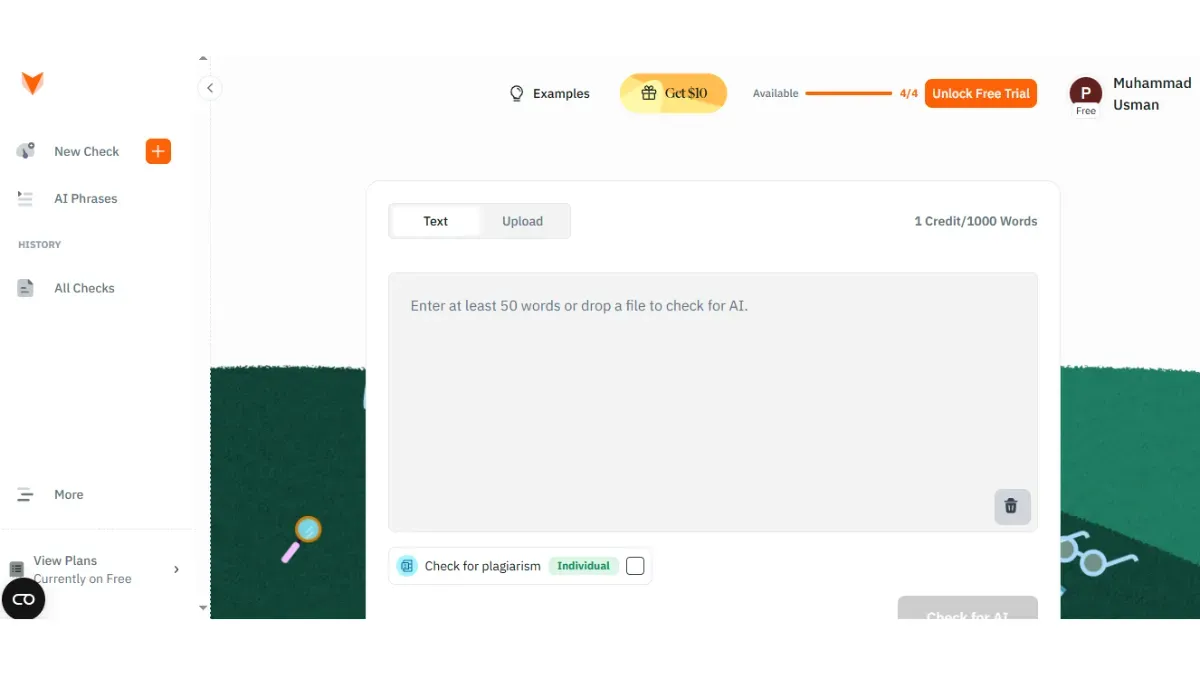
Pangram AI Detector (often called Pangram Labs AI detector) is an AI detection platform founded on research and built for teachers, publishers, and trust and safety teams.
Powered by a multi-step model training process, Pangram detects AI-generated text, even rewritten, lightly edited, or humanized content, using explainable, sentence-level detection signals.
Developed by former Tesla and Google engineers, Pangram AI Detector has been independently validated by studies from the University of Chicago Booth School of Business and the University of Maryland, third-party verification that few, if any, AI detectors can boast.
Pangram AI Detector is intended for K-12 and higher-education educators, content publishers, HR and trust teams, and academic researchers who require trustworthy, explainable results at scale.
Key Features at a Glance
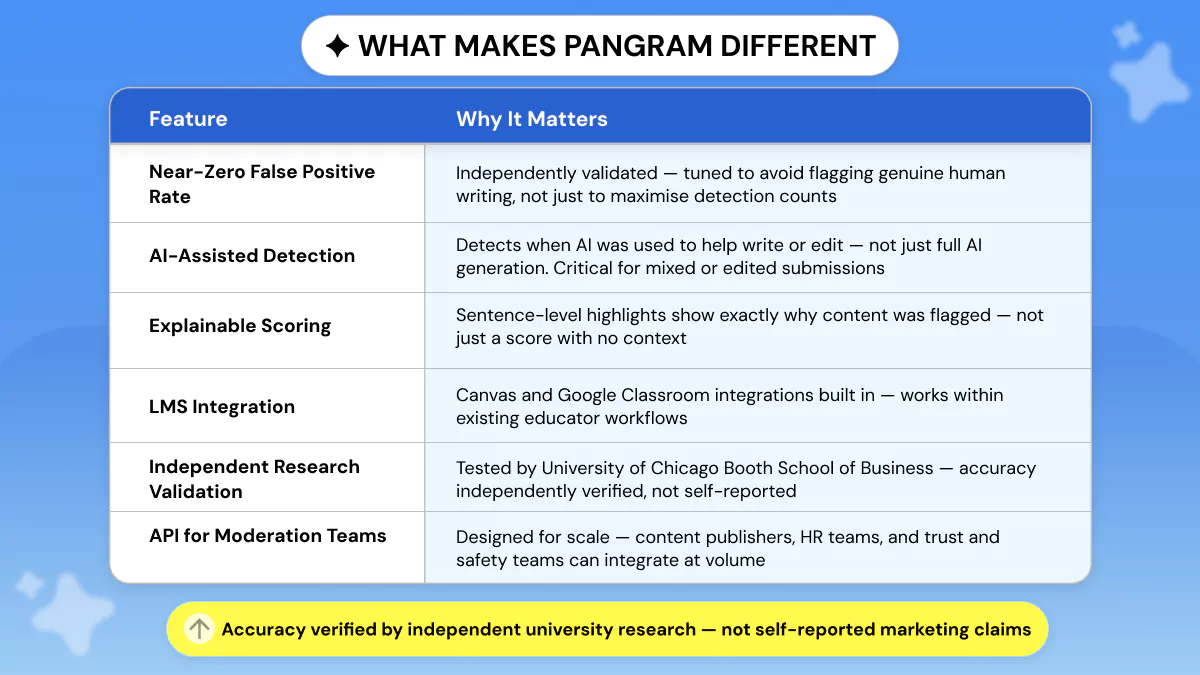
- Near-zero false positive rate: Independently verified, meaning genuine human writing is almost never flagged as AI-generated.
- AI assistance detection: Goes beyond full AI generation. Identifies text where AI was used to assist with editing or rewriting.
- Explainable scoring: Sentence-level highlights show exactly which parts of a document triggered the detection signal.
- Multilingual detection: Supports 20+ languages: significantly wider than most competing tools.
- Platform integrations: Chrome extension, Google Docs support, Canvas and Google Classroom LMS integrations, and API access for enterprise moderation teams.
- Document upload: Accepts PDF, DOCX, and RTF file formats for bulk checking.
How Accurate Is Pangram AI Detector?
Pangram AI Detector is among the most precise AI detectors available.
In independent testing by the University of Chicago Booth School of Business, Pangram AI Detector achieved 100% accuracy against most AI models, dipping no lower than 99.8%, while sustaining an extremely low false positive rate.
Pangram AI detector is a high-accuracy product that surpasses most others in this space. Pangram AI Detector is more accurate than any other comparable tool when operating under stringent false-positive requirements, according to verified third-party research.
Its key result: set the permissible error margin extremely low to simulate conditions for institutional use cases where false accusations have serious consequences, and false positive rates for other detectors skyrocketed.
Pangram AI Detector remained consistent. That’s what makes the difference between Pangram and the accuracy claims other tools just make about themselves.
This is especially important given how often strict detectors mistakenly flag human writing as AI. A real risk that institutions simply can't afford.
Live Test Results: What We Found
We ran three live tests using a real Pangram free trial account:
|
Test Type |
Input |
Pangram Score |
Verdict |
|
Test 1 |
ChatGPT-generated paragraph |
97–100% AI |
Correctly flagged |
|
Test 2 |
Human-written paragraph |
2–4% AI |
Correctly cleared |
|
Test 3 |
Lightly rewritten AI text |
74–88% AI |
Partially flagged with
highlights |
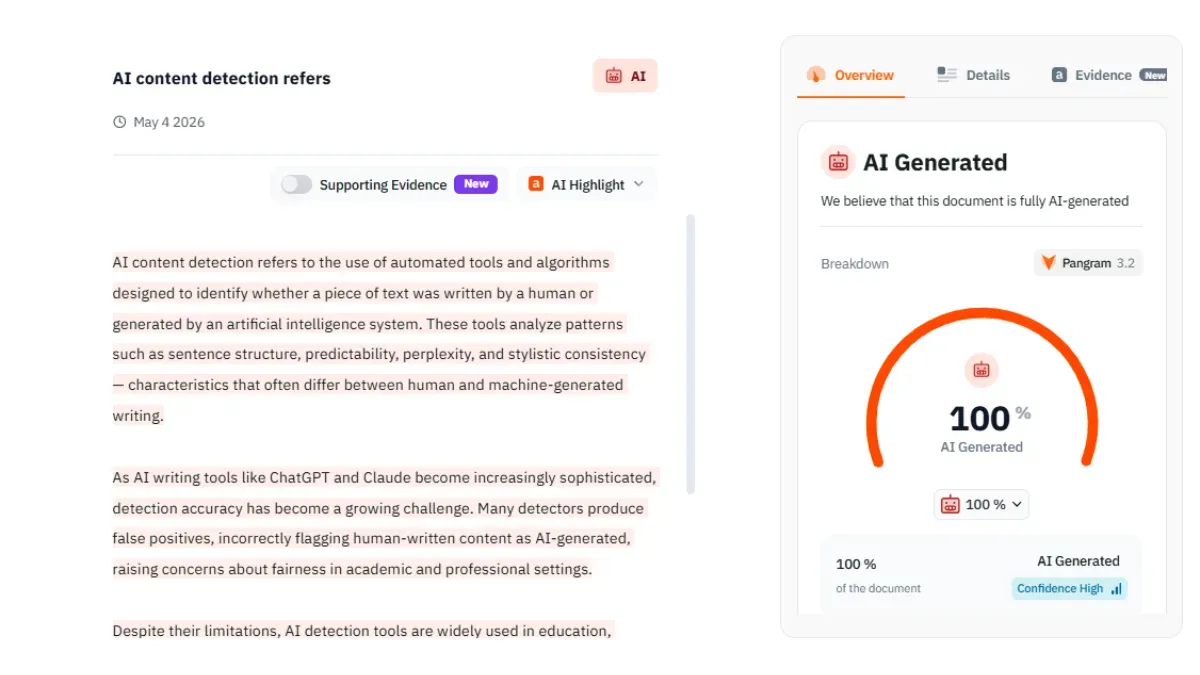
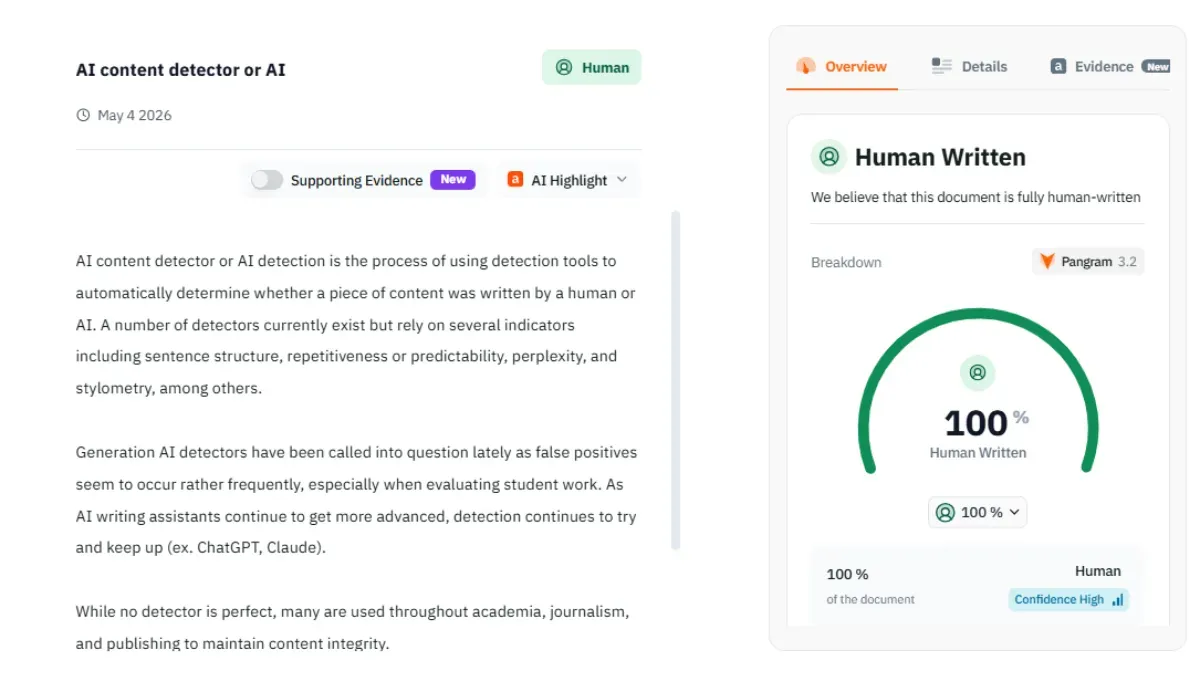
AI-Assisted Detection: Pangram's Standout Feature
AI-assisted detection is what sets Pangram apart from the majority of tools. It's not just about detecting content that was solely written by AI; it detects when AI was used to help edit, polish, or rewrite. The gray area that every other detector gets fooled by.
This matters because most humanizers only swap words at the surface level. Detectors like Pangram are built to catch exactly that.
For a deeper look at why surface-level rewriting fails, this guide on why AI humanizers don't work explains what detectors are actually measuring.
As educators who need to assess students' work, this matters: you have a student who writes a paper, then copies and pastes it into ChatGPT to "tidy it up". Easily slips past most tools, but Pangram doesn't.
No detector is 100% accurate under all circumstances. There are edge cases. (One area that's prone to false positives is very formal/academic text that happens to echo the cadence of AI-generated text.)
However, Pangram's accuracy has been validated by third parties. That's a much stronger endorsement than you'll get from the makers of competing products, who just give themselves high scores.
Pangram Pricing: Is It Free?
Pangram has a free trial with 4 credits per day. Just enough to try the tool but not enough for continuous use. Plans start at about $20/month for 600 credits. Each credit allows you to moderate up to 1,000 words.
Pricing for institutions and APIs are available for teams with higher volume needs.
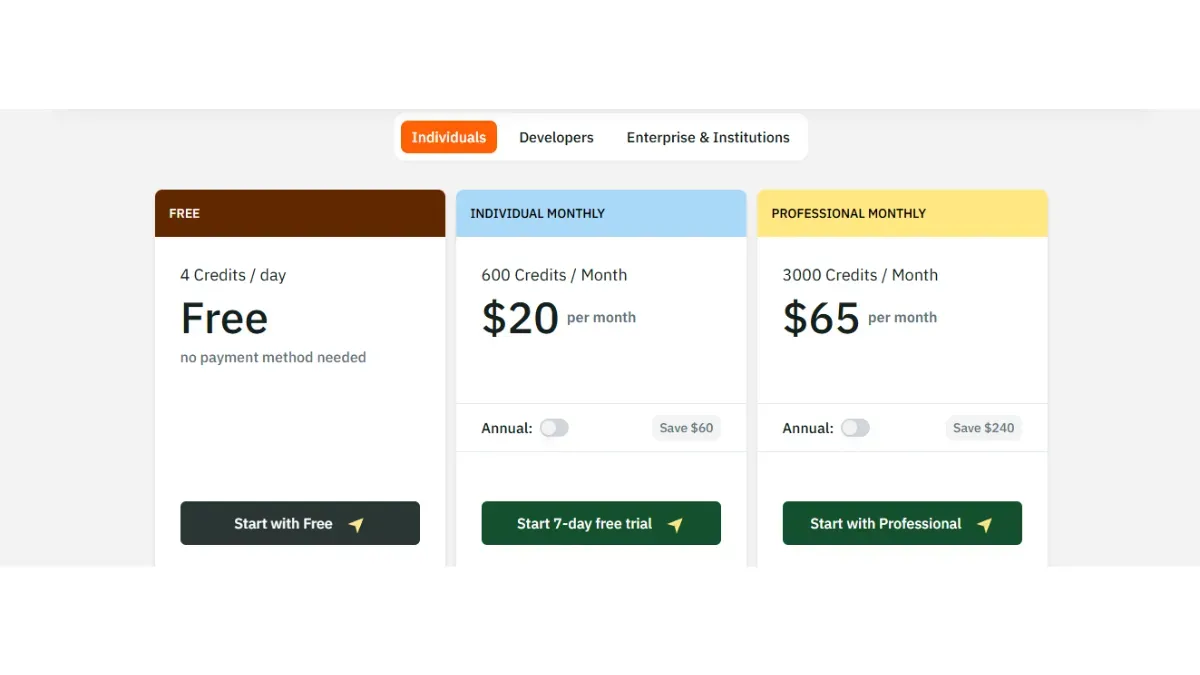
At $20/month, Pangram is in the same price range as Originality.ai; however, Pangram produces fewer false positives, which is significant when plagiarism detection is being used in institutions and a false positive could have professional/ethical consequences.
If you're using it every now and then for personal use/school essays, it's hard to justify when there are free options.
Pros and Cons of Pangram AI Detector
Pros
- Independently validated near-zero false positive rate. Backed by University of Chicago Booth School of Business research, not just self-reported claims.
- Detects AI-assisted writing, not just full AI generation. Critical for catching hybrid human/AI content that other tools miss.
- Explainable scoring with sentence-level highlights. Educators can show students exactly which passages triggered the flag.
- Native LMS integrations. Canvas and Google Classroom support make it workflow-friendly for institutional adoption.
- Chrome extension and Google Docs support for flexible, in-context checking.
- API access for content moderation teams needing programmatic integration.
- Multilingual detection across 20+ languages: unusual reach for this category.
Cons
- No unlimited free tier. Paid plan required for any regular use beyond the 4 daily trial credits.
- Can flag formal academic prose. Highly structured or technical writing can occasionally produce elevated AI scores even when human-written.
- It Won't replace human judgment in ambiguous edge cases. Results should inform decisions, not replace them.
- Credit-based pricing is less practical for occasional consumer use. Individual content creators or students with low-volume needs may find the cost-per-check model inefficient.
Try Phrasly AI Detector Free: No Credits, No Signup 👇
If Pangram's credit-based pricing isn't the right fit, Phrasly offers free, unlimited AI detection with no credits, no signup, and no monthly cost.
Phrasly also includes an integrated humanizer + detector. Phrasly is built for creators and students who need both tools in one place.
Pangram Vs Other AI Detectors
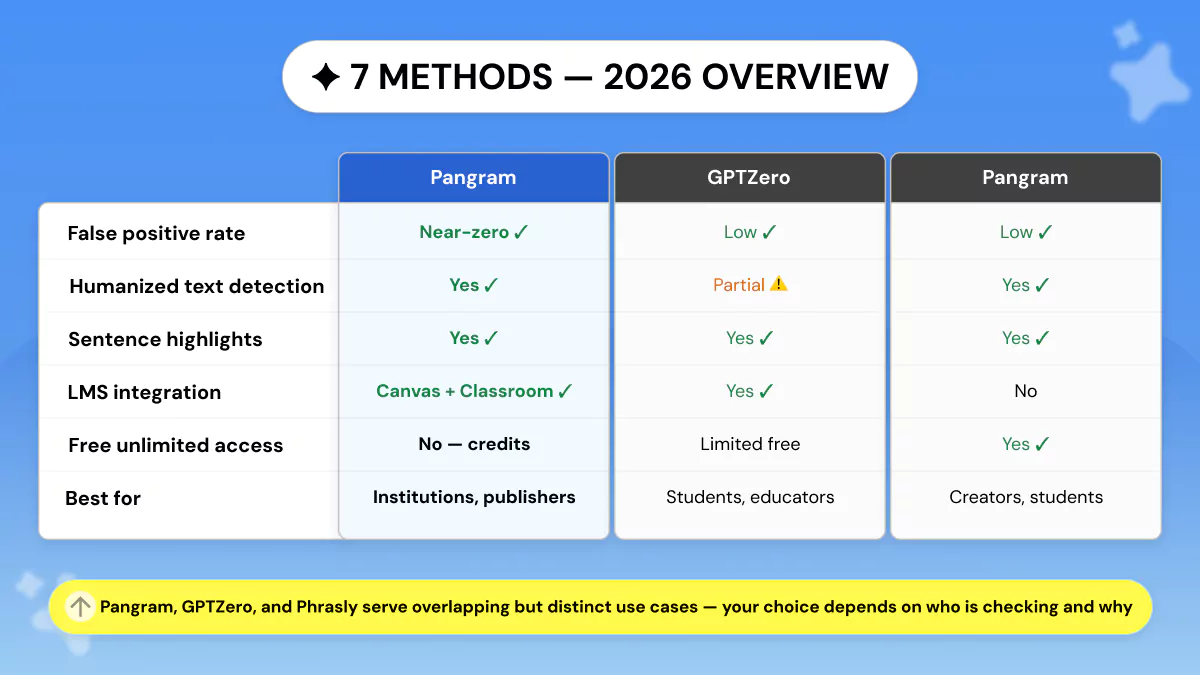
Pangram AI Detector scores highest among competitors in both false positives and humanized text detection. The primary reason not to use Pangram over a free alternative is the credit-based pricing model.
Below is a straightforward comparison of the three most commonly compared tools.
Pangram Vs GPTZero
The more widely known consumer-facing tool is GPTZero (which offers a free tier). Pangram AI Detector is more accurate when operating under stringent false positive restrictions and is engineered for enterprise-scale deployments.
If you're looking for a tool for individual use, GPTZero has a lower barrier to entry; if you need something defensible for institutional use where false detections matter, Pangram is the better choice.
Pangram is better than GPTZero for institutional use, based on independent testing. For occasional personal use, GPTZero's free access is a significant practical advantage.
Pangram Vs Originality.ai
Originality.ai takes a more aggressive approach to detection. It is calibrated to flag AI content at lower confidence thresholds, which increases its catch rate but also increases its false positive rate.
Pangram's design philosophy runs in the opposite direction. It prioritizes minimizing false positives even if it means some borderline content slips through.
If you're a publisher or teacher for whom accusing an innocent author/student is worse than missing some plagiarists, Pangram's technology more closely matches your institutional requirements.
Pangram Vs Phrasly
Pangram AI Detector and Phrasly operate in markets that intersect but are legitimately different. Pangram targets institutions: paid, API-first, with LMS integrations for teachers and moderation teams.
Phrasly targets creators and students: free, unlimited, built around a humanizer + detector workflow for regular content creation.
If you're a creator looking to understand which humanizer actually holds up under modern detectors, this tested comparison of the best AI humanizer tools in 2026 is worth a read before you commit to any tool.
Think of these tools as complementary instead of competitors. Pick the right tool for your use case, not based on some abstract metric of which is 'better'.
|
Feature |
Pangram |
GPTZero |
Originality.ai |
Phrasly |
|
Free Tier |
4 credits/day trial only |
Yes (limited) |
No |
Yes, unlimited |
|
Verified Accuracy |
99.8–100% (Chicago Booth) |
Self-reported |
Self-reported |
Self-reported |
|
False Positive Rate |
Near-zero (verified) |
Low-moderate |
Moderate-high |
Low |
|
AI Assist Detection |
Yes |
Partial |
Partial |
Yes |
|
LMS Integration |
Canvas, Google Classroom |
Canvas |
No |
No |
|
Humanizer Included |
No |
No |
No |
Yes |
|
Best For |
Institutions, publishers |
Students, casual users |
Content publishers |
Creators, students |
Final Verdict: Is Pangram AI Detector Worth It?
Pangram's AI Detector is among the most accurate and trusted AI detectors on the market today.
With independently validated accuracy metrics, explainable sentence-level scoring, seamless LMS integrations, and robust AI-assisted writing detection, Pangram is the most powerful institutional-grade option available.
Best for: K-12 and higher-education educators, content moderation teams, academic researchers, and publishers with high submission volumes. Any context where a false accusation carries real professional or ethical weight.
Not the best fit for: Students checking individual essays before submission (free alternatives like Phrasly are entirely sufficient), or individual content creators with low-volume needs where credit-based pricing is inefficient.
Frequently Asked Questions
Is Pangram AI Detector free?
Pangram has a free trial, allowing you 4 credits per day, which allows you to test drive the tool but not actually use it regularly. Plans start around $20/month for 600 credits, or 1 credit equals up to 1,000 words.
How accurate is Pangram AI Detector?
Verified by independent testing from the University of Chicago Booth School of Business, Pangram has 100% accuracy on most AI models and has never tested below 99.8% with a near-zero false positive rate.
What's the false positive rate of Pangram?
Pangram is designed and has been third-party tested to achieve a false positive rate as close to zero as possible.
False positives (flagging actual human writing as AI) just aren't acceptable for institutional adoption, where falsely accusing someone of using AI would have serious repercussions.
Does Pangram detect humanized AI text?
Yes! Pangram's AI-assistance detection detects AI-assisted content, where AI was used to help edit or rewrite something rather than something written completely by AI.
This means it catches lightly reworded/generated AI content that other detectors don't catch.
Is Pangram better than GPTZero?
Yes, independently tested. Pangram beats GPTZero when it comes to false positives while operating under strict accuracy requirements. This matters for institutional/professional use.
If you're weighing your options more broadly, this breakdown of the best AI checker tools covers how Pangram stacks up against the wider field.
GPTZero's free tier is good enough for rare/noncommittal personal use, something Pangram's credit system can't compete with.
Does Pangram work with Google Docs and Canvas?
Yes! Pangram is available on Google Docs through a Chrome extension and is native to Canvas and Google Classroom LMS systems, allowing for easy deployment at schools and universities that already use these applications.
Is Pangram safe for student use?
Pangram is intended for teachers and institutions, not individual students. However, students can try it out to see what a detector might catch in their own writing.
If you're a student looking for a way to check your work before you turn it in, Phrasly's free AI detector may be a better fit.
Can Pangram catch reworded AI content?
Yes! This is Pangram's strongest feature. The AI-assisted writing detector is designed to catch content that has been rewritten, paraphrased, or slightly edited through AI tools.


Keep reading

What Are Common Phrases That AI Uses? We Tested 50 Pieces to Find Out
We ran 50 pieces of content through Phrasly's AI Detector to find out what are the common phrases that AI uses.

The Content Strategist's Workflow for AI-Assisted Production
A sound AI content workflow puts humans at the brief and expertise stages, letting AI handle outlining and drafting, then routes every piece through fact-checking, plagiarism, and AI-flatness QA gates before it can be published.