
JustDone AI Review 2026: Is the Detector Actually Accurate? (We Tested It)
We put JustDone AI's detector to the test in 2026. Here's exactly what we found and why it matters before you pay.
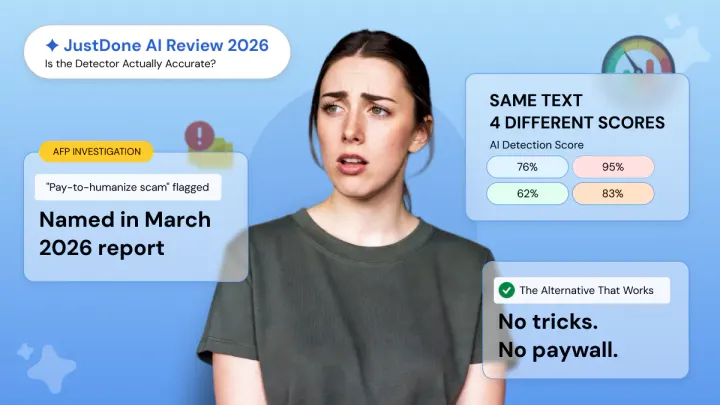
In March 2026, Agence France-Presse, one of the world's three largest news agencies, named JustDone AI in an investigation into fraudulent AI detectors and the pay-to-humanize scam pattern behind them.
We decided to put it to the test ourselves.
We ran multiple experiments across different types of content to see how the detector actually holds up. The results were eye-opening.
Here's what we found.
Is Justdone AI's Detector Accurate?
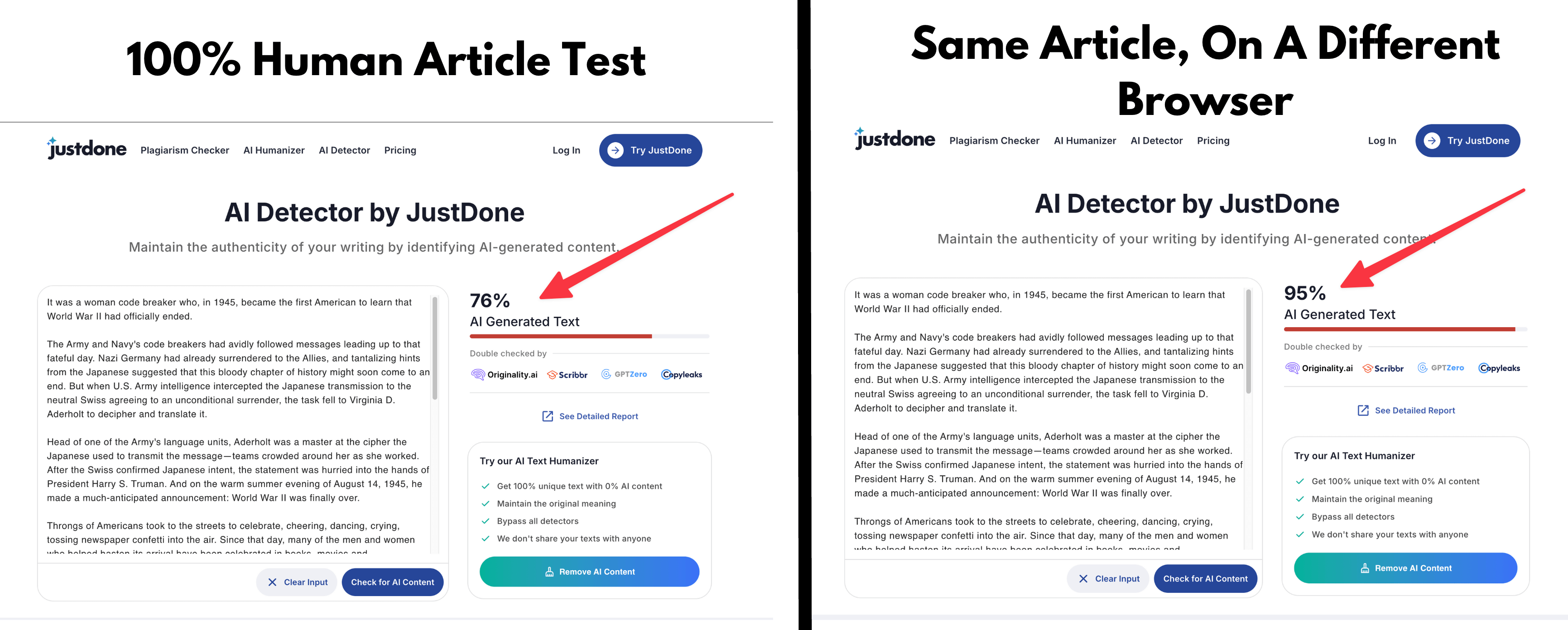
Our testing revealed troubling inconsistencies with Justdone AI's detector. Using a passage from a magazine (published 2017 before the wide adoption of AI) - which is 100% human-written - Justdone AI produced dramatically different results:
- Standard browser test: 76% AI probability
- Different browser test: 95% AI probability
- Second standard browser test: 62% AI probability
- Second incognito test: 83% AI probability
Why the inconsistency is a red flag
Legitimate AI detectors are built around two core signals and understanding AI detector accuracy starts with knowing what those signals are.
A reliable tool that measures both consistently and the score, should stay stable regardless of which browser you use, what time you run the test, or how many times you submit the same paragraph.
JustDone's wildly inconsistent scores suggest it is not measuring either of these signals in any meaningful way.
Independent findings back this up
This isn't the first time someone has caught this. There are several Reddit posts documenting the same pattern. One user noted that typing a single word into the detector returned a 92% AI score.
AFP's fact-check, published March 30, 2026, confirmed the false positive problem at a much larger scale. AFP (Agence France-Presse) is one of the three largest news agencies in the world, when its fact-checkers test a tool and publish findings, that is not an opinion. It is documented, cross-language evidence.
When AFP presented these findings directly to JustDone, the company acknowledged that its free version "may provide less precise results" due to "high demand and the use of a lighter model designed for quick access."
Our verdict
We cross-checked our test passage with GPTZero, a reputable AI detector, and received 0% AI across multiple attempts, confirming the content was human-written.
The fact that two tools analysed identical text and produced opposite conclusions is not a grey area, one of them is not doing any real analysis, and the one returning random scores is not GPTZero.
As of April 2026, our position is unchanged: JustDone AI's detector results appear randomly generated, with no reliable analysis of the text underneath. That is not a minor accuracy gap. It is a fundamental reliability problem.
We Tested 3 Human-Written Paragraphs in JustDone
To assess whether JustDone AI's detector performs any real text analysis, we ran three human-written passages through it independently.
If the tool were doing genuine analysis, the scores should reflect the actual content.
We used human-written content from the US newspaper The New York Times, specifically articles published before 2010, well before the widespread adoption of AI writing tools.
The results were consistent with everything we had already documented.
Test 1: 94% AI flagged
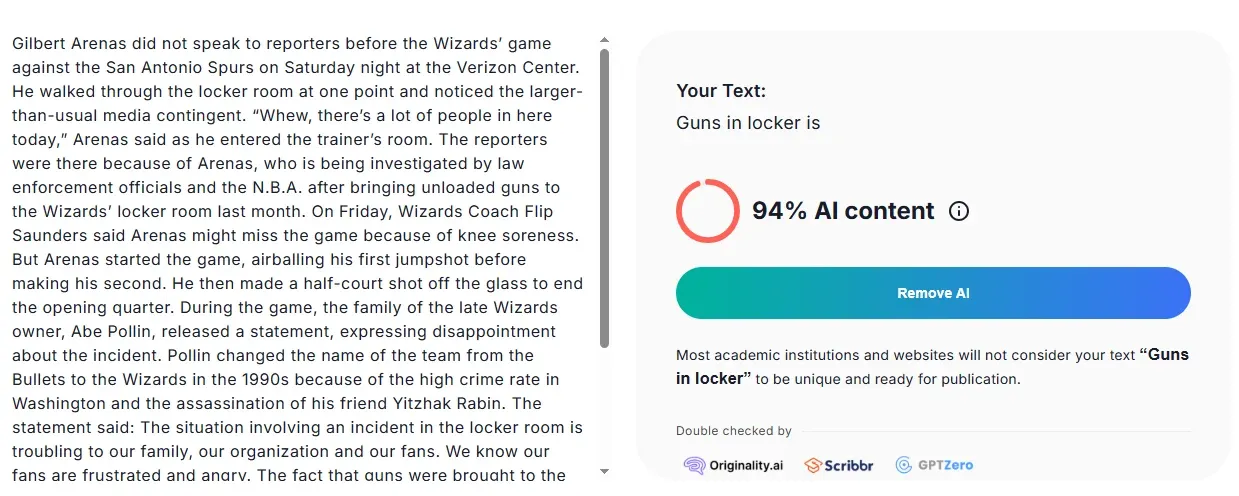
The first passage, taken directly from a news report, was flagged as 94% AI-generated. The writing was straightforward journalistic prose with no unusual patterns, no statistical anomalies, and no AI authorship of any kind.
Test 2: 93% AI flagged
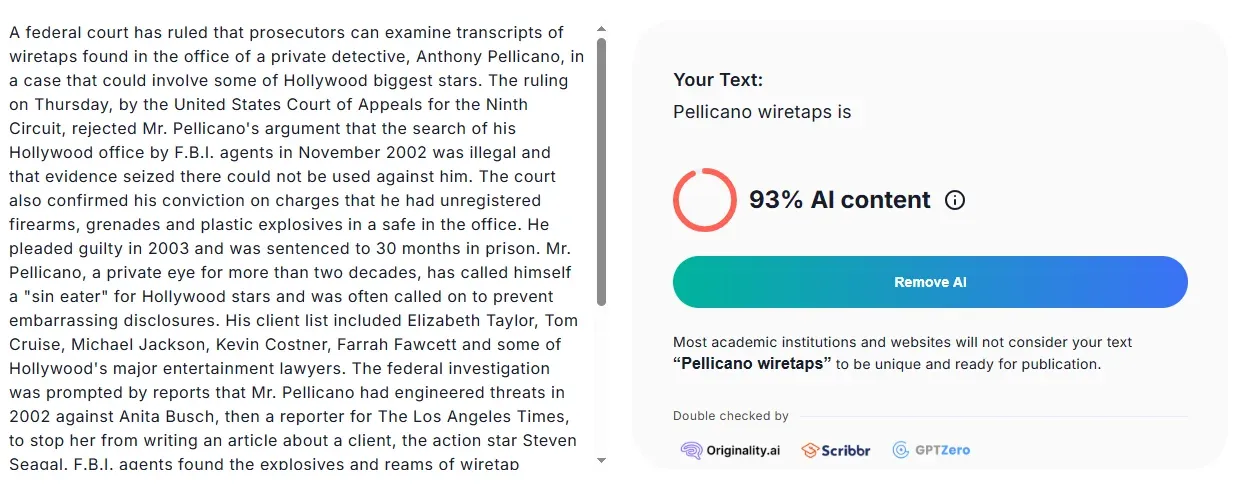
The second passage returned a 93% AI score. Again, the content was verifiably human-written, published years before tools like ChatGPT existed at scale.
Test 3: 73% AI flagged
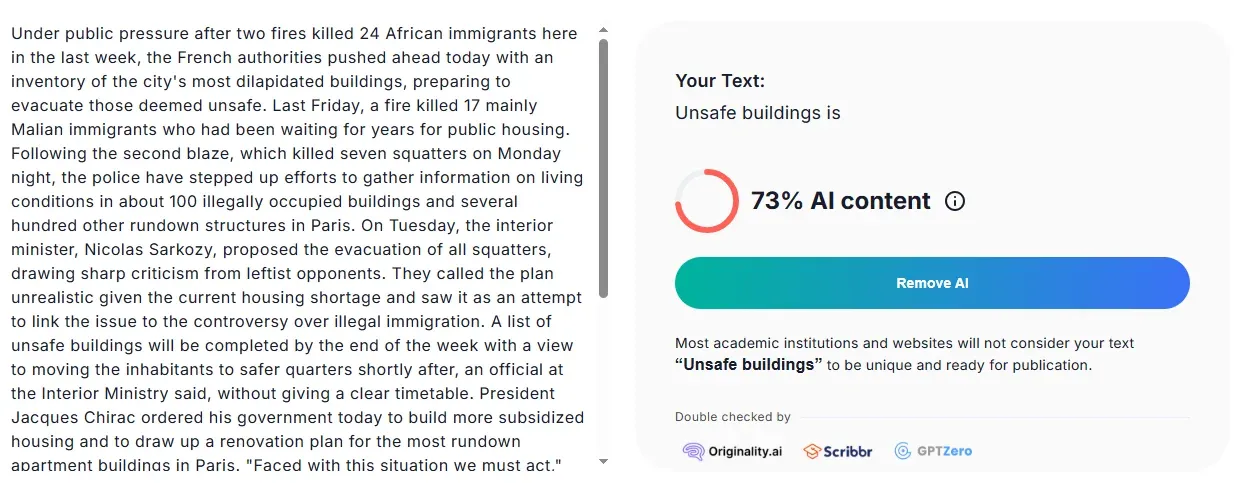
The third passage scored 73% AI. Across all three tests, JustDone failed to correctly identify a single human-written paragraph as human.
Every passage was 100% human-written. Every passage was wrongly flagged.
A detector that cannot pass a basic human-written content test is not a detector. It is a false positive machine with a paid humanizer waiting on the other side.
Try a Detector That Actually Works on Human Writing
Is JustDone AI a Scam? What AFP's Investigation Found
Our own testing raised serious concerns about JustDone AI's detector. We found a tool that flags human writing as AI at high rates and does so inconsistently, which are two problems that should not exist in the same product.
In March 2026, one of the world's largest news agencies arrived at the same conclusion independently.
What AFP tested and how
AFP's fact-checkers ran verified human-written samples through JustDone and two other detectors across four languages: Dutch, Greek, Hungarian, and English.
The language variety matters here. It rules out the possibility that JustDone simply struggles with one writing style or regional vocabulary.
Every single sample was wrongly flagged as AI-generated, including passages from an acclaimed 1916 Hungarian literary classic that predates computing itself.
AFP also found that JustDone returned high AI scores even for completely nonsensical text, which makes it clear the tool is not reading what you submit.
The pay-to-humanize scam pattern
The AFP investigation identified something more troubling than simple inaccuracy.
When JustDone processed a human-written report about the US-Iran conflict, it returned an 88% AI verdict and immediately offered to fix the problem for a fee of up to $9.99.
The site told users their text was "humanizing" and placed what it called "100% unique text" behind a paywall.
This is the pay-to-humanize scam pattern in its clearest form: flag the content as AI, then sell the cure.
What the experts say
Debora Weber-Wulff, a Germany-based academic who has spent years researching AI detection tools, told AFP directly: these are not detectors but scams designed to sell a humanizing tool that produces what she calls "tortured phrases," meaning unrelated jargon or nonsensical rewrites that distort the original meaning of the text.
The real-world consequences of this go beyond wasted money. When a flawed detector is used as evidence, the damage lands on real people, not on the tool.
Earlier this year in Hungary, pro-government influencers circulated JustDone screenshots on social media to support a false claim that an opposition party's election campaign document had been entirely AI-generated. The claim was unfounded.
The document was human-written. JustDone flagged it as AI anyway, and that screenshot was enough to fuel a political disinformation campaign.
The screenshots from a tool that flags everything as AI were enough to spread the allegation.
JustDone's own response
For balance, JustDone did respond to AFP's findings.
The company reiterated that no AI detector can guarantee 100% accuracy and acknowledged that its free version may produce less precise results due to high demand and the use of a lighter model built for quick access.
That response does not address the offline functionality concern or the monetisation pattern AFP documented.
JustDone AI Pricing 2026 — Is It Worth It?
JustDone AI's pricing has changed since we last reviewed it in April 2025. Here is what the plans look like in 2026:
The annual plan looks reasonable at first glance. But the pricing only makes sense once you understand what it is actually built around.
The freemium funnel in practice
The free detector is not a standalone product. It is the entry point into a paid ecosystem. You do not need to pay to use the detector.
You feel like you need to pay after you see the results.
JustDone's free version flags your content as AI-generated, often inaccurately as both our testing and AFP's March 2026 investigation confirmed, and the paid plans are then positioned as the fix.
The free tool manufactures a problem. The paid tool charges you to solve it.
Every paid plan bundles access to JustDone's AI Humanizer alongside 35 other tools. The detector alone is never what you are actually paying for.
How it compares
Phrasly's flat $19.99 per month includes a consistent, accurate detector with no upsell loop built into it. There is no free tool designed to scare you into upgrading. The detector works, and the pricing reflects the full product from the start.
JustDone's equivalent monthly plan costs the same but relies on a detection model that AFP independently found unreliable.
How to cancel JustDone
You can cancel anytime from your account settings or by emailing [email protected]. If you signed up on the $2.00 trial, cancel at least 24 hours before the 7 days are up or you will be automatically charged the full $39.99 monthly rate.
Is JustDone AI Ethical?
JustDone's free detector flags content as AI-generated, frequently and inaccurately, and the paid humanizer then offers to fix it. That sequence is not a coincidence.
It is the structure the entire product is built around.
The detector creates the problem. The product sells the cure. AFP's March 2026 investigation confirmed this pattern: JustDone labeled a human-written report as 88% AI-generated, then directed the user to a $9.99 paywall.
AFP also found the tool appeared to function without an internet connection, suggesting results may be scripted rather than based on real text analysis.
In Hungary, pro-government influencers used JustDone screenshots to falsely claim an opposition election document was AI-generated.
The tool did not distinguish between a fabricated accusation and a genuine detection. It just returned a high score, as it does for almost everything.
The claim was unfounded. It has been confirmed by one of the world's most respected news agencies.
JustDone AI Humanizer Review — Does It Actually Work?
The JustDone AI Humanizer is the product the entire platform is built around. The detector brings users in. The humanizer is what they are actually being sold.
It claims to rewrite AI-generated content so it reads more naturally, adjusting rhythm, tone, word choice, and sentence flow while keeping the original meaning intact. There are three modes available in 2026:
- Sound Human: Surface-level adjustments that preserve most of the original phrasing
- Auto: A balanced approach between rewriting depth and meaning preservation
- Bypass Detectors: Aggressive restructuring designed specifically to pass AI detection tools
The Bypass Detectors mode is worth pausing on. A humanizer with a mode explicitly built to fool detection tools is a product that has accepted unreliable detection as a given, including its own.
Does the humanizer actually work?
In testing, the paid humanizer performs better than the free detector.
That is a low bar given what the free detector produces. A tool that scores higher than random is not the same as a tool that works reliably enough to trust with academic or professional content.
JustDone's own FAQ acknowledges that humanizing can reduce AI-like patterns but states that "no tool can guarantee undetectable AI," which is an honest caveat but also confirms the humanizer is not a clean fix.
User reviews on a major consumer review platform, which currently has around 6,400 JustDone reviews and a 4.3 score, tell a more mixed story. The positive reviews tend to focus on the broader writing tools. Complaints cluster specifically around the detector and humanizer, which are the two features most users sign up for.
- One reviewer noted the humanizer "distorts some sentences and misrepresents the content." That is a meaningful problem for students and academics, where altering the meaning of a sentence is not a cosmetic issue.
- Others reported that rewritten text still returned AI-like results after processing.
The Bigger Issue
The humanizer working reasonably well does not resolve the ethical problem. If JustDone's free detector were accurate, most users would never need to pay for humanization in the first place. The paid tool exists because the free one produces false positives by design.
We Tested JustDone AI Humanizer on 3 AI-Generated Paragraphs (2026)
We generated three paragraphs using ChatGPT-5.3 and ran them through JustDone AI's humanizer. JustDone offers three humanizer modes — Auto, Sound Human, and Bypass Detectors — and we tested all three to evaluate how the output actually changes.
Example 1 — Academic Writing (Mode: Auto)
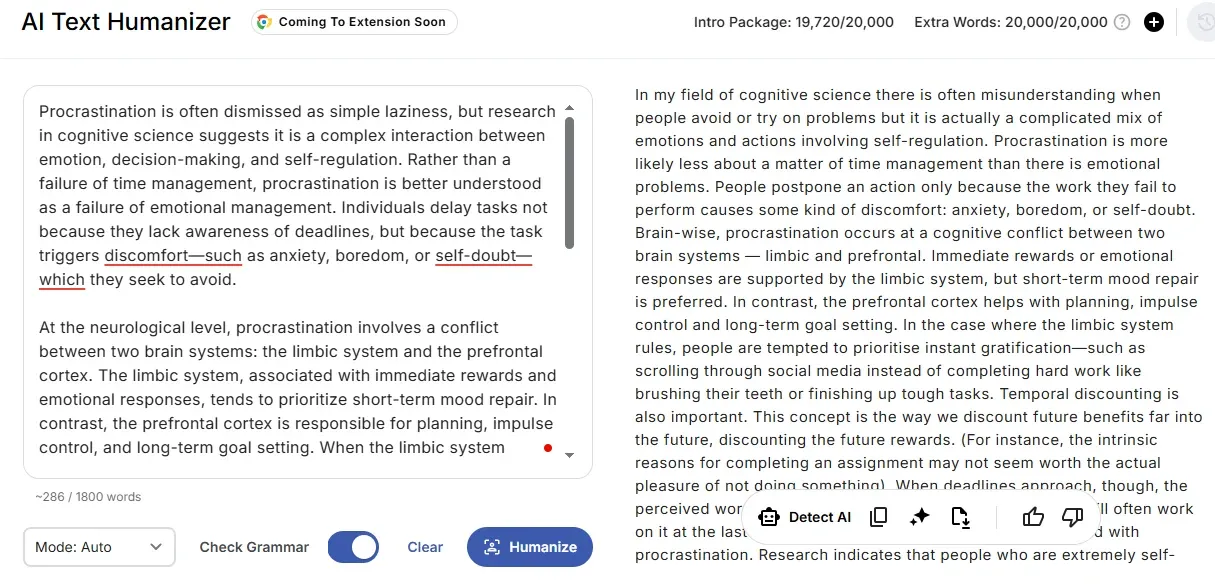
What changed:
- Sentence structure became fragmented and repetitive
- Tone shifted from formal and precise to inconsistent and awkward
- Phrases became unnatural and redundant
- Minor meaning distortion in cognitive concept explanations
Example 2 — Blog / Marketing Style (Mode: Sound Human)
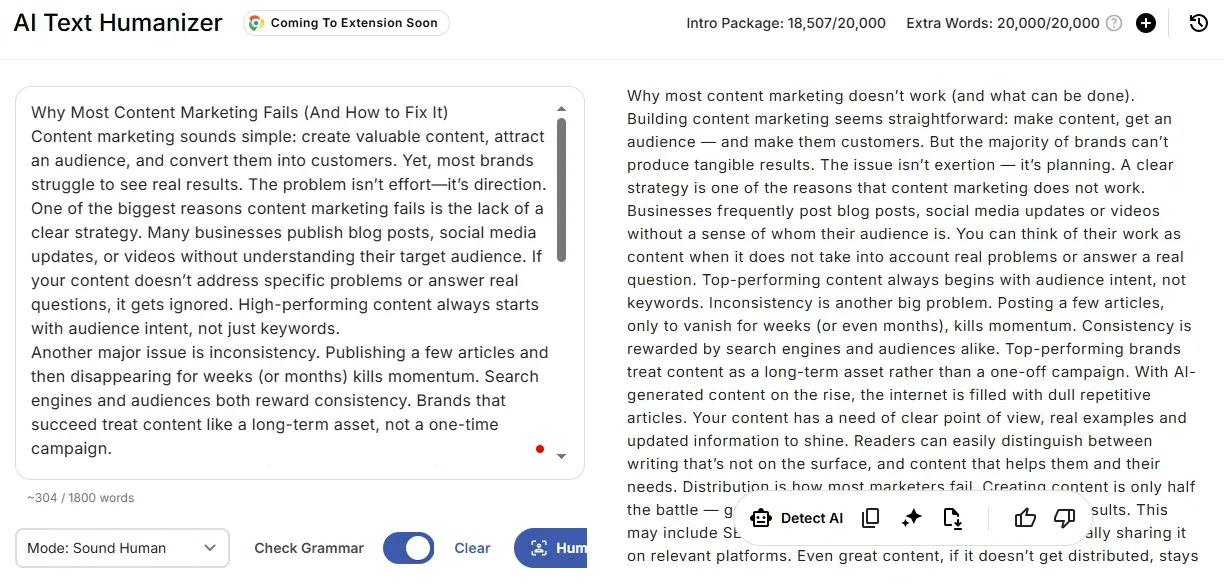
What changed:
- Slightly more conversational tone but with inconsistent flow
- Sentences became grammatically awkward or overly reworded
- Redundant phrasing and unnatural expressions appeared throughout
- Readability declined despite the lighter rewriting mode
Example 3 — Simple / General Writing (Mode: Bypass Detectors)
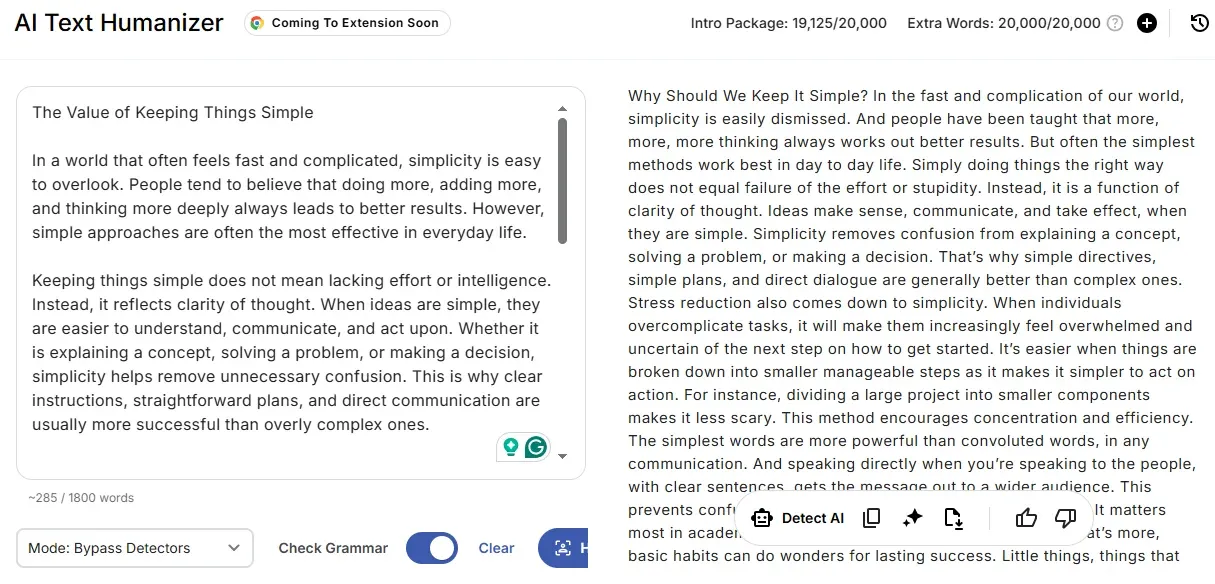
What changed:
- Clarity decreased significantly despite simpler input
- Multiple unnatural phrases introduced throughout
- Sentence flow became inconsistent and confusing
- Grammar issues appeared across the rewritten output
AI Detector Results on JustDone AI Humanized Output
We ran the humanized outputs through two independent detectors to check whether the rewriting actually works.
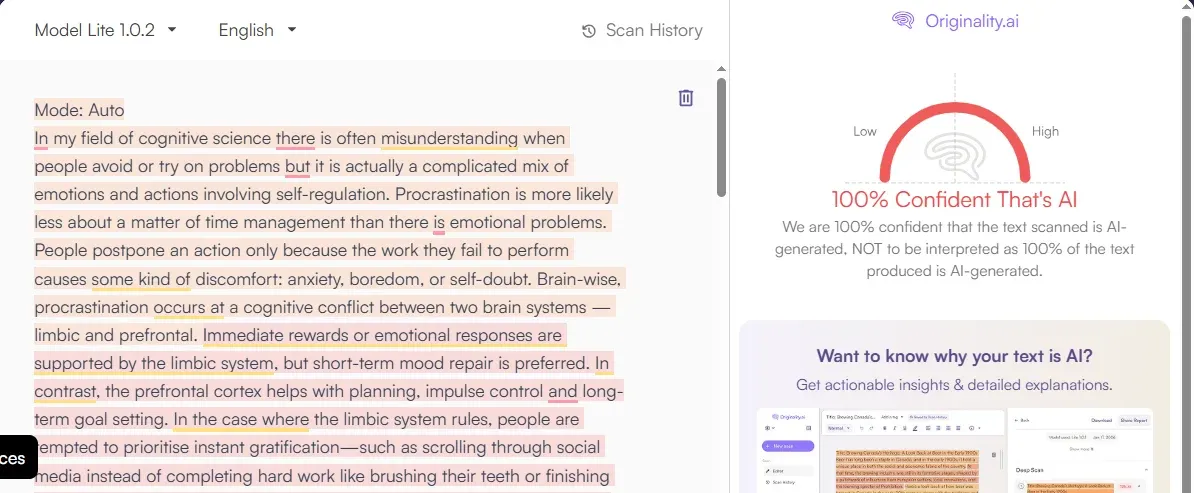
Originality AI: 100% confident the text is AI-generated.
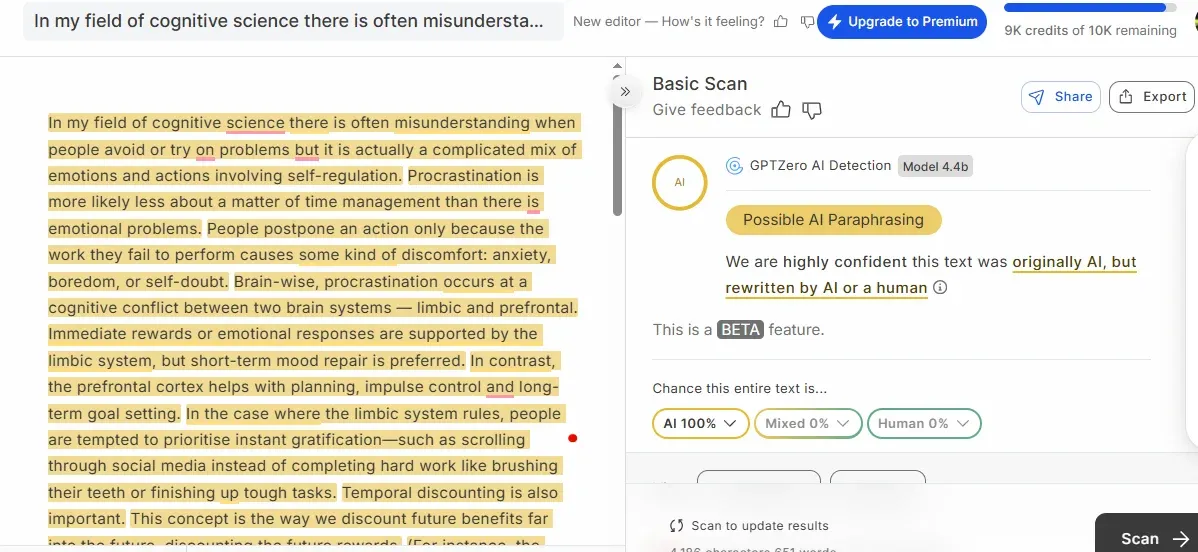
GPTZero: Flagged as possible AI paraphrasing; "highly confident this text was originally AI, but rewritten by AI or a human."
Final Observations:
Across all three tests, the humanizer consistently altered sentence structure but reduced clarity, introduced awkward phrasing, and occasionally distorted meaning.
This was not isolated to one mode or one type of content.
Whether the input was academic, conversational, or general writing, the output shared the same problems: sentences that technically read differently but communicate less effectively than the original.
The tool prioritizes surface-level change over meaningful improvement.
What makes this particularly relevant for students and professionals is that distorted meaning is not a cosmetic issue.
If a humanizer rewrites your argument in a way that shifts what you are actually saying, the output is not a cleaned-up version of your work. It is a different, weaker version of it.
Originality AI flagged the humanized output as 100% AI-generated, and GPTZero identified it as highly likely AI-paraphrased content.
That result matters because it directly undermines the core promise of the product. The Bypass Detectors mode, in particular, is marketed as an aggressive rewrite designed to pass detection tools.
It did not pass the two most widely used ones. Paying for a mode that fails its own stated purpose is not a minor shortcoming.
It also raises a practical question for anyone considering JustDone's paid plan: if the humanizer cannot reliably clear two standard detectors after processing, what exactly is the $9.99 per use covering?
The rewriting changed the surface appearance of the text but did not fool two of the most widely used detectors in 2026. This pattern masks AI origins rather than genuinely improving content.
Want to see what a humanizer looks like when it actually works? 👇
Paste your text into Phrasly's AI Humanizer below. No fragmented sentences. No tortured phrases. No paywall after the fact.
Is Phrasly AI Better Than JustDone AI?
We tested both tools with the same content. Phrasly AI Detector correctly identified human-written passages as human-written every time. JustDone flagged the same content as between 71% and 90% AI-generated.
On pricing, Phrasly AI’s full platform costs $19.99 per month. JustDone's equivalent plan runs between $29.99 and $39.99 per month.
Side-by-Side Comparison
JustDone AI Alternatives — What Should You Use Instead?
If JustDone's free detector produces random results and routes you into a paid humanizer, the logical question is: what should you actually use instead?
Phrasly AI
Phrasly is the most direct JustDone alternative in 2026. Phrasly was not named in AFP's March 2026 investigation into fraudulent AI detectors. It was not built around a freemium funnel that manufactures false positives to sell a correction tool. The product starts from a different premise: that a detector should detect accurately, and that a humanizer should improve content without distorting it.
For students, content creators, and academics who need a reliable detector they can actually trust, that consistency matters more than a wide tool suite built around a flawed free product.
GPTZero
GPTZero is a well-established detector that we used as a cross-reference throughout our own testing. It is built specifically for AI detection rather than packaged as part of a broader content toolkit.
Founded in January 2023, GPTZero has served over 10 million users and works with more than 100 organizations across education, hiring, publishing, and legal sectors. GPTZero measures perplexity and burstiness, the two core signals that genuine AI detection is built around, using a neural network trained on millions of labeled human and AI text samples.
For users who want a dedicated, single-purpose detector, it is a credible option.
Based on our testing, we cannot recommend JustDone AI's free detector. The core issue is not that JustDone occasionally gets it wrong. Every detector has edge cases. The issue is that JustDone gets it wrong consistently, in both directions, with no stable pattern that would suggest real text analysis is happening underneath.
The same human-written content returned scores of 76%, 95%, 62%, and 83% across different sessions. Our 2026 tests with human-written produced false positives of 94%, 93%, and 73%. Those numbers do not add up for a tool doing real analysis. If the same text returns four different scores across four sessions, something other than the text is driving the result.
When we ran AI-generated content through the humanizer, Originality AI still flagged it as 100% AI-generated and GPTZero identified it as AI-paraphrased content.
AFP's March 2026 investigation reached the same conclusion independently, naming JustDone as part of a pay-to-humanize scam pattern in which the free detector appears designed to create demand for the paid humanizer rather than provide accurate results.
JustDone has acknowledged that its free version may produce less precise results. What it has not addressed is a business model that appears to profit directly from those imprecisions.
For anyone who needs a detector they can actually rely on, the evidence points elsewhere.
Frequently Asked Questions
Is JustDone AI accurate?
Based on our 2026 testing, JustDone AI's free detector is not reliable. The same human-written content returned scores of 76%, 95%, 62%, and 83% across different sessions. AFP's March 2026 investigation reached the same conclusion independently across four languages. For a step-by-step guide on testing any tool yourself, read how to check if text is AI written.
Is JustDone AI legit?
JustDone is a registered platform and a real product, but its free AI detector has been named in an AFP investigation into fraudulent detection tools. User reviews on major platforms also flag inconsistent results and billing complaints as recurring concerns.
How much does JustDone AI cost in 2026?
JustDone currently offers three plans: a 7-day trial at $2.00 that auto-renews at $39.99 per month, an Unlimited Monthly plan at $19.99 per month, and an Unlimited Annual plan at $9.99 per month billed annually. Note that the trial requires cancellation at least 24 hours before it ends to avoid the full monthly charge.
Does the JustDone AI humanizer work?
The paid humanizer performs better than the free detector, but our testing showed that humanized outputs were still flagged as AI-generated by both Originality AI and GPTZero. Users on review platforms also report that the tool distorts sentence meaning and introduces unnatural phrasing.
How do I cancel my JustDone AI subscription?
You can cancel a JustDone subscription anytime from your account settings or by emailing [email protected]. If you are on the $2.00 trial, cancel at least 24 hours before the 7 days end to avoid being automatically charged the full $39.99 monthly rate.
What is the best JustDone AI alternative?
Phrasly AI is the most direct alternative, offering a free and consistent AI detector with no upsell funnel and a full platform at $19.99 per month. GPTZero is also a credible option for users who need a dedicated, single-purpose detector they can trust. We compared the top tools side by side in our best AI checker tools guide for 2026.


Keep reading

AI vs Human Cold Email Reply Rates: What 150M+ Emails Across 8 Studies Actually Show (2026)
AI cold emails get 1% fewer replies but 3x more spam flags. We compared 8 studies covering 150M+ emails, including peer-reviewed research, to show what actually works in 2026 and the fix that closes the gap.
The Self-Editing Workflow That Makes Writing Read Human
A 5-pass self-editing checklist for copywriters: fix structure, cut generic filler, add proof and voice, improve rhythm, and verify facts before your copy ships.