
Can University Professors Detect ChatGPT? What Students Need to Know in 2026
Are you wondering can University professors detect Chat-GPT? Yes, they can detect but using Phrasly you can humanize and bypass the AI detector.
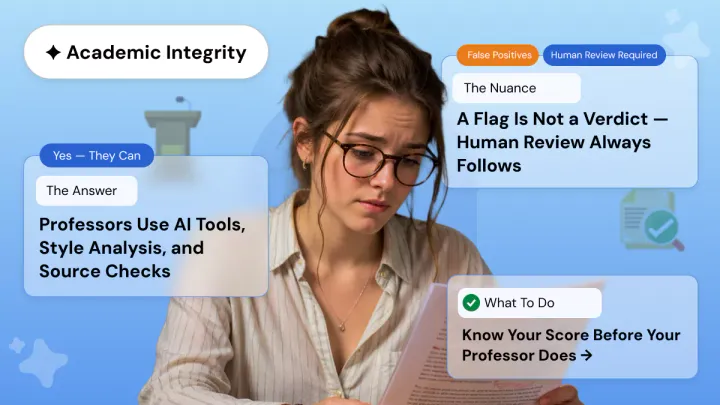
You submitted your essay, and you wrote every word yourself. Then your instructor calls you into their office and talks about an AI detection score.
This scenario is becoming more frequent in 2026, and it’s something that impacts students who used AI and students who didn’t.
If you lie awake at night wondering, “Can professors detect ChatGPT?” here is a straightforward answer: this article tells you exactly what professors are checking, how detection tools work, and what to do if your authentic work is flagged.
Can Professors Detect ChatGPT?
Yes! Teachers and professors use AI detection tools, grammar checking tools, writing style analysis against previous papers, source checking, and version history review. No single method is conclusive on its own.
Detection has also increased since 2023.
GPTZero and Winston AI work similarly by analyzing submissions for patterns commonly found in AI-written text.
Crucially, a detection flag does not equal a guilty verdict. Professors and schools must confirm with their own investigation prior to making an academic integrity decision.
After a flag, a manual review is triggered: the professor reviews the student's previous assignments for similarity to the flagged submission, verifies the quality of the source material, and may even ask follow-up questions face-to-face.
The tool raises a flag. The human makes a judgment.
How Professors Detect ChatGPT in 2026?
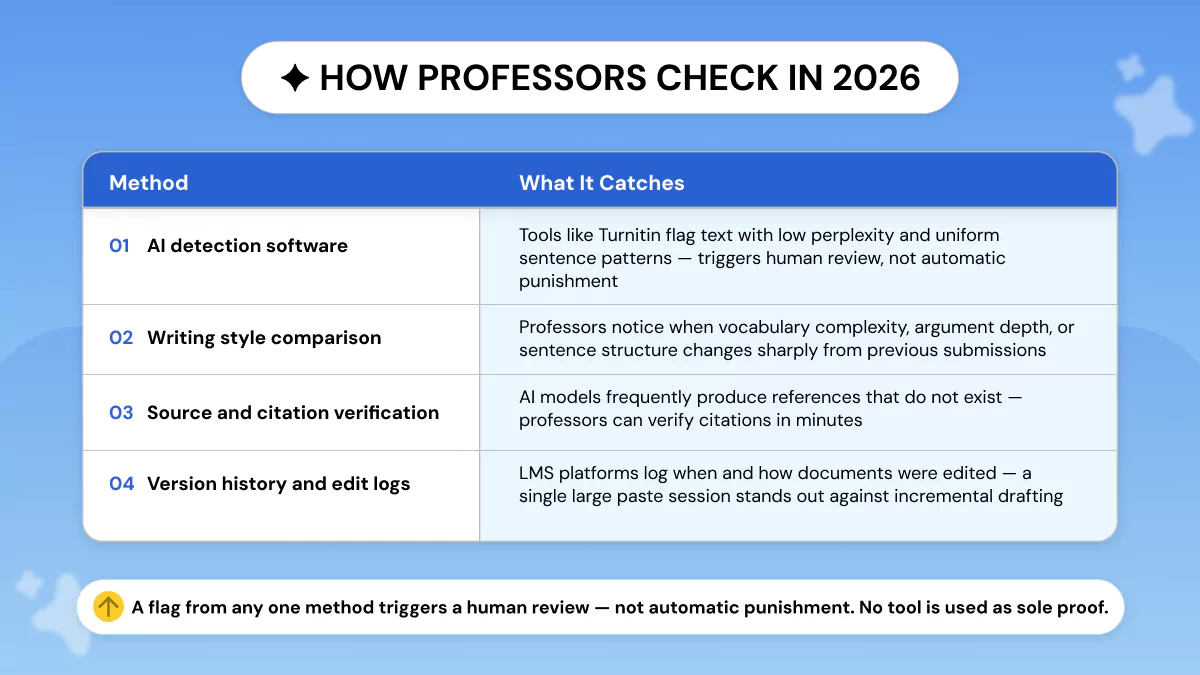
Professors employ four primary strategies to detect AI-generated content, including the use of AI detection tools, writing style analysis, source verification, and version history review. Here’s what those look like in action:
Many organizations already hold institutional licenses for at least one of these tools.
To understand how Turnitin detects ChatGPT, it helps to know that Turnitin, GPTZero, and Winston AI analyze submissions for two primary statistical signals:
- Perplexity: The degree to which each word is expected given the previous words. Machine-generated text has a low score because natural language processing chooses safe words all the time.
- Burstiness: The variability of sentence length within a document. Humans are inconsistent. Machines are not.
They mark things for review by humans. They don’t make the final decision, and they make mistakes. That’s why understanding false positives is important for every learner.
Writing Style Comparison
Teachers who've read several papers from the same student will inevitably get a good intuitive feel for that student's style, vocabulary breadth, and typical depth of argumentation.
A student who has consistently turned in colloquial, developing-level prose, submitting something that reads like a professional journal article, should raise suspicions no matter what the match score is.
No detection tool can match an experienced instructor's judgment about a student's writing style. Writing style analysis is one of the strongest signals around, and it requires zero technology.
Source Verification
AI language models often hallucinate citations: made-up titles that sound believable, incorrect page numbers, and authors listed for journals they never published in. You can verify a citation in less than a minute.
If your paper has sources you made up or can't verify, it should raise red flags, no matter what any detector says.
Version History and Submission Patterns
Learning management systems (Google Classroom, Canvas, Moodle) track when/how documents get modified.
A paper submitted with no edit history or with one big paste session the night before the due date will stand out from a paper with edits spread out over multiple days.
Detection Method Comparison Table
Can Professors Detect ChatGPT If You Paraphrase?
Often Yes! Rewording text from AI decreases verbatim matches, but maintains the writing style metrics that AI detection tools flag. Over-paraphrased AI writing will still have low perplexity and stylistically homogenous sentences.
Paraphrasing alters surface words, not foundational patterns of idea ordering and phrasing. Tools like Turnitin analyze on a paragraph level.
It's also worth noting that this same paragraph-level analysis is what causes Turnitin false positives, meaning even genuine human writing with consistent phrasing patterns can get caught in the same net as paraphrased AI text.
What Paraphrasing Does and Does Not Change?
If you are a student who has ever gone back and edited text generated by AI before hitting submit, this distinction may matter to you:
- What paraphrasing changes: specific word choices, some surface-level phrasing, direct phrase overlap with the source text
- What paraphrasing does not change: paragraph-level predictability, argument structure, and low burstiness at the sentence level
- What paraphrasing cannot add: the specific personal detail, course-specific references, and original analysis that characterize genuinely student-written work
- What manual review still catches: inconsistency between the submitted work and the student's established writing history, regardless of detection tool scores
Your best defense against a false positive is writing only you could have written.
Detailed references to readings from your actual course, analysis based on your own position on an issue, and observations drawn from your own experience or previous coursework. They can't be created or duplicated by paraphrasing anything else.
Check If Your Work Might Be Flagged Before Your Professor Does
Wrote something yourself and curious how it would score before you submit?
Try it out on the Phrasly AI Detector.
You'll receive your AI probability score and highlights of where your writing is most formulaic or statistically detectable, precisely the areas where more specific, personal language can improve your writing & your score.
Free, no account needed.

What Happens If Your Genuine Work Gets Flagged?
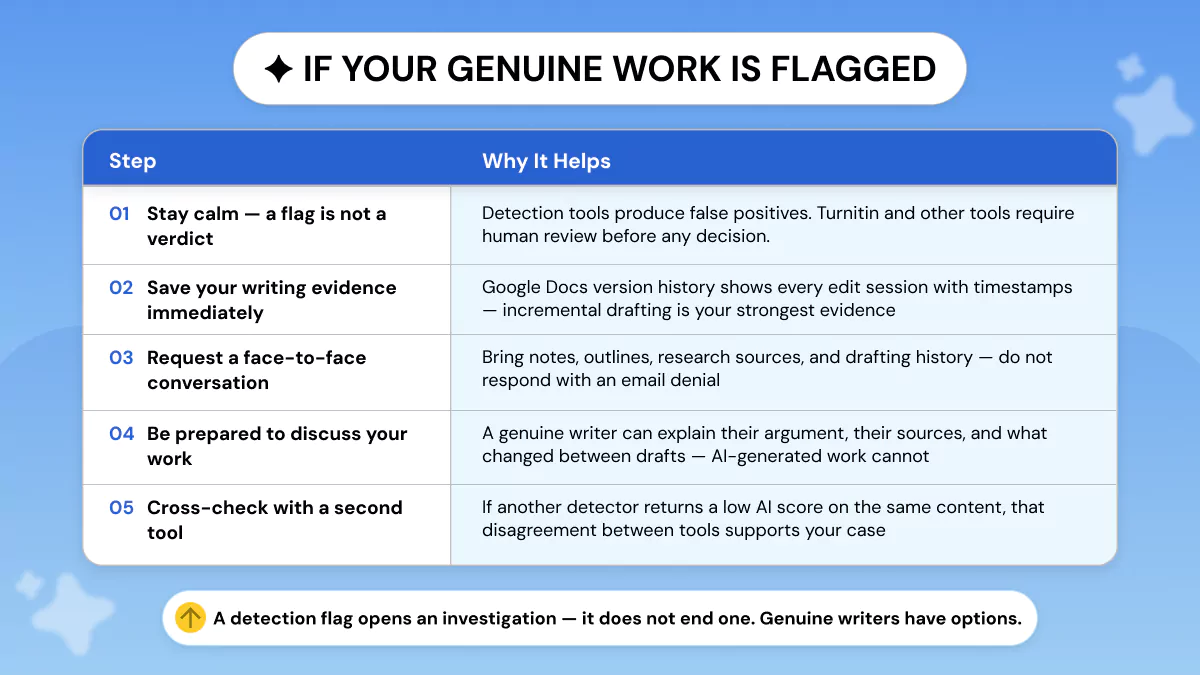
A detection flag does not automatically initiate a sanction. Faculty must review evidence prior to issuing an academic integrity decision. Flags are not proof of academic misconduct.
If you authored your own work and were wrongly flagged, here’s what to do:
- Step 1: Stay calm. AI detection tools produce false positives.
Understanding why essays get flagged as AI can help contextualize what happened.
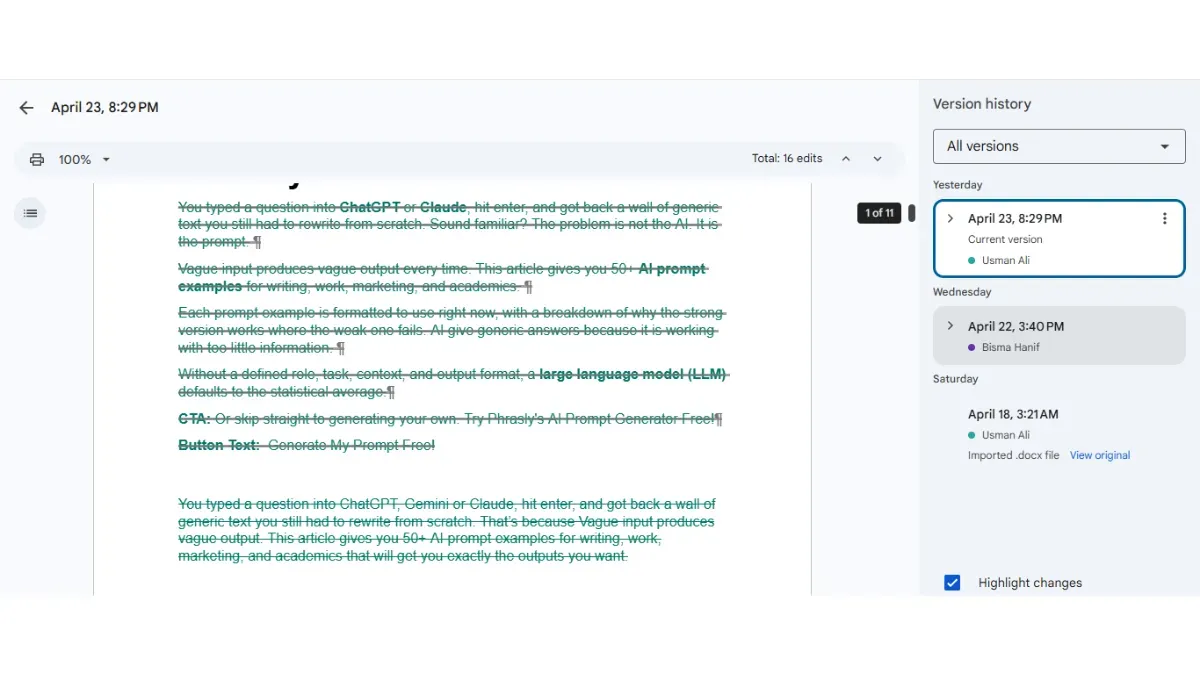
- Step 2: Gather your writing evidence. Google Docs version history lists each time you've edited the document. If you worked on your document little by little each day, this is your best proof.
Take a screenshot or download the entire version history right away.
- Step 3: Request a meeting. Do not send an email excuse. Ask to meet in person with your professor. Come prepared with your notes, your original outline, your research sources, and your history of drafting.
Showing up with notes shows that you understand your own process.
- Step 4: Be prepared to discuss your work in depth. A real writer can defend their argument, articulate what changed from draft to draft, and respond to follow-up questions regarding their thought process.
This is the part that matters most in any formal review.
- Step 5: Cross-check with Phrasly AI Detector. Run the submitted content through Phrasly AI Detector.
If Phrasly returns a low AI score on content that Turnitin or GPTZero flagged, that disagreement between tools is meaningful.
It supports the case that the content is genuinely human-written. You can also reference AI detector false positives as documented context for your professor.
How to Write Authentically and Avoid False Flags?
You’re not trying to beat a detection algorithm. You’re trying to write something that’s so undeniably yours, so specific, so rooted in your own way of thinking that no algorithm or professor could possibly consider it the work of AI.
Let’s take a look at how to write with a human voice and structure that’s indicative of human thought.
Prioritize specific personal details. Identify the particular reading that changed your mind. Cite the argument someone made in the last seminar that you disagreed with.
Recall the question you could not answer when you first confronted the issue. You cannot produce these from an AI cheat sheet, and they are also what make Academic writing remarkable.
Write in your actual voice. Writing that is highly fluent, tersely edited, formally symmetrical, and sounds nothing like how you would actually think is much more likely to be flagged as AI-written than less-smooth academic prose with your own idiosyncrasies.
Formal or authentic voice does not equal unnatural. Natural means recognizably human.
Vary your sentence length naturally. Use a combination of short, choppy sentences with long-winded ones. It will boost your burstiness, which is one of the main things AI detectors look for.
Even if a piece is penned by a native English speaker, consistently using sentences of the same length can still lead to good rankings.
Avoid common AI phrase patterns. The following constructions appear so frequently in AI-generated text that they raise AI detection scores even in genuinely human writing:
- "It is worth noting that…" and similar hedging openers.
- "Delve into," "tapestry of," "nuanced understanding".
- Formulaic transition sequences: "Furthermore… Moreover… In conclusion…".
- Too-balanced paragraph construction with each topic sentence presented, developed, and concluded with matching cadence.
Before submitting high-stakes work, check your score. Run your content through the Phrasly AI Detector before you submit.
When your score is high, the highlighted areas will indicate where your writing sounds the most generic and where incorporating personalized, concrete language will improve your score.
FAQs
Can professors detect ChatGPT?
Yes! Professors look at signals from AI detectors, writing patterns, cited sources, and revision history. One flag doesn't mean dishonesty; it means you're being reviewed.
How can professors detect ChatGPT?
The four techniques primarily used are:
AI detection software such as Turnitin, GPTZero, Winston AI, which calculate perplexity and burstiness scores; comparing writing styles to previous pieces of work; checking whether cited sources exist; and inspecting the version history of the document if submitted through LMS such as Canvas or Google Classroom.
Can professors detect ChatGPT if you paraphrase?
Often yes! Paraphrasing will alter words on the surface, but leaves intact the predictable sentence structure that AI detectors look for at the paragraph level.
Can my professor detect ChatGPT?
Professors at schools with institutional Turnitin/other licenses typically have access to AI Detection. One flag will not determine whether or not action is taken, but your overall originality report will go through manual review.
Do professors know when you use ChatGPT?
Won't always know for sure, but experienced teachers can sense the shifts in voice, depth of argument, and quality of sources that AI detectors won't necessarily catch. Tools plus humans are better than either by itself.
Can teachers see if you copy and paste from ChatGPT?
The version history of Google Docs and a learning management system's submission logs can reflect one massive paste event and no previous editing history.
An entirely pasted document with no prior editing history looks significantly different from something typed slowly and methodically, and that trend is something professors notice.
Is 20% AI detection bad?
This depends on the checker and what type of content is being checked. For Turnitin, 20% would be considered low risk and would not typically initiate a formal review independently.
You have to consider your context. Turnitin scores this high on personal reflection papers are different than seeing this score on a literature review.
If you want to be sure, paste your content into Phrasly AI Detector and get another data point.
How do I make sure my genuine writing does not get falsely flagged?
Write something unique and personal that only you would write. Use a mix of long and short sentences. Try to avoid the generic phrasing AI would use. Run your score through Phrasly AI Detector prior to submission.
If you end up getting flagged, your revision history and ability to thoroughly discuss your process are your best defense.
Professors can detect ChatGPT, but a flag is not a verdict. Detecting AI writing has gotten better in 2026 than ever before, but a flag is not a conviction, and no tool is completely accurate.
Your best defense is writing that is so uniquely and obviously yours that no tool or professor could plausibly confuse it with someone else's work.


Keep reading

Does SafeAssign Have an AI Detector? What Students and Teachers Need to Know
SafeAssign checks for plagiarism not AI. A 0% score doesn't mean your work is AI-free. Learn what SafeAssign actually detects, why it misses ChatGPT, and what tools like Copyleaks really do.

How to Protect Yourself from AI Detector False Positives
Discover why AI Checkers flags human writing as AI-generated. Learn about false positive rates, who's at risk, and how to protect yourself from false accusations.