
ChatGPT Prompts for Students: 70+ Examples That Actually Help You Study
Most students are leaving 80% of ChatGPT's potential on the table. These 70+ prompts show exactly what studying with AI should look like.
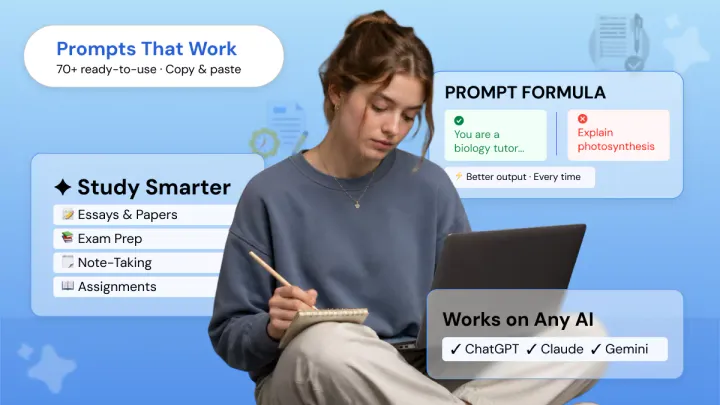
Many students seem to think of ChatGPT prompts as a sort of magic search engine. But the model can only do as good a job as you instruct it to.
This guide is a subject-by-subject library of ChatGPT study prompts you can copy, adapt, and use today.
How to Build a ChatGPT Prompt That Actually Works for Studying?
The optimal prompt for ChatGPT when conducting research or any academic endeavor, really, is to treat the model as if it were an intelligent but context-blind assistant.
It can know everything, but it won't know your circumstances until you provide that information. That's where structure comes in.
Here's the difference that formula makes:
The strong variant forces the model with natural language input that closely resembles how a student would actually think and the output quality reflects that.
OpenAI's own prompt engineering guidance confirms this: clarity, specificity, and sufficient context are the three foundations of a well-constructed prompt.
If you're applying it at work, this guide to ChatGPT prompts for professionals shows how the same Role + Task + Context + Format structure translates into workplace tasks like writing professional bios, client emails, and strategic briefs.
This principle underlies effective prompting, regardless of whether you're requesting a summary, a quiz, or a first draft.
Generate a Study Prompt for Your Exact Assignment 👇
The Role Trick — Why Assigning ChatGPT a Persona Changes Everything
Prefacing a prompt with 'You are a...' verifiably does something: it conditions the large language model to respond with a specific register of knowledge and tone.
Tell it you're a patient exam coach, and it will slow down, define terms, and confirm comprehension. Tell it you're a savvy journal editor and it will edit your prose tersely, unprompted.
Student-specific examples that work immediately:
- You are a patient exam coach. Quiz me on Chapter 4 of my macroeconomics textbook, one question at a time.
- You are a strict academic editor. Review this paragraph for clarity and argument strength, not style.
- You are a Socratic tutor. Don't give me the answer. Ask me questions that lead me there.
This one habit, assigning a role, is the biggest upgrade you can make to AI-assisted learning. It costs you five words and pays back relevance and depth.
ChatGPT Prompts for Essay Writing & Academic Papers
If you're wondering what some good prompts for ChatGPT to write an essay are, the answer is: start earlier in the process than you think. The best prompts aren't 'write my essay'.
They're the ones that help you think through your argument before a word hits the page. Below are ready-to-use ChatGPT prompts for essay writing organized by stage.
Brainstorming & Thesis Development
Structuring Arguments
Writing Introductions & Conclusions
Editing & Improving a Draft
In academic writing, the best ChatGPT prompts are those that allow you to remain in control. Let ChatGPT help you clarify your thinking, test your argument, and polish your prose, but do not take over the job of writing.
ChatGPT Prompts for Research Papers & Literature Reviews
If you want ChatGPT to summarize a topic, prompt it with a scope, word limit, and a desired format. Here are the ChatGPT prompts for research papers that genuinely assist with research paper writing.
Formulating a Research Question
Building a Literature Review Structure
ChatGPT can't read real journal articles — but it can help you structure what you've read and apply Bloom's Taxonomy thinking to your review.
Finding Counterarguments & Gaps
Remember, ChatGPT prompts for learning work best when you're an active participant. Verify any factual claims ChatGPT makes against your actual sources. The model is a thinking partner, not a citation machine.
ChatGPT Prompts for Exam Preparation & Active Recall
Students often ask: “how do I get ChatGPT to quiz me before an exam?” Paste your material in, assign ChatGPT the role of examiner, and tell it explicitly to wait for your answer before moving on.
That one line switches the session from passive reading into genuine active recall. The retrieval-based revision method that cognitive science consistently rates as the most effective approach to long-term retention.
The eight ChatGPT prompts for exam preparation below are built around that principle.
Generating Quiz Questions from Notes
Explaining Concepts at Different Difficulty Levels (Feynman Technique Style)
Creating Flashcard-Style Q&A Pairs
Simulating Exam Conditions with Timed Questions
Prompt Chaining for Exam Prep: How to Stack Prompts for Deeper Understanding
Prompt chaining for research and for revision requires sending one prompt at a time, where each subsequent prompt is built upon the previous answer. Here’s a chain of three that spans an entire revision session:
- Step 1 - Summary prompt: Summarize [topic] from my notes in bullet points, grouped by sub-theme. [Paste notes]
- Step 2 - Quiz prompt: Now quiz me on the summary you just produced. One question at a time. Wait for my answers.
- Step 3 - Gap-fill prompt: Based on my answers, identify the two weakest areas and explain them in more depth.
This sequence turns a passive reading session into an AI study companion loop. It's the closest thing to an AI-powered study schedule you can run inside a single chat window.
ChatGPT Prompts for Note-Taking & Lecture Summaries
ChatGPT can help you take better notes from your textbook. The quality of the output depends entirely on the quality of the input.
Paste a transcript, a passage, or a page of rough notes, and it can restructure, condense, and surface what matters most.
The prompts in this section are built around that exchange. You bring the raw material, and the ChatGPT prompts for note-taking below shape it into something you can actually use.
Pasting a Lecture Transcript and Asking for a Structured Summary
Converting Messy Notes into Bullet-Point Outlines
Identifying Key Concepts from a Reading
Generating Mind Map Structures from Content
A useful format to request when summarizing lecture notes is Cornell-style: main notes on the right, cue questions in the left margin, and a three-sentence summary at the bottom.
ChatGPT Prompts for Assignments & Subject-Specific Tasks
You can use ChatGPT for homework, but it's an important distinction. ChatGPT can help you think through a problem: that's studying. ChatGPT shouldn't produce work you hand in as yours: that's cheating.
Every prompt here is designed to help you with the former. You'll find the most popular ChatGPT prompts for homework as well as ChatGPT prompts for assignments across every major subject area.
Science & STEM
For STEM work, the most useful study techniques involve asking ChatGPT to walk through the process, not just give the answer.
Humanities & Social Sciences
Business & Economics
Business students often need to apply models to real scenarios. ChatGPT can help practice that application without doing the thinking for you.
Language & Literature
For literature essays, ChatGPT prompts in humanities should focus on analysis scaffolding.
Across all subjects, the goal is knowledge retention. The prompts that ask you to engage actively (explain, identify, compare, practice) consistently outperform prompts that ask ChatGPT to simply produce. That's the whole premise of AI-assisted learning.
If you're looking to spark original ideas before diving into analysis or essays, the AI Creative Writing Prompts guide offers a strong set of starting points, particularly useful for creative writing modules or when a personal response piece is part of your assignment.
Generate Your Own Student Prompts in Seconds
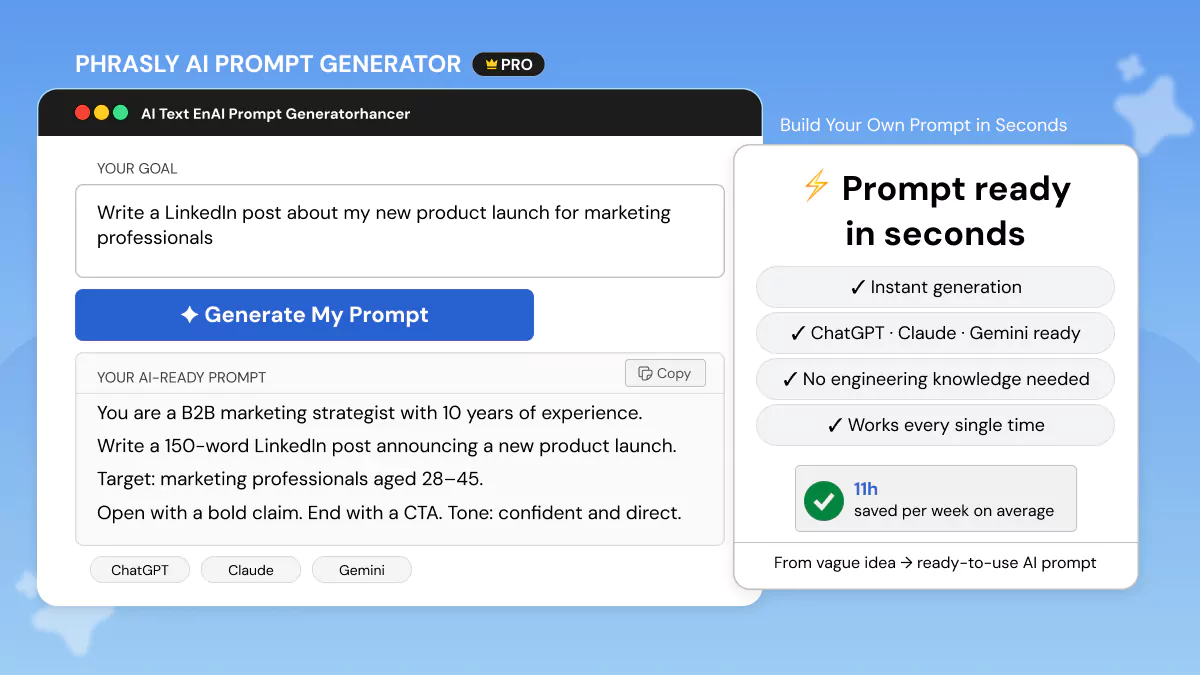
All of the prompts are formatted like this: Role + Task + Context + Format. After this, you can create your own format for any homework assignment, test, or subject in seconds.
Phrasly's AI Prompt Generator was created to help you do just that.
Simply enter details about your study scenario (topic, assignment, word count, level of education), and it will craft you a customized, ready-to-copy prompt for ChatGPT (or any Conversational AI tool you use).
It applies prompt engineering for education principles automatically, so you don't have to think about the formula every time.
Students who understand how to build prompts consistently get better outputs, save revision time, and develop stronger writing clarity in their own work.
Frequently Asked Questions
What is a prompt in writing, and why does it matter for students?
A prompt is the instruction you give an AI model in natural language. It determines what the model focuses on, how it frames its response, and how useful the output actually is.
If you want a deeper breakdown of what prompts are and how they function across different writing contexts, this guide to what a prompt is in writing covers it in full.
How do students use ChatGPT effectively without it doing the work for them?
The best way to use ChatGPT is as a partner in thinking, not a ghostwriter. Have it quiz you, challenge your argument, or explain something. Don’t have it write your answer for you.
Are these prompts safe to use for academic assignments?
Utilizing AI to learn concepts, generate ideas, practice exam questions, or enhance your writing process is perfectly fine, and many would argue that you should.
Copying and pasting AI generated text as your own work is plagiarism. Please check your school's AI guidelines and utilize these prompts responsibly.
How do I use ChatGPT to help with studying when I have a lot of material to cover?
Start with the prompt-chaining technique in the Exam Prep section. First, ask for a structured summary of your notes, then ask it to quiz you, then ask it to explain the areas you got wrong.
This sequence: summarize, retrieve, reinforce mimics spaced repetition and active recall in a single chat session.
What are the best ChatGPT prompts for college students who are new to AI tools?
Start simple: 'You are a tutor. Explain [topic] to a first-year university student in plain English. Then give me two practice questions.'
Once you're comfortable with the output, add role, format, and context constraints to sharpen the results.
The four-part formula (Role + Task + Context + Format) covered above is the fastest path to consistent, high-quality outputs.
For students who want to go further, this guide on prompt optimization techniques walks through how to refine and improve your prompts as your confidence with AI tools grows.


Keep reading

How to Prompt Claude Fable 5 (With Copy-Paste Prompts)
Claude Fable 5 doesn't respond like older Claude models. Get 7 prompting rules from Anthropic's own docs, copy-paste templates for writing, research, and work, plus current pricing and plan access after the July 20 change.

Claude Prompt Generator: Build Better Prompts for Claude AI (Free Tool)
Learn how a Claude prompt generator builds better prompts for every Claude model, from Sonnet 4.6 to Fable 5. Includes ready-to-use XML templates, effort levels, and a free tool.