
What Is a Prompt in Writing? Types, Uses, and How to Write One
Most writing guides stop at "just start writing." This one gives you the actual structure behind every type of prompt, and how to use each one.

The writers who produce clear, focused work faster than everyone else aren't necessarily more talented, they just know how to use a good prompt.
A prompt gives your writing a starting point: a direction, a tone, and a purpose before you've written a single word. Once you understand how they work, every writing task gets easier.
What Is a Writing Prompt? (Simple Definition)
A writing prompt is a precise and well-focused instruction with a clear objective to inspire a writer and provide a starting point for their work.
It is an impetus that motivates ideas, creativity, and logical thought processes.
A writing prompt can be a sentence, a question, or a short scenario that acts as a beginning for a writer. They also can be short passages, that provide cues for storytelling, leading the writer toward a particular topic, style, or tone.
They provide a specific point of entry to the more complex and open-ended question "what to write" and help to make the writing process easier.
Writing Prompt Vs. Topic — What's the Difference
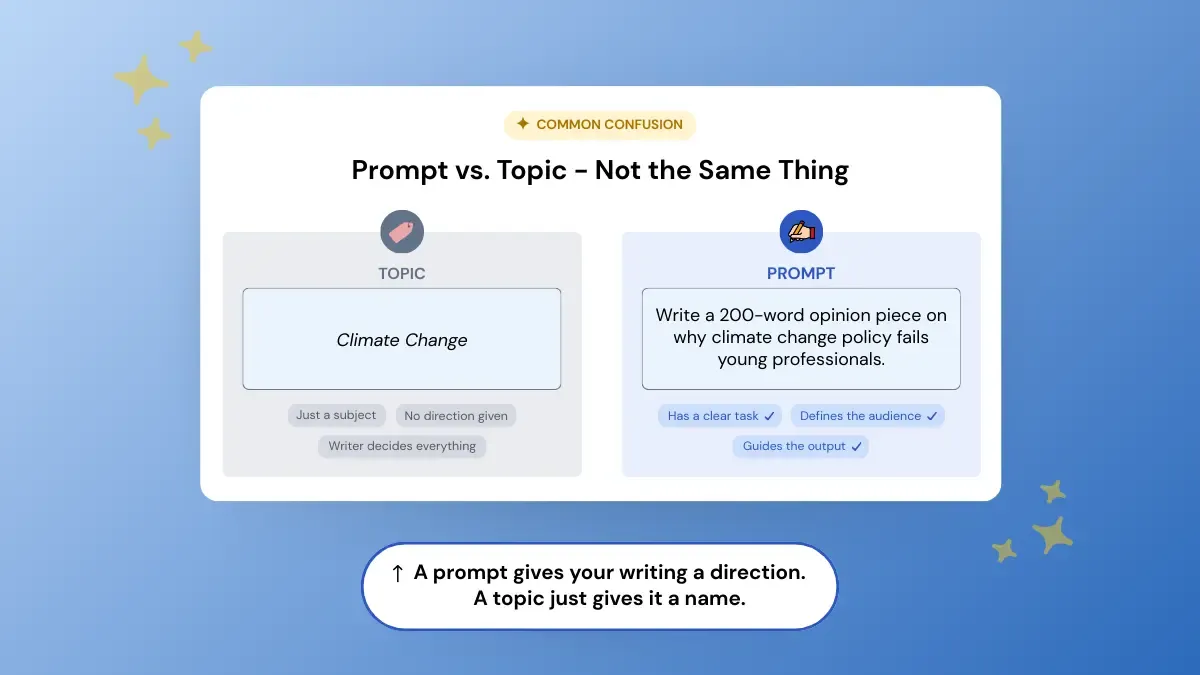
Many writers mistakenly use a writing prompt and a topic synonymously.
However, these are very different in their nature and use.
|
Topic |
Writing
Prompt |
|
A subject or idea ("climate change") |
A specific, actionable instruction |
|
Tells you what to write |
Tells you what, how, and why |
|
Open-ended, no constraints |
Includes tone, format, perspective |
|
"Social media" |
"Write a letter to a friend explaining how
social media changed your daily routine" |
A topic is a destination. A prompt is a map with a marked route.
Both tell you where to go — but only one tells you how to get there.
Generate Your Own Writing Prompt in Seconds 👇
How Do Writing Prompts Work?
Writing prompts work by offering a structured starting point that stimulates ideas and guides the writer's thought process.
Essentially, a prompt act as a mental cue, focusing attention and organizing thoughts before the actual writing begins.
The two components of most writing prompts are:
- The writing situation, and
- The directions.
The writing situation is the context for the writing, a situation, problem or theme.
The directions describe how to approach the writing: the tone, perspective, or format of the response.
The 3 Cs of Prompt Writing
The 3 Cs of prompt writing are Clarity, Context, and Constraint.
- Command ensures that the prompt is easy to understand, leaves no room for confusion, and tells the writer exactly what to do.
- Context provides background information, a setting, or a scenario. It gives the writer a starting point and cues for storytelling.
- Constraint involves limitations such as word count, format, or perspective. It helps focus creativity and structure the response.
The counterintuitive truth about constraint: the tighter the box, the more creative the output.
The 3-Step Prompt Structure
The 3-step prompt is a basic approach to make writing prompts more efficient and actionable.
- Introduce the topic: Introduce the topic or scenario to help writers know where to begin.
- Stimulate Brainstorming: Include cues or questions to allow the writer to think and consider their response. This allows time for the writer to think about different angles before committing to a response.
- Task Description: When giving directions, be as specific as possible about how to structure the writing. For instance, direct the writer to use a particular tone or point of view or even format.
Example in action:
Types of Writing Prompts Explained
Understanding the different types of writing prompts is very important.
It helps in expressing thoughts, generating new ideas, and offers a structured starting point for writing.
Narrative Writing Prompts
Narrative prompts are designed to inspire storytelling.
They offer a scenario, situation, or character as a starting point for the story. Narrative prompts focus on plot, character development, and creative expression.
They are great for creative writing and teaching writers how to structure stories, create voice, and pull in readers.
Additionally, they provide storytelling cues for writers and are ideal for both classrooms and professional content brainstorming.
Descriptive Writing Prompts
Descriptive writing prompts are there to help you, a writer, describe in detail a person, a place, an object or an event.
They use cues that help you rely on your senses to create descriptions.
These are great for new writers or just anyone wanting to work on their observation skills and write some strong, short pieces.
These are the prompts that force you to focus on detail and, in doing so, learn to choose your words and imagery wisely.
Expository Writing Prompts
Expository writing prompts make the writer either explain or inform or analyze a topic. The cue words are often why, how or explain. These prompts provide a structured approach.
Expository prompts are commonly employed in academic writing and professional documentation to develop analytical thinking and clarity of expression.
Persuasive Writing Prompts
Persuasive prompts ask writers to convince or influence the reader, using evidence and reasoning. Cue words include persuade, convince, and argue for.
You can use these prompts for marketing, advocacy, and professional communication. If you want to see how persuasion works in real content, these copywriting examples and AI writing tips are worth studying.
Argumentative Writing Prompts
Argumentative prompts are different from persuasive prompts because they must be balanced, third person, and data-driven.
Writers should also consider counterarguments and support their position with evidence.
The prompts also teach critical thinking, research and structured writing–skills that most persuasive prompts ignore.
Creative Writing Prompts
Creative writing prompt ideas are broad and open-ended.
They often involve fictional scenarios, fantasy, or “would you rather” questions. They inspire brainstorming, creativity, and imaginative exploration.
Creative prompts are great for novice or expert writers searching for inspiration, in classrooms or for content-creators or AI-assisted projects.
How to Respond to a Writing Prompt (Step by Step)
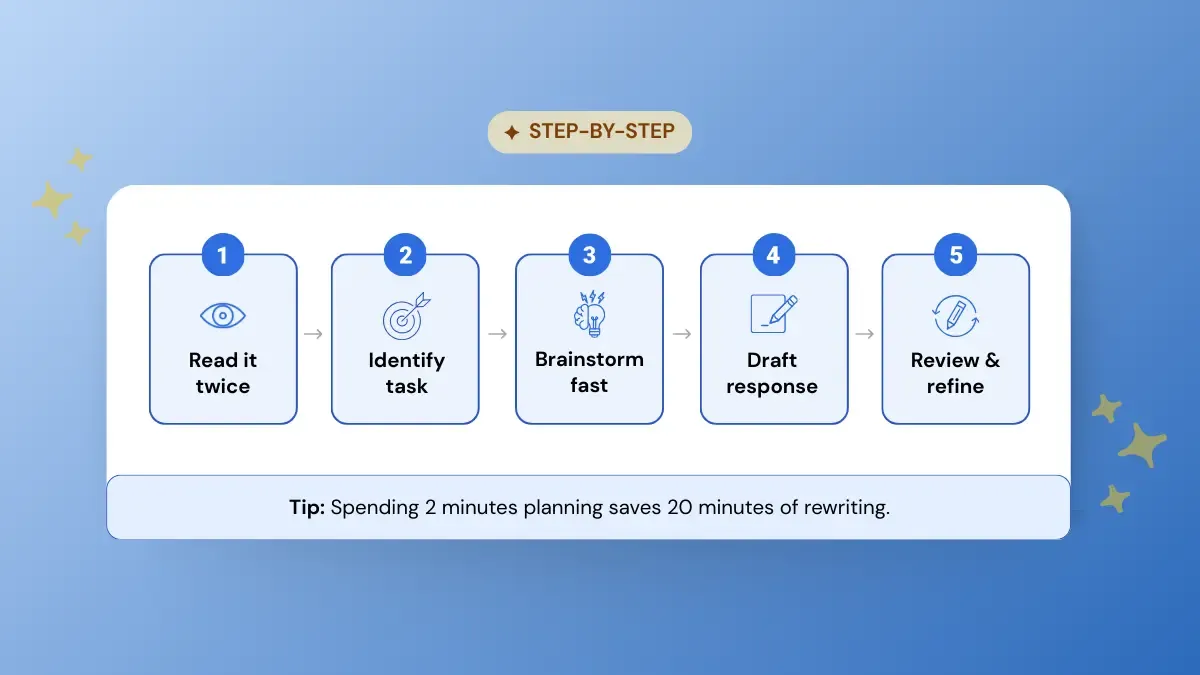
The key is to move from comprehension to organized output. A prompt is not simply a suggestion—rather, it’s an instruction to steer your answer.
Here are some tangible steps to start:
- Read carefully. Then, identify the writing situation and the directions.
- Underline keywords. Look for cue words such as explain, describe, argue, or compare.
- Brainstorm a bit. Jot down 3–5 ideas before you begin writing.
- Make a quick outline. Even an informal one with an intro–body–conclusion will help.
- Write with purpose. Keep to the task and don't ramble.
- Re-read the prompt after your draft. Ask: did I answer the whole question? The most common mistake is partial answering. Writers address part of the prompt and assume they're done.
Tips for Beginners
If you’re new to writing prompts, then
- Start with simple prompts.
- Use short prompts with explicit instructions.
- Set a timer for 10–15 minutes and write freely without overthinking.
- Strive for completion, not perfection.
- Revisit and revise after you’ve written a draft, not while writing.
- Save your best responses — over time they become a portfolio that reveals your strengths and your writing voice.
Can Writing Prompts Really Improve Your Writing Skills?
Yes! Writing prompts can help you become a better writer when you practice consistently.
They give you structured guidance and focused topic suggestions, allowing you to practice without the pressure of deciding what to write about.
Responding to a variety of prompts ensures that you get to try different styles, tones, and formats. Today you might be working on storytelling and tomorrow analytical or persuasive writing.
Variety makes you a more adaptable writer, and more critical thinker. Prompts can also help you find your own voice.
The more fluency, clarity, and confidence you can develop by practice, the more you are able to write "effortlessly."
After practicing for a while, you may see trends in your abilities and areas of improvement. The first and most important: Prompts spark interest. Writers don’t simply wait around for inspiration; they jump into structured creativity.
For them, writing is not an intermittent attempt to create, but a routine habit. Pairing that habit with a solid content writing strategy using AI can take your consistency even further.
Writing Prompts Beyond the Classroom
Writing prompts aren't just for schoolwork and creative writing exercises anymore.
In professional and academic settings, a prompt is a tool for structured thinking to help with clarity, research, innovation, and communication strategy.
In fact, the 2025 Future of Jobs Report by the World Economic Forum lists analytical thinking and creative problem solving as two of the most sought-after workplace skills.
Writing prompts and structured writing exercises directly target and improve these skills through targeted reflection and idea generation.
Today, prompts have become go-tos for kick-starting brainstorming sessions, reframing research, planning out content strategies, and even therapy interventions.
In all cases, they help professionals move from vague ideas to actionable insight.
Writing Prompts for Professionals and Academics
If you’re a content marketer or journalist, you may think of prompts as specific topic suggestions that can help you narrow the focus of your messaging and sharpen awareness of your audience.
For a UX writer, prompts can help you craft better microcopy as well.
For instance:
These constraints emulate actual UX design problems and help create more specificity.
In the design thinking process, prompts are often leveraged in ideation. They're used to frame the user problems, encourage empathy, and to steer a brainstorm toward solutions.
Rather than posing the question, "What should we build?" a prompt would reframe it as "How might we make this process easier for first-time users?"
Researchers and academics also use prompts to clarify research questions, organize abstracts or try out theoretical suppositions before formal writing processes.
Writing Prompts in AI and Prompt Engineering
AI models running on an LLM are prompt-based.
Prompt engineering is a process of creating prompts, which are specific instructions used to achieve desired output from models like ChatGPT or Claude in a relevant and high-quality manner.
It’s all about the structure and the level of detail you put in.
A vague instruction produces generic results.
A detailed prompt, complete with context, constraints, and examples, yields focused and usable responses.
According to The Business Research Company Prompt Engineering Global Market Report, as of 2025, the prompt engineering market is valued at $1.13 billion, with projections to reach $1.52 billion in 2026 and 68% of firms now provide formal training in prompt engineering skills.
Professionals use prompt engineering to generate structured reports, refine marketing copy, draft research summaries, and simulate scenarios for analysis.
Best Writing Prompts for Creativity (and How to Generate Them)
Are you looking for the best writing prompts for creativity? Here are 10 open-ended creative writing prompt ideas to apply to academics and professional work alike:
- Write a research abstract for a study that hasn’t been conducted yet.
- Describe a future workplace where AI makes all decisions.
- Rewrite a historical event from a minor character’s perspective.
- Explain a complex theory using only everyday language.
- Imagine your industry 20 years from now—what changes?
- Write a “would you rather” scenario related to ethical leadership.
- Turn a data report into a short narrative story.
- Describe in detail a place that symbolizes innovation.
- Argue both sides of a controversial workplace issue.
- Create a dialogue between a human and an AI assistant.
To generate your own prompts, try practical techniques like:
- Word jars (random keywords combined into a scenario)
- Using images as visual cues
- Starting with sentence stems (“What if…”, “Imagine that…”)
- Opening a book to a random line and building from it
You can also leverage AI to help brainstorm prompts. Professional tools like Phrasly can rapidly generate structured prompt ideas without replacing your own judgment.
FAQs
Are writing prompts only for students?
Not at all. Prompts can be used by all kinds of professionals, academics, and creatives.
Content marketers developing new campaigns to researchers fine-tuning abstracts can all use prompts as structured cues to develop ideas, bring clarity, and help inspire creativity outside the classroom.
How long should a response to a writing prompt be?
The length can vary depending on the purpose and context of the prompt. If the prompt is for practice or a creativity exercise, a short paragraph may suffice.
If the prompt is for an academic or professional setting, a longer response with more developed arguments or explanations may be appropriate. The important thing is to fully address the prompt while remaining focused.
What is a picture or image-based writing prompt?
This kind of prompt has an image in place of words as the starting point. Writers interpret the picture, using visual cues to develop a story, descriptive imagery, or analysis.
Image prompts are a good fit for visual thinkers and can help with creativity in all genres.
Can writing prompts be used for non-fiction writing?
Yes. Prompts help to organize ideas, arguments and the research process. Whether you're writing essays, reports, or other professional documents, prompts direct your thinking, making writing easier and faster.
For instance, see this resource that describes ways to simplify the writing process with an AI writer, making the process of both creativity and productivity more natural.


Keep reading

Claude Prompt Generator: Build Better Prompts for Claude AI (Free Tool)
Learn how a Claude prompt generator builds better prompts for every Claude model, from Sonnet 4.6 to Fable 5. Includes ready-to-use XML templates, effort levels, and a free tool.


50 Highest-Engagement AI Prompts for LinkedIn, Instagram, and X for marketers
Learn the prompt frameworks behind top-performing social posts, avoid common AI prompting mistakes, and use proven templates to scale your content creation across every platform.