Ahrefs AI Humanizer Review (2026): We Tested 3 Content Types
13 min read
Ahrefs AI Humanizer is a free, browser-based tool designed to rewrite AI-generated text so it sounds more human and natural, by changing word choice, restructuring sentences, and shifting the tone to a more conversational style. It currently accepts up to 2,048 characters per input.
This is our complete Ahrefs AI Humanizer review, tested on September 17, 2026. We ran three current AI-generated samples, an academic explainer, an SEO blog section, and a marketing email, through this humanizer tool without any manual edits.
For each sample, we checked both the raw and humanized versions with three AI detectors: Phrasly, GPTZero, and ZeroGPT. Across all three samples, the results weren't quite what you'd expect, especially on one sample where humanizing seemed to backfire.
This guide covers the full test: real prompts, unedited outputs, screenshots, current limits, and where Ahrefs realistically fits into your workflow.
Besides, if you're working on longer content, consider Phrasly instead: its free AI Humanizer allows up to 800 words per input, more than double Ahrefs' 2,048-character limit, which works out to only around 300 to 350 words.
Humanize Your AI Draft With Phrasly, Sound More Natural
Ahrefs AI Humanizer Review: The Quick Verdict
Ahrefs AI Humanizer is best for quick, simple rewrites of short, casual copy. In our test, it didn't lower AI-detector scores on any sample, and even made one score more confidently as AI. Its main advantage was speed, while a tight input limit and no rewrite-strength control made it less suitable for longer, formal writing.
Item | Verified Answer |
Best for | Short, simple drafts, like a quick blog paragraph, where you want lighter, more casual wording |
Less suitable for | Academic or formal writing where tone matters, drafts longer than 2,048 characters, and anyone hoping to lower AI-detector scores |
Price | Free, as shown on the official Ahrefs page* |
Input limit | 2,048 characters (verified September 17, 2026) |
Output control | Multiple variants could be generated per submission (up to 5 for shorter inputs), but no rewrite-strength selector was visible during testing. |
Overall verdict | Ahrefs AI Humanizer handles quick, simple rewrites reasonably well, but in our test it did not lower AI-detector scores, and on one sample it made the text sound more artificial, not less. |
Pricing is accurate as of the date this article was written and is subject to change. Confirm the current price on the tool's official pricing page before purchasing.
What Is Ahrefs AI Humanizer and How Does It Work?
Ahrefs AI Text Humanizer is one of Ahrefs' public writing tools, available on ahrefs.com without requiring a paid Ahrefs SEO subscription. You paste AI-generated text into the input box, choose a language from a dropdown menu, and click Generate to receive a rewritten version.
On the interface we checked, verified September 17, 2026, the input field displayed a 0/2,048 character counter and a variant-count option. Ahrefs describes the tool as suited to blog content, social media posts, email marketing campaigns, academic writing assistance, and website copy.
The page states it 'uses a language model' to rewrite text, without naming a specific underlying model, so we have not attributed one. If you want to compare it against other options, our roundup of the best AI humanizer tools is a good place to start.
To keep our three tests consistent, we followed the same steps each time:
Paste a sample that fits within the 2,048-character limit.
Keep the default language and settings unchanged so every sample is treated the same way.
Save the unedited output and note the timestamp before running it through any detector.
Nothing on the page ties this humanizer to Ahrefs' paid SEO tools, and it makes no claim about improving search rankings.
How We Tested Ahrefs AI Humanizer
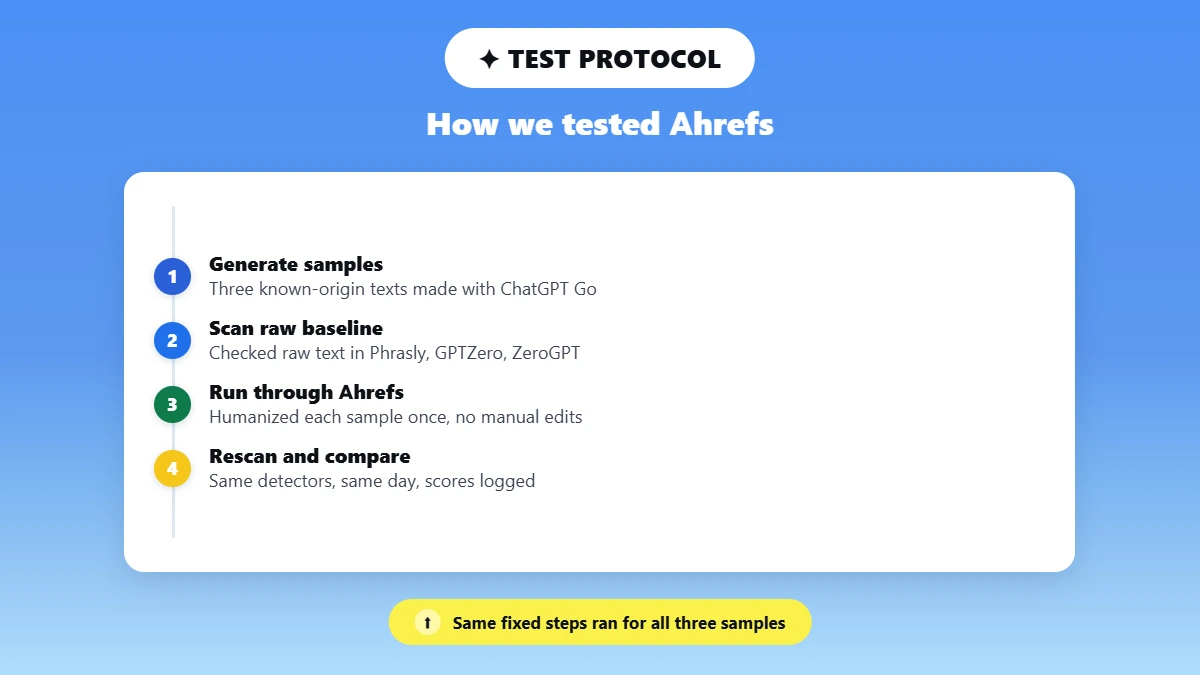
To keep this review reproducible, we followed a fixed protocol from sample generation through to the final detector check.
💡 First, we generated three known-origin samples with ChatGPT Go on September 17, 2026, using three prompts: an academic explainer on sleep and memory consolidation, an SEO blog post on reusable water bottles, and a marketing email about a small software feature update.
Each sample was written to run 180 to 230 words, long enough for detectors to analyze meaningfully, and short enough to fit inside Ahrefs' 2,048-character input limit. Word counts were 214, 208, and 183 words for the academic, blog, and email samples.
Next, we scanned each raw sample in Phrasly, GPTZero, and ZeroGPT to establish a baseline, then ran each raw sample through Ahrefs AI Humanizer once, using the default settings. We made no manual edits to any Ahrefs output.
If you'd like to check your own text the same way, here's the Phrasly's Free AI Detector we used for this test.
We then scanned each unchanged Ahrefs output with the same three detectors, on the same day and in the same order as the raw check, and saved a screenshot of every result along with the numeric score and the tool's exact wording.
Finally, we reviewed each pair for meaning preservation, naturalness, factual accuracy, and how much editing the output still needed.
Important Test Controls:
Browser extensions that rewrite text were disabled.
Paragraph breaks and punctuation were preserved exactly.
We did not regenerate a sample to chase a more favorable result.
If a detector gave a label instead of a percentage, as GPTZero did on one sample, we reported the label exactly and wrote "no numeric score" rather than estimating one.
We did not average detector percentages together, since Phrasly, GPTZero, and ZeroGPT use different models and different labeling systems.
Test Results: 3 Types of AI Content Through Ahrefs
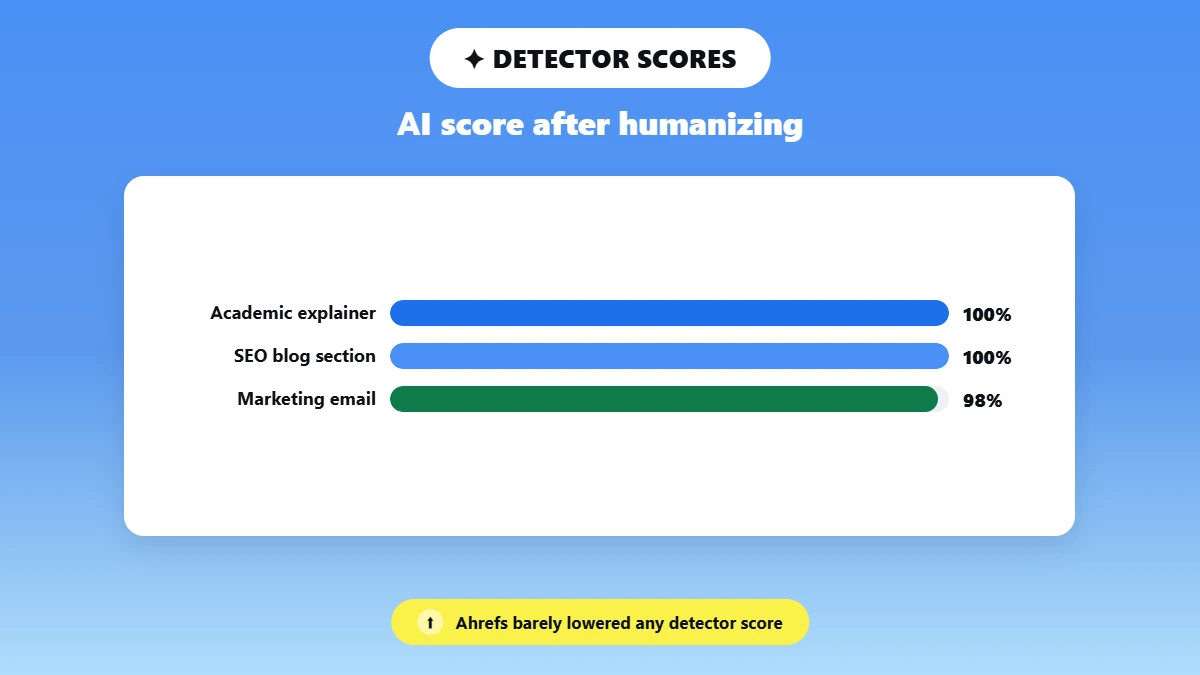
Across all three samples, Ahrefs AI Humanizer left detector results essentially unchanged, and on writing quality it helped in one case, made no difference in another, and made the text read worse in the third.
Test 1: Academic Explainer
We asked ChatGPT Go to explain how sleep supports memory consolidation for a first-year college audience in 180 to 220 words, using a formal but clear tone without citations or quotations.
The core definitions and the cause-and-effect chain, sleep strengthens neural connections, non-REM sleep consolidates factual learning, REM sleep processes emotional memory, stayed intact in the Ahrefs rewrite.
What changed was tone: Ahrefs introduced casual phrases like "catching those Z's" and "switch gears" that clashed with the requested formal register, making the rewrite read as more complicated and less natural than the raw AI draft, not more natural.
On detectors, Phrasly and ZeroGPT scored both versions at 100% AI. GPTZero was the outlier: it read the raw sample as "Mixed, human written and polished with AI," but flagged the Ahrefs rewrite as 100% AI generated, a swing in the opposite direction from what a humanizer is supposed to do.
💡 A student using this output would still need to walk back the casual phrasing to match an academic register, roughly 10 to 15 minutes of editing in our test.
Test 2: SEO Blog Section
We asked for a 180 to 220-word section on choosing a reusable water bottle, covering material, size, cleaning, and daily use in a conversational, specific style.
Here Ahrefs performed better. Sentence structure varied more, practical details, the 500 to 750 ml sizing range, the wide-opening tip for cleaning, all survived, and the rewrite added a slightly more expressive, conversational tone without turning generic or robotic.
All three detectors scored the raw and rewritten versions identically: 100% AI on Phrasly, ZeroGPT, and GPTZero, before and after. Ahrefs added roughly 46 extra words and a handful of contractions, and this sample needed the least editing of the three before use.
Test 3: Professional Marketing Email
We asked for a 180 to 220-word customer email announcing a small software update, with one clear next step and a warm, professional tone.
Tone, clarity, and the call to action carried over largely unchanged, and we found no meaningful difference in vagueness or repetition between the raw and rewritten versions.
Both versions also left the same bracketed placeholders, such as [Feature Name], unfilled, so neither was ready to send without additional editing regardless of humanizing.
Detector scores barely moved: Phrasly and GPTZero stayed at 100% AI on both versions, while ZeroGPT ticked up slightly, from 95.6% to 98%. If email is your main use case, our guide to the best AI humanizer for email marketing covers this in more depth.
Sample | Raw: Phrasly | Raw: GPTZero | Raw: ZeroGPT | Ahrefs: Phrasly | Ahrefs: GPTZero | Ahrefs: ZeroGPT | Meaning kept? | Editing |
Academic explainer | 100% AI | Mixed (human + AI polished) | 100% AI | 100% AI | 100% AI | 100% AI | Y | M |
SEO blog section | 100% AI | 100% AI | 100% AI | 100% AI | 100% AI | 100% AI | Y | L |
Marketing email | 100% AI | 100% AI | 95.6% AI | 100% AI | 100% AI | 98% AI | Y | L |
The one disagreement worth flagging is on the academic sample: GPTZero's label moved from Mixed to AI while Phrasly and ZeroGPT stayed at 100% AI on both versions. This does not mean Phrasly or ZeroGPT are more accurate, or that GPTZero is wrong.
It means the three models weigh sentence-level signals differently, and a rewrite that shifts tone can move one detector's confidence without moving another's. Treat detector percentages as directional signals from each tool, not as a single verifiable fact about authorship.
Does Ahrefs Output Actually Sound More Human?
Ahrefs' rewrites read as more casual, not more human, in our test. On one sample the added conversational phrasing worked; on another it clashed with the expected tone.
Detector scores stayed high regardless, showing that fluency and detectability are separate questions, not the same problem.
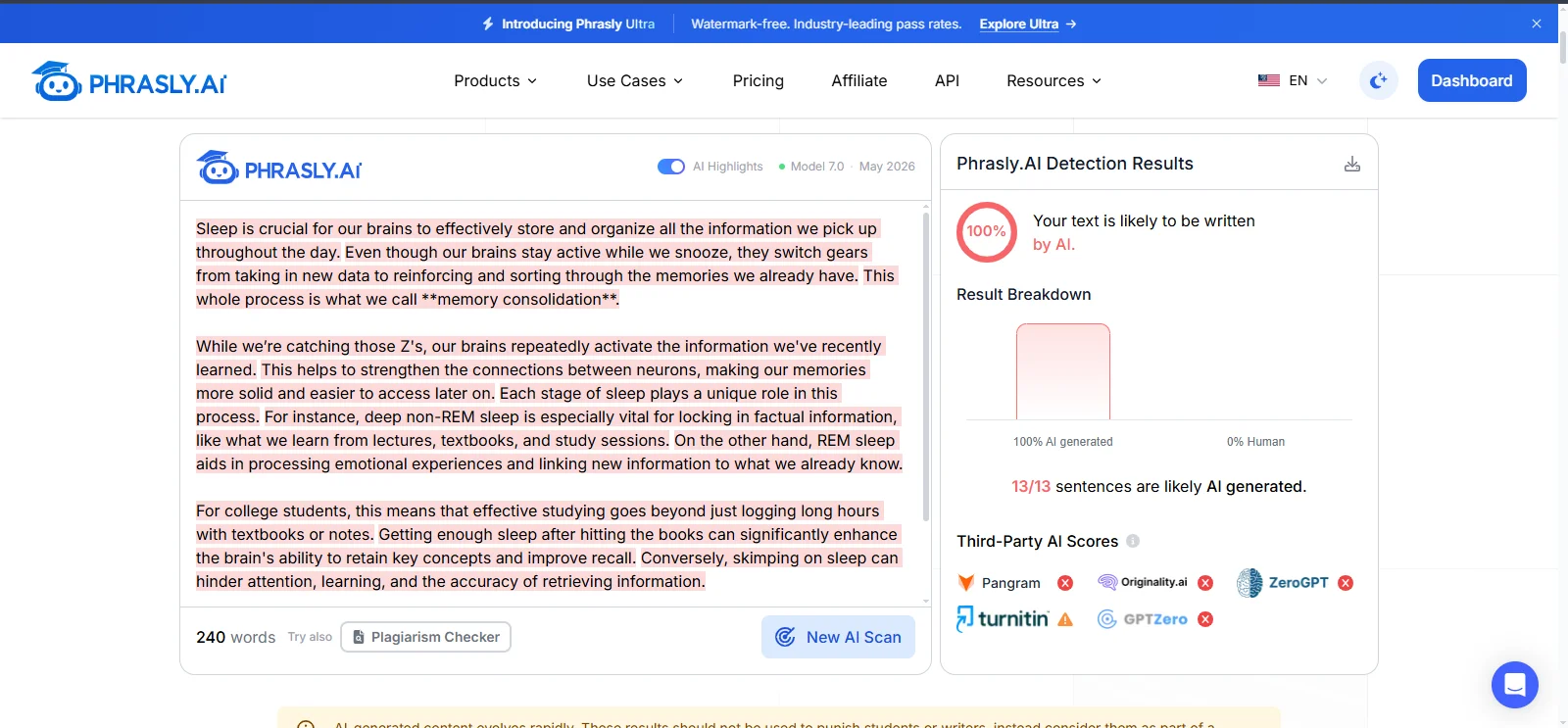
On the academic explainer, meaning and facts stayed intact, but naturalness got worse: the raw line "During sleep, recently learned information is repeatedly reactivated in the brain" became "While we're catching those Z's, our brains repeatedly activate the information we've recently learned," a casual swap that read as more formulaic, not less. It needed a tone edit, not a full rewrite.
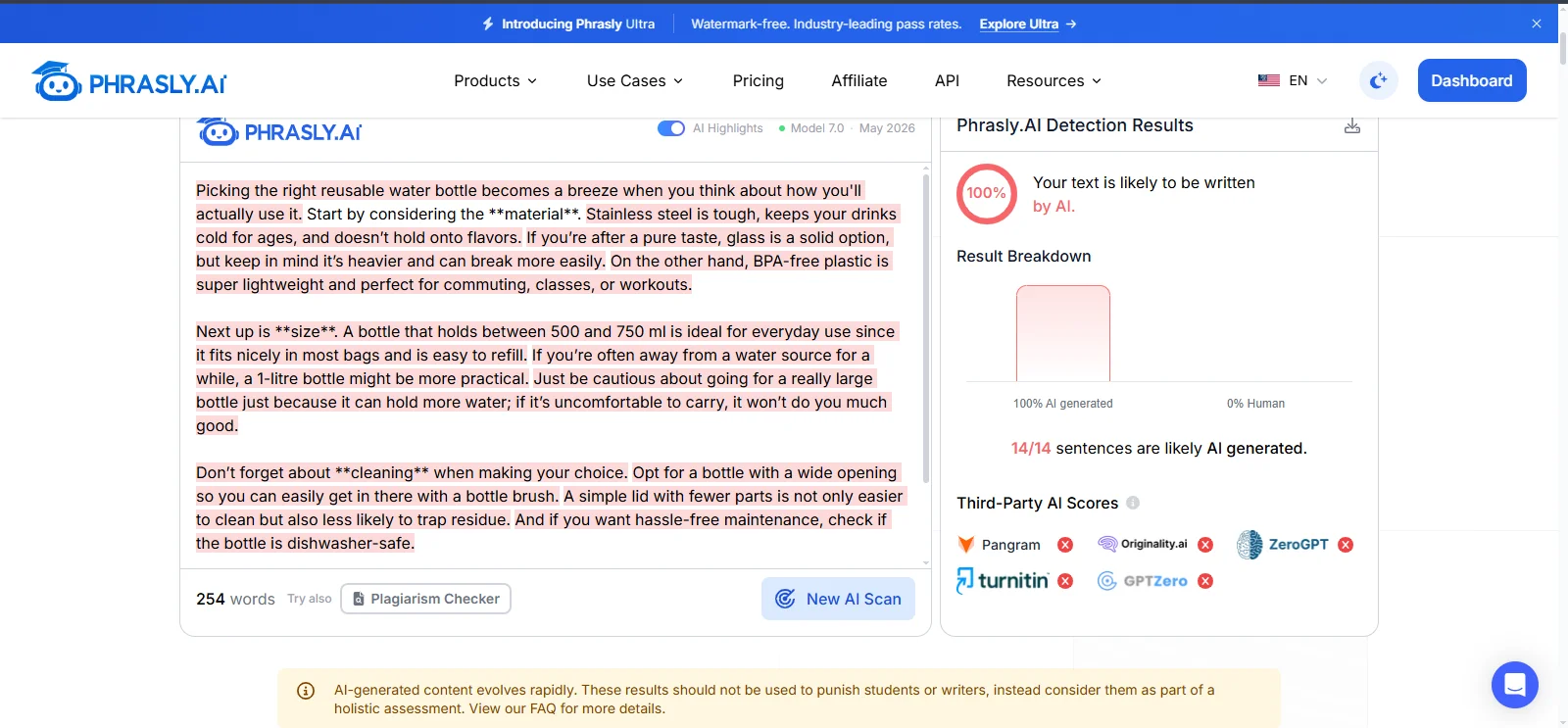
On the water bottle section, meaning and accuracy held, and naturalness improved slightly: "Choosing a reusable water bottle is easier..." became "Picking the right reusable water bottle becomes a breeze...," a livelier but still natural phrasing. It needed only a light edit.
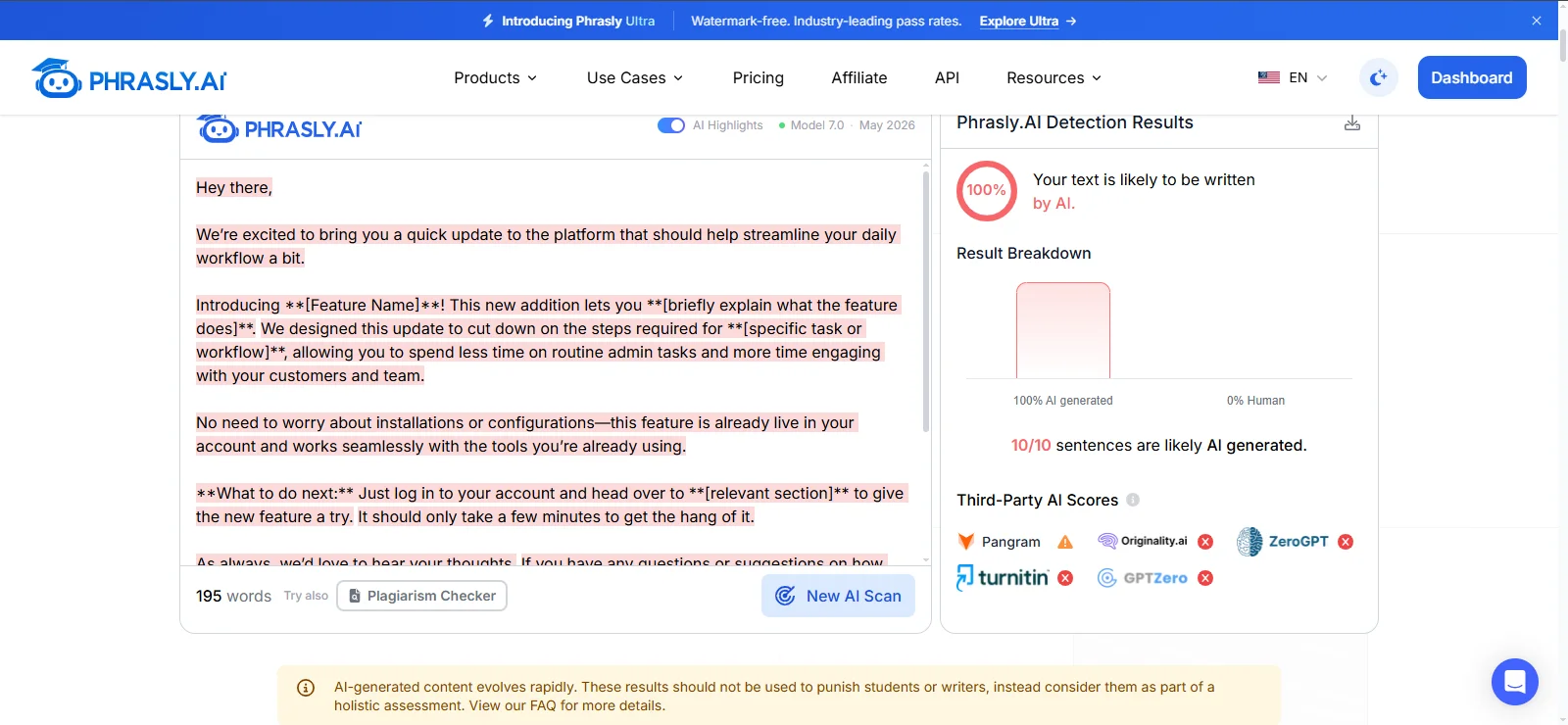
On the marketing email, meaning, accuracy, and the call to action carried over almost unchanged, and naturalness was about the same either way. The same light edit was needed regardless of version.
💡 A 2025 study of 28 AI-generated and 50 human-written essays found GPTZero usually flagged the AI essays correctly (91 to 100 percent) but produced some false positives on human work, so treat detector output as a signal, not proof.
This mismatch between casual phrasing and genuine naturalness is a common issue with many free, basic AI humanizers. If you want to understand why this keeps happening, our guide breaks down why many AI humanizers still sound robotic.
Ahrefs AI Humanizer Pros and Cons
Based on what we saw during testing, not on marketing claims, here is where Ahrefs AI Humanizer holds up and where it doesn't.
Besides Ahrefs, we've also reviewed other humanizers, like the one in our GPTHuman AI Humanizer review, if you want to see how they compare.
Pros:
Public, simple interface: paste text, pick a language, and click Generate, no account required for basic use
Fast, single-step workflow with no settings to configure before generating
Useful for short, casual copy when the raw draft already reads reasonably well, as our water bottle sample showed
Can generate multiple rewrite variants per submission, up to 5 in our shorter-input tests
Cons:
A 2,048-character input limit, which kept every test sample near 200 words
On longer inputs closer to the character limit, later variants can cut off mid-sentence with no warning
No visible strength or tone control on the page we tested, unlike tools built around adjustable rewrite intensity
Longer drafts have to be split into sections manually before they fit the input box
Ahrefs AI Humanizer vs Phrasly: Which Fits Your Workflow?
Ahrefs and Phrasly solve different problems when you need to humanize AI text. Ahrefs gives you one free, no-frills rewrite pass with a 2,048-character cap; Phrasly adds rewrite-strength control and an integrated AI detector so you can check your output without leaving the page. Which one fits depends on how much control and length you actually need.
Feature | Ahrefs AI Humanizer | Phrasly AI Humanizer |
Best fit | Quick, single-pass rewrites of short, simple text | Rewrites that need adjustable strength plus a built-in AI check |
Input shown on page | 2,048 characters | Free editor shows 800 words; paid plans advertise up to 5,000 words per request |
Rewrite controls | Multiple variants possible (up to 5 for shorter inputs); no visible strength selector | Easy, Medium, and Aggressive modes |
Built-in AI checking | A separate Ahrefs AI Content Detector page exists, outside the humanizer workflow | AI detector built into the same page, so you can check text before publishing |
Long-form suitability | Drafts must be split once the character limit is reached | Paid plans are positioned for longer inputs |
Price | Free, as shown on the Ahrefs page* | Free access available; unlimited humanization and 5,000 words per request are paid-plan claims* |
Note: Pricing and specs are accurate as of the date this article was written and is subject to change. Confirm the current price on the tool's official pricing page before purchasing.
Which One Should You Actually Use?
If you just need to quickly humanize a short piece of text, 50 to 100 words, Ahrefs AI Humanizer works fine for that. But if you're humanizing a longer draft and want control over how deep the rewrite goes, Phrasly AI Humanizer is the better fit, with Easy, Medium, and Aggressive modes to match what your text actually needs.
Who Should Use Ahrefs AI Humanizer?
Ahrefs AI Humanizer works best for short, one-off rewrites where speed matters more than control. If your draft is long, needs a specific rewrite strength, or you want humanization and AI detection in the same workflow, a dedicated humanizer suits you better.
Use Ahrefs if... | Consider a dedicated humanizer if... |
Your draft is short | You are working with long sections or full documents |
You want a quick, simple rewrite | You need control over rewrite strength |
The live tests show acceptable quality for your content type | The output still needs substantial editing or changes meaning |
You will review and personalize the result | You want humanization and checking in one workflow |
Students in particular should follow their course or institution's AI policy and disclose AI assistance where it's required, whichever tool they use.
Final Verdict: Is Ahrefs AI Humanizer Worth Using?
Ahrefs AI Humanizer is worth a try for quick, free rewrites, but it did not reliably lower AI-detector scores across our tests, and on one sample it moved a detector's reading from Mixed to fully AI-flagged rather than helping.
Its best use case, based on our tests, was short, casual copy: on the reusable water bottle sample, it added a more natural, conversational tone without losing any details, and needed only a light edit before use.
Its most important limitation, based on our tests, is that it did not consistently change how AI-detectable the text was: two of three samples showed no detector movement at all, and the academic sample actually read more confidently as AI after the rewrite than before.
For a quick, free rewrite of short text, Ahrefs AI Humanizer is enough. For longer drafts, or when you want control over how the rewrite is done, Phrasly AI Humanizer is the better fit.
Note: This review covers only the free Ahrefs AI Humanizer tool. It does not evaluate Ahrefs' paid SEO software suite.
Frequently Asked Questions
Is Ahrefs AI Humanizer free?
Yes. As tested on September 16, 2026, Ahrefs presents AI Humanizer as a free tool on its public writing-tools page, with no login required to generate a rewrite. We did not encounter a daily cap or a login wall during testing, though Ahrefs may change this without notice, so it's worth checking the live page before relying on it.
What is the Ahrefs AI Humanizer limit?
The official interface displayed a maximum of 2,048 characters per input when we tested it on September 16, 2026. That's a character count, not a word count, so usable length varies with sentence structure, roughly 300 to 350 words for typical English text. Anything longer has to be split into sections and run through the tool separately.
Does Ahrefs AI Humanizer actually work?
It works as a rewriter, not as a way to make text undetectable. It changed wording and sentence structure on every sample, yet all nine post-rewrite checks stayed at 98% AI or higher, and quality improved on one sample but worsened on another. Detectors disagreed with each other, so treat any score as a signal, not proof; our Phrasly AI review covers this scoring behavior further.
Is Humanizer AI reliable?
Not consistently, in our test. It changed sentence structure on every sample but left all nine post-rewrite detector checks at 98% AI or higher, and detectors disagreed with each other on one sample. Treat any single detector reading as a signal, not proof of reliability.
Can AI detectors still flag text rewritten by Ahrefs?
Yes, in our test. Phrasly, GPTZero, and ZeroGPT all flagged the Ahrefs-rewritten versions as AI-generated on every sample, at scores of 98% or higher. On one sample, GPTZero moved from a Mixed label on the raw text to a full AI label after humanizing. Detectors can disagree with each other, so no single score proves who wrote a passage.
Is Ahrefs AI Humanizer the same as its paraphraser or sentence rewriter?
No. A humanizer aims to make AI-assisted writing sound more natural, while a paraphraser or sentence rewriter mainly restates the same wording differently. Ahrefs doesn't name a different model for each tool, so treat them as different features, not different technology. See our AI humanizer vs paraphrasing tools guide for a deeper comparison.

Written by
Hasnain
Karachi, Pakistan
I help businesses grow with SEO-friendly blog posts, landing pages, and long-form content. With 3+ years of experience, I deliver clear, original, and well-researched writing that drives results.