
Why AI Marketing Copy Sounds Generic (and How to Fix It)
AI copy sounds generic because language models default to the statistical average, not your brand's voice. Learn why AI writing blends together, see real before-and-after examples across email, social, and ads, and get a 3-step fix to make your content specific, authentic, and unmistakably yours.
AI marketing copy sounds generic because language models are built to produce the most statistically likely words. They regurgitate the mean of all of the data they were trained on.
Provided no specific inputs are used, the out-of-the-box results will be adequate, reliable, and identical to all other models leveraging those same tools. The solution isn't engineering a better prompt.
It's injecting the specifics and point of view that your model can't know on its own.
Average copy doesn't just perform poorly; it vanishes.
We diagnose the 3 causes of complaints that makes your AI content sounds generic, illustrate examples of generic content in email, social, and ads, and provide the solutions to create AI content that’s specific, authentic, and 100% yours.
The Root Cause: Models Write the Average
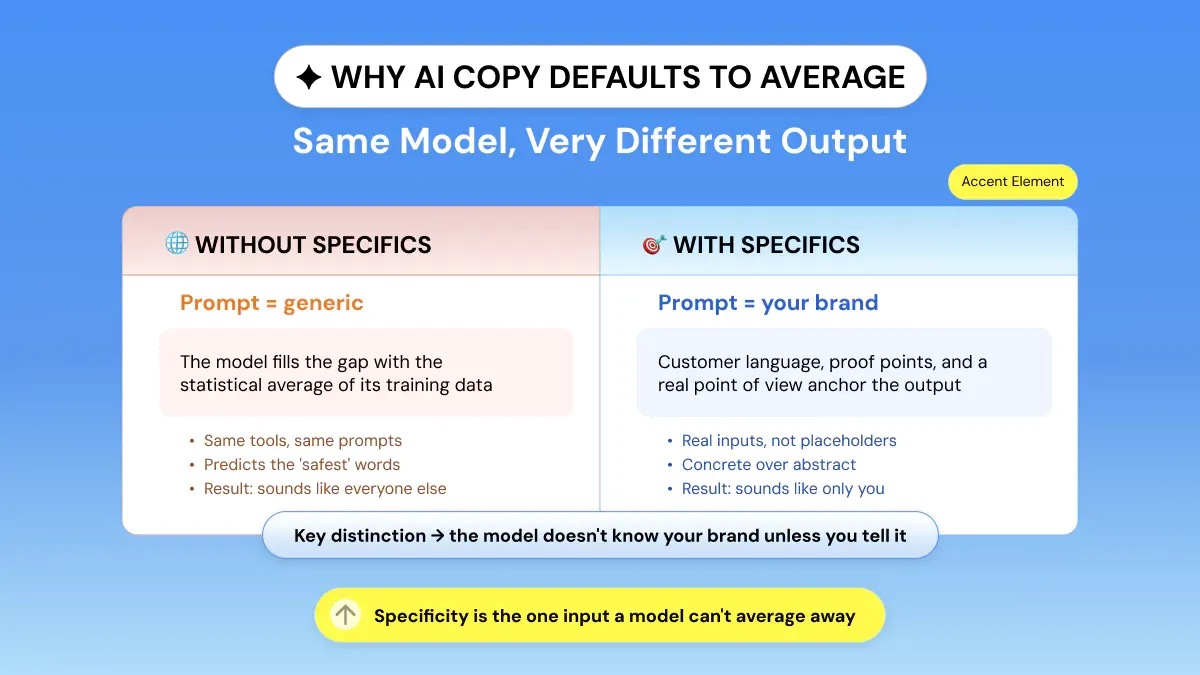
Generic AI copy isn't a bug you can prompt around until you fix. It's a property of how large language models work. Large language models always reach for the statistically likely next word based on everything they've previously "seen".
That tends to drag every prompt response toward the distribution mean. Without careful prompting, you'll get Web-average, not your brand.
How "Averaging" Pulls Every Draft Toward the Middle?
A language model trained on millions of examples of marketing writing has essentially learned what a "generic" sentence about a product benefit sounds like.
That's training data averaging.
A kind of statistical regression to the mean where the most extreme language gets ironed out in favor of whatever is most common and safest. You don't need to invent a statistic to explain this.
It's just what occurs when you train a system to guess what the most likely next word is instead of the most unique next word.
This is why AI writing is so bland is such a frequent complaint, even when there are no grammatical or structural errors. Because two competitors can feed the same tool with a similar prompt and get nearly the same wording back.
Because they're drawing from the same statistical middle.
The result is AI copy that lacks personality. It reads correctly and says nothing that only your brand could say.
Specificity is the one thing a model can't produce independently. Customer phrasing, proof points, and a clear brand voice must be derived by you. All other aspects can be generalized.
What Does Generic Look Like Across Formats?
Generic AI copy looks and sounds the same across every channel. It uses lofty benefits instead of specific details. Instead of making commitments, it hedges its claims. And it uses vague phrases that could come from any brand in the space.
Let’s see it side by side.
Email is where this problem shows up most often, since subject lines and CTAs are the first thing a generic-detector (human or algorithmic) trips on.
Humanizing isn't just about tone. It's about doing that final pass without losing the exact commitments and phrasing you built in during the concreteness step.
|
Format |
Generic
AI Version |
Specific,
Human Version |
|
Email subject line |
"Unlock Your Business Potential Today" |
"You left 14 carts unfinished this week here's
why" |
|
Social caption |
"We're passionate about delivering quality
solutions for our customers." |
"Our support team answered 400 tickets last month
in under 6 minutes each." |
|
Ad headline |
"The Smarter Way to Grow Your Business" |
"Cut your reporting time from 3 hours to 20
minutes" |
Across all three formats, the shared tells are the same:
- Abstraction: Describes benefits in broad terms rather than quantifying with a specific outcome or number.
- Hedging: Using vague or ambiguous language to avoid making a concrete claim.
- No unique perspective: There is no opinion, angle, or stance that your competitor cannot claim as well.
- No proof: No customer-identifiable language, data, or detail that could only come from your business.
These tells are problematic because they contradict the two things buyers claim they truly desire.
Does Generic Content Still Work?
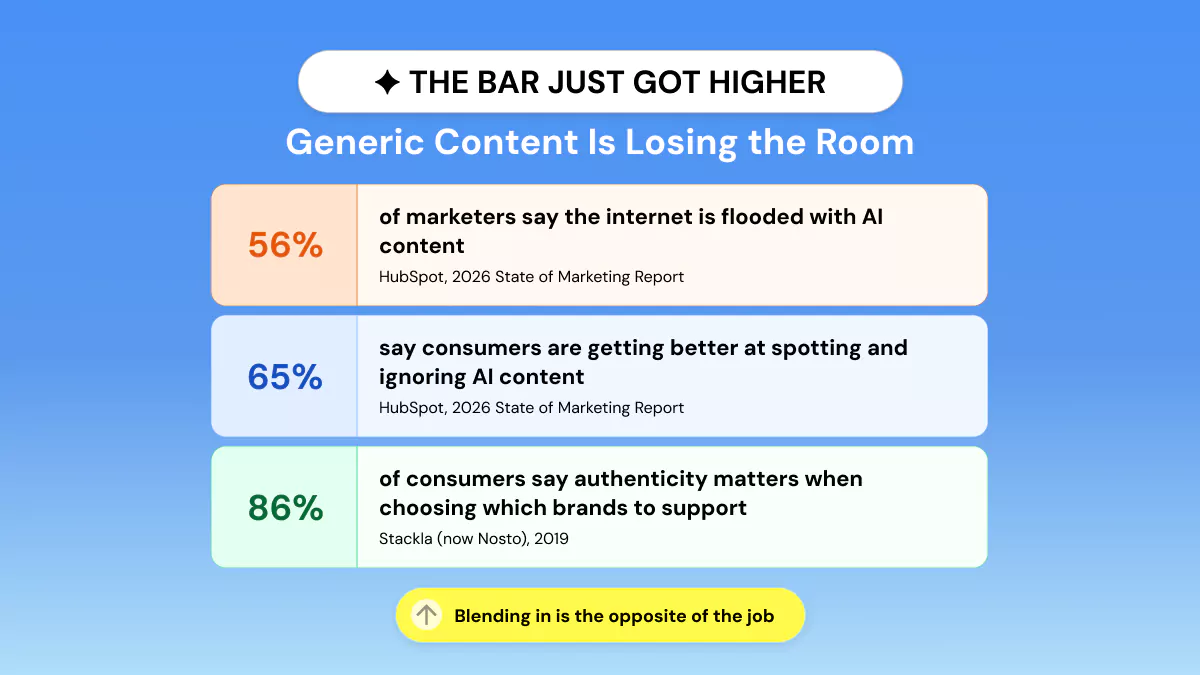
Even with overflowing inboxes and feeds, HubSpot's data shows that consumers can detect AI-generated content 65% of the time. Generic copy just blends in with everything else that's doing the same thing.
But blending in is the opposite of standing out, which is what we're here to do. As AI saturation becomes more prevalent, bespoke, human-crafted copy that clearly goes above and beyond is what will make you stand out.
This should help reshape your definition of what "humanizing" AI copy means. It's not a polish step you add for style points. It's how you differentiate AI content in a feed where every competitor has access to the same tools.
Content Differentiation and originality is going to be what's rare because generic output is going to be ubiquitous.
The Fix: Make It Specific, Then Humanize
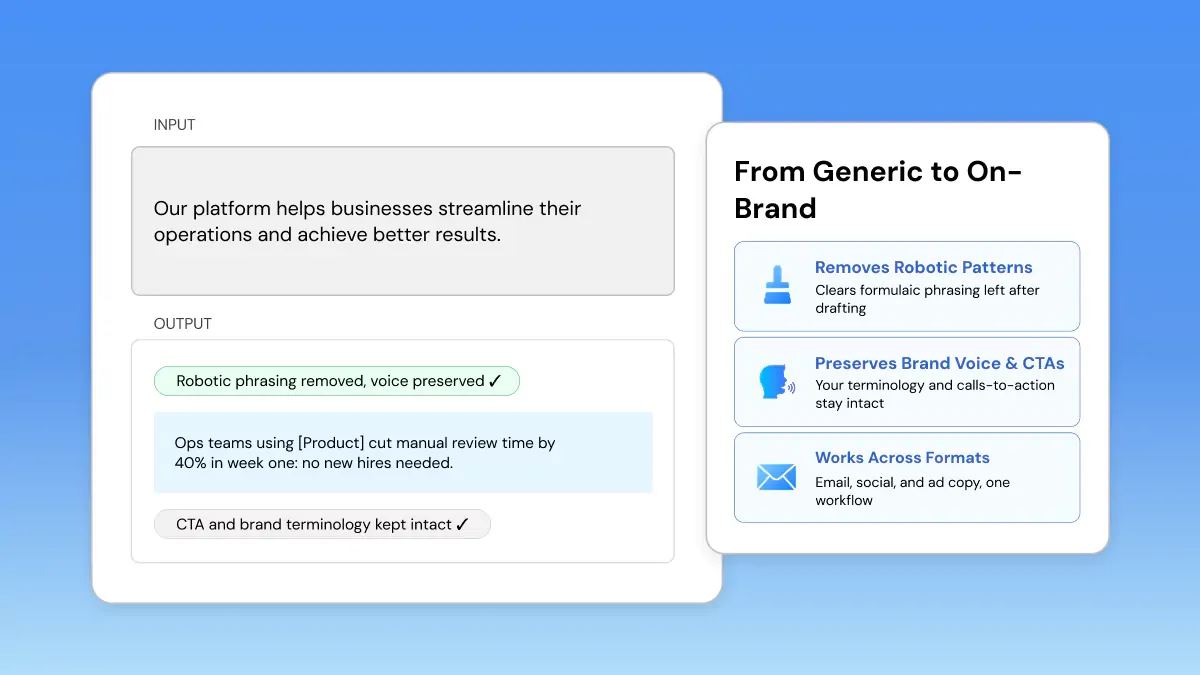
Feed the exact customer language and a clearly defined POV into the model. Edit the draft for concreteness, then run through a humanizer to clear up whatever robotic language remains while leaving your voice and CTAs untouched.
A Three-Step Fix: Specific Inputs, Concrete Edits, Humanized Phrasing
Fixing generic AI copy is actually simple. It doesn't require abandoning AI tools.
It's a useful companion to the three-step fix below if you want templates rather than just the theory.
- Provide the model with information it can't make up: real customer testimonials, statistics, and a clear angle/opinion.
This is also where your choice of tool matters.
You still need to add in your own customer language and POV, but starting from a sourced, accurate draft means there's less generic filler to strip out later.
- Edit for concreteness. Replace vague benefit claims with a specific outcome, number, or proof point.
- Humanize the phrasing. Once your draft is edited and polished, pass it through a humanizer to help eliminate any residual formulaic language. Be sure to undo any changes to your meaning and CTAs.
The humanizer's job is to clear the sameness that averaging introduces. Your job is to supply the substance. The specificity, proof, and brand voice that no model can generate on its own.
Try it: Phrasly's AI Humanizer
Paste any draft into the Phrasly AI Humanizer to clear formulaic, average-sounding phrasing while preserving your voice, facts, and calls to action.
Phrasly is trusted by 3,000,000+ users at a 4.7/5 rating (Phrasly.ai, 2026). It's a finishing step, not a replacement for the specific inputs only you can provide.
Frequently Asked Questions
Why does AI marketing copy sound generic?
Language models assign probabilities to words based on their training data, which averages out every prompt you feed them. If you don't tell it about your brand, it will regurgitate generic, safe sentences.
Why does all AI content sound the same?
Since different brands with similar tooling and similar prompts are drawing from the same statistical average, their outputs settle around very similar language.
Nothing but brand-specific inputs (actual proof, voice, and point of view) breaks up that pattern.
Can I make AI content less generic with a better prompt?
Prompting helps, but it has limits. A model still can't invent facts, customer language, or a stance it wasn't given. The most reliable fix is feeding it specific inputs, then editing and humanizing the result.
Does generic AI content hurt my marketing?
Yes, more and more. Generic AI-written drafts get lost in the noise of other brands publishing AI-written copy, and audiences are learning to ignore it more quickly, says HubSpot's 2026 data. Human-specific, authentic copy still stands out.
How do I make AI copy sound like my brand?
Provide the model with something concrete for it to work with. Using actual customer language, numbers, and a clearly stated opinion. Then edit for concreteness. Afterwards, run it through a humanizer to get rid of any robotic sentences.
What does a humanizer actually change?
Humanizers rewrite robotic-sounding, generic phrases into natural wording without changing your intent. Think of tools like Phrasly's AI Humanizer as a last step in your process to naturally rewrite average sounding content.
If you want more control over how much a draft changes, Phrasly's AI text enhancer is built for exactly this step.
Instead of a single rewrite, it gives you Easy, Medium, or Aggressive settings, so you can do a light polish on copy that's already close, or a full transformation on a draft that still reads like Web-average.
It's a practical way to strip out the residual "AI-ness" without touching the specifics, proof points, and voice you've already added.


Keep reading

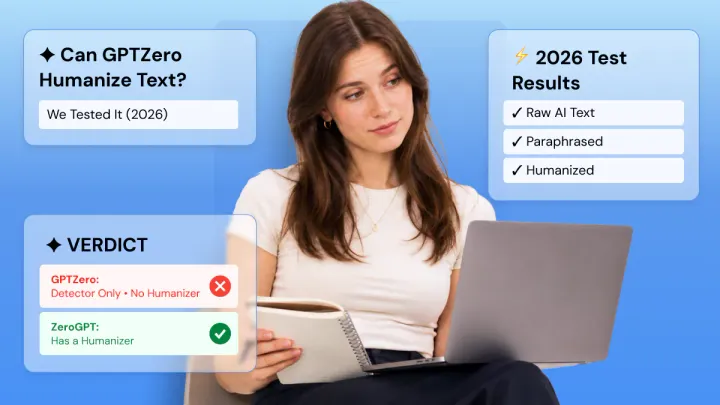
Can GPTZero Humanize Text (+ Can It Detect Humanized Text)
GPTZero doesn't have a humanizer and never has. We tested 5 AI samples raw, paraphrased, and humanized to see what actually beats its detector. Paraphrasing failed almost every time. Properly humanized text scored 98–100% human across the board. Here's exactly what worked.
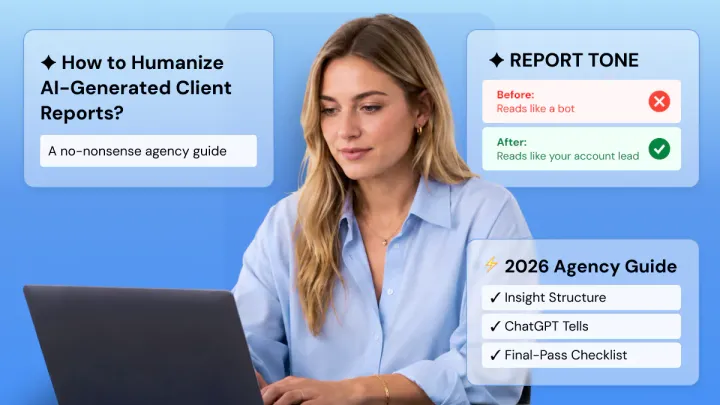
How to Humanize AI-Generated Client Reports (Before They Read as Robotic)
AI reports default to describing the numbers. They default to describing 'traffic increased 12% month over month' without explaining why it happened or what to do about it. That's dumping data and calling it deliverable; spoken in a professional voice.