Does Rephrasy's Plagiarism Checker Actually Work?
We tested Rephrasy's plagiarism checker so you don't have to. Here's an honest look at what works, what doesn't, and what to use instead.
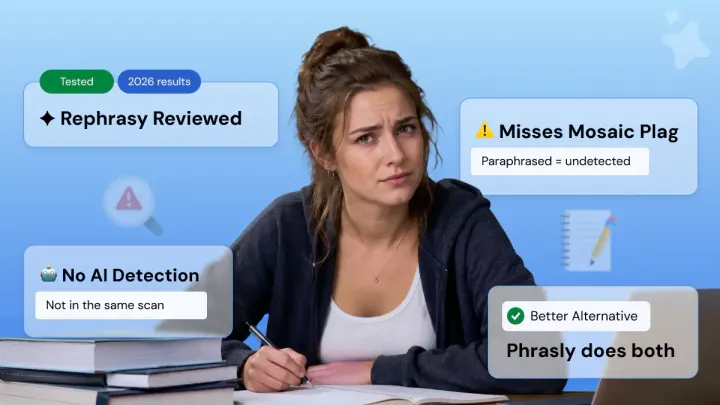
Rephrasy does include a plagiarism checker, but whether it's reliable enough for academic submission is a different question.
The Rephrasy plagiarism checker sits inside a three-in-one suite alongside an AI humanizer and an AI detector, positioned as a support tool rather than the main feature.
This Rephrasy review covers what the scan catches, what it misses, and three real gaps (mosaic detection, no bundled AI checking, and credit-based word limits) that matter when using an AI plagiarism checker 2026 to clear an assignment before submission.
Check your assignment with Phrasly before you submit 👇
What Is Rephrasy's Plagiarism Checker?
Rephrasy's plagiarism checker is a text originality tool that scans your writing against online sources to flag copied or closely matched content.
You upload a document or paste your text, and Rephrasy returns a plagiarism report showing how much of your assignment overlaps with existing material online.
The checker sits inside Rephrasy's wider writing suite alongside an AI humanizer and an AI detector.
That matters because students searching for Rephrasy AI humanizer plagiarism usually want two things at once:
- Confirmation their work is not copied, and
- Reassurance their rewritten or AI-assisted text is safe to submit.
Plagiarism checking is one feature in that system rather than the main one.
A standard originality report from Rephrasy gives you three things:
- Similarity score: the percentage of your text that matches online sources
- Flagged sections: the specific passages Rephrasy considers copied or paraphrased
- Source links: the URLs where each match was found
The score is the headline number, but the flagged passages tell you more. A 12% score with one uncited copied paragraph can be riskier than a 22% score made up of properly cited quotes and common academic phrasing.
Accuracy depends on what kind of copying you are trying to catch.
How to Read Your Rephrasy Similarity Score
Your similarity score is not a plagiarism verdict. It shows how much of your text matches existing sources, so you still need to review the flagged passages, source links, and citation context before you submit.
Turnitin's own student guide makes the same point: similarity does not automatically mean plagiarism, because quotes, references, and common academic phrasing can also trigger matches.
Use this as a quick student reading guide:
- 0–15%: Low risk. Generally safe, but still check whether any full sentences or paragraphs are copied without citation.
- 16–30%: Moderate risk. Review every flagged section. This range can be fine for source-heavy assignments, but weak paraphrasing or missing citations can raise concerns.
- 30% and above: High risk. Revise before submission. A high score usually means too much matching text, overused quotes, or uncited source material.
One thing to remember: Rephrasy does not set your pass/fail threshold.
Your instructor, department, or institution decides what similarity score is acceptable, and plagiarism detection accuracy varies between tools, so always cross-check against your institution's own checker before final submission.
What Rephrasy's Plagiarism Checker Does Well
Rephrasy's plagiarism checker is not a Turnitin replacement.
Turnitin is the institutional standard universities actually grade submissions against, while Rephrasy is a third-party tool for self-checking your work before that final review.
With that scope in mind, Rephrasy earns fair credit on four fronts: bundled workflow, fast scan speed, multilingual support, and Turnitin reporting on paid plans.
Here is what each one looks like in practice.
1. Bundled workflow in one workspace
Plagiarism checking sits next to Rephrasy's AI humanizer and AI detector in the same dashboard, so you can move between originality, AI detection, and rewriting without opening three different platforms.
Paste your text or upload a document and you get an instant plagiarism report. For a fast first review before submission, that bundled flow saves real time.
2. Fast scan speed
Results come back in seconds, which matters when you are working against a deadline. It does not replace an institutional report, but it can surface obvious copied text, missing citations, or sections that need a rewrite before you submit.
3. Multilingual support
Third-party reviews report support for 50+ languages, which helps non-English academic writers check and rewrite content across different writing contexts.
4. Turnitin reporting on paid plans
A 2025 review lists one Turnitin report on the Growth plan, two on Business, and ten on Professional. For anyone searching "rephrasy plagiarism checker turnitin", that integration is often what justifies the upgrade.
3 Things Rephrasy's Plagiarism Checker Won't Catch
Rephrasy's plagiarism checker is only partially reliable for academic submissions: it catches verbatim copying well, but three types of content consistently slip through, and for institutional review, that gap matters.
A clean score can tell you obvious copied text was not found, but it does not prove the assignment is fully original, properly cited, or safe for institutional review.
It works as a first scan, but students should understand what the report is not built to catch.
Limitation 1: Mosaic and Patchwork Plagiarism
Rephrasy does not reliably detect mosaic plagiarism. Its checker is stronger on direct copying than on complex source misuse, so a sentence lifted closely from one webpage has a fair chance of being flagged.
But mosaic plagiarism and patchwork plagiarism are harder to catch because the writing is stitched together from several sources, with words changed just enough to slip past basic text matching.
That matters because modern plagiarism is rarely pure copy-paste.
A 2025 systematic review in Frontiers in Computer Science notes that early string-matching methods work well for verbatim overlap, but plagiarism has evolved into paraphrasing, translation, idea-based copying, and AI-generated content, making traditional methods less reliable for paraphrased content detection.
Privacy matters too when you upload a draft. Per Rephrasy's privacy policy, the company stores your data only as long as necessary to provide the service, and users can request deletion at any time.
That is more flexible than tools that wipe content the moment a scan completes, but it also means your draft stays on Rephrasy's servers until you actively ask for it to be removed.
Limitation 2: AI-Assisted Content Not Always Flagged
Rephrasy does not detect AI-generated content as part of its plagiarism scan. Plagiarism checking and AI detection live as separate workflows inside Rephrasy's toolset.
Plagiarism checking is mainly about source similarity, while AI detection is a separate type of analysis, and Rephrasy's own AI detector tutorial treats AI checking as its own dedicated flow.
For students in 2026, that gap matters because institutional tools increasingly show AI signals alongside similarity data.
Turnitin's 2026 product update says investigators can view AI writing scores alongside integrity results such as the Similarity score, and its guide shows the AI Writing Report as a separate tab inside the report flow.
Relying on Rephrasy's plagiarism checker alone leaves that AI detection blind spot wide open.
Limitation 3: Word Limits on Paid Plans
The third issue is cost at scale. Rephrasy's plagiarism checking is credit-based, not unlimited, and pricing has shifted across plans and public reviews.
One 2025 review lists plagiarism credits across Rephrasy's short-term and lifetime options, plus Turnitin reports tied to Growth, Business, and Professional plans.
That makes Rephrasy less comfortable as a plagiarism checker for thesis 2026. A 1,500-word essay is easy to scan, but a 10,000 to 15,000-word thesis can burn through credits quickly. For long academic submissions, check Rephrasy's live pricing page before relying on it as your main originality tool.
Rephrasy vs Phrasly Plagiarism Checker: Side by Side
For students comparing Rephrasy vs Phrasly plagiarism, the real difference is not just whether both tools scan for copied text. The bigger question is whether the tool checks plagiarism, AI-writing risk, source matches, privacy, and long-document limits in one practical workflow.
Phrasly's key advantage is that it works as an AI content detector and plagiarism checker in one scan, with a generous 20,000-word monthly allowance and a strong user rating (4.7 from nearly 2,700 reviewers) to back it up.
Rephrasy works if you want a broader AI humanizer workflow with optional plagiarism credits and Turnitin reports on higher plans.
For students who specifically want a plagiarism checker with AI detection, source matching, mosaic plagiarism review, and fewer long-document worries in the same workspace, Phrasly is the stronger pick.
A Better Alternative for Students
The gaps with Rephrasy are clear: weaker confidence around mosaic plagiarism, no bundled AI detection inside the plagiarism report, and word-limit or credit concerns for longer submissions.
Assignment checking is not only about finding copied sentences. It is about catching paraphrased overlap, AI-writing risk, and source-match problems before you submit.
Phrasly is built around that exact workflow. Here is how it closes each gap:
1. Broader scan, smarter detection
Phrasly scans against 10B+ web pages, academic papers, and research databases, then returns a report with a similarity score, highlighted matches, direct source links, and a source-by-source breakdown.
It catches copied, paraphrased, restructured, and mosaic plagiarism, which is exactly where basic text-matching tools fall short.
2. AI detection in the same scan
Instead of running one tool for similarity and another for AI-generated content, you review both side by side in one report. That makes Phrasly a far more practical plagiarism checker with AI detection for essays, dissertations, and research papers.
3. Privacy by default
Phrasly never stores or shares your text, and documents are deleted immediately after scanning. Your draft does not sit in someone else's database after the report is generated, which matters when the work is original research.
4. No per-scan word cap anxiety
A 20,000-word monthly allowance covers most full thesis chapters in one go, so you are not rationing credits halfway through a draft.
Frequently Asked Questions
Is Rephrasy's Plagiarism Checker Accurate?
Rephrasy is accurate for verbatim copying but less reliable for paraphrased, mosaic, or patchwork plagiarism. Its similarity scan flags direct text matches against online sources, but more complex source misuse can pass with a clean score. Students should always review the flagged sections and citations manually before submitting.
Does Rephrasy Bypass Turnitin?
No. Rephrasy should not be used as a way to avoid Turnitin review. Turnitin's Similarity Report compares your submission against its own database of academic papers, journals, and student work, which a third-party tool cannot replicate. The final academic judgment still rests with your instructor or institution.
Is Rephrasy Plagiarism Checker Free?
Rephrasy offers a limited free plan with 3 credits on signup, where 300 words equals 1 credit. Beyond that, plagiarism checks are credit-based, with paid options like the $12.99 Quick Pass for 20 credits or higher subscription tiers. For longer submissions like a thesis or dissertation, the free plan runs out quickly.
What Is a Good Similarity Score for Assignment Submission?
There is no universal safe similarity score. Most institutions treat 0–15% as low risk, 16–30% as moderate, and 30%+ as high risk, but the actual threshold depends on your school, course, or assignment type. Always check your syllabus or department policy before submitting.
Can Rephrasy Detect Mosaic Plagiarism?
No, Rephrasy's plagiarism checker does not reliably detect mosaic or patchwork plagiarism. It catches verbatim text matches against online sources, but content stitched together from multiple sources with words swapped or rearranged often passes with a clean score. For mosaic and paraphrased plagiarism review, students need a tool that scans for restructured and paraphrased content alongside direct copying.
Is Rephrasy Safe to Use for Academic Work?
Rephrasy's plagiarism checker is safe to use as a pre-submission self-check, but the wider Rephrasy suite carries academic risk. Its AI humanizer is marketed as a way to bypass detectors like Turnitin, which many universities treat as a violation of academic integrity policy. Always check your institution's AI use rules before running graded work through any humanizer-based tool. For more on what institutional tools actually scan for, see SafeAssign Check for Plagiarism? Honest Review + 3 Things It Misses.
Is Rephrasy Better Than Phrasly for Plagiarism Checking?
Rephrasy is the better fit for a broader AI humanizer workflow, but Phrasly is stronger for student submissions. Phrasly's plagiarism checker scans against 10B+ web pages, runs AI detection in the same scan, and catches copied, paraphrased, restructured, and mosaic plagiarism. For an assignment-ready originality report, Phrasly covers more ground in one place.


Keep reading

Copyleaks Plagiarism Checker: Tested, Rated & Compared
Copyleaks Plagiarism Checker review: we tested verbatim, minor-change, and paraphrased content to see how its 3-layer detection performs. See pricing, AI-detection accuracy (77%-96%), free plan limits, and how it compares to Phrasly in a head-to-head scan before you subscribe.
Does Canvas Have a Plagiarism Checker? What It Uses, How It Works & What Students Should Do
Canvas has no built-in plagiarism checker. It relies on instructor-enabled tools like Turnitin or Copyleaks. Learn how scanning actually works, whether Canvas detects AI writing (ChatGPT, Claude, Gemini), and how to check your paper for plagiarism and AI content before you submit.