
AI Humanizer vs Paraphrasing Tools: Which One Actually Works?
Head-to-head testing shows clear differences. One tool category consistently produces more natural, human-quality writing. See the data.
According to Typeform's 2026 report, 79% of marketers now use AI for written content. But most of them face the same problem. AI-generated text sounds robotic. It lacks the natural rhythm, personality, and flow that makes writing feel genuinely human.
Two tools claim to fix this: AI humanizers and paraphrasing tools. They sound similar but work in completely different ways. Picking the wrong one means your content still reads like a machine produced it.
We tested four tools head-to-head using the same AI-generated text to give you real data, not opinions. By the end, you will know exactly which tool produces better, more natural-sounding writing.
But if your content needs improvement now, Phrasly's AI humanizer is a good place to start.
What Is an AI Humanizer?
An AI humanizer is specialized software designed to transform AI-generated text into language that closely resembles authentic human writing. Unlike basic rewriters or paraphrasers, humanizers analyze intricate stylistic elements such as sentence rhythm, word choice, transitions, idiomatic expressions, and natural flow to improve overall writing quality and readability.
Humanizers operate by applying advanced language models trained on large corpora of genuine human writing. This allows them to reinterpret AI text with context-aware adjustments rather than performing simple word swaps. The result is content that reads naturally and authentically, complete with smooth transitions, varied pacing, and expressive phrasing.
To experience this transformation firsthand, see how Phrasly's AI humanizer transforms AI text into natural-sounding writing.
What Is a Paraphrasing Tool?
A paraphrasing tool is content transformation software designed to rewrite text while preserving its original meaning. These tools take an input passage and generate a new version by substituting synonyms, reordering phrases, and modifying sentence structure.
The primary goal of a paraphraser is to produce a fresh rendition of the source content that avoids direct duplication and enhances readability, originality, or stylistic variation.
Because these transformations often occur at the word or phrase level, the essential structure of the original text typically remains recognizable. This makes paraphrasing effective for basic originality or clarity purposes, but also means that the underlying patterns of AI-generated text, such as uniform rhythm or templated phrasing, may persist after paraphrasing.
For instance, when comparing how QuillBot performs against dedicated humanizers, the limitations become clear when the goal is producing genuinely natural-sounding writing.
Key Technical Differences Between Humanizers and Paraphrasing Tools
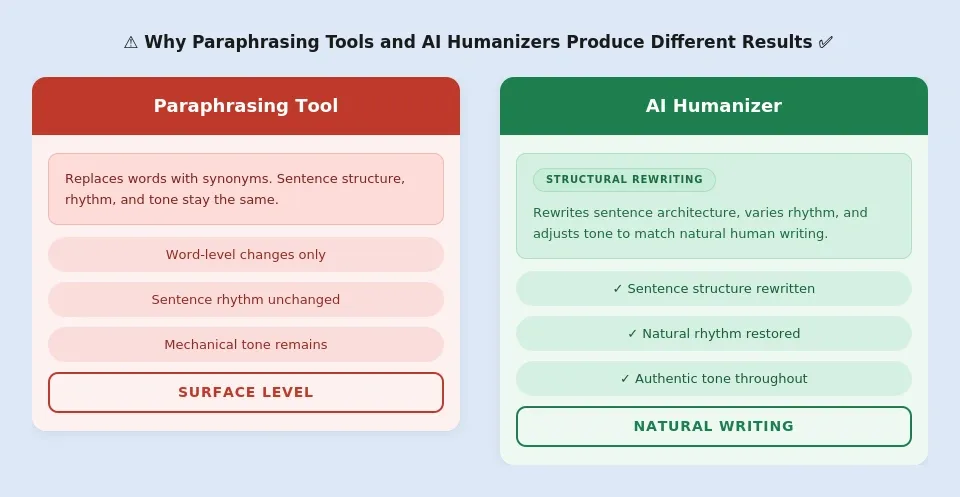
Primary Objective
AI humanizers make AI content read like human writing by targeting stylistic markers such as repetitive syntax, predictable rhythms, and overly polished phrasing. Paraphrasers rewrite text for uniqueness or clarity through word replacement without a strategic focus on improving overall writing naturalness.
Transformation Depth
Humanizers apply deep transformations considering context, semantic flow, and rhetorical variation to mirror natural human language with idioms, casual phrasing, and variable sentence lengths. Paraphrasers perform synonym replacement and basic structural tweaks that change wording but not deeper stylistic indicators, leaving robotic writing patterns intact.
Writing Authenticity vs. Text Uniqueness
Humanizers eliminate robotic writing patterns that make text sound machine-generated, through internal quality checks or iterative rewrites. Paraphrasers increase text distinctness for plagiarism tools but don't address unnatural writing signals. This makes humanizers the best tool to produce authentic, human-quality writing.
Output Characteristics
Humanized output exhibits variable pacing, conversational tone, and rich sentence diversity. Paraphrased text often retains a mechanical tone since changes are algorithmic substitutions rather than nuanced stylistic adaptations.
Use Case Alignment
Humanizers are best for final-stage content intended to meet writing quality standards or deeply engage readers, such as blog posts, academic essays, or professional copy. Paraphrasers excel where multiple unique versions of content are needed quickly, such as SEO rewriting or plagiarism avoidance.
Not sure how to get started? Read our full guide on how to humanize AI text for a step-by-step walkthrough.
Summary Of AI Humanizer Vs Paraphrasing tool
| Feature | AI Humanizer | Paraphrasing Tool |
|---|---|---|
| Addresses robotic writing patterns | ✅ Deep level | ❌ Surface level |
| Improves sentence rhythm & flow | ✅ Yes | ❌ No |
| Synonym replacement | ✅ Yes (contextual) | ✅ Yes (algorithmic) |
| Preserves original meaning | ✅ High accuracy | ⚠️ Sometimes distorts |
| Adjusts tone & voice | ✅ Yes | ❌ No |
| Produces natural-sounding output | ✅ Consistently | ⚠️ Inconsistent |
| Requires manual editing after | ✅ Minimal | ⚠️ Often needed |
| Works for academic writing | ✅ Ideal | ⚠️ Limited |
| Works for marketing/blog content | ✅ Ideal | ✅ Adequate |
| Speed | ⚠️ Medium | ✅ Fast |
| Multiple rewrite modes | ✅ Some tools | ✅ Common |
Real-World Testing: Which Tool Works Better?
To provide concrete evidence of performance differences, we tested four tools representing both AI humanizers and paraphrasing utilities. Each tool was evaluated using the same ChatGPT-generated source text and analyzed with the same AI detector to measure writing quality output, using detection score as a proxy for how natural and authentic the writing sounds. When you compare humanizer options, understanding real-world results is essential.
About This Test
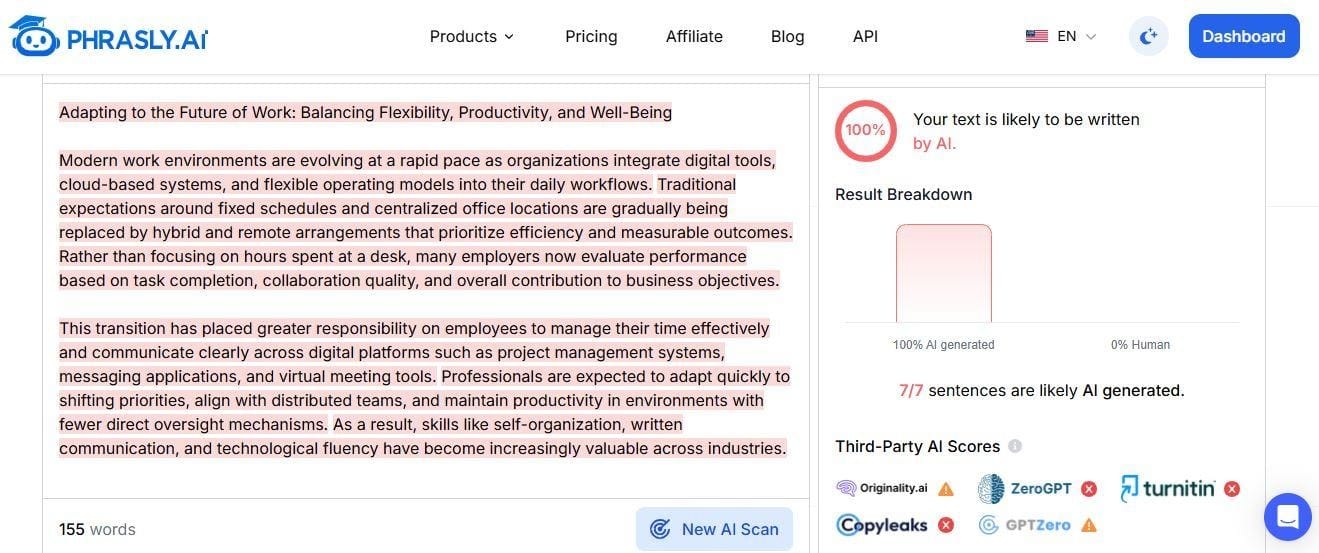
- Source Text: ChatGPT-generated passage titled "Adapting to the Future of Work: Balancing Flexibility, Productivity, and Well-Being."
- AI Detector: Phrasly AI Detector (Latest V2 mode) with AI probability scores and sentence-level analysis
- Tools Tested: Phrasly Humanizer, ZeroGPT, QuillBot, Paraphrase Online
- Baseline Detection Score: 100% AI probability, "Your text is likely to be written by AI"
- All tools used default settings with no manual edits to ensure objectivity
AI Humanizer Results
Phrasly Humanizer
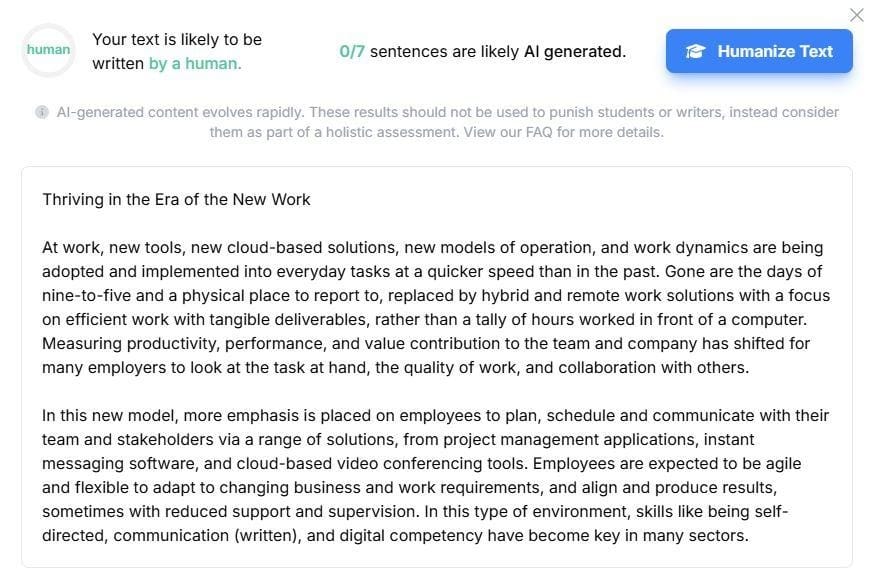
- AI Probability Score: 0% (100 percentage point reduction)
- Detector Verdict: "Your text is likely to be written by a human."
- Adjusted sentence lengths and transitions to reflect natural human cadence
- Added subtle connectors and phrasing variations for conversational flow
- Core ideas remained intact with negligible semantic changes
Phrasly's output read naturally with varied sentence lengths, smooth transitions, and conversational flow. The AI detection score confirmed what the text sounds like when read aloud authentically human.
ZeroGPT
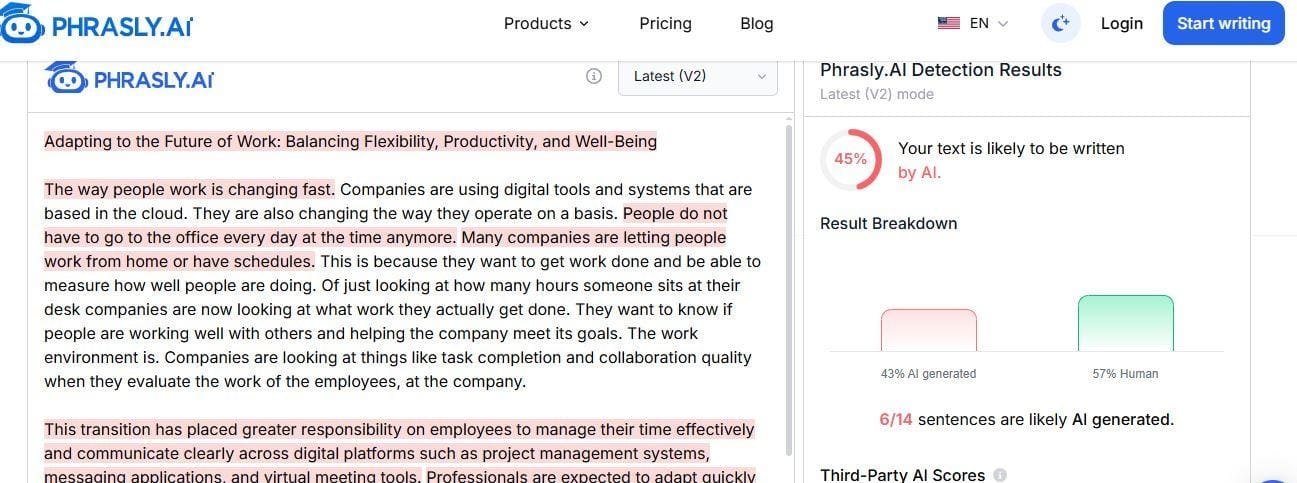
- AI Probability Score: 46% (54 percentage point reduction)
- Detector Verdict: Partial improvement with some sentences still flagged
- Simplified complex sentences and improved readability
- Partially improved but retained some mechanical patterns in sentence structure
Paraphrasing Tool Results
QuillBot
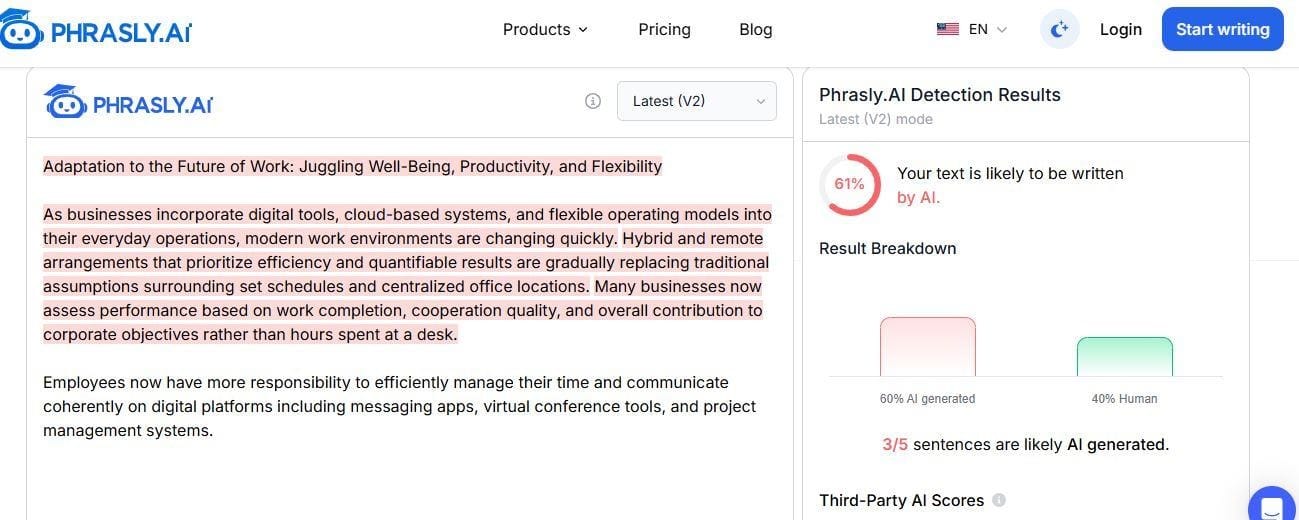
- AI Probability Score: 61% (39 percentage point reduction)
- Detector Verdict: Mostly formulaic, some sentences improved
- Focused on synonym replacement and minor sentence restructuring
- Word-level changes without deeper structural improvement. Text still reads formulaically
Paraphrase Online
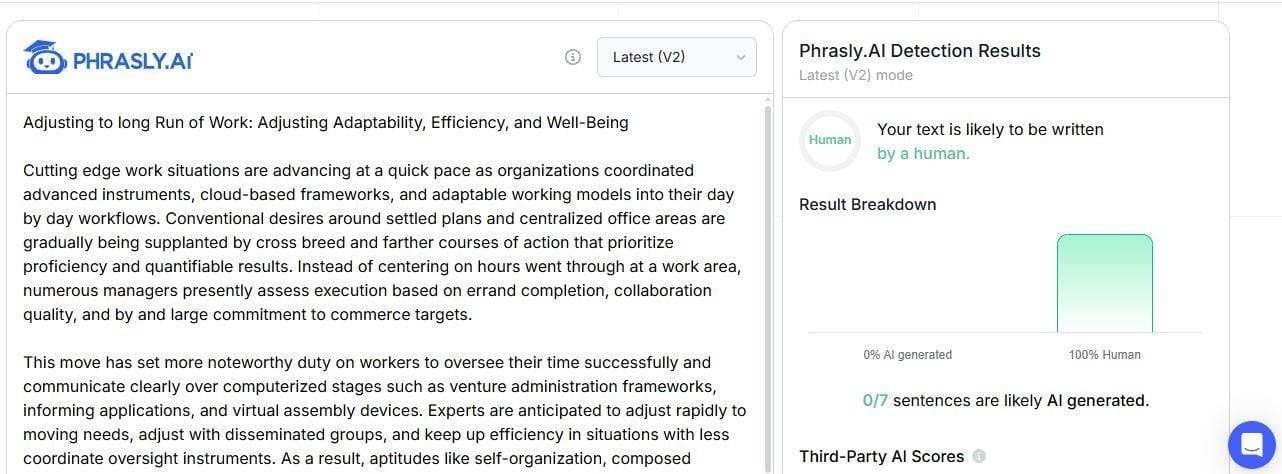
- AI Probability Score: 0% (100 percentage point reduction)
- Detector Verdict: Classified as human
- Performed aggressive word and clause-level reordering
- Aggressive rewriting achieved natural-sounding output but introduced meaning shifts that required manual editing
Test results summary
| Tool | Type | AI probability score | Writing quality |
|---|---|---|---|
| Phrasly Humanizer | Humanizer | 0% ↓ 100 pt reduction | Natural, no meaning loss |
| ZeroGPT | Humanizer | 46% ↓ 54 pt reduction | Partial, some patterns remain |
| QuillBot | Paraphraser | 61% ↓ 39 pt reduction | Formulaic, surface changes only |
| Paraphrase Online | Paraphraser | 0% ↓ 100 pt reduction | Natural but meaning shifted |
Baseline score: 100% AI probability on all tools before processing
Verdict
The results were mixed, and that is worth being transparent about. Phrasly Humanizer produced the most naturally readable output with no meaning loss. ZeroGPT showed partial improvement but retained noticeable mechanical patterns at 46%.
On the paraphrasing side, QuillBot scored 61%, confirming the limits of word-substitution. Paraphrase Online surprisingly matched Phrasly at 0%, but introduced meaning shifts that required manual editing to fix.
That distinction matters. Achieving natural-sounding output while preserving original meaning at the same time is harder than it looks. Paraphrase Online achieved one but sacrificed the other. Phrasly achieved both.
For writers who need quality output without extra editing time, a dedicated humanizer is the more reliable choice. If quick drafts with some manual cleanup are acceptable, paraphrasing tools can work. The right choice depends on your quality bar.
Try the AI Humanizer That Scored 0% AI Detection
Paste any AI-generated text and see the difference. Free, no signup required.
When to Use a Humanizer vs. a Paraphrasing Tool
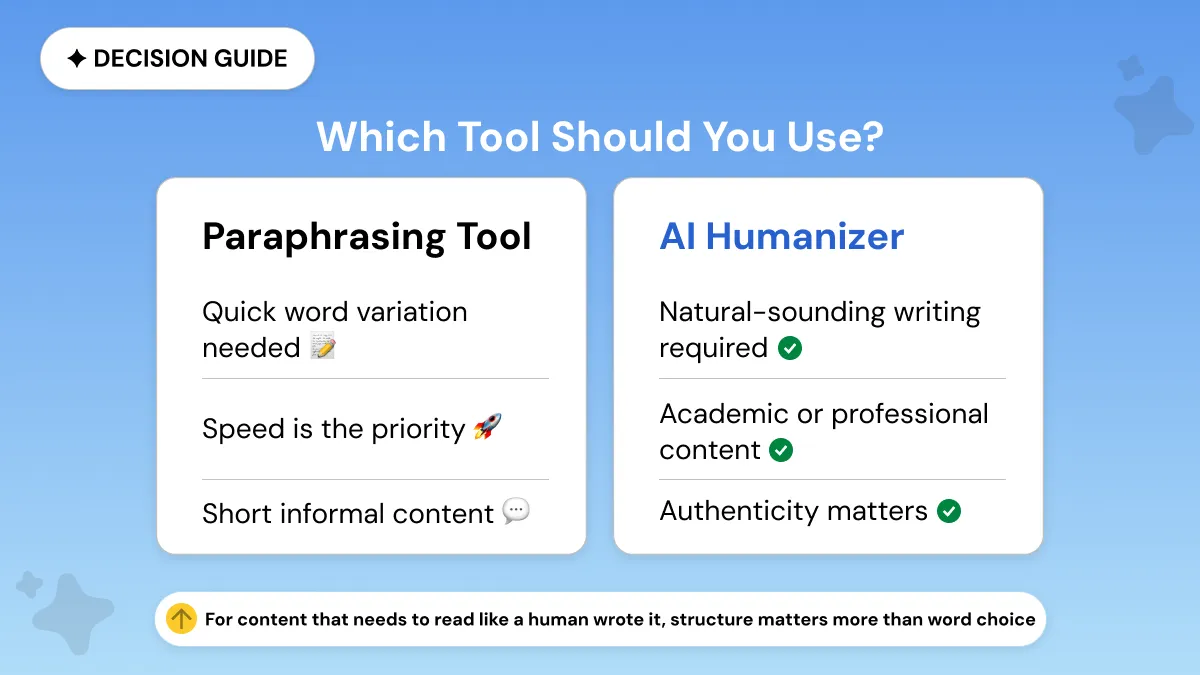
hoosing between a humanizer and a paraphrasing tool depends on your purpose, desired output quality, and how naturally you need your content to read. Here's practical guidance based on our testing:
Use an AI Humanizer When:
- You need content that sounds naturally written, not machine-generated
- Authenticity matters, such as for academic essays, professional reports, or client-facing business documents
- You want to preserve original meaning while improving readability and natural flow
- Time is limited and minimal post-editing is required
Use a Paraphrasing Tool When:
- You need rapid rewording for draft blog posts, internal reports, or content summaries
- Basic readability improvement is the primary goal, rather than deep stylistic refinement
- You want to rephrase text for SEO purposes or improved readability
- You plan to manually refine the output for tone and naturalness
For high-stakes content where writing quality and authenticity are the priority, a humanizer is the safest choice. Paraphrasing tools are useful for general content adaptation but may require additional editing to ensure natural tone and overall readability.
What About AI Rewriters?
AI rewriters occupy a middle ground between humanizers and paraphrasers. Unlike paraphrasers that focus on word substitution, rewriters work more like digital editors, reorganizing sentences, smoothing transitions, and tightening phrasing to improve clarity, grammar, and overall structure while keeping the original meaning intact. If your content is already well-written but simply needs polishing, a rewriter can be a strong and efficient fit.
However, for AI-generated text that needs to sound genuinely human, rewriters alone aren't enough. They improve surface-level readability but don't address the deeper stylistic patterns, such as uniform rhythm, predictable sentence structure, and formulaic phrasing, that make AI writing feel mechanical. For that level of transformation, a dedicated humanizer remains the most effective solution.
Critical Limitations of Paraphrasing Tools
While paraphrasing tools can improve readability and provide alternate versions of text, they come with important limitations that become apparent when the goal is producing genuinely human-quality writing:
Partial Improvement in Writing Naturalness
Many paraphrasing tools only replace words or adjust minor sentence structures. Predictable writing patterns remain, particularly in longer, complex passages. The fundamental difference between humanizer and paraphraser lies in how deeply each tool addresses these stylistic indicators.
Loss of Natural Flow
Aggressive word substitution may result in sentences that feel stilted or unnatural. Tools may fail to preserve transitions, tone, or sentence rhythm, making the text harder to read or less engaging compared to properly humanized content.
Meaning Distortion
Some paraphrasers unintentionally alter the original meaning of the text. Over-reliance on automatic rewording can lead to inaccurate or misleading statements if the output is not carefully reviewed.
Limited Contextual Adaptation
Paraphrasing tools typically work at the sentence or clause level, without understanding the broader context or argument flow. This can create inconsistencies or disrupt logical progression in academic, technical, or professional writing.
Manual Editing Still Required
Even after paraphrasing, writers often need to manually refine the text to ensure natural readability, correct tone shifts, and preserve meaning and clarity. This is partly because no automated tool is perfectly reliable, AI detectors can be wrong, and human review remains essential regardless of which tool you use.
Paraphrasing tools are effective for rewording and improving readability, but they are not a substitute for humanization if your goal is truly natural-sounding, human-quality content. For the most reliable results, humanization tools like Phrasly remain the superior choice when evaluating AI humanizer vs paraphraser options.
Our testing revealed a clear and consistent gap between the two categories. Humanizers transform how text sounds, adjusting rhythm and sentence variety to produce writing that feels genuinely natural. Paraphrasers change which words are used, but leave the underlying structure and tone largely intact.
For anyone who needs writing that reads naturally, a dedicated humanizer consistently outperforms paraphrasing tools. The difference isn't just technical; it's the difference between content that reads authentically and content that still feels machine-generated despite being reworded.
If you want to see this in practice, the Phrasly humanizer is what we used in our testing. You can try it free and judge the output for yourself.
Frequently Asked Questions
What is the main difference between a humanizer and a paraphrasing tool?
A humanizer improves AI text by adjusting rhythm, flow, and stylistic markers to produce naturally human-sounding writing. Paraphrasing tools rewrite for uniqueness through word substitution without addressing deeper stylistic patterns.
Can paraphrasing tools produce human-quality content?
Some tools can improve content authenticity moderately, but most cannot fully replicate natural human writing patterns. Simple synonym replacement still leaves stylistic signatures that advanced content analysis systems can identify.
Which tool is better for academic writing?
AI humanizers preserve meaning while matching natural writing patterns, making them ideal for essays and research papers where authenticity and readability matter.
How does Phrasly Humanizer compare to other tools?
Phrasly achieved 0% AI probability by modifying sentence structure, rhythm, and transitions, applying deep transformations versus simple word substitution.
Do I still need to edit text after using a humanizer?
Quality humanizers like Phrasly require minimal editing. However, always review for context-specific accuracy and tone alignment.
Can I use both tools together?
Yes, but using a quality humanizer alone is typically more efficient, performing both rewording and stylistic improvement in one step.
Will humanized text maintain my original ideas?
Yes, effective humanizers preserve core meaning while adjusting stylistic elements, changing how text is expressed, not what it says.
Is it ethical to use humanizers?
Ethics depend on context and policies. Many professionals use humanizers to polish AI-assisted drafts they've written. Always check institutional guidelines and use responsibly.
What makes a humanizer better than a paraphraser for AI-generated text?
Humanizers address rhythm, tone, and sentence structure, the deeper patterns that make AI text sound mechanical. Paraphrasers only swap words at the surface level, leaving the underlying writing style largely unchanged. For a deeper comparison, see our complete guide on the best AI humanizer tools in 2026.
How much does humanization typically cost?
Costs vary by provider. Many humanizers offer tiered pricing with free trials. Considering the quality and time saved, achieving polished, publish-ready content in one pass is often more cost-effective than multiple rounds of manual revisions. Try Phrasly's AI Humanizer free to see the difference firsthand.

Keep reading

Best AI Humanizer for SEO Content Teams in 2026
Comparing AI humanizers for SEO content teams? Phrasly, Undetectable AI, and Humbot lead for bulk use, but keyword preservation is the real risk. Learn what to test before running your content calendar through any tool, plus true cost-per-word at scale and picks by team size.
Rewriting AI Drafts for Client Deliverables Without Losing Your Voice
AI can draft your client copy in minutes, but that's not what clients pay for. Learn how to treat AI drafts as scaffolding, not final copy, rewrite for both your voice and your client's brand guidelines, cut hedge words, vary rhythm, and proofread before delivery so nothing generic ships.