
GPTinf AI Detector Review: Does It Actually Work in 2026?
We tested GPTinf's AI Detector on ChatGPT 5.3, Claude Opus 4.7, Gemini 3, and a real human-written NYT article. It caught AI content from all three models but wrongly flagged the human article as 89% AI. Get the full accuracy test, 2026 pricing, pros and cons, and the best alternatives.
GPTinf is an AI text platform that includes both an AI Detector and an AI rewriting tool. The detector returns probability-based scores designed to flag whether content reads as AI-generated or human-written, but third-party testing in 2026 has shown mixed accuracy, especially when checking text processed through GPTinf's own rewriting tool.
So is the GPTinf AI Detector actually accurate in 2026? We ran a live test using content from ChatGPT 5.3, Claude Opus 4.7, Gemini 3 Flash, and a real human-written article, and the results revealed a serious false positive problem.
In this GPTinf review, we'll cover:
- How accurate GPTinf's AI Detector really is (with live 2026 test results)
- GPTinf pricing 2026, free vs paid breakdown
- Who GPTinf is built for
- Honest pros and cons
- Best GPTinf alternatives if detection accuracy matters
What Is GPTinf?
GPTinf is an all-in-one AI text platform built around an AI Humanizer (its main product), with a free AI Detector and a plagiarism checker bundled in the same workspace. The detector is what most people land on first. It's free, unlimited, and works without a sign-up, which is a big part of why this AI checker pulls steady search traffic in 2026.
How the Detector Works
Instead of leaning on a single model, GPTinf says it uses a custom AI detection engine trained on ChatGPT, Gemini, and Claude, looking at three things: text structure, probability markers, and writing patterns. The output is a probability-based score (0–100) rather than a hard yes-or-no verdict, and GPTinf is upfront that the result should be treated as guidance, not a final judgment.
The detector also runs directly in your browser, lets you re-scan as many times as you want, and recommends at least 30 words of input for the most reliable read.
What GPTinf Is Really Built For
One thing worth flagging up front. GPTinf has rebranded its messaging in 2026, with its homepage now stating the tool is meant to "refine your writing, not to deceive or circumvent rules." But the core product is still its humanizer, which rewrites AI text to reduce detection signals. The detector sits inside that ecosystem, mainly so users can verify their rewritten output before publishing or submitting.
That context matters when you're judging how accurate the detector actually is, which we'll get to next.
Who GPTinf Is Marketed To
GPTinf targets a broad audience:
- Students working on academic writing and essays
- SEO writers and marketers reviewing content drafts
- Professors and educators screening submissions
- Journalists checking copy for AI involvement
In short, anyone who wants a quick probability-based AI check on text from ChatGPT, GPT-5, Claude Opus 4.7, Gemini 3, or human writers, without paying or signing up.
How Accurate Is GPTinf's AI Detector?
To find out, we ran a live GPTinf accuracy test in May 2026 using the latest AI models. Short answer: it's reliable at catching content from major LLMs, but it wrongly flagged 100% human-written content as AI, which is a serious false positive issue.
The Test Setup
We tested GPTinf's AI Detector against four content sources:
- ChatGPT 5.3 (thinking mode)
- Claude Opus 4.7 (adaptive thinking)
- Gemini 3 Flash
- Purely human-written content (2015 NYT article)
To keep the comparison fair, we used the same prompt across all three AI models:
Each piece was around 1,000 words, then pasted into GPTinf's free AI Detector for analysis.
Test 1: ChatGPT 5.3 Content
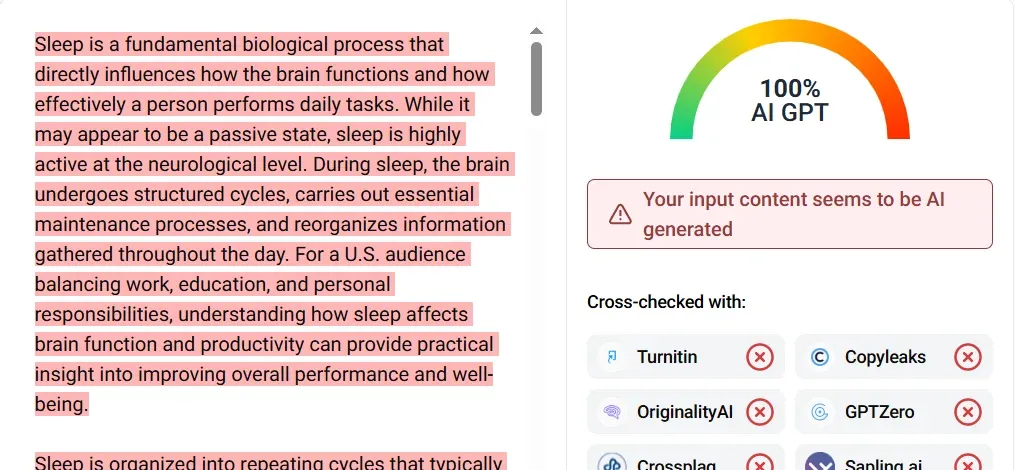
We started with ChatGPT 5.3 in thinking mode. GPTinf's detector handled it correctly:
100% AI GPT — "Your input content seems to be AI generated."
Verdict: Accurate detection.
Test 2: Claude Opus 4.7 Content
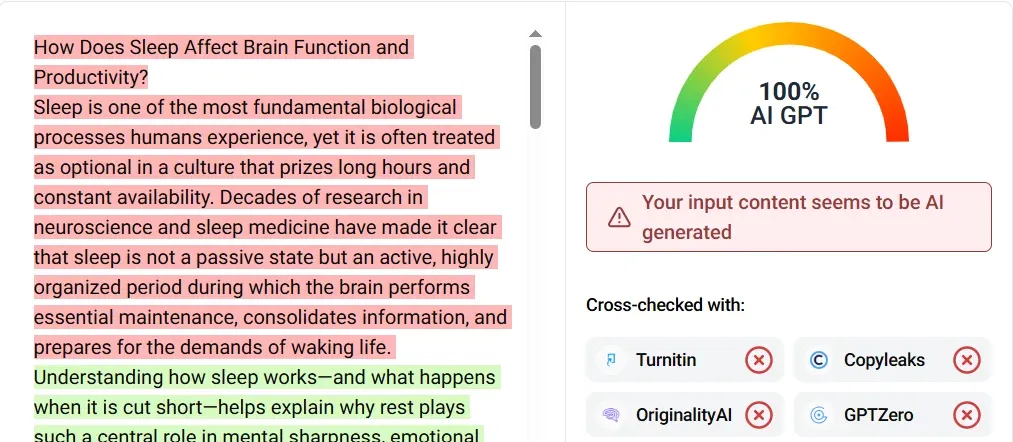
Next, we generated the same article using Claude Opus 4.7 with adaptive thinking enabled. Again, GPTinf flagged it correctly:
100% AI GPT — "Your input content seems to be AI generated."
Verdict: Accurate detection.
Test 3: Gemini 3 Flash Content
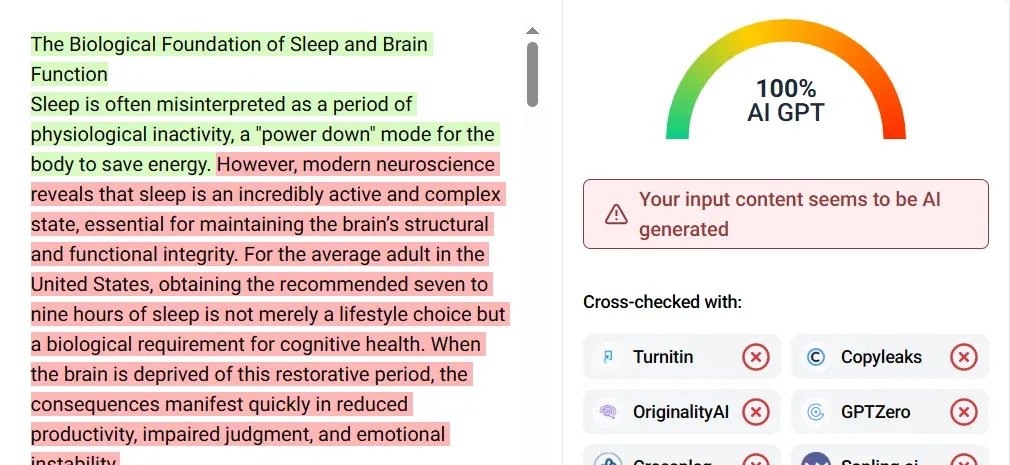
For the third AI test, we ran the same prompt through Gemini 3 Flash. GPTinf's detector picked it up without issue and flagged the content as AI-generated.
Verdict: Accurate detection.
So far, so good. GPTinf correctly identified AI content from all three major LLMs: ChatGPT, Claude, and Gemini.
Test 4: Purely Human-Written Content (Where It Falls Apart)
Here's where things got interesting. To test whether GPTinf could correctly identify human writing, we pulled a New York Times article from 2015 titled "Marketing to Sports Fans Online, With Help From Google and Social Networks."
The article was published years before ChatGPT existed, so there's zero chance it was AI-written.
The result?
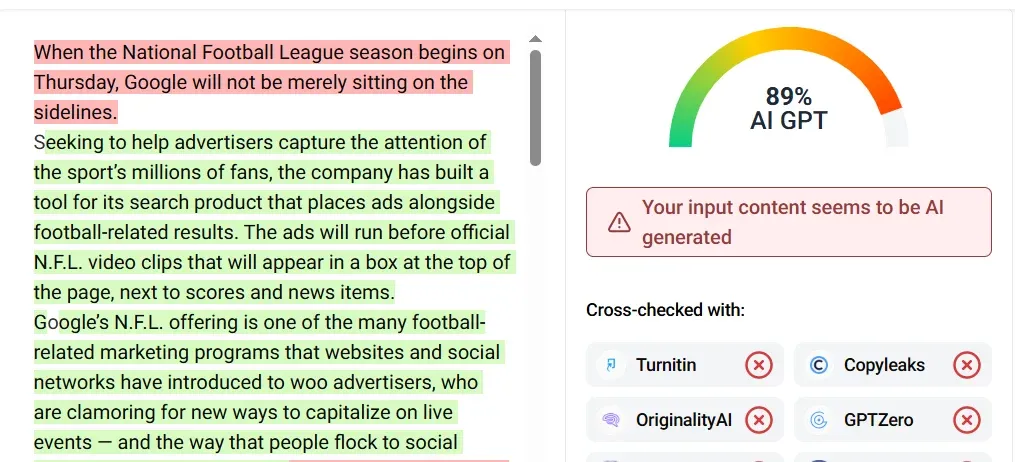
GPTinf flagged 89% of the human-written content as AI.
What This Means for Accuracy in 2026
GPTinf's detector returns probability scores from what the company describes as a multi-detector, Turnitin-like workflow, but it doesn't publicly name the specific engines behind the score. Based on our testing, the tool is reasonably good at flagging obvious AI output but prone to false positives on real human writing, especially for journalistic, academic, or formally structured prose.
In other words, the entire detection landscape is being re-evaluated, and tools with high false positive rates (like GPTinf) are losing trust fast.
Third-Party Testing Confirms the Pattern
Our results aren't an outlier. Independent testing has reached similar conclusions:
- Originality.ai's published review found that text rewritten through GPTinf's humanizer still scored 100% AI on Originality.ai, GPTZero, and Copyleaks. Only Writer AI returned a "human" verdict, and Originality.ai noted Writer AI is known for inconsistent flagging.
- A Medium review titled "Do Not Buy GPTinf for Humanizing & Bypassing AI Detectors" reached a similar negative conclusion about the platform's reliability.
- Turnitin's August 2025 humanizer-detection update specifically targets tools like GPTinf, meaning rewritten content is now flagged at a higher rate inside academic systems.
There's also a practical implication. If you're using GPTinf's own detector to check whether GPTinf's humanizer worked, the score might say "human", but stricter tools like Originality.ai, GPTZero, and Copyleaks will likely still flag it as AI. That makes the detector a weak verification tool inside its own ecosystem.
Is GPTinf AI Detector Accurate?
Based on our hands-on testing, GPTinf's AI Detector is partially accurate but not fully reliable. It correctly identified AI-generated content from ChatGPT 5.3, Claude Opus 4.7, and Gemini 3 Flash, flagging all three at 100% AI. That's a solid result for catching obvious AI output from major models.
But the human-written test broke the credibility. A real 2015 NYT article was flagged at 89% AI, which isn't a small margin of error. That's the detector confidently mislabeling a human journalist's work.
So is it worth using?
- For a quick free probability check on AI drafts → GPTinf works fine.
- For verifying human-written content, academic submissions, or client deliverables → too risky.
To be fair, no AI detector is 100% accurate, and false positives happen industry-wide. But GPTinf's results are noticeably weaker than dedicated detection tools like GPTZero, Originality.ai, or Turnitin, which are built specifically around detection accuracy rather than as a side feature of a humanizer product.
GPTinf Pricing: Is It Free?
Yes, GPTinf's AI Detector is completely free, unlimited, and requires no sign-up in 2026. You can paste text into the detector, run as many scans as you want, and see results instantly without hitting a paywall or daily limit. The catch is that the detector is the only fully free part of the platform. GPTinf's main product, the AI Humanizer, runs on a paid subscription with a small free trial.
Free Plan: What You Actually Get
The AI Detector is the headline free feature. No daily cap, no character limit, no account required. GPTinf recommends pasting at least 30 words for the most accurate read, but beyond that, you can scan as much content as you want.
For the humanizer, GPTinf offers a small free trial:
- 120 free words without signing up
- 120 additional words after creating a free account
- 240 free humanizer words total
After that, you'll need a paid plan to keep using the rewriting tool.
GPTinf Paid Plans 2026 (Humanizer)
GPTinf currently lists three monthly plans:
GPTinf also offers yearly billing with up to 50% off if you commit upfront. All plans are month-to-month, so you can cancel or switch tiers anytime, and any unused word balance stays available until your billing period ends.
(Always verify current pricing at gptinf.com before subscribing.)
Is GPTinf Worth Paying For?
If you only need a quick free AI detection check, GPTinf's detector is genuinely useful. But based on the 89% false positive on a human-written NYT article, the smarter approach is to treat GPTinf as a first-pass checker, then verify high-stakes content with a more reliable detector before submitting or publishing.
For students, SEO writers, and content creators, the free detector is fine as a starting point. For anything with real consequences if flagged wrong, like academic submissions or client work, pair it with a stronger tool.
Pros and Cons of GPTinf AI Detector
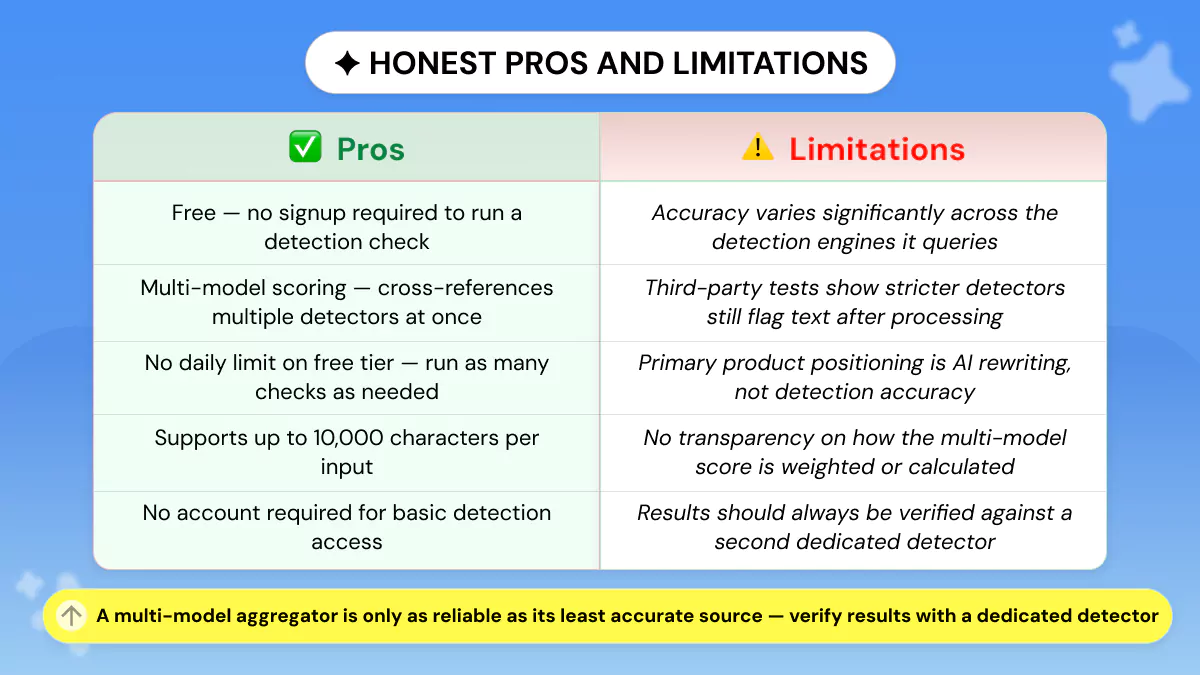
Like any AI checker, GPTinf has clear strengths and equally clear weaknesses. Here's the honest breakdown based on our 2026 live testing.
Pros
- Correctly identifies AI content from major LLMs. GPTinf accurately flagged content from ChatGPT 5.3, Claude Opus 4.7, and Gemini 3 Flash as 100% AI in our test.
- Free and unlimited with no sign-up. Paste and scan as often as you want, no paywall.
- No daily limits on the free tier. Useful for checking multiple drafts in one sitting.
- Handles long inputs. Supports up to 15,000 characters per basic scan, covering most blog posts and short essays in a single check.
- Probability-based 0–100 score. Reflects how strongly content reads as AI, instead of a black-and-white verdict.
- Cross-checks multiple detection patterns. Uses pattern and probability analysis, plus text structure and writing markers.
- Bundled with a plagiarism checker. Both tools run in the same workspace, useful for academic and SEO workflows.
- Broad audience fit. Built for students, educators, SEO writers, marketers, and journalists.
Cons
- False positives on human-written content. This is the biggest issue. GPTinf flagged a real NYT article as 89% AI, a serious false positive rate for anyone verifying human work.
- GPTinf itself says results are only guidance. The platform admits the detector should be treated as a probability signal, not an absolute judgment.
- Weak verification for its own humanizer output. Originality.ai's review found GPTinf's rewritten text still scored 100% AI on Originality.ai, GPTZero, and Copyleaks.
- No transparency on score weighting. GPTinf doesn't publish how its multi-signal score is calculated, making the result hard to audit.
- Detector is a secondary feature. GPTinf's main product is its humanizer. Detection accuracy isn't the platform's central focus.
- No sentence-level analysis. Modern detectors like GPTZero, Phrasly, and Pangram highlight which sentences are AI-generated. GPTinf still returns a single overall score.
- Negative third-party reviews. A widely cited Medium piece, "Do Not Buy GPTinf for Humanizing & Bypassing AI Detectors," publicly questions the platform's reliability.
Try Phrasly AI Detector Free (More Reliable AI Detection)
Tired of false positives flagging your human writing as AI? Phrasly delivers accurate, dependable detection across ChatGPT, GPT-5, Claude Opus 4.7, Gemini 3, and every major model.
Free, unlimited checks. No signup required.
Better Alternatives to GPTinf for AI Detection
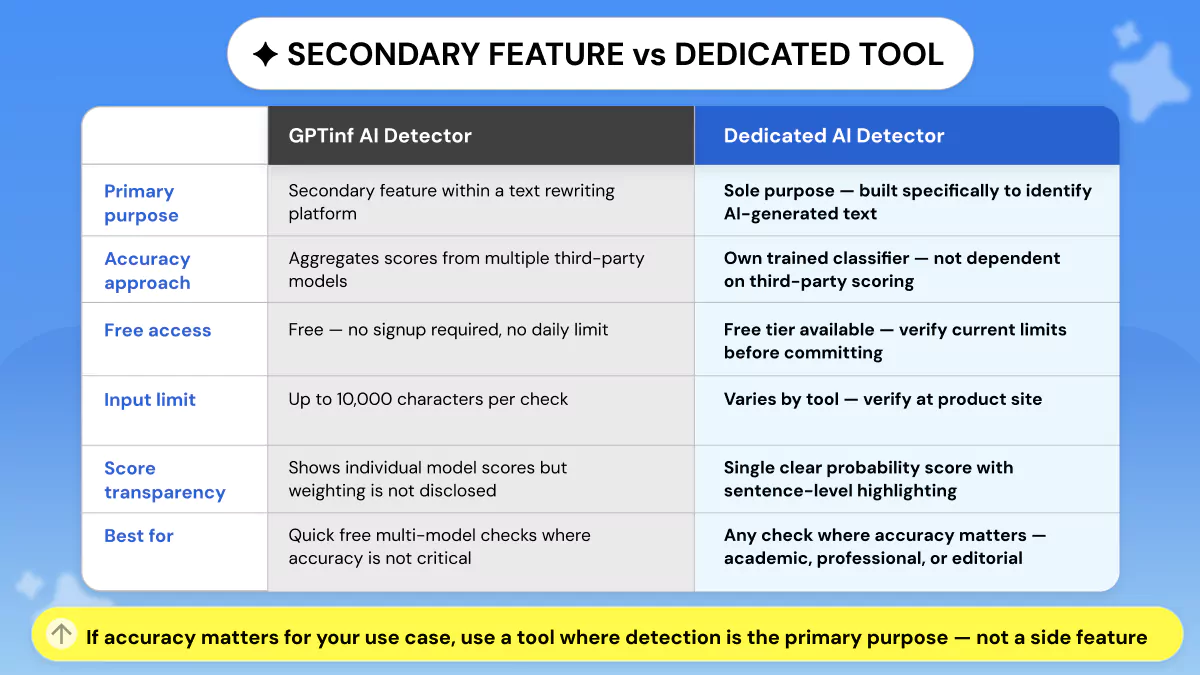
If GPTinf's false positive rate is a dealbreaker, you have stronger options. The three best alternatives to GPTinf in 2026 are Phrasly AI Detector, GPTZero, and Originality.ai, each built with detection accuracy as the main priority.
1. Phrasly AI Detector (Best Free Option)
Phrasly AI Detector is free, unlimited, and requires no sign-up, with no character caps and full coverage for ChatGPT, GPT-5, Claude Opus 4.7, Gemini 3, and other major AI models.
It's purpose-built for accurate detection rather than bundled with a humanizer, so the score reflects the actual content rather than the influence of a rewriting tool. For students, writers, and content teams who want a reliable check before publishing, it's the most friction-free choice on this list.
2. GPTZero (Best for Education)
GPTZero is the institutional standard for AI detection, widely used by teachers, professors, and schools. The free plan includes 10,000 words per month, advanced AI detection, multilingual support, and writing feedback. GPTZero claims around 99% accuracy with low false-positive rates, validated against the independent RAID benchmark (95.7% true-positive rate at 1% false-positive rate). It also includes sentence-level highlighting, which GPTinf still doesn't offer.
3. Originality.ai (Best Paid Option)
Originality.ai is the most rigorous paid AI detector and the one most often cited in third-party accuracy testing. It advertises 99%+ accuracy with low false positives, and its 2026 educational model is built for students, teachers, and serious content publishers. There's no free tier, but if accuracy is non-negotiable, it's worth the cost.
Which One Should You Use?
- Free and unlimited → Phrasly
- Education-trusted free option → GPTZero
- Maximum accuracy, paid → Originality.ai
Final Verdict: Is GPTinf AI Detector Worth Using?
GPTinf's AI Detector works as a basic free check, but accuracy concerns make it unreliable as a standalone verification tool in 2026. If you need to genuinely verify whether content reads as human, use a dedicated detector like Phrasly, GPTZero, or Originality.ai instead.
Best for: users who want a quick, free probability check and don't need high accuracy.
Not recommended for: students verifying academic submissions, writers checking client-ready content, or anyone where a wrong score has real consequences.
Frequently Asked Questions
Is GPTinf AI Detector free?
Yes, GPTinf's AI Detector is completely free, unlimited, and requires no sign-up. You can paste text and run as many scans as you want, with no account, no paywall, and no daily limits. The paid side of GPTinf is its humanizer, not the detector.
How accurate is GPTinf in 2026?
GPTinf's accuracy is mixed. In our live test, it correctly flagged AI content from ChatGPT, Claude, and Gemini, but labeled a human-written NYT article as 89% AI, a clear false positive. Independent testing from Originality.ai found that GPTinf's rewritten text still scored 100% AI on Originality.ai, GPTZero, and Copyleaks. It works as a quick first-pass checker, not a dependable final verdict.
Is GPTinf legit?
Yes, GPTinf is a legitimate platform with paid plans, public pricing, and active development. The question isn't legitimacy, it's reliability. GPTinf is real software, but its detector accuracy and humanizer effectiveness are inconsistent, especially against modern detectors like Originality.ai, GPTZero, and the post-August-2025 Turnitin update.
Does GPTinf work for Turnitin?
No, not as a guarantee. GPTinf is a general AI checker, while Turnitin's AI detection is purpose-built for academic submissions and has been updated to specifically target humanizer tools like GPTinf as of August 2025. A clean GPTinf score doesn't mean the same content will pass Turnitin. For a deeper look at how Turnitin handles AI-generated content, read Does Turnitin Detect ChatGPT? Here's What Actually Happens.
Does GPTinf detect GPT-5?
GPTinf says its custom algorithm is trained on ChatGPT, Gemini, and Claude, but it doesn't explicitly confirm coverage for GPT-5 or GPT-5.5. With newer models producing more human-sounding output, the 2026 Fritz.ai study found that even Originality.ai catches only 31.7% of GPT-5 output, so GPT-5 detection accuracy across all detectors, GPTinf included, is currently weak.
Does GPTinf detect ChatGPT, Claude, and Gemini?
Yes. GPTinf's detector is trained to identify content from ChatGPT, Claude, Gemini, and other major large language models. Our test confirmed this. All three were correctly flagged at 100% AI. The weakness is on the human-content side, not on detecting AI output.
Is GPTinf safe to use for academic essays?
It's safe as a drafting or self-check tool, but not safe as a final authority for academic submissions. GPTinf produces false positives, and most schools rely on Turnitin or institutional detectors that aren't influenced by GPTinf's score. Use it as a preliminary check, then verify with a stronger detector like Phrasly or GPTZero before submitting. See our roundup of the best free AI detector tools for academic writing for safer options.
What's better — GPTinf or GPTZero?
GPTZero is stronger for accuracy, while GPTinf is the better free, no-signup option. GPTZero's free plan includes 10,000 words per month and is benchmarked at around 99% accuracy on the RAID benchmark. GPTinf wins on convenience with unlimited free scans, but loses on reliability when it really matters.
Can professors detect GPTinf?
Yes. Professors can still flag content through Turnitin, institutional AI detectors, and manual review of writing style. GPTinf even markets a dedicated detector page for professors, which shows that academic review remains part of the workflow. Treating GPTinf as a way to avoid academic scrutiny is a mistake, especially after the 2025–2026 academic integrity lawsuits raised the bar on detection oversight.
Why is GPTinf flagging human content as AI?
Because no detector is perfect, and GPTinf's pattern-based engine is prone to false positives on formal, journalistic, or structured prose. Studies (including the Stanford ESL bias research) have shown that AI detectors often misclassify clean, well-edited human writing as AI. Our test confirmed this: a 2015 NYT article was wrongly flagged at 89% AI. If this happens to you, our guide on how to protect yourself from AI detector false positives covers what to do next.
Is GPTinf worth paying for?
Only if you need the humanizer and larger word limits. GPTinf's paid plans range from $4.99/month (Lite) to $29.99/month (Unlimited), but the detector is already free, and its accuracy concerns make paying for detection alone hard to justify. For more reliable AI checks, see our best AI checker tools comparison or try Phrasly's free AI Detector.


Keep reading


The Content Strategist's Workflow for AI-Assisted Production
A sound AI content workflow puts humans at the brief and expertise stages, letting AI handle outlining and drafting, then routes every piece through fact-checking, plagiarism, and AI-flatness QA gates before it can be published.

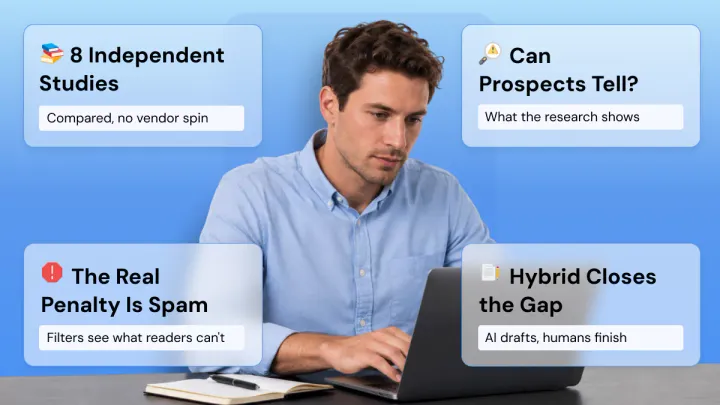
AI vs Human Cold Email Reply Rates: What 150M+ Emails Across 8 Studies Actually Show (2026)
AI cold emails get 1% fewer replies but 3x more spam flags. We compared 8 studies covering 150M+ emails, including peer-reviewed research, to show what actually works in 2026 and the fix that closes the gap.