
GPTHuman AI Humanizer Review: Does the Output Actually Sound Human?
We tested GPTHuman AI Humanizer on real content from Claude Sonnet 4.6, then ran the output through Originality.ai. The detector flagged it at 97% AI. Here's what GPTHuman actually delivers on writing quality, grammar, free plan limits, pricing, and how it compares to alternatives in 2026.
GPTHuman AI Humanizer promises to turn AI-generated text into natural writing. But does the output hold up against AI detectors, or do you end up editing every paragraph?
We tested GPTHuman by running Claude Sonnet 4.6 content through its Balanced mode, then checked the result with Originality.ai. The detector flagged it at 97% AI. We also pulled findings from three independent 2026 reviews (Leap AI, Jotform, and Clever AI Humanizer), and the pattern was the same: rough grammar, inconsistent tone, and output that needs heavy editing before it's usable.
This review covers writing quality on real content, AI detection performance, what the free trial gets you, pricing and per-output limits, and how GPTHuman compares to alternatives in 2026.
What Is GPTHuman AI Humanizer?
GPTHuman AI Humanizer is a web-based tool at gpthuman.ai that rewrites AI-generated text to sound more natural. You paste in content from ChatGPT, Claude, or Gemini, pick a couple of settings, and the tool returns a rewritten version designed to read more like something a person would actually write.
The interface is a simple two-column layout, with input on one side and output on the other. Before you run a humanization, you choose from two sets of options:
- Tone: Standard, High School, College, or PhD
- Mode: Professional, Balanced, or Enhanced
In practice, these settings control how formal the rewrite sounds and how aggressively the tool restructures your sentences. If you're new to how these tools work in general, this guide explains what an AI humanizer is and why the rewrite quality matters more than any single setting.
What separates GPTHuman from something like Writesonic or DigitalMagicWand is focus. Those platforms include humanization as one feature inside a larger writing suite. GPTHuman is built specifically around this job, and its product lineup is just a Humanizer, an AI Detector, a Paraphraser, and an API. In theory, that specialization should translate to better output quality. Whether it actually does is the question we'll get to in the next section.
A few specs worth knowing upfront:
- Free plan: 300 words of humanizer output total (a one-time trial, not per day)
- Paid plans: Start at $8.25/month on annual billing
- Language support: Claim is a little inconsistent. The homepage says 80 languages while the pricing page lists 50+, so take that number with a small grain of salt.
One quick naming note before we move on. There's a separate site at gpthuman.com that sells a different product entirely. This review covers gpthuman.ai only.
How Good Is GPTHuman's Writing Quality?
GPTHuman's AI Humanizer output is inconsistent, and it sits below what you'd expect from a paid, dedicated humanization tool. We ran our own test, and the third-party reviews from 2026 line up with what we found.
Our Test: Claude Sonnet 4.6 → GPTHuman
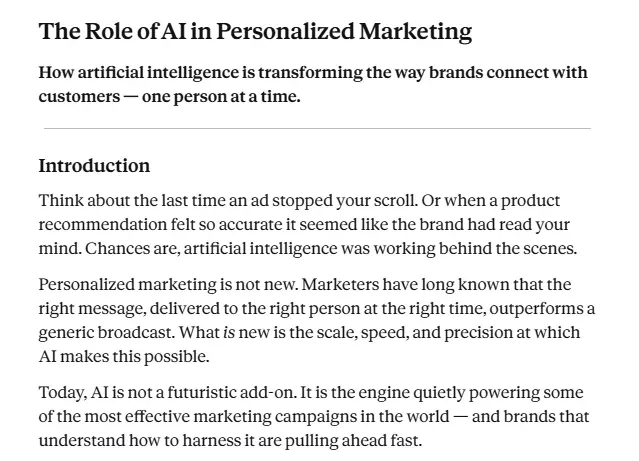
To check GPTHuman's writing quality firsthand, we generated a piece on "The role of AI in personalized marketing" using Claude Sonnet 4.6, then ran it through GPTHuman's humanizer.
Claude's original output:
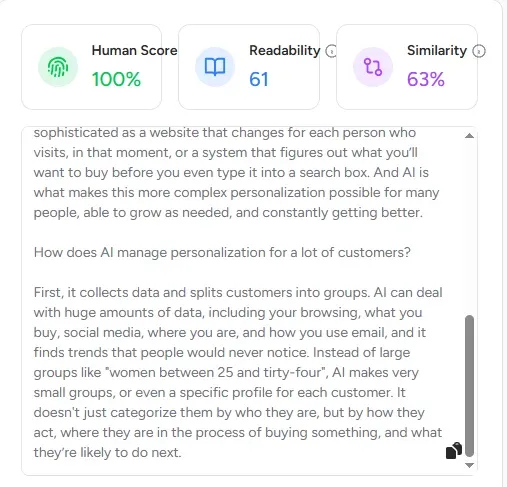
GPTHuman's humanized version:
We used GPTHuman's Balanced mode with the Claude source option selected, so the tool knew it was processing Claude-generated text.
What the Test Actually Shows
Grammar and mechanical errors. Inside a single 300-word sample, we counted multiple defects:
- "doing the work of it": Non-idiomatic, awkward construction
- "AI isn't some thing for the future": Should be "something"
- "women between 25 and tirty-four": Straight typo for "thirty-four", visible in the screenshot above.
- Inconsistent quote styles throughout
Loss of domain vocabulary. Claude's "AI creates micro-segments and even individual-level profiles" became "AI makes very small groups, or even a specific profile for each customer." The rewrite is wordier, vaguer, and drops the actual marketing term that signals expertise to a reader in the niche.
Register drops noticeably. Claude's version reads like a marketing publication. GPTHuman's reads like a student paraphrase ("the deals you offer, and their overall experience"). For B2B content, that's the wrong direction.
The structural work is real. Sentences are restructured, vocabulary is swapped, rhythm changes. It's not just a thesaurus pass. But the output trends wordier and less precise than the source, with enough small errors to require a careful editing pass before publication.
AI Detector Results
We ran GPTHuman's humanized output through Originality.ai's standard model. The detector flagged it clearly.
"97% Confident That's AI. We are 97% confident that the text scanned is AI-generated, NOT to be interpreted as 97% of the text produced is AI-generated."
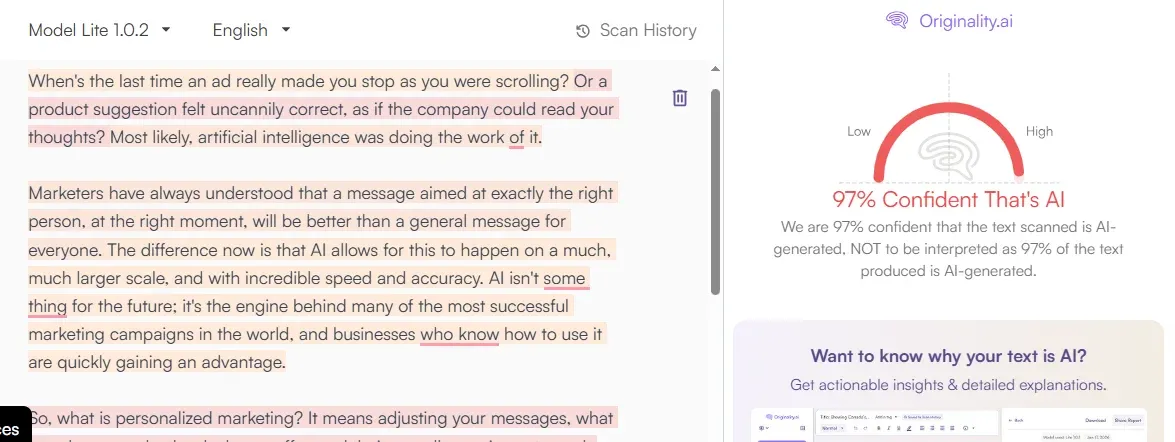
That's a poor result for a tool built specifically to produce undetectable output. The rewrite was rough enough to introduce errors and weaken the writing, but not strong enough to read as human to a mainstream detector, so users lose on both quality and detection.
What Independent Testers Found
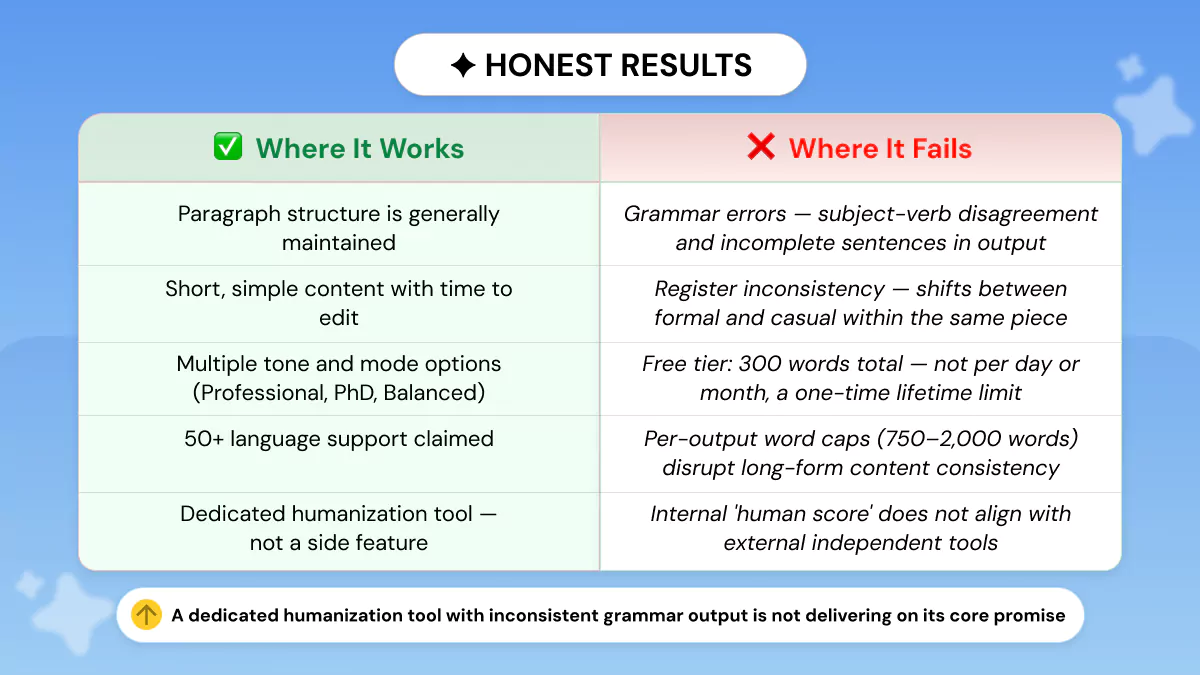
Our results aren't an outlier. Three recent third-party reviews report similar issues:
Leap AI's April 2026 review called the output "rougher than the premium tier."
Jotform's April 2026 test concluded the humanized text didn't pass their subjective review and would need major rewriting, citing "extremely poor sentence structure" and phrasing that was hard to trust without heavy editing.
The Clever AI Humanizer review from December 2025 is still the most detailed breakdown publicly available. It scored GPTHuman's writing quality 5/10 and documented specific defects:
- Incomplete sentences and unfinished opening clauses
- Subject-verb disagreement (plural subjects followed by singular verbs)
- Redundant phrasing and awkward word choices
- Broken, near-incomprehensible phrases in longer samples
If you're publishing anything client-facing or long-form, plan to read every line before using the output.
Register Inconsistency
GPTHuman has a habit of switching tones inside the same piece. The output might open with formal, explanatory prose and then drop a casual, idiomatic phrase into the middle of a technical paragraph. The Clever review flagged this directly, noting that informal expressions kept landing in technical content and making the overall tone feel unstable.
For professional, client-facing, or academic writing, this is a real problem. Readers pick up register shifts immediately, and fixing them usually means rewriting whole sections rather than tweaking a word here and there.
The Internal Score Problem
After each humanization, GPTHuman displays a Human Score, Readability Score, and Similarity Score on its own dashboard. It looks reassuring. The problem is that independent testers found GPTHuman's internal score doesn't align with results from external detectors or readability tools. You can see a high score inside GPTHuman while outside tools return a completely different verdict.
The practical takeaway: ignore the internal score. Judge the output the way a reader would, by checking grammar, flow, and clarity yourself. A number on a dashboard isn't a substitute for actually reading the text.
Where GPTHuman Actually Works
It's not all bad. Paragraph structure holds up well, the output doesn't collapse into a wall of text or lose its formatting, which is a common failure mode for cheaper humanizers. Multiple 2026 testers said the output looked fine at a glance, and the issues only surfaced once they read carefully.
That makes GPTHuman a reasonable fit for short, low-stakes content: social captions, brief summaries, quick rewrites where a final human pass is expected anyway. The closer your writing needs to get to polished, publish-ready quality, the more editing the output is going to need.
So, Is GPTHuman Worth Using?
No. As an AI humanizer, GPTHuman falls short on the two things that actually matter: clean writing quality and reliable results against AI detectors. Our test produced grammar errors, lost domain vocabulary, and a 97% AI score on Originality.ai, and the 2026 independent reviews report the same pattern.
It's only worth using for short, low-stakes rewrites where you have time to edit every line. For professional, long-form, or undetectable AI content that needs to read naturally on the first pass, GPTHuman isn't the right tool.
The risk is compounded by the fact that major academic and professional detectors have evolved; Turnitin’s 2025-2026 update explicitly includes the ability to flag 'AI bypasser' tools, meaning simply spinning the text is no longer enough to ensure safety.
Looking for a GPTHuman Alternative? Try Phrasly AI Humanizer
If you need output you can publish without a full rewrite, Phrasly AI Humanizer is built specifically for writing quality. Consistent tone across long-form content, clean grammar on the first pass, and no formatting loss on 2,000+ word drafts.
GPTHuman Free Plan, What You Actually Get
GPTHuman's free plan gives you 300 words of humanizer output, and that's it. The pricing page describes it as 300 words per single output, with no mention of a daily or monthly reset. In practice, it works as a one-shot trial rather than an evaluation period you can actually spend time with.
This is one of the most restrictive free tiers in the humanizer market. Most competing tools offer a daily or monthly word allowance, which lets you run a few tests, compare output across different content types, and make an informed decision before paying. GPTHuman's total-words model means you get one short rewrite, and then you're asked to commit.
Paid plans (billed yearly):
- Starter: $8.25/month → 25,000 words/month, 750 words per output
- Plus: $14/month → 60,000 words/month, 1,200 words per output
- Unlimited: $26/month → unlimited monthly words (subject to abuse guardrails), 2,000 words per output
The Per-Output Cap Is the Real Issue
The monthly word totals look generous, but the per-output limit is where long-form content gets awkward. Even on the Unlimited plan, a single humanization maxes out at 2,000 words. A 5,000-word article has to be split into at least three separate chunks and stitched back together.
That matters because tone and rhythm are not just sentence-level qualities, they carry across a whole document. When you humanize a long piece in 2,000-word segments, each chunk gets rewritten in isolation, and the transitions between them rarely match. You end up doing a second editing pass just to smooth out the seams, which defeats part of the reason for using a humanizer in the first place.
Privacy and Data Usage
Worth reading before you paste anything sensitive. GPTHuman's current privacy policy says the company may use content you submit to train the models that power GPTHuman. You can opt out by going into your account settings and unchecking the option, but only registered users get that control. On the free tier, before you create an account, the opt-out isn't available.
One more thing for business users: GPTHuman's terms allow the company to use your company name and logo in case studies, promotional materials, and other write-ups unless you specifically request otherwise. If you're running humanizations as part of an agency or brand workflow, that's a clause worth flagging to your team.
Language Support
GPTHuman claims broad multilingual support, though the site itself is a little inconsistent about the number. The homepage says 80 languages, while the pricing page lists 50+. Either way, it covers most major languages you're likely to need, just don't treat the exact figure as gospel.
How Does GPTHuman Compare to Alternatives?
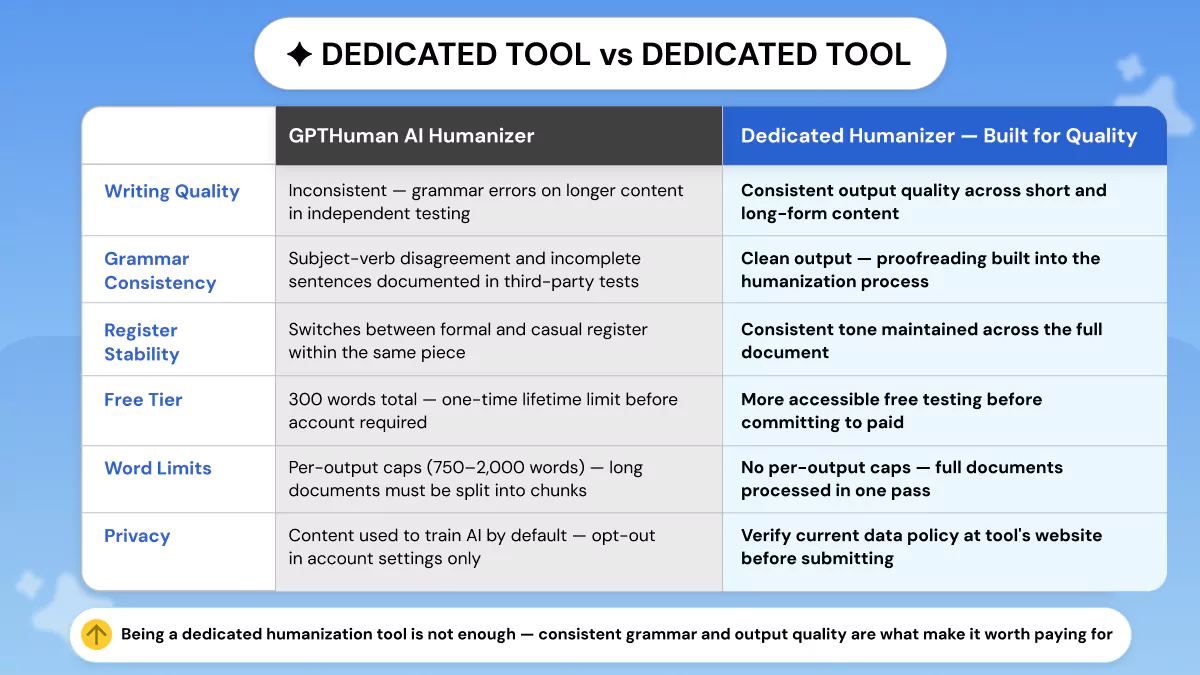
GPTHuman positions itself as a dedicated humanization tool, which should theoretically give it an edge over writing suites that treat humanization as a side feature. In practice, the quality evidence doesn't back up that positioning, and the usage limits make it a tighter workflow than most alternatives at the same price point.
GPTHuman vs DigitalMagicWand
DigitalMagicWand is much easier to test before you pay. The official humanizer page advertises a free demo, with the app costing one credit per use for up to 30,000 characters. A 2026 third-party review reported four signup credits of 10,000 characters each. Either way, the testing allowance is far more generous than GPTHuman's 300-word total cap.
That said, DigitalMagicWand isn't a clean quality win either. Tenorshare's April 2026 review reported mixed results across detectors, with some outputs still getting flagged heavily after rewriting. So DigitalMagicWand gives you more room to try the tool, but not a clear jump in consistency once you do.
GPTHuman vs Phrasly AI Humanizer
Phrasly is the more practical alternative for creators working on real, long-form content. A few of the differences worth knowing:
- Free 300 words access to start humanizing, with no one-shot word cap to burn through
- Three humanization modes for different content types and intensity levels
- Up to 5,000 words per request on paid use, with no monthly caps getting in the way
- Eight tools in one platform, including an AI Humanizer, AI Detector, Content Generator, Thesis Generator, Translator, and the Pages editor
For drafting long articles, the 5,000-words-per-request limit is the single biggest difference. GPTHuman's Unlimited plan caps each output at 2,000 words, which means a 5,000-word piece gets split into three chunks. Phrasly handles the same draft in one pass, which keeps tone consistent across the whole document.
Pricing and exact plan details change, so verify current numbers at phrasly.ai before committing.
GPTHuman is a real product with a real feature set, and for short, simple rewrites where you have time to edit the output, it works well enough. The problem is the gap between how it's positioned and how it actually performs:
- Writing quality is uneven. Our test produced grammar errors and lost domain vocabulary, and independent reviews report the same pattern, including a 5/10 score from December 2025 and a April 2026 review that called the output too informal for professional use.
- AI detection results don't hold up. Our humanized output scored 97% AI on Originality.ai, despite GPTHuman's claim of producing undetectable content.
- Plan structure is less flexible than competitors, especially the 2,000-word per-output cap on the highest tier.
- The free tier is too restrictive to evaluate the tool properly before paying.
For short rewrites where you have time to edit, GPTHuman gets the job done. For professional or long-form content where writing quality and AI detection actually matter, it falls short.
Frequently Asked Questions
What is GPTHuman AI Humanizer?
GPTHuman AI Humanizer is a web-based tool that rewrites AI-generated text into more natural-sounding writing. Available at gpthuman.ai, it processes content from ChatGPT, Claude, and Gemini using four tone settings (Standard, High School, College, PhD) and three rewrite modes (Professional, Balanced, Enhanced) inside a two-column editor.
Is GPTHuman AI Humanizer free?
GPTHuman offers a limited free trial of 300 words total, which works as a one-shot evaluation rather than a recurring free tier. Paid plans start at $8.25/month for Starter (billed yearly), with Plus at $14/month and Unlimited at $26/month.
How good is GPTHuman's output quality?
GPTHuman's output quality is mixed. Independent testing in December 2025 gave it a 5/10 writing quality score, with documented grammar issues, incomplete sentences, and register inconsistency on longer content. The output is readable at a glance but usually needs careful editing before publishing. You can verify outputs yourself with a tool like Phrasly's AI Detector. If you want to understand why so many humanizers produce output that still gets flagged, this breakdown of why AI humanizers don't work in 2026 explains the core problem.
Is GPTHuman AI Humanizer worth it?
GPTHuman is worth using only for short, simple rewrites where editing time is available. For social captions, quick summaries, and low-stakes content, the tool gets the job done. For professional long-form writing, the 2,000-word per-output cap and inconsistent quality make it a weak standalone choice.
What is the best alternative to GPTHuman AI Humanizer?
The best alternative to GPTHuman AI Humanizer is Phrasly AI Humanizer. Phrasly handles up to 5,000 words per request with no monthly caps, offers three humanization modes, and includes eight bundled tools such as an AI Detector, Content Generator, and the Pages editor.
Does GPTHuman use your content to train its AI?
Yes, GPTHuman uses submitted content to train its AI by default. The company's privacy policy states it may use content you submit to power its models. Registered users can opt out in account settings, but free-tier users cannot opt out before their first humanization.


Keep reading


The Content Strategist's Workflow for AI-Assisted Production
A sound AI content workflow puts humans at the brief and expertise stages, letting AI handle outlining and drafting, then routes every piece through fact-checking, plagiarism, and AI-flatness QA gates before it can be published.

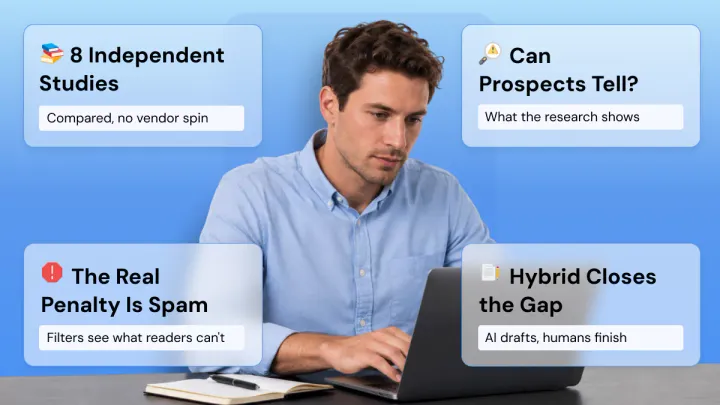
AI vs Human Cold Email Reply Rates: What 150M+ Emails Across 8 Studies Actually Show (2026)
AI cold emails get 1% fewer replies but 3x more spam flags. We compared 8 studies covering 150M+ emails, including peer-reviewed research, to show what actually works in 2026 and the fix that closes the gap.