
Why AI Humanizers Don’t Work in 2026 (And What Smart Writers Do Instead)
Most AI humanizers just swap words but detectors measure patterns, not vocabulary. Learn why synonym swapping fails against Turnitin and GPTZero in 2026, and what actually works instead.
You ran your text through AI Humanizer. It looked different. The detector still flagged it.
If that sounds familiar, you're not alone and you're not doing anything wrong. The problem is that most AI humanizers don't work the way they claim to. These tools change your words, but detectors don't measure words.
Tools like GPTZero, Originality.ai, and Turnitin are analyzing how predictable your text is, how much your sentence lengths vary, and how your writing flows at a statistical level. Swapping synonyms doesn't touch any of that.
The good news is that once you understand why they fail, the fix becomes easy. This guide breaks down exactly what free humanizers are doing under the hood, what detectors are actually measuring, and what writers who consistently pass AI detection do differently.
AI Humanizers Fail Because They Change Words, Not Patterns
Most AI humanizers are glorified paraphrasers and if you're not sure what an AI humanizer actually is, that's worth a quick read first. The short version: these tools swap synonyms, shuffle sentences around, and call it humanized but the statistical fingerprint of your AI-generated text stays completely intact.
Here's what that looks like in practice:
Different words. Same detection score. Detectors don't care that "significant" became "considerable." They're not reading your word choices, they're reading the statistical pattern underneath them.
Free Humanizers Only Operate at the Word Level, Not the Structure Level
Free AI humanizers only change vocabulary. They don't touch sentence rhythm, information flow, or the statistical patterns that detectors actually measure.
There are two distinct layers in any piece of writing. The lexical layer is the surface, the words and phrases you can see. The structural layer is everything underneath, how sentences flow, how information is sequenced, how predictable the text feels to a language model.
Free tools work entirely at the lexical layer. That's it.
Here's the breakdown:
What free humanizers change:
- Synonyms and word choices
- Minor grammar patterns
- Clause order within sentences
What free humanizers leave completely untouched:
- Sentence rhythm and pacing
- Paragraph flow and information sequencing
- Token probability distribution
- Predictability metrics detectors actually measure
So when you paste your AI draft into a free humanizer and hit "humanize," you're essentially getting a thesaurus with extra steps. The words look different on the surface, but every statistical signal that trained Turnitin, GPTZero or Originality.ai to spot AI content is still sitting there, unchanged.
How AI Detectors Catch Humanized Text (Perplexity and Burstiness Explained)
AI detectors don't scan for specific words. They measure perplexity (how predictable your text is) and burstiness (how much sentence length varies). Synonym swapping doesn't change either metric and that's exactly why most humanizers fail.
To understand why your humanized content keeps getting flagged, you need to understand what detectors are actually measuring.
GPTZero, Originality.ai, and Turnitin all use variations of these signals to evaluate content. They're running your text against probability models trained on millions of examples of both human and AI writing.
To learn more about how one of the most widely used tools handles this, check out our breakdown of how accurate GPTZero actually is.
Synonym Swapping Doesn't Lower Your AI Detection Score
Replacing words with synonyms doesn't meaningfully change perplexity or burstiness scores. Even heavily paraphrased AI text retains the same statistical fingerprint.
Think about it this way. Swapping "significant rise" for "considerable increase" doesn't change how long your sentences are. It doesn't make your word choices less predictable to a language model.
The probability distribution of your text stays almost identical. You've changed the surface, not the structure. And structure is what detectors care about.
Detectors Retrain on Humanized Text — The Arms Race Never Stops
Detection systems don't stay static. Developers actively collect outputs from popular humanizer tools, label them as AI-generated, and retrain their models on that data. Whatever pattern a humanizer introduces today becomes a detectable signal tomorrow.
It's worth noting that the arms race isn't perfect in the other direction either. Detection systems can still make mistakes. In fact, Turnitin's AI detector has mistakenly flagged human work as AI, which creates real problems for students and writers caught in the middle.
5 Reasons Most AI Humanizers Don't Work in 2026
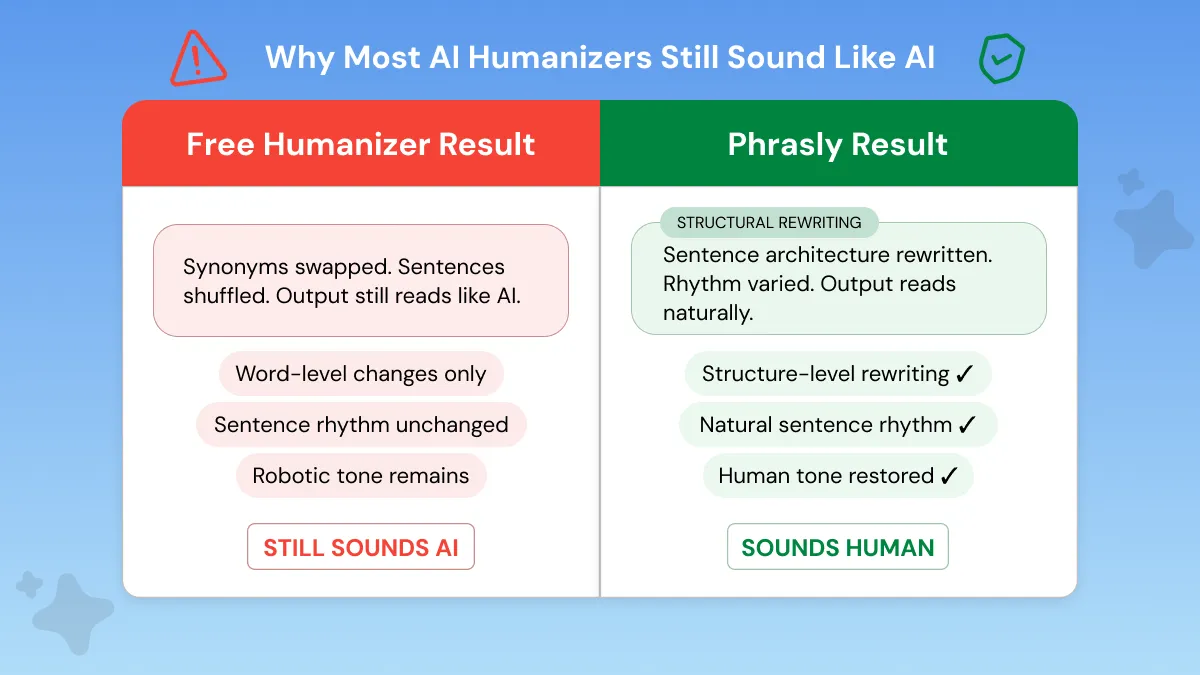
If you tested several AI humanizers and they all failed, you were probably using the wrong type of tool. Most humanizers fail because they destroy meaning, produce robotic phrasing, can't replicate personal voice, sometimes worsen detection scores, and rely on outdated models that detectors have already learned to catch.
1. They destroy meaning and context. Aggressive synonym replacement doesn't just change words, it breaks the relationships between them. When a paraphraser swaps out terms without understanding the surrounding context, the original meaning quietly shifts. You end up with text that technically says something, but not quite what you intended.
2. They produce robotic, unnatural phrasing. There's a particular flavor of awkwardness that comes out of paraphrasing tools, overly formal vocabulary, stiff sentence structures, zero personality. It reads like something translated through three languages and back. Ironically, this kind of writing often feels less human than the original AI draft.
3. They can't replicate personal voice or lived experience. Human writing carries something tools can't manufacture: real opinions, personal stories, and the kind of specific detail that only comes from actually knowing something. A paraphraser can rearrange your sentences but it can't inject your perspective. The result is content that's technically rewritten but still hollow.
4. Detection scores sometimes get worse after humanizing. This one surprises people. Run your AI text through a basic humanizer and your score can actually go up. The tool introduces new patterns that detectors have been specifically trained to recognize. You started with a 72% AI score and ended up with an 85%.
5. Free tools use outdated models detectors have already mapped. Most free humanizers are running on the same rewriting engines that were being built in 2022 and 2023. Detection platforms have had years to study these outputs, label them, and retrain. Those patterns are fully known at this point.
Most Free AI Humanizers Are Just Repackaged Paraphrasers
Free AI humanizer tools aren't exactly scams, but they're being sold as something they aren't. The majority are the same basic paraphrasing engine with a different name on the tin, and they simply aren't built for detection evasion.
Spend ten minutes in r/WritingWithAI or r/PromptEngineering and you'll find thread after thread of people discovering this the hard way. Same complaints, different tool names. The underlying technology is almost always identical: synonym substitution, clause rearrangement, light grammar tweaks.
When Humanized Text Gets Flagged More Than the Original
Here's the paradox nobody warns you about. Some humanized text is actually more detectable than what you started with. The tools introduce a specific fingerprint of their own, and detectors have learned to spot it.
The telltale signs include uniform sentence length across the whole piece, vocabulary that's oddly formal for the topic, a complete absence of contractions, and paragraph structures so rigid they feel templated. These aren't human signals. They're paraphraser signals and in 2026, they're just as detectable as raw AI output.
What Smart Writers Do Instead of Using Free Humanizers
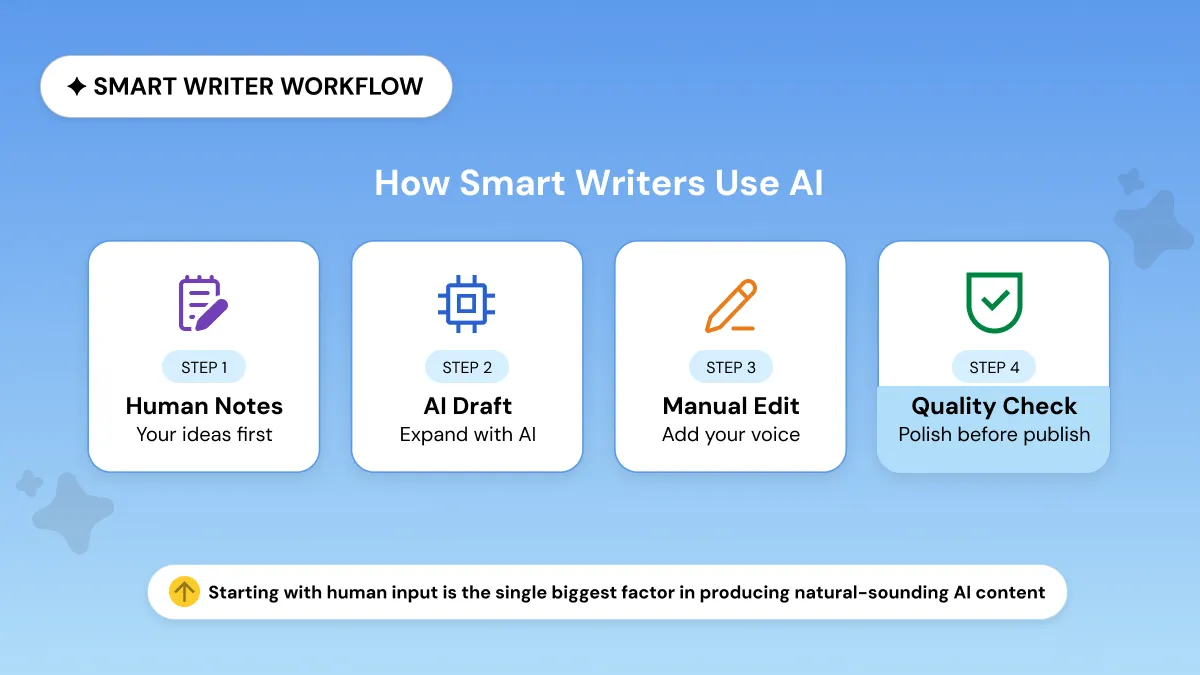
Smart writers in 2026 don't start with an AI draft and then try to fix it. They start with human input, use AI to expand on it, then either edit manually or run it through a tool that rewrites structure. That order matters more than most people realize.
Start With Human Input, Not an AI Draft
The most effective approach is outlining your ideas or recording voice notes before you touch any AI tool. Then use AI to expand what you've already written.
When you start with a blank prompt and ask AI to write something from scratch, you get pure AI output with zero human signal. But when AI is expanding on your rough notes, your opinions, your specific examples. It's genuinely harder to detect because it genuinely contains more of you.
The workflow looks like this:
- Jot down raw ideas or record a voice note
- Let AI build a draft around them
- Edit to vary sentence length, add contractions, and inject specific detail only you would know
- Test before you publish
Use a Humanizer That Rewrites Structure, Not Just Words
Not all humanizers are built the same. Most operate at the word level, as we've covered. But some tools actually restructure sentence architecture, vary rhythm, and adjust information flow to match how humans naturally write.
We tested a lot of tools putting this article together. Most failed, detection scores barely moved, and in some cases got worse. The ones that actually worked all did one thing differently: they rewrote structure, not just vocabulary.
If you're going to use a humanizer at all, use one that understands what detectors actually measure. Anything else is just burning time.
How to Test If Your Content Will Pass AI Detection
Run your content through at least two AI detectors before publishing. Focus your edits on the flagged sections only.
Most people make the mistake of treating detection as a pass/fail moment right before they hit publish. The smarter move is building testing into your workflow throughout the writing process. Draft, test, edit the flagged parts, test again. That loop gets you to a clean score much faster than trying to fix everything at the end.
When it comes to which detectors to use, Turnitin, GPTZero, and Originality.ai are worth running together because they don't catch exactly the same things. GPTZero is particularly sensitive to perplexity, it flags text that reads too predictably.
Originality.ai tends to catch structural patterns and is widely used by SEO and content teams. Turnitin breaks your text into 250-word segments and analyzes each one independently for perplexity and burstiness. Running all three gives you a more complete picture than any one alone.
One underrated check: Read your content out loud. If you stumble over a sentence or it sounds like it was written by someone filling out a form, that's your detector right there.
Most AI humanizers don't work because they're solving the wrong problem. They change words. Detectors measure patterns, perplexity, burstiness, token distribution, sentence rhythm. Those are two completely different things, and no amount of synonym swapping bridges that gap.
The writers getting consistent results in 2026 aren't chasing the perfect humanizer tool. They're starting with their own ideas, using AI to build on them, and either editing carefully or using a tool that rewrites at the structural level rather than the surface one.
Frequently Asked Questions
Why Do AI Humanizers Not Work?
AI humanizers don't work because they only replace words, not the statistical patterns detectors actually measure. In 2026, tools like GPTZero and Originality.ai analyze perplexity and burstiness, signals that synonym swapping simply doesn't change.
Is There an AI Humanizer That Actually Works in 2026?
Yes, but only tools that rewrite at the structural level rather than just swapping vocabulary. Phrasly takes this approach, unlike basic paraphrasers covered in our breakdown of QuillBot vs AI detectors that consistently fail against modern detection systems.
Can AI Humanizers Fool Turnitin?
Most tools can't oversmart Turnitin. It continuously retrains on humanizer outputs, meaning patterns from basic paraphrasers get identified and flagged quickly. As of early 2026, Turnitin has also added explicit detection for popular paraphrasing tools including QuillBot.
What Is the Best Alternative to AI Humanizers?
Start with your own notes, opinions, or voice recordings, then use AI to expand on them rather than generate from scratch. If you need a tool, choose one that restructures content at the sentence level rather than just reshuffling words.
Can AI Detectors Tell the Difference Between Humanized and Human-Written Text?
Usually yes, but AI detectors can be wrong, some still falsely flag human-written pieces as AI-generated.That's why testing across multiple detectors and editing flagged sections specifically will always outperform relying on a single score.
Does Humanizing AI Content Affect SEO?
Humanizing AI content doesn't directly affect SEO rankings. Google ranks content on quality and usefulness, not origin. What does hurt rankings is the broken readability and degraded meaning that most paraphrasing tools introduce in the process.
What Makes AI-Generated Text Detectable in the First Place?
AI text is detectable because language models consistently choose high-probability word sequences, making the output statistically predictable and rhythmically uniform. Detectors measure these patterns through perplexity and burstiness scores, not by scanning for specific words.
What Is the Limit of AI Humanizers?
Even the best humanizers can't inject real opinions, lived experience, or natural variation that only a human writer produces. They reduce detection scores somewhat, but rarely enough to pass strict platforms like Turnitin and Originality.ai.


Keep reading

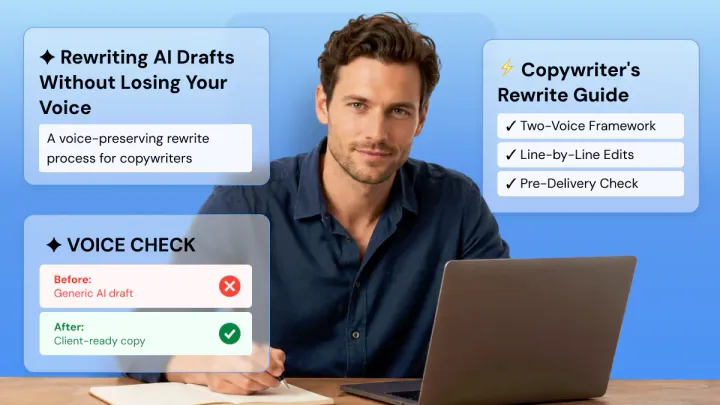
Rewriting AI Drafts for Client Deliverables Without Losing Your Voice
AI can draft your client copy in minutes, but that's not what clients pay for. Learn how to treat AI drafts as scaffolding, not final copy, rewrite for both your voice and your client's brand guidelines, cut hedge words, vary rhythm, and proofread before delivery so nothing generic ships.
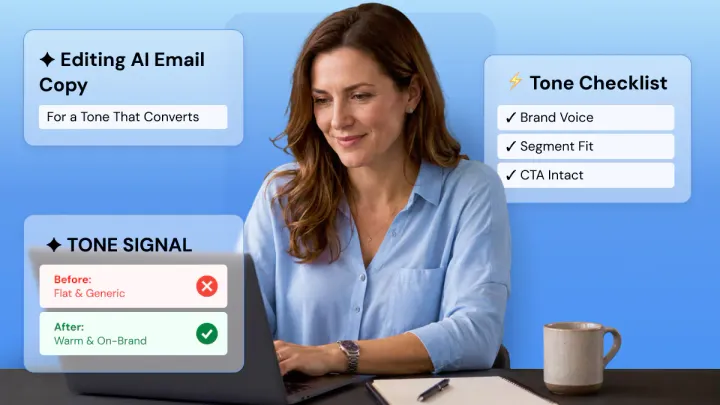
Editing AI Email Copy for a Tone That Converts
Editing AI email copy for tone isn't about a full rewrite. It's a repeatable calibration pass. Match your brand voice baseline to each segment's lifecycle stage, swap hedged phrasing for direct language, and measure results by click-to-open rate and reply rate, not inflated opens.