
AI Text Improver Vs AI Text Enhancer: What's the Difference and Which Do You Need?
AI text improver vs AI text enhancer. They sound the same but solve completely different problems. Here's which one your writing actually needs.
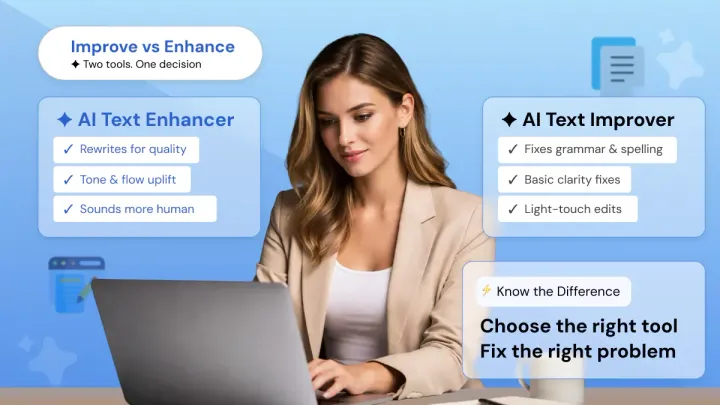
You’ve likely been searching for an AI text improver but kept landing on pages about AI text enhancers, wondering if they were the same thing.
AI text improver vs AI text enhancer are terms found on dozens of AI writing assistants in 2026, often used interchangeably despite referring to tools with very different purposes.
They’re related, but different. The guide explains both, associates both with common situations, and guides you on which to choose.
What Is an AI Text Improver?
An AI text improver takes existing text as input and applies localized edits to improve specific types of mistakes.
Usually, grammar, spelling, punctuation, and basic writing problems are addressed.
It makes what's wrong better but leaves the structure and voice unchanged. .
Imagine it as It acts as an obsessive-compulsive editor that leverages natural language processing (NLP). More than often, its functionality revolves around accuracy.
Thus, an AI-based writing improver looks for errors in your content and fixes them.
- It isn't concerned with rewriting sentence structure or evaluating whether your voice suits your target audience.
- It's similar in scope to a grammar checker, but broader.
- A grammar checker detects rule violations like subject-verb disagreement and comma splices.
- An AI text improver also recognizes clumsy wordings, excessive passive voice, and readability problems that grammar checkers overlook.
- There's significant overlap, but the improver is generally smarter about context.
Grammar and punctuation mistakes are the primary target.
Style adjustments, such as flagging a sentence that is grammatically correct but awkwardly worded may be incorporated as secondary goals, but complete style editing is not the objective.
Who uses it, and why?
- The typical user already has text that's pretty good.
- They've written a document, proposal, or email and want a quick, light-touch pass before hitting send.
- They aren't looking for a rewrite.
- They want a dependable cleanup.
What Is an AI Text Enhancer?
An AI text enhancer does more than fix errors, it elevates your writing entirely.
It rewrites sentences, smooths out flow, adjusts tone, and upgrades the overall quality of your content.
Rather than simply proofreading, it analyzes your writing using natural language processing (NLP) to ask deeper questions:
Is your sentence structure too repetitive? Do your paragraphs transition logically? Is your tone right for your audience? Is your word choice precise or vague?
An AI writing enhancer answers all of these and helps you act on them.
- It's different from a paraphrasing tool, which rewrites primarily for uniqueness or alternate wording, not for better writing.
- An enhancer rewrites to make your content more effective and polished.
- The output of both can look similar on the surface, but the intention and outcome are quite different.
- A paraphraser changes how something is said; an enhancer changes how well it's said.
The core problem an enhancer solves is sentence-level quality.
Grammar-correct writing can still lose readers when it sounds robotic or dull. Understanding how to enhance your sentences with AI explains exactly why technically clean writing still underperforms, and what fixing it actually looks like.
Who uses it, and why?
- The typical user has content that is technically grammatical but reads dull, robotic, or muddy.
- AI-generated content is a common culprit. It aces grammar checks but still sounds lifeless.
- They're not looking for error correction; they need their writing to feel sharper, more natural, and more engaging.
- They want output that sounds like a skilled human wrote it, not like a machine produced it.
Enhance Your Text with Phrasly - Try it for Free 👇
AI Text Improver Vs AI Text Enhancer
The difference between an AI text improver vs enhancer really depends on how much improving/editing the tool does.
Improvers fall on one end of the scale: fixing mistakes and light editing.
Enhancers fall into the other: complete text transformation and improving writing quality. Most tools do a bit of both, but their foundations are built on different functionalities.
If a tool asks the question, "What is wrong with this text?" then it is an improver. If it asks "how can this text be more effective?" then it is an enhancer.
The distinction comes down to which question you designed the tool to answer.
Quick Comparison Table: AI Text Improver vs AI Text Enhancer
|
Feature |
AI Text Improver |
AI Text Enhancer |
|
Primary Goal |
Fix errors and basic writing clarity |
Transform writing quality holistically |
|
Grammar Correction |
✅ Core function |
✅ Included but
secondary |
|
Sentence Restructuring |
❌ Minimal or none |
✅ Core function |
|
Tone Adjustment |
❌ Minimal or none |
✅ Core function |
|
Readability Improvement |
⚠ Limited |
✅ Core function |
|
Vocabulary Improvement |
⚠ Basic suggestions |
✅ Core function |
|
Best for |
Text with errors and basic issues |
Text that reads flat, robotic, or unclear |
This isn't always the case in practice. However, lots of these tools label themselves as an AI text improver or text polisher without really explaining what they do.
Labels aside, the difference here doesn't matter; what you should care about is what the tool does.
Evaluate any AI writing Improvement tool based on how it improves your output. If it only corrects grammar mistakes but claims to be an "enhancer", it's really an improver.
Essentially, this category overlaps with AI rewriter tools as well as grammar and style checker platforms. Both of which can also sit anywhere on the improver-to-enhancer spectrum depending on how they’re built.
The main difference is always: is the tool error-focused, or quality-focused?
Which One Do You Actually Need?
Choosing the correct tool depends on what issues your text really has.
If you want your content to sound less robotic, that’s an enhancement issue. Running it through an AI text improver will not correct dull AI tones.
It will correct your grammar and leave the writing just as robotic. You need something that does tone adjustment, sentence restructuring, and readability improvement.
These are the fundamentals of an enhancer.
Use an AI Text Improver If....
- Your text is structurally sound and mostly well-written, but has errors.
- You need a quick grammar and punctuation pass before publishing.
- You are editing someone else's work and want to avoid making major changes.
- You need basic writing clarity fixes, not a full rewrite.
- The writing already flows well. It just needs a cleanup.
AI text improver fixes primarily grammar and clarity. These are the core functions.
Style improvements (like marking text as too passive or word-choice edits) can be implemented as secondary objectives, but complete stylistic transformations are not something an improver is designed to do.
If your concerns are style and tone-focused, an enhancer would be better suited.
Use an AI Text Enhancer If...
- Your text is grammatically fine, but still sounds robotic, flat, or generic.
- You have used AI to generate a draft, and it needs to sound more human-sounding.
- You want to improve tone, readability, and writing flow.
- You need full text transformation, not light corrections.
- You are producing SEO content, marketing copy, or client proposals where quality is judged not just by accuracy.
The same applies to everyday professional writing. From follow-up emails to performance feedback, there are specific types of messages that always need an AI message enhancer before they go out.
If you have used ChatGPT to write content, but the output sounds flat, it is an enhancer problem. AI-generated drafts are usually grammatically correct. Processing them with improver won't change much.
The problem isn't correctness. It's writing quality, tone, and lack of human writing flow. That requires an enhancement. Enhancers treat toning and readability upgrades as a single pass, instead of separate tasks.
If you want AI writing improvement that is more than grammar checking, use an enhancer.
How Phrasly's AI Text Enhancer Covers Both?
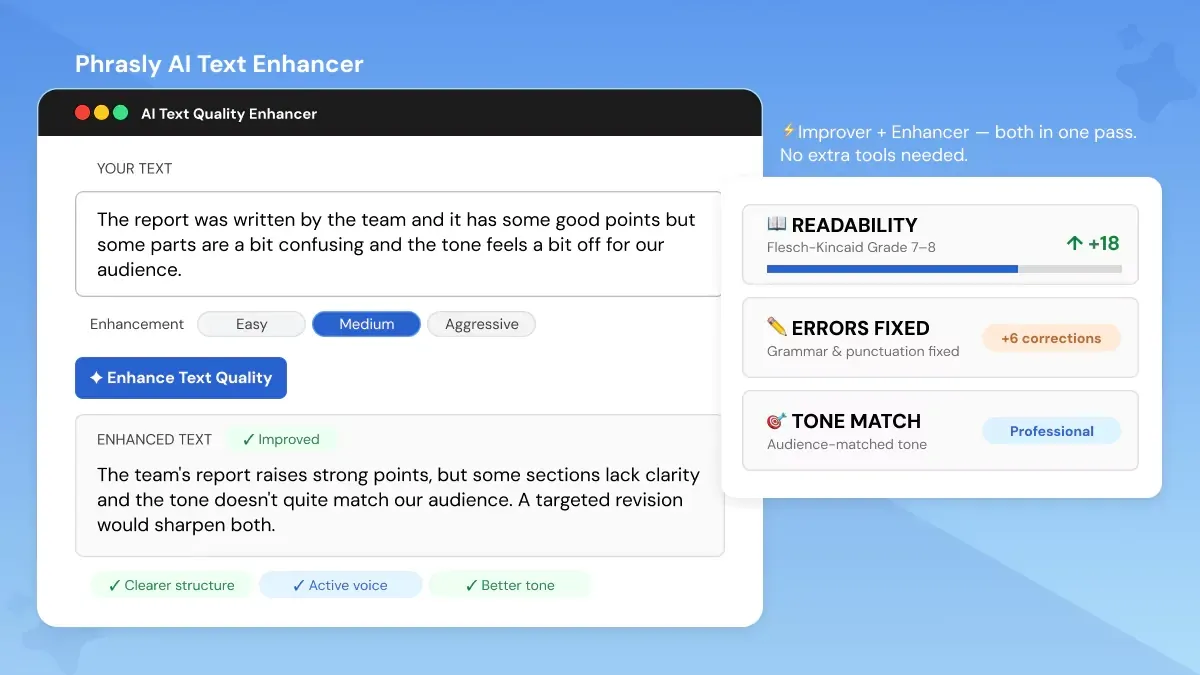
Here’s how Phrasly approaches this distinction and why it is built to solve the tougher problem.
Phrasly’s AI Text Enhancer is built specifically for enhancement: transforming the overall quality of writing.
It covers grammar fixes as a baseline, but goes beyond: sentence restructuring, style/tone adjustment, readability enhancement, and word precision, all simultaneously.
Most people don’t need a separate “improver” tool.
Phrasly covers both extremes within one workflow.
The tool offers three enhancement levels, each mapping to a different user need:
- Easy: light polish, closer to traditional improvement. Fixes errors, smooths awkward phrasing, and makes minimal structural changes. Best for text that is mostly strong.
- Medium: balanced rewrite. Improves writing flow, adjusts tone, and tightens structure. Best for functional-but-flat drafts.
- Aggressive: full quality transformation. Maximum enhancement: deep sentence restructuring, vocabulary enhancement, and a complete improvement of the text to professional-grade quality. Best for raw AI output or rough first drafts.
FAQs
What is the difference between an AI text improver and an AI text enhancer?
An AI text improver focuses on fixing specific errors, such as grammar, punctuation, spelling, and basic clarity issues.
An AI text enhancer goes further. It transforms the overall quality of writing through sentence restructuring, tone adjustment, and readability improvement. If your text passes a grammar check but still reads as flat or robotic, you need an enhancer.
Can an AI text enhancer replace a grammar checker?
Yes, typically speaking. Grammar/style checking is part of the base functionality of a complete AI text enhancer. It fixes errors before attempting to make quality improvements.
A grammar checker will not make the text transformations that an enhancer does.
What is the best free AI text improver in 2026?
Determining the best AI text improver for you in 2026 depends on whether you're looking for simple error correction or comprehensive quality enhancement.
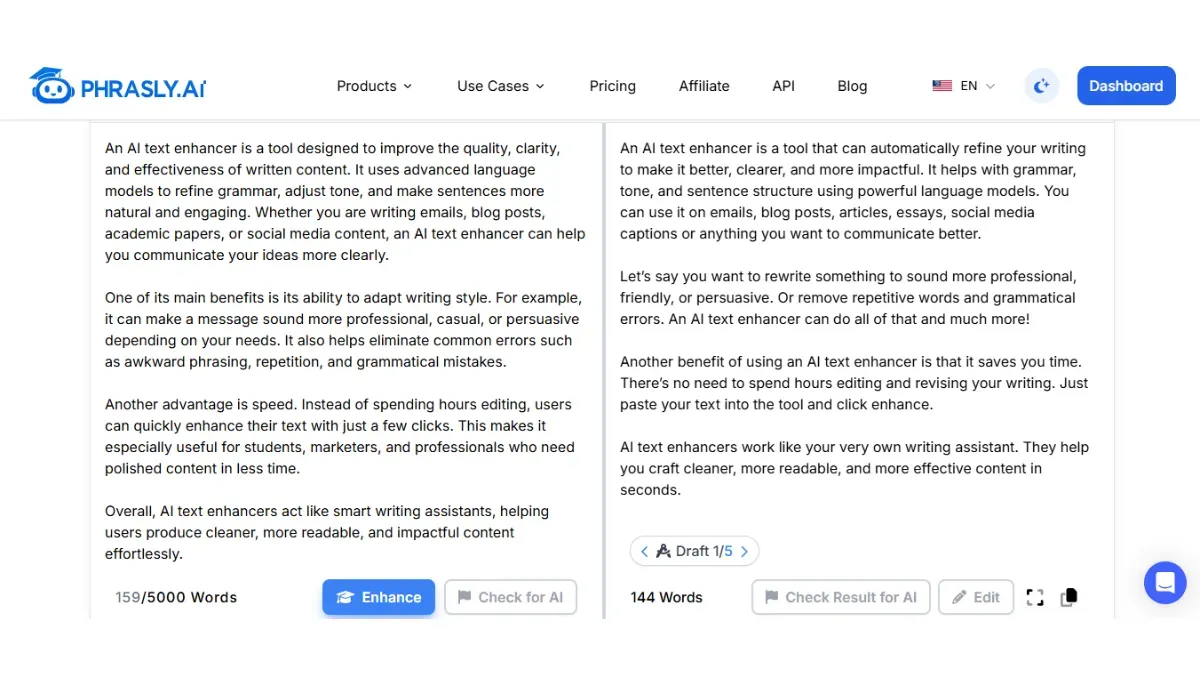
If you're looking for a free tool that handles both improvement and enhancement, check out Phrasly's AI Text Enhancer. It boosts grammar, tone, and readability with one pass through your content.
Read this Phrasly AI vs Originality AI text enhancer comparison to see how it stacks up.
Should I use an AI text improver or enhancer for SEO content?
If you’re writing SEO content, an enhancer is the strongest choice. Search engines for 2026 care about writing quality, user engagement, and readability. Improving AI text readability and tone is a core part of that.
An AI text enhancer fixes sentences, vocabulary, and writing flow. These factors affect bounce rate and time-on-page. If you’re writing content for rankings and engagement, use an enhancer.
How do I know if my AI-generated text needs improving or enhancing?
If you find grammar mistakes, spelling errors, or punctuation issues, you need an AI text improver. If your text is error-free but reads as robotic, generic, or lacks a clear voice, you need an AI text enhancer.
Most AI-generated drafts fall into the second category: technically correct but lacking human-sounding quality. If that's the case, bypass the improver and head straight for the enhancer.