
Editing AI Email Copy for a Tone That Converts
Editing AI email copy for tone isn't about a full rewrite. It's a repeatable calibration pass. Match your brand voice baseline to each segment's lifecycle stage, swap hedged phrasing for direct language, and measure results by click-to-open rate and reply rate, not inflated opens.
When edit AI email copy for tone so that the tone actually converts, stop settling for the model’s default neutral-professional voice and calibrate tone of voice to your brand voice and the specific segment and lifecycle stage you’re speaking to.
A welcome email should not sound like a win-back or a renewal notice. AI will make them sound the same. Measure it by the right metric.
Mail Privacy Protection silently boosts open rates for Apple Mail. So tone's impact is more accurately reflected in your click-to-open rate (CTOR) and reply rate.
In this post, you'll learn why all AI emails sound the same. How to adjust AI email tone by brand & segment; what exact edits create email copy tone that converts; and how to test tone before you press send.
You'll also learn helpful AI email conversion tips you can use on your next campaign.
Why AI Emails All Share the Same Flat Tone?
AI tends towards generic safety in registers, opting always for safe neutral-professional register. That means every draft AI comes up with will sound the same, no matter who you’re writing to or what lifecycle stage you are in.
Large language models are trained to avoid offense. This pushes every draft toward the same hedged, corporate middle ground.
That's fine for a policy update but it's a problem when the same voice shows up in a first-purchase thank-you, a churn-risk win-back, and a VIP loyalty reward. Three emails that need three very different levels of warmth and formality to land.
When the majority of a brand's outbound copy passes through the same model with the same defaults, small tone problems stop being isolated. They become a pattern your whole list learns to recognize and tune out.
- The model is trained for "safe," not "suited". It does not know your reader's relationship to your brand.
- Keep in mind the model is trained for "safe," not "suited". It has no knowledge of your persuasion reader's relationship to your brand.
- Tone calibration is the fix. A repeatable editing pass, not a full rewrite.
Does the tone of email affect conversion? Absolutely! Tone determines whether a reader believes you and takes action on your message, and it factors into click-to-open rate and reply rate quite visibly once you exclude Apple MPP's skewed open rates.
Calibrate Tone to Brand and Segment
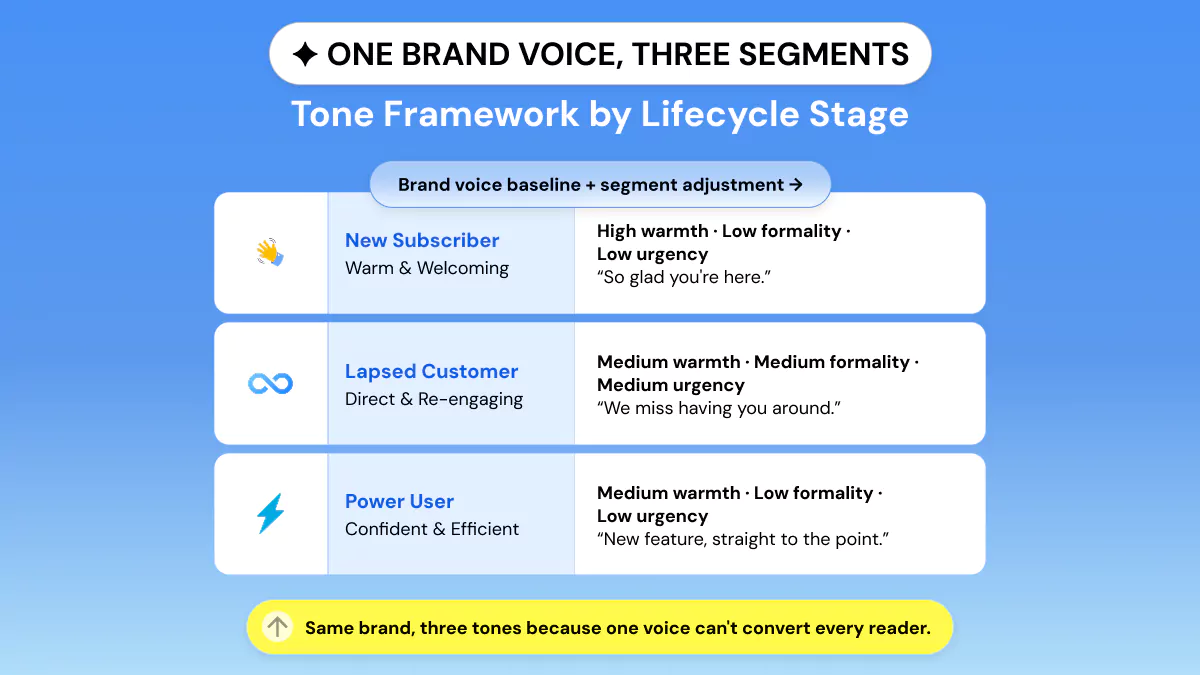
Your tone should match two things: your brand voice baseline and the reader's context. A new subscriber vs. a dormant customer vs. a power user will all require different levels of warmth/formality/urgency.
There's no single tone that will convert all three. This is how you think about adjust AI email voice, rather than just arbitrarily tweaking sentences.
Build a Two-Layer Tone Framework
Think of tone as two stacked layers. The base layer is your brand tone email marketing guidelines already define. Are you playful or authoritative, terse or conversational?
The second layer is a segment adjustment. Warmth and formality up or down depending on who's reading and where they sit in the lifecycle stage.
|
Segment |
Tone Adjustment |
Example Opening Line |
|
New subscriber |
High warmth, low formality, light persuasion |
"Glad you're here; where to start." |
|
Lapsed / win-back |
Direct, low guilt, clear value restated |
"It's been a while here; what changed." |
|
Power user / renewal |
Higher formality, respectful, fewer exclamation points |
Your plan renews soon;
here's what's included. |
See Tone Change Across Segments
Take one of these core messages. Notice how email copy tone that converts for one segment can fall flat for another:
- New Subscriber: Considering still? Don't worry, we've saved your cart.
- Lapsed customer: We've been waiting on your cart. Let's give you 10% back if you check out today.
- Loyalty / VIP: As our highest-level member, your saved items will be shipped first this week.
- B2B decision-maker: Your quote is ready for review. Let us know if you need any adjustments.
It should come as no surprise that segmentating your audiences instead of using one tone for all of your company will lead to better results.
How do you match brand tone in AI emails? If you want to keep brand voice consistent across AI emails, start by defining your baseline brand voice once. Then add an email-specific adjustment to warmth, formality, & urgency for each send.
The Edits That Make Tone Convert
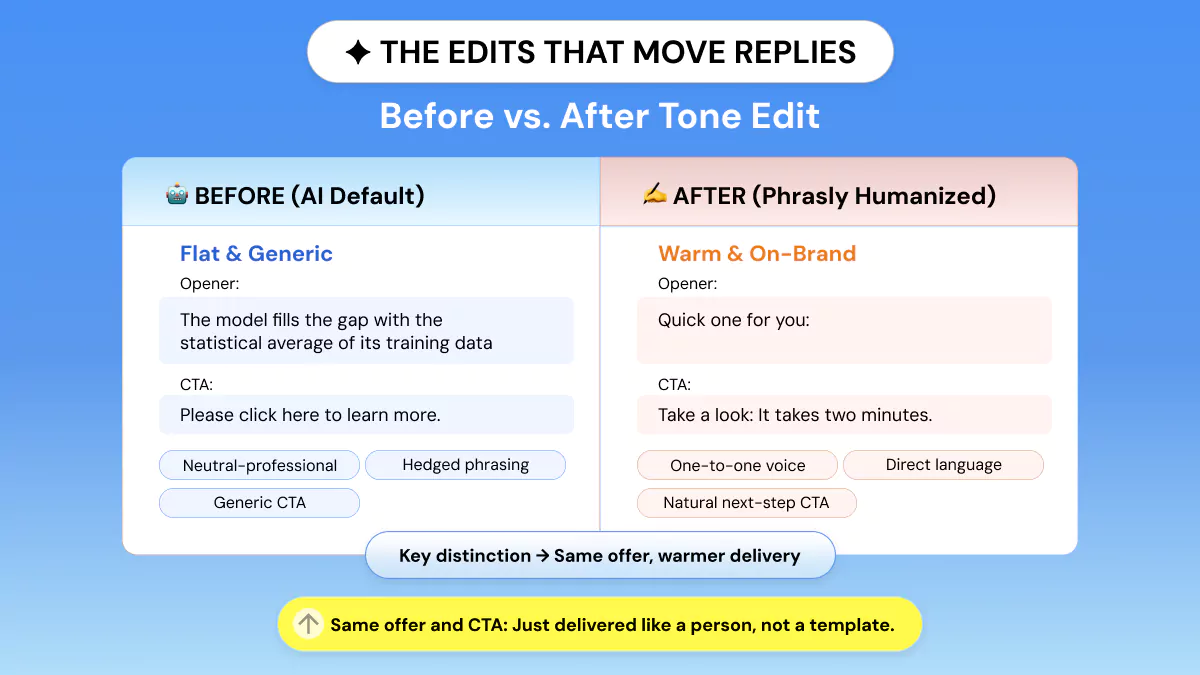
Warm up the opening, write conversationally (as if one person is talking to one person), use direct language (swap hedged phrases for power words), and frame the call to action as the next logical step instead of a demand.
To make AI-generated emails more persuasive, you can implement these changes without modifying the actual offer.
- ✅ Opener: Cut the generic greeting. Open with the reader's context or a specific benefit.
- ✅ Body voice: Swap passive, hedged phrasing (“we wanted to reach out”) for direct statements (“here's what's new”).
- ✅ CTA: Phrase the call to action as the obvious next step, not a command (“see your plan” vs. “click now”).
- ❌ Avoid: Manufactured urgency, all-caps pressure, or manipulative scarcity that isn't true. It erodes trust and persuasion over time.
Before / after (a renewal reminder):
✊ Try it: Phrasly AI Humanizer
It clears the robotic edges the model leaves behind instead of rewriting your message from scratch.
Verify Tone Before You Send
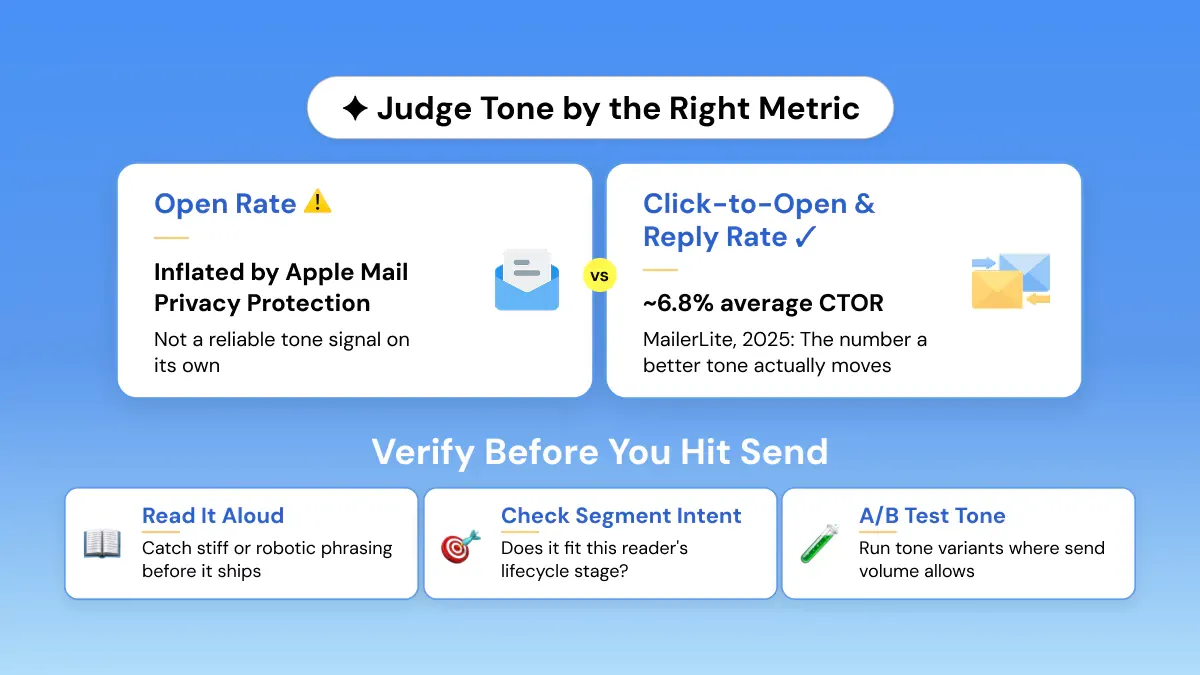
Read your email out loud and compare it to your segment's goal. Evaluate based on click-to-open rate and reply rate, not opens. Opens are inflated by Apple MPP.
A quick pre-send checklist:
- ✅ Read it aloud. If you wouldn't say it to one person, rewrite it.
- ✅ Check the opener and CTA against the segment's lifecycle stage (new, active, lapsed, VIP).
- ✅ Confirm the offer and call to action are unchanged after any tone edit.
- ❌ Don't judge tone success by open rate alone. Track click-to-open rate and reply rate instead.
Whenever possible, A/B test different tones of the same message rather than shooting in the dark. These AI email conversion tips compound over dozens of sends.
Calibrating your brand voice is a low-cost, scalable lever vs revamping an entire campaign.
You should also keep a master log of what tone tweaks affected reply rate or click-to-open rate for each segment so you can base future tweaks on data rather than intuition.
Over a quarter, that log becomes a lightweight style guide.
A record of precisely how much warmth or formality each segment of your list tolerates. And that will make every future AI email tone pass go faster and smoother for everyone on the team.
Which tone converts best in email? There is no one-size-fits-all winner. The tone that converts best is the one tailored to your brand baseline and your reader's segment and lifecycle stage, measured against Click-to-open rate and reply rate, not opens.
How do you turn AI-generated email copy into persuasive email copy? Warm the opening, write like you are one person talking to one person, delete hedged phrasing, and make the call to action a logical next step that modifies delivery, not offer.
FAQs
How do I edit AI email copy for tone?
Begin with your baseline brand voice. Make adjustments to match warmth/formality/urgency with the reader segment and lifecycle stage.
Read it aloud. Edit for concise language, particularly with hedging phrases. Do not edit your offer and call to action. If you'd rather use a tool to speed this up, here's a look at the best AI humanizer for email marketing.
What tone converts best in email?
No one tone is right for every email. The winning tone is the one that resonates with your brand and the specific subset of your list that is reading it, as measured by click-to-open rate and reply rate, not just open rate.
How do I make AI emails match my brand voice?
Establish your brand voice foundations (playful vs serious, concise vs chatty), then weave that through. Add any niche-group voice/tone shifts on top.
Should I judge email tone by open rate?
No! Opens are skewed by Apple's Mail Privacy Protection. Click-to-open rate and reply rate are more dependable signals that a tone is converting.
Can tone really affect conversions?
Yes, writing in a tone that doesn’t match your audience will sound canned and untrustworthy. It drives down clicks and responses. Tailored messaging that's relevant to your recipient boosts engagement dramatically.
Personalized subject lines created an approximately 50% increase in open rates according to research by Yes Lifecycle Marketing / Marketing Dive, 2017.
Will humanizing change my offer or CTA?
No! Phrasing and tone of voice should change with a humanizing pass. Only your offer, pricing, and call to action should remain exactly the same before and after.


Keep reading

Rewriting AI Drafts for Client Deliverables Without Losing Your Voice
AI can draft your client copy in minutes, but that's not what clients pay for. Learn how to treat AI drafts as scaffolding, not final copy, rewrite for both your voice and your client's brand guidelines, cut hedge words, vary rhythm, and proofread before delivery so nothing generic ships.
Humanizing AI-Written SEO Content Without Hurting Rankings
Worried that humanizing AI content will tank your rankings? It won't if you protect the right elements. Learn how to edit AI drafts for voice and E-E-A-T while keeping keywords, headings, and internal links intact, so your content ranks well and reads as if a human wrote it.