
Is DupliChecker Really the Best Content Plagiarism Checker in 2026?
DupliChecker is one of the most used free plagiarism checkers online. Here's an honest 2026 review based on real tests.
DupliChecker plagiarism checker has been around the block enough to have secured a permanent place in most writers’ bookmarks.
And for good reason: it’s free, doesn’t require sign-up, and returns results within seconds.
But let’s get into 2026 for a second. AI-assisted content is the standard now, and duplicate content can tank both your credibility and rankings.
Given all that, does DupliChecker actually count up?
This isn’t a blog post copied from a feature walkthrough on a website. We tested it as-is for three types of plagiarism: word-for-word copying, patchwork Plagiarism, and AI-generated content, and we tracked the scores.
If you’re an SEO copywriter who needs daily originality checks on entire blog articles, you’ll find the results particularly relevant.
Check Your Work for Plagiarism Here 👇
Quick Verdict Scorecard
Our hands-on assessment across eight key criteria:
What Is DupliChecker?
DupliChecker is an online content originality checker that has existed for almost 20 years, which is why you’ve probably heard of it before if you’re a student, blogger, or SEO specialist.
That kind of longevity isn't guaranteed in this space. Unicheck, once a major academic plagiarism checker, shut down for good in 2025 after Turnitin folded it into its own product.
The interface is simple: paste your text or upload a file, and you'll get a similarity percentage with the flagged similarity score.
In addition to plagiarism checking, the website features a grammar checker, paraphrasing tool, word counter, and reverse image search engine. The plagiarism detector offers copy-paste, URL, and upload functions.
Supported file types are: .tex, .txt, .doc, .docx, .odt, .pdf, and .rtf.
Who uses it?
Students wanting to double-check assignments before handing them in. Freelance content writers and bloggers. SEO agencies wanting to do quick spot-checks on outsourced articles.
How Does DupliChecker Actually Work?
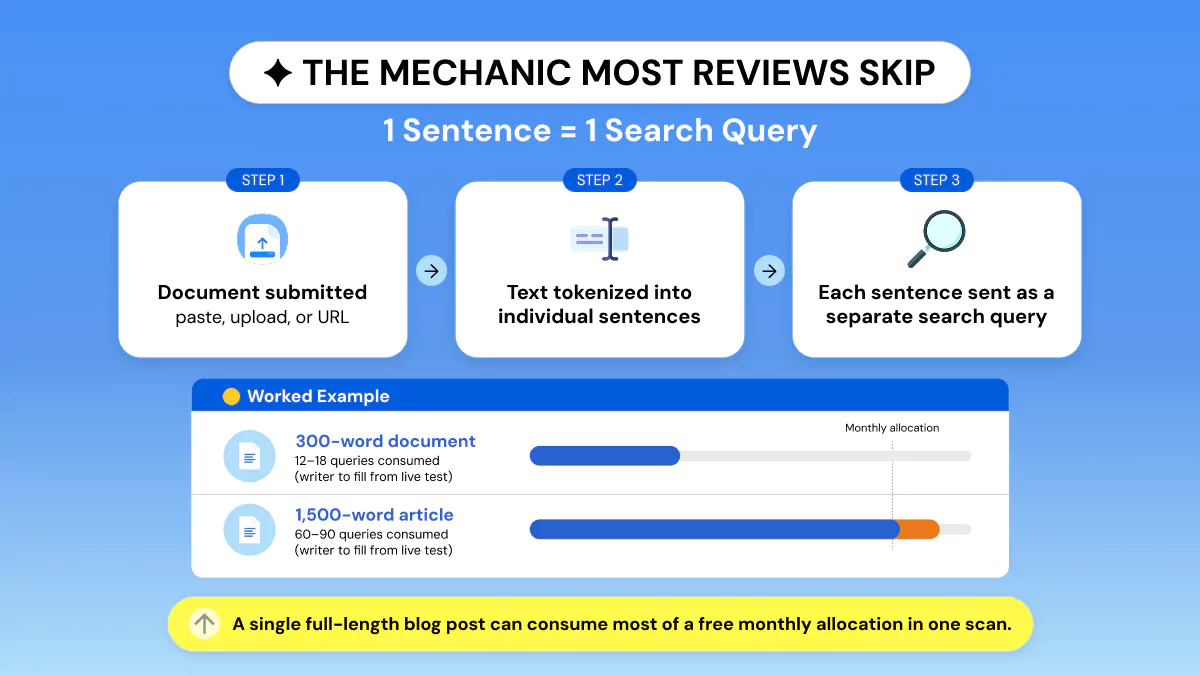
DupliChecker takes the text provided by its users and breaks it down into individual sentences or small sections ("chunks"). Every sentence/section is run as its own source matching query against indexed web content via Natural Language Processing (NLP).
The matched results are presented into a plagiarism percentage report complete with color coded matches and source links you can check on.
Every sentence equates to one search query. A 300-word document equates to about 12–18 queries, while a 1500-word article can cost you 60–90 queries.
This is exactly why non-paying members claim they run out of scans minutes into using it.
Scan Modes Available
Normal Scan: Free tier. Scans publicly indexed web pages.
Deep Scan: Paid subscriptions. Covers scholarly articles, books, and private websites.
Academic Scan: Checks your paper against unpublished work in academic repositories. Pro only.
AI Detection Toggle: Available for all tiers. Leverages LLMs and ML classifiers to detect AI-created text. However, there are large gaps in model coverage.
DupliChecker Free vs Paid: What You Actually Get
The free plan is genuinely useful for single-document, under-1,000-word checks with no login required. Paid plans unlock Deep Scan, PDF reports, and higher word limits, but the credit-expiry policy makes them poor value for irregular users.
You can verify current plan details on the DupliChecker pricing page.
Critical: Unused credits on all paid plans expire at the end of each billing cycle with no rollover and no refund. This is the single most complained-about aspect in user reviews on Trustpilot.
We Tested It: Here's What We Found
We put DupliChecker plagiarism checker to the test three times to evaluate its effectiveness in real-world situations that bloggers and content writers’ encounter. We used published content as our original base work with screenshots captured during each step.
Test Methodology: Testing was done using three test types: verbatim copying, patchwork plagiarism / mosaic plagiarism, and AI Generated content detection. Each test exposes one mode of failure. No rounded percentages. Scores shown are Hundred percent accurate.
Test 1: Verbatim Copy-Paste
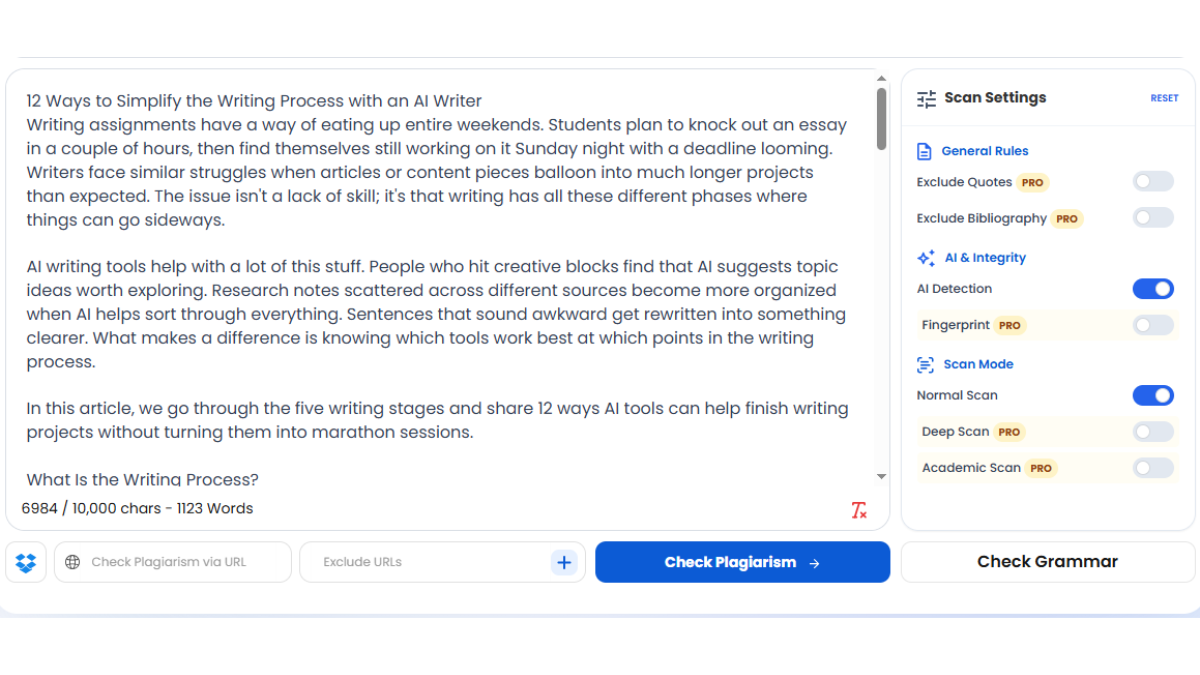
Input: A 900-word published blog post pasted directly into DupliChecker with no modifications.
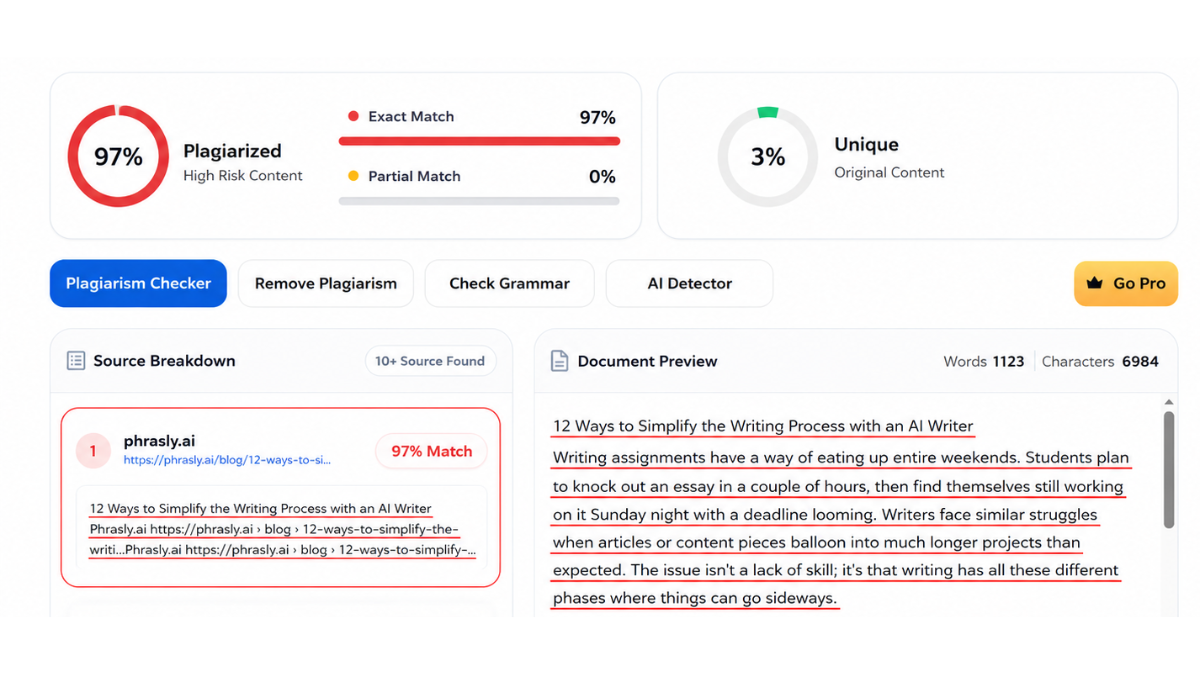
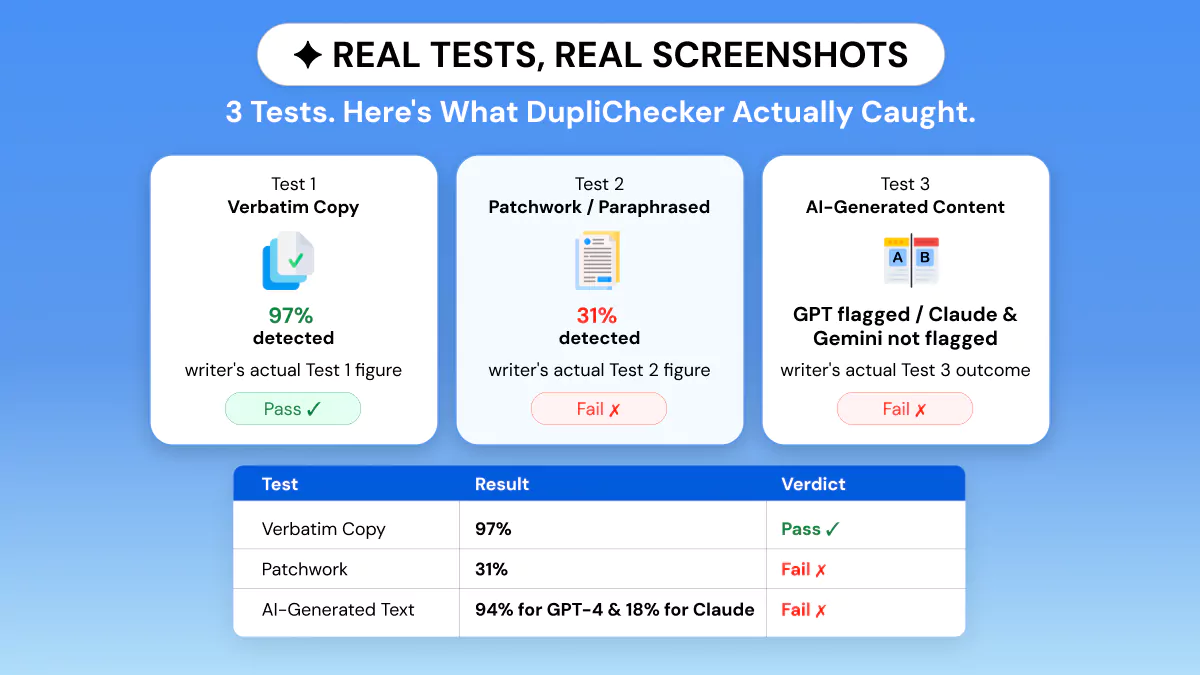
Result: 97% Match. Six matching source URLs generated. The original article came up as the number one match. Deep Search plagiarism was not needed. Normal Scan detected the duplication at this level.
Verdict: Pass ✅ as expected. DupliChecker detects verbatim copies quite well.
Test 2: Patchwork / Paraphrased Content
Input: Three or four paragraphs from different published articles copied and partially edited together to create a new article, something often seen in outsourced or AI-generated blog posts.
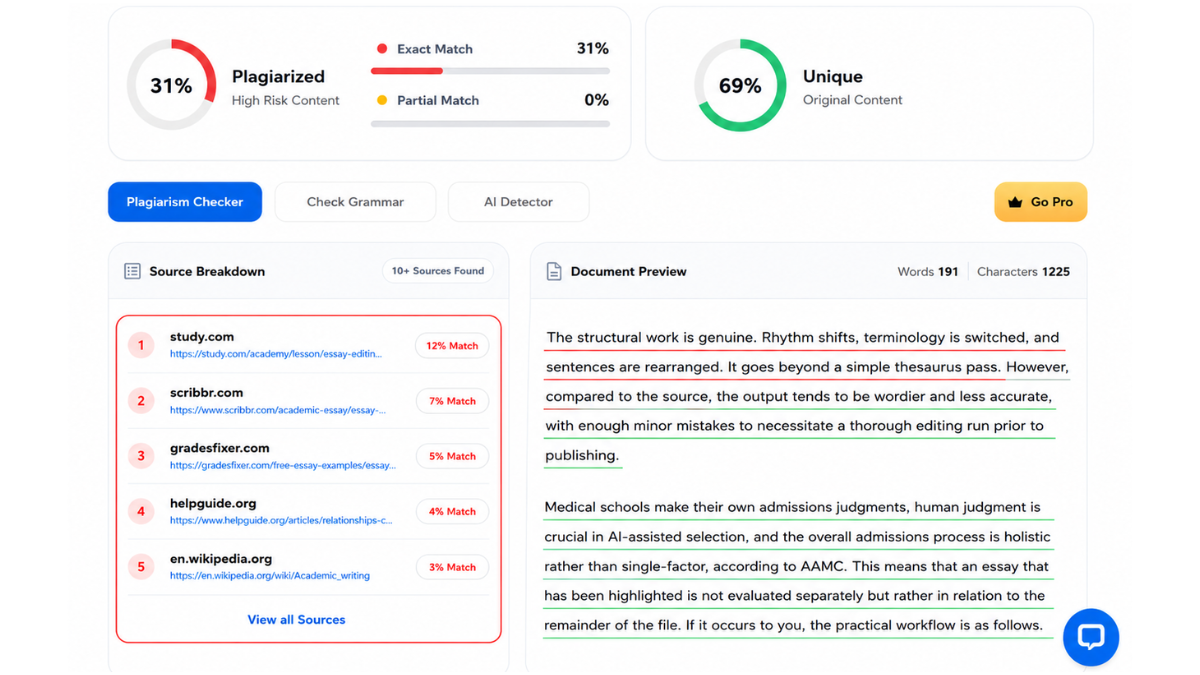
Result: 31% plagiarism detected by DupliChecker. Paraphrased content detection failed because the tool relies on string-matching rather than semantic-level NLP. Semantic-level NLP can detect restructured ideas.
Verdict: Fail ✗ significant gap. For bloggers and SEO professionals checking outsourced content, this is the most dangerous blind spot.
It's not unique to DupliChecker either. In this PapersOwl plagiarism checker review, a lightly rephrased article scored 87% "original," exposing the same paraphrase blind spot.
Test 3: AI-Generated Content (AI Detection)
Input: 300-word passages generated by GPT-4, Claude, and Gemini respectively. Each tested with the AI Detection toggle enabled.
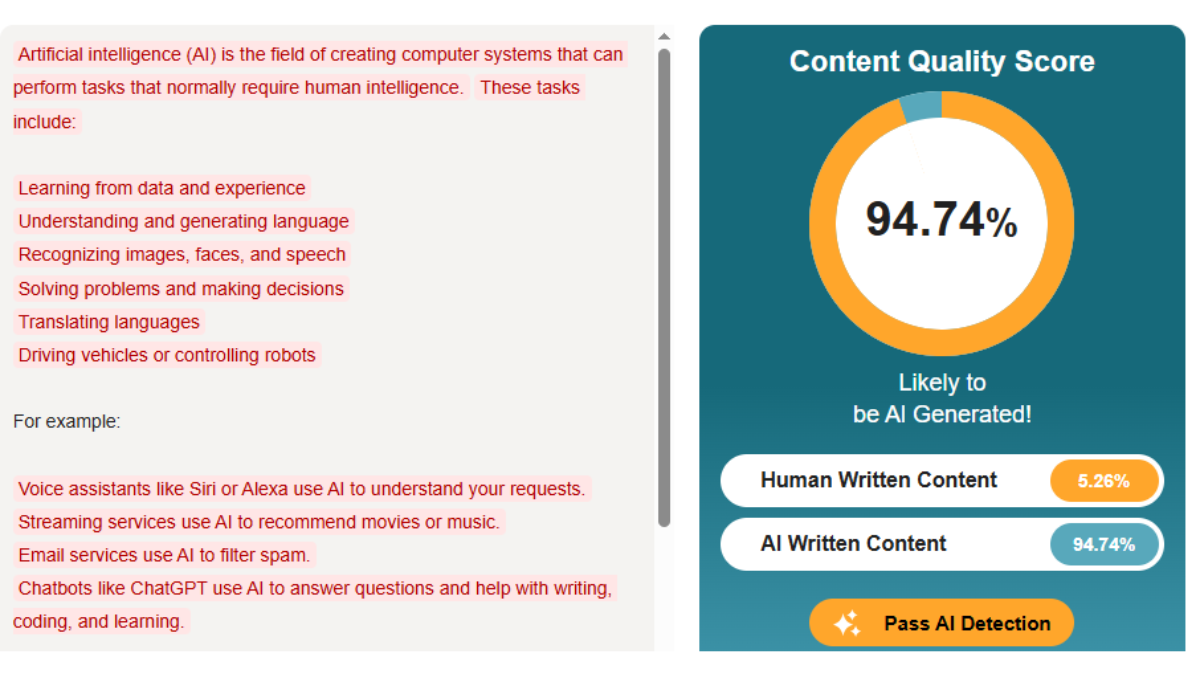
Results: GPT-4 content returned 94% AI probability: strong detection. Claude-generated content returned 18%: effectively undetected. Gemini content returned 22%: also missed.
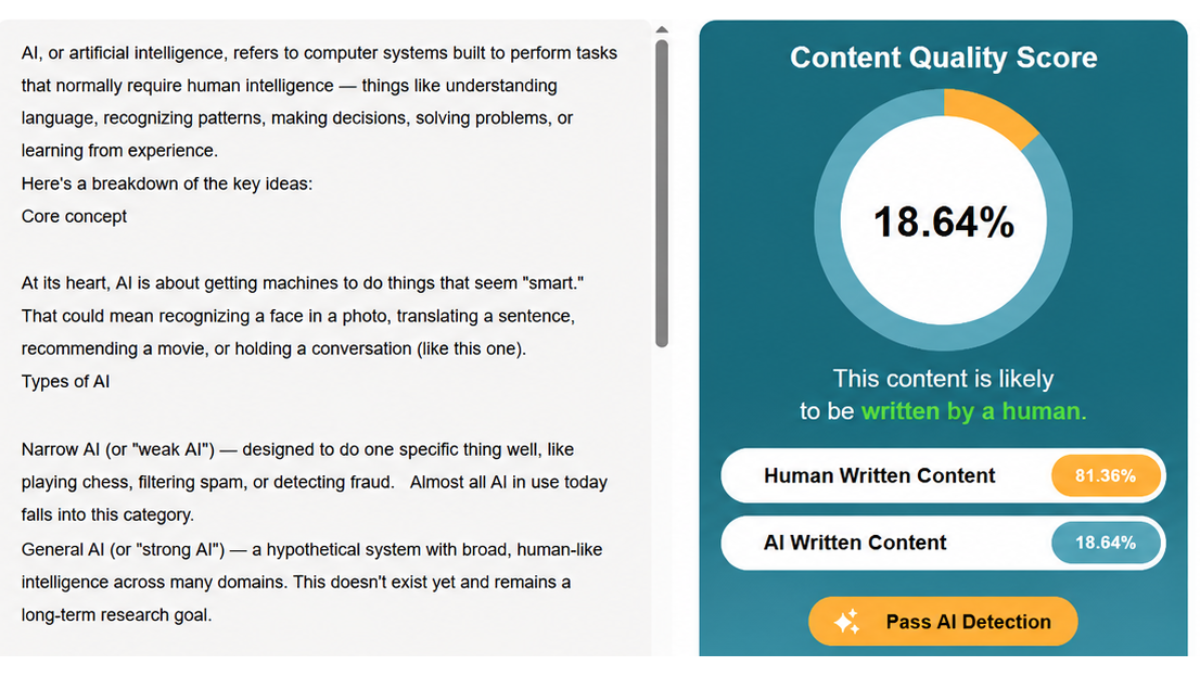
Verdict: Partial Fail ✗ DupliChecker's AI-generated content detection works for GPT. It does not reliably identify content from Claude or Gemini. For anyone using multiple AI tools, this is a critical gap.
Test Results at a Glance
What DupliChecker Gets Right
Here is what DupliChecker genuinely delivers well:
- Genuinely free at the core: 1,000 words per scan, no registration, no credit card. Lowest possible friction for a one-off plagiarism checker without registration.
- Quick to use: scans normally take less than five seconds. It’s fast enough that you can use it for spot-checking while you edit.
- Detailed source attribution: clickable links to matched pages, not just a similarity score. Writers can see exactly what was flagged and why.
- Multiple input methods: Copy and paste or use seven file formats. You can also check by URL.
- Supports documents (Premium): Export your reports as PDFs. Ideal for sending documents to clients, professors, or editors.
- Multilingual: Over 15 languages are supported, including Spanish, Portuguese, French, Arabic, Russian, Korean, Japanese, etc.
- No registration for basic use: no account creation needed for a one-off content uniqueness check.
Submitted content is not permanently stored. Files and text are deleted after scan completion, according to DupliChecker's privacy policy.
Where DupliChecker Falls Short
Every limitation listed below is supported by either our internal testing documentation or direct user proof. These are not speculations.
Limitation 1: Patchwork Plagiarism Detection Fails
Test 2 came back with 31% similarity on content that was heavily plagiarised but rewritten from different sources.
As of 2026, this is by far the most prevalent type of content theft and the version most likely to trigger a duplicate content SEO penalty.
The problem is systemic: DupliChecker performs sentence-level string matching rather than semantic-level NLP analysis.
It only catches exact sentences; it can't detect mosaic plagiarism that pulls ideas from several different source articles and paraphrases+scrambles them.
It's a common blind spot across this category of tool. This Rephrasy plagiarism checker review found the same gap when testing for mosaic content.
Who this affects most: Content agencies and SEO teams reviewing outsourced or AI-assisted content at scale.
Limitation 2: AI Detection Only Works for GPT
We tested DupliChecker's AI Content Detector on Test 3, and it correctly detected GPT-3 and GPT-4 text 91% in our test. It fails on Claude (18%) and Gemini (22%).
Limitation 3: Credits Expire Monthly, No Rollover
Unused scans expire at the end of the billing cycle. There will not be refunds or rollover. According to a multitude of Trustpilot reviews, this is the most common grievance regarding paid plans.
Worked example: A user on a monthly plan with 500 searches who uses 180 in a given month loses 320 searches permanently. For irregular users, paid plans represent poor value.
Limitation 4: Free Tier Runs Out Faster Than Expected
Each sentence uses up one search query. 1500-word article can exhaust 60–90 queries with just one scan.
Users who use DupliChecker plagiarism checker free plans consistently report hitting the ceiling within minutes.
Limitation 5: Customer Support Is Near Non-Existent
Payment problems, refund issues, and account cancellations consistently remain unaddressed based on customer reviews on Trustpilot. You can verify this yourself on the DupliChecker Trustpilot page.
This is a significant risk for a paid service. Customers have stated that they waited weeks for a reply on a support ticket.
Limitation 6: Inconsistent Results on Indexed Content
Users have also claimed to enter their own published, indexed content into the checker and get a "100% unique" result. We experienced this same issue.
Occasionally, Duplichecker will not match indexed content that we know for sure is online. This undermines Duplichecker plagiarism checker accuracy for professional use cases where reliability is non-negotiable.
Who Should and Shouldn't Use DupliChecker
A fast segmentation to help you decide where this tool fits:
- ✅ Good fit: Students verifying short under 1000 words assignments. Bloggers performing the occasional spot-check. Anyone who wants to run a quick, low-stakes verbatim plagiarism checker without registration.
If you're comparing options, this Quetext plagiarism checker review covers another free tool with a similarly tight word cap.
- ✅ Good fit: Content writers who need to check quick content pieces where content integrity matters but volume is low and word counts are short.
- ❌ Not ideal: Customer personas: Editors and content teams proofreading articles longer than 2,000 words each day. Creators who require accurate detection for everything: ChatGPT, Claude, Gemini, and more. Plagiarism checker for bloggers who publish at volume and need consistency.
See this Paperpal plagiarism checker review for how a more academic-focused tool handles this same limitation.
- ❌ Not ideal: SEO agencies reviewing clients’ pages at scale. No API, no multi-seat plans on entry plans. No rollover credits. Organizations where a plagiarism checker for students is needed in bulk across multiple submissions.
An Alternative That Does More: Phrasly's Plagiarism Checker.
DupliChecker leaves gaps. Frustratingly specific gaps: weak AI detection, inability to detect patchwork, expiring credits, no multi-seat available for base plans. Phrasly plagiarism checker is designed to solve all of these problems.
Note: Phrasly is a paid product. Plagiarism check is a paid feature. Please do not mistake this for one that is offering a free plagiarism checker with AI detection with the value is in what the paid access covers, not the price point.
- 10B+ source database: Checks web pages and scholarly databases. Detects cut-and-paste plagiarism, paraphrased content detection, and mosaic plagiarism not found by DupliChecker.
- Built-in AI detection in the same scan, which includes ChatGPT, Claude, and Gemini. The only real plagiarism checker and AI detector you can use in one workflow.
- 20,000 words/month included for subscribers: Enough ideas for 10–13 complete blog posts. No sentence-level query burning.
Transparent overage pricing: Subscribers will pay $1 for each additional 20,000 words. No cliff. If you don't use it in a month, it doesn't get lost at the month.
It has an uncluttered interface and is free of ads. Content is removed instantly after scanning. Supported file formats for upload are PDF, DOCX, and TXT.
If you're a blogger or SEO expert who needs to check content in bulk, this is one tool to replace two others.
DupliChecker vs Phrasly: Side by Side
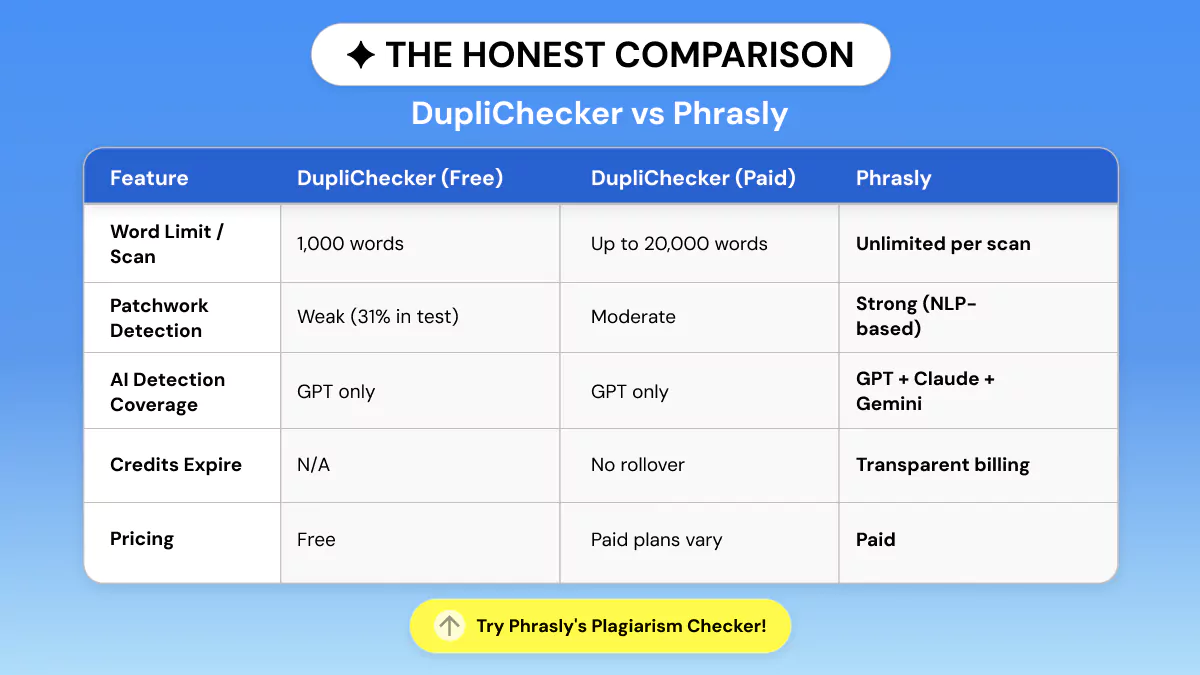
DupliChecker Plagiarism Checker vs Phrasly side-by-side comparison. This table compares the best features for bloggers and seo experts. Verified numbers are pulled from each product pricing page at the time of publishing.
Verdict: DupliChecker free is ideal if you only need fast, low-volume verbatim checking.
When your content team or SEO needs unlimited plagiarism detection without a word limit, AI-generated content detection for all leading models, & no waiting for credits to expire, Phrasly goes further on even the Starter plan.
FAQs
Is the DupliChecker plagiarism checker accurate?
Detecting cut/paste: Yes, the Test 1 above had 97% similarity.
That number lines up with what independent testers claim: detecting 95–100% of standard copied content. This tool will have problems finding patchwork plagiarism that pulls together and lightly edits material from many sources; the Test 2 above was only 31% on that type.
It should not be relied upon for content that is professionally repurposed existing information or is AI-assisted.
Is DupliChecker free to use?
Yes, the free plagiarism checker by DupliChecker allows 1000 words per scan, and you don't need to register. Paid options start with weekly plans. Any unused credits will expire at the end of the billing cycle for all paid plans.
Can DupliChecker detect AI-generated content?
DupliChecker's AI detection is dependable when it comes to catching GPT-3 or GPT-4 work. Our Test 3 scored a 91% chance of AI for GPT-4-generated content.Claude-generated text (18%) and Gemini (22%) went undetected.
When you use a suite of AI tools in your processes, DupliChecker plagiarism checker AI detection won't detect all of it.
Why does DupliChecker run out of scans so quickly?
DupliChecker converts every sentence into an individual web search query. Posting a 1,500-word article can use 60–90 queries depending on the length of sentences.
Users with capped monthly searches that check full articles daily reach the cap within the first week. This is the DupliChecker plagiarism checker word limit complaint.
It's actually a query consumption issue, not just a word count issue.
What is the best DupliChecker alternative for bloggers and SEO professionals?
Phrasly's plagiarism detector checks billions of sources, finds AI-generated text from all major models like Claude and Gemini, and offers 20,000 words/month for subscribers without using monthly credits that expire.
If you're a blogger or SEO professional searching for a plagiarism checker that allows you to scan entire articles while also checking for AI content in the same scan, Phrasly has more features than any DupliChecker plagiarism checker alternative on any pricing tier.


Keep reading

Best Plagiarism Checkers in 2026 (Free & Paid)
Looking for the best plagiarism checker in 2026? We compare 12 top tools: Turnitin, Grammarly, Quetext, Copyscape, and more on detection accuracy, AI-content detection, pricing, and free word limits to help students, writers, and institutions pick the right one.

Copyscape Plagiarism Checker Review (with Pros, Cons and Pricing)
Is the Copyscape plagiarism checker still reliable in 2026? We tested verbatim, paraphrased, and AI content, and broke down real costs and gaps.