
Do Residency Programs Check for AI in Applications? What ERAS Applicants Need to Know in 2026
ERAS doesn't scan for AI, but the AAMC requires you to certify your statement is your own. AI is fine for brainstorming, proofreading, and editing, not for writing your story. Here's the 2026 policy, what Cortex actually does, and how to use AI ethically.
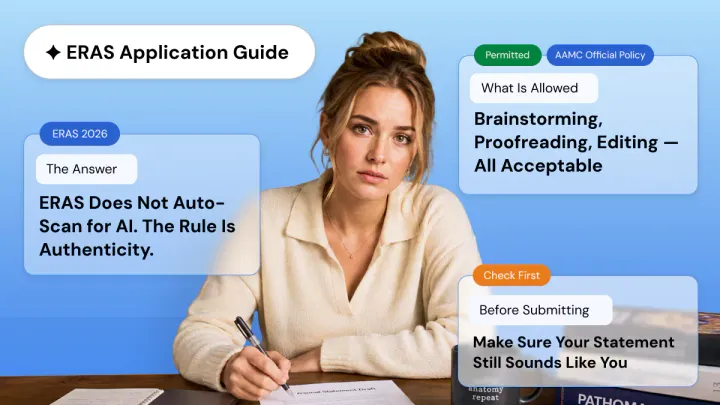
No, residency programs do not automatically scan ERAS applications for AI-generated content. The AAMC requires applicants to certify that their personal statement is their own work, meaning the rule is about authenticity, not automated detection. AI use for brainstorming, proofreading, and editing is explicitly allowed. AI-written content presented as your own is not.
If you are sitting in front of your ERAS application wondering whether you can use ChatGPT to help with your personal statement, you are not alone. The rules shifted in 2025–2026, and most applicants are confused about what is actually allowed.
This guide covers the AAMC's official AI policy, what counts as acceptable AI use, the new Thalamus Cortex screening platform now used by program directors, the attestation requirement, and how to use AI safely on your residency application.
Do Residency Programs Use AI Detectors on Applications?
No, residency programs do not run ERAS applications through AI detection tools as a standard step. ERAS itself does not automatically scan personal statements for AI-generated writing. The AAMC has stated clearly that the ERAS platform does not use AI to analyze, sort, or evaluate applications, and that application data is transmitted exactly as applicants submit it.
That distinction matters more than most applicants realize.
ERAS Is a Delivery System, Not a Detection System
ERAS is the centralized platform you use to send your application and supporting documents to residency programs. Once your file is submitted, ERAS hands it off. From there, each program decides how to review the application, which criteria to prioritize, and which tools to bring into their own screening process.
So while ERAS itself is not checking your personal statement for AI, that does not mean nobody ever will. An individual program director could still run a flagged statement through an AI detector if something feels off, especially if the tone of your essay does not match the rest of your application.
We have explained this issue in more detail in How to Protect Yourself from AI Detector False Positives.
The realistic picture: ERAS does not appear to run standard AI checks, but a specific program may choose to investigate a statement that raises concerns.
Cortex Is Not an AI Detector
This is where most of the confusion lives right now. Starting in July 2025, the Thalamus Cortex platform became available at no cost to all ERAS-participating residency and fellowship programs for the 2026 ERAS season.
Cortex uses AI, machine learning, natural language processing, and OCR to help programs organize and review applications faster. Thalamus reports that Cortex cuts screening time by roughly 50% and has processed more than 3 million residency and fellowship applications. WIRED reported in May 2026 that around 1,500 residency programs, about 30% of all programs, used Cortex during the 2025–2026 cycle.
Here is the key point:
It is not designed to flag whether you used ChatGPT to tighten a paragraph. Those are two completely different things, and conflating them creates anxiety that does not match the actual rules.
So, stop worrying about whether ERAS is secretly scanning your statement. Focus instead on the rule that actually matters: your final application must represent your own work and accurately reflect your experiences.
What the AAMC Actually Says About AI in ERAS Applications
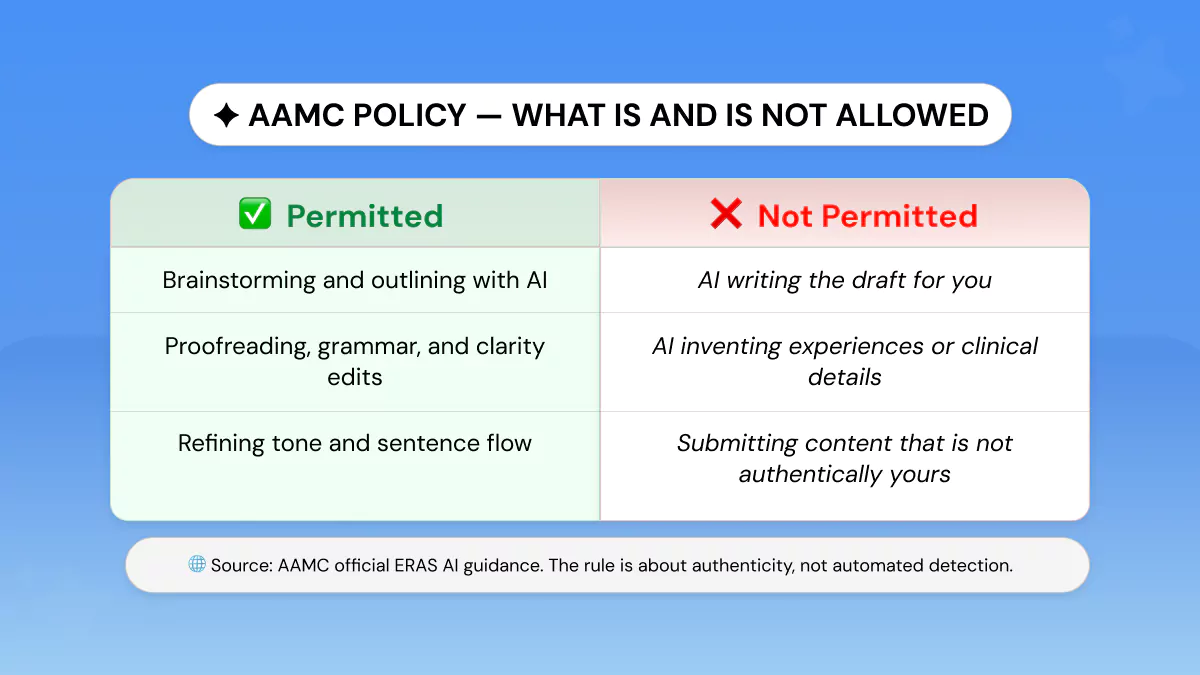
The AAMC allows ERAS applicants to use AI for brainstorming, proofreading, and editing, but the final application must still represent the applicant's own work and accurately reflect their real experiences. In plain terms, AI support is allowed. AI-written or inaccurate content is not.
This matters because a lot of applicants assume any AI use is automatically risky. It is not. The AAMC has been explicit about where the line sits.
The Exact AAMC Policy
Here is the official wording directly from the AAMC:
The ERAS personal statement guidance reinforces the same point. Your statement should reflect your personal perspective and experiences accurately, it must be your own work, and AI may be used for brainstorming, proofreading, or editing as long as the final submission still represents your own work.
What "Represents Your Own Work" Actually Means
This phrase is the part that confuses applicants the most, so it is worth breaking down.
"Own work" means the substance of your statement must come from you. That includes your ideas, your clinical experiences, your motivations, your reflections, and your conclusions about the kind of physician you want to become. These pieces have to be real, and they have to be yours.
AI is allowed to help with how you say something. It is not allowed to decide what you say happened. That single distinction covers most of the policy. AI can clean up a clunky sentence, suggest a tighter way to phrase a transition, catch grammar mistakes, or help you organize a rough outline. What it cannot do is invent a patient encounter, exaggerate a research role, or write a statement that no longer sounds connected to your actual story.
Editing is allowed. Replacement is not.
ECFMG Echoes the AAMC and Adds a Sharper Warning
ECFMG's May 2026 Personal Statement Do's and Don'ts quotes the AAMC's AI policy directly, then states the rule more plainly:
The document groups AI-written statements with paying a for-profit writing service or having someone else write your statement, because all three damage credibility.
ECFMG also makes the consequences concrete. Copying language from any source and presenting it as your own is plagiarism, and reported allegations prompt an AAMC investigation that may result in becoming ineligible for the Main Residency Match. That risk applies whether the copied language came from a sample essay online or from a generative AI tool.
The protective advice is the same advice that keeps you safe under the AAMC policy: show your statement to mentors or colleagues for feedback and proofreading, not for rewrites.
The bigger framing here is worth holding onto. The AAMC is not telling you never to use AI. It is asking you to use support responsibly and then certify that the final application is yours.
Can Program Directors Tell If You Used AI?
Maybe, but not reliably in every case. A peer-reviewed pilot study found that blinded reviewers could not consistently distinguish AI-generated personal statements from human-written ones using a standardized rubric. But experienced reviewers can still spot AI through pattern recognition, generic phrasing, and inconsistency with the rest of the application.
What the Research Actually Shows
In the PMC pilot study (PMC12799199), researchers asked ChatGPT-4 to generate five otolaryngology residency personal statements in 2024 and compared them with five de-identified human-written statements from 2019, before ChatGPT was widely available. Eight blinded reviewers, four otolaryngologists and four attorneys, rated each statement on readability, originality, persuasiveness, and interview desirability.
The result: no statistically significant differences between the AI-generated and human-written statements on any of those measures.
That sounds reassuring on the surface. It is not the full picture.
For a broader breakdown of tool reliability, read AI Detection Accuracy: Which Checkers Get It Right?
What Experienced Reviewers Actually Notice
Detection software is only one piece of it. Program directors who read hundreds of statements every cycle develop pattern recognition that no rubric can fully capture. AMA coverage from 2025 noted that veteran program directors look closely at authenticity, personal reflection, and statements that could not simply be dropped into another applicant's essay.
AI-generated personal statements tend to share a few telling traits:
- Generic phrasing that could apply to almost any applicant
- Vague clinical examples with no specific patient, moment, or lesson
- Polished tone that does not match the applicant's other materials, like emails, secondary responses, or interview answers
- Missing voice, the kind of small quirks and word choices that make writing feel like a real person
That last point is where most AI use actually gets noticed. A perfectly polished personal statement sitting next to a less polished email exchange or interview performance is the kind of mismatch that raises questions, not the writing itself.
If you want to understand what reviewers and software both look for, our guide on whether professors can detect ChatGPT covers the patterns in detail.
What Happens If You Are Caught Using AI on a Residency Application?
Misrepresenting AI-generated content as your own work on an ERAS application violates the AAMC's certification requirement and can result in withdrawal of interview offers, rescinded acceptances, or referral to medical school leadership for unprofessional conduct. Using AI is not automatically a violation.
The AAMC allows AI for brainstorming, proofreading, and editing. The risk starts when AI use crosses into misrepresentation: inventing details, copying language, or submitting a statement that is not genuinely yours.
The Realistic Consequences
AAMC guidance states that suspected plagiarism will be investigated, and substantiated findings may be reported to the programs you apply to in the current ERAS season and in later seasons. That report follows you.
For international medical graduates, ECFMG warns that plagiarism allegations can affect Main Residency Match eligibility. AI-generated content presented as your own falls under the same plagiarism framework when language overlaps with other sources or when experiences are fabricated.
Program-level consequences depend on each program's professionalism policies. Realistic outcomes include:
- Withdrawal of an interview offer if concerns surface before interview season
- Rescinded acceptance or rank decisions if issues are discovered later
- Referral to your medical school's leadership for a professionalism review
None of these are automatic. There is no public AAMC rule saying ethical AI editing leads to penalties. The penalties exist for misrepresentation, not for using AI to clean up a sentence.
What Institutions Are Saying
The University of Washington Graduate Medical Education page tells applicants to use AI to enhance their own work rather than replace it, to make sure content accurately reflects their experiences and skills, and to personalize AI suggestions, fact-check, and proofread the final version. UW also advises applicants to be ready to discuss how they used AI responsibly if asked.
If a program asks about your writing process, you should be able to answer honestly. That is the standard worth writing to.
How to Use AI Ethically on Your ERAS Personal Statement
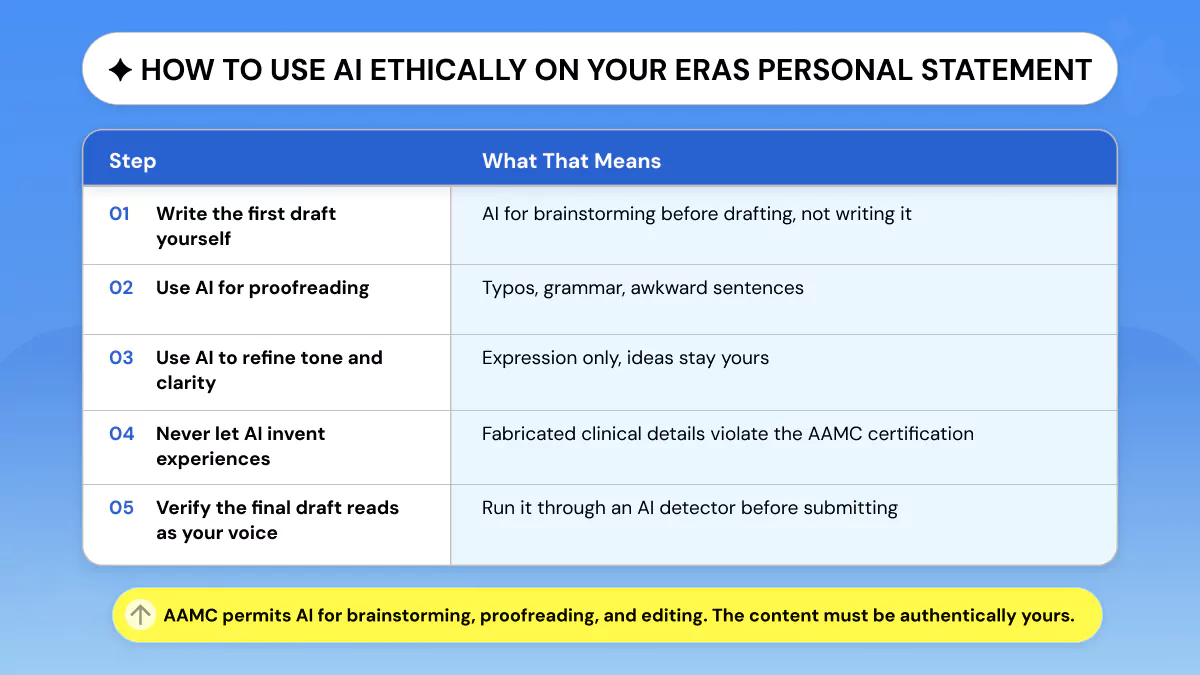
The AAMC explicitly permits using AI for brainstorming, proofreading, and editing. Acceptable use means AI helps you express your own ideas more clearly, not write the content for you.
AI can help with structure, grammar, tone, and clarity. The experiences, examples, and final message must come from you. ERAS guidance requires your statement to reflect your personal perspective accurately and represent your own work.
1. Write the First Draft Yourself
Use AI before drafting for brainstorming or outlining only. Do not ask AI to write the statement from scratch. Your patient-care examples, specialty choice, and personal voice must come from your actual medical training.
2. Use AI for Proofreading and Grammar
This is directly allowed by the AAMC. AI can catch typos, fix awkward wording, shorten long sentences, and clean up readability. This supports your writing without replacing your authorship.
3. Use AI to Edit Tone and Clarity
If a paragraph sounds stiff or wordy, AI can smooth it out. Review every suggestion and keep only edits that still sound like you. If a sentence feels too formal or generic compared to how you talk, rewrite it.
4. Never Let AI Invent Experiences, Achievements, or Clinical Details
This is the line you cannot cross. Do not let AI create patient stories, exaggerate your research role, or describe clinical moments that did not happen. The AAMC requires your application to accurately represent your experience. ECFMG treats fabricated content in the same category as plagiarism.
5. Verify the Final Draft Reads as Your Voice
Read your statement out loud. If a section feels generic or different from how you usually communicate, rewrite it in your own words.
Running your edited draft through an AI detector is a useful final check. It is quality assurance for your own writing, helping you spot sections that drifted too far from your voice during editing. If a paragraph is flagged as obviously AI-written, rewrite it the way you would actually say it.
Check Your ERAS Personal Statement Reads as Your Own Voice — Free
Make sure your personal statement reads as your authentic voice before submitting. Free AI check, no signup.
Cortex and AI Application Screening: What This Means for Applicants
Starting July 2025, the Thalamus Cortex AI screening platform became available free to all residency and fellowship programs through the AAMC's ERAS partnership for the 2026 cycle. Program directors use Cortex to streamline holistic application review. It reviews applicants, not whether applicants used AI to write personal statements.
How Cortex Works
Cortex is part of the AAMC-Thalamus collaboration, described as a technology-assisted holistic application review platform. It uses natural language processing, OCR, and other AI/ML tools to analyze transcripts, letters of recommendation, and other application materials.
The AAMC's November 2024 announcement stated Cortex has reduced screening time by an average of 50%.
Cortex organizes and screens application data faster. It is not designed to flag whether you used ChatGPT to edit a paragraph. Two different tools, two different purposes.
AI Screening Does Not Match Human Judgment
A 2025 Journal of Surgical Education study compared AI-selected interview candidates with a program director's manual selections. The result: only 7.3% overlap between the two pools, even when preferences were programmed by the same director.
The authors concluded AI may help with screening but should not replace human review. Do not assume AI-assisted review will favor you more than a human reviewer would.
Known Concerns About Cortex
A January 2026 Laryngoscope article reported persistent errors in the Cortex system. WIRED reported in May 2026 that around 1,500 residency programs (roughly 30%) used Cortex during the 2025–2026 cycle, with some institutions raising concerns about inaccurate grade displays and unreliable AI-surfaced information. Thalamus told WIRED that during that cycle, Cortex did not use AI to sort, filter, exclude, score, or rank applicants.
The Bigger Picture: Why Authenticity Matters More Than AI Detection
Authenticity matters more than AI detection because your ERAS personal statement is supposed to reflect your real experiences, perspective, and voice. The AAMC allows AI for brainstorming, proofreading, and editing, but the final statement still has to represent your own work.
The strongest personal statements include details only the applicant could know: a specific patient interaction, a clinical moment that changed how they think, a mentor who shaped their specialty choice, or a real challenge that taught them something about medicine. AI can polish a sentence. It cannot replace the weight of lived clinical experience.
This is what program directors are looking for. AMA coverage from August 2025 emphasized that veteran residency program directors value authenticity, emotional intelligence, and reflection over generic AI-polished writing. A clean essay helps. A personal essay has to feel personal.
The same boundary appears in ECFMG guidance: get feedback and proofreading, not rewrites. That is also how to think about AI. It can support your writing process. It should not take over your story.
Worry less about AI detection and more about whether your statement tells the program something true and memorable about who you are as a future physician.
Frequently Asked Questions
Do residency programs check for AI in applications?
Not as a standard ERAS-wide process. ERAS delivers applications to residency programs, but each program decides how to review what they receive. Individual program directors may use AI detectors on their own if a statement raises concerns.
How can I check my personal statement for AI before submitting?
Use an AI detector as a final voice check, not a replacement for honest editing. If a section sounds generic or different from your natural voice, rewrite it so it reflects your real experience. For a related admissions guide, see Do Medical Schools Use AI Detectors on Essays?
Does ERAS detect AI in personal statements?
No. There is no public AAMC guidance saying ERAS automatically scans personal statements for AI-generated writing. The AAMC focuses on authorship: your statement must reflect your own work, even if AI was used for brainstorming, proofreading, or editing.
Is it okay to use ChatGPT for my ERAS personal statement?
Yes, for brainstorming, proofreading, or editing. The AAMC explicitly permits AI use for those purposes. The final submission must accurately represent your experience and your own work.
What does the AAMC say about AI in residency applications?
The AAMC says AI tools are acceptable for brainstorming, proofreading, or editing the personal statement and other application materials. Applicants must affirm the final application accurately represents their experience and represents their own work.
Can program directors tell if I used AI?
Maybe, but not reliably. A 2025 pilot study found blinded reviewers could not consistently distinguish ChatGPT-4-generated personal statements from human-written ones. Reviewers can still notice generic wording, weak clinical detail, or a voice that does not match the rest of your application. For more on this problem, read How to Tell If Text Was Written by AI.
What is Cortex AI in ERAS?
Cortex is Thalamus's tech-assisted holistic application review platform, offered free to ERAS-participating residency and fellowship programs for the 2026 cycle starting July 2025. It helps programs screen applicants, not detect AI use in personal statements.
What happens if I'm caught using AI on a residency application?
Using AI is not automatically a violation if it was used for allowed editing support. The risk comes if the final statement is not your own work, misrepresents your experience, or contains copied content. ERAS says suspected plagiarism can be investigated and substantiated findings may be reported to programs.