
AI Detector for SEO Content: What to Check Before Publishing
Google doesn't penalize AI content for being AI-generated. It rewards quality 'however it is produced.' The real risk is thin, generic writing. Here's the actual pre-publish checklist: E-E-A-T markers, original data, sourced claims, and a detector check last, not first.

An AI detector for SEO content won’t tell you whether your writing will rank. But it is a useful pre-publish signal for one thing: generic, low-effort writing.
Google doesn’t penalize AI content for being AI-generated. Its own guidance says it rewards quality “however it is produced.” It only treats AI used to manipulate rankings as a spam policy violation.
Thin content is the real risk here, and high AI scores often go hand in hand with it.
That changes the entire framing. Instead of seeing this as some anti-AI bias, think of it more as an “AI penalty.” Google’s filters penalize vague, useless content and reward helpful content. And unedited AI content tends to fall into that category.
So Google isn’t really trying to detect “AI” language; its detector serves as a proxy for content that sounds effortless and undifferentiated and struggles with search rankings.
We explain Google’s actual position straight from their own guidelines, offer you a handy pre-publish checklist that looks at far more than just one detector score, and share why humanizing AI content is really about earning citations and E-E-A-T, about dodging an algorithm.
Does Google Penalize AI Content? (What the Documentation Actually Says)
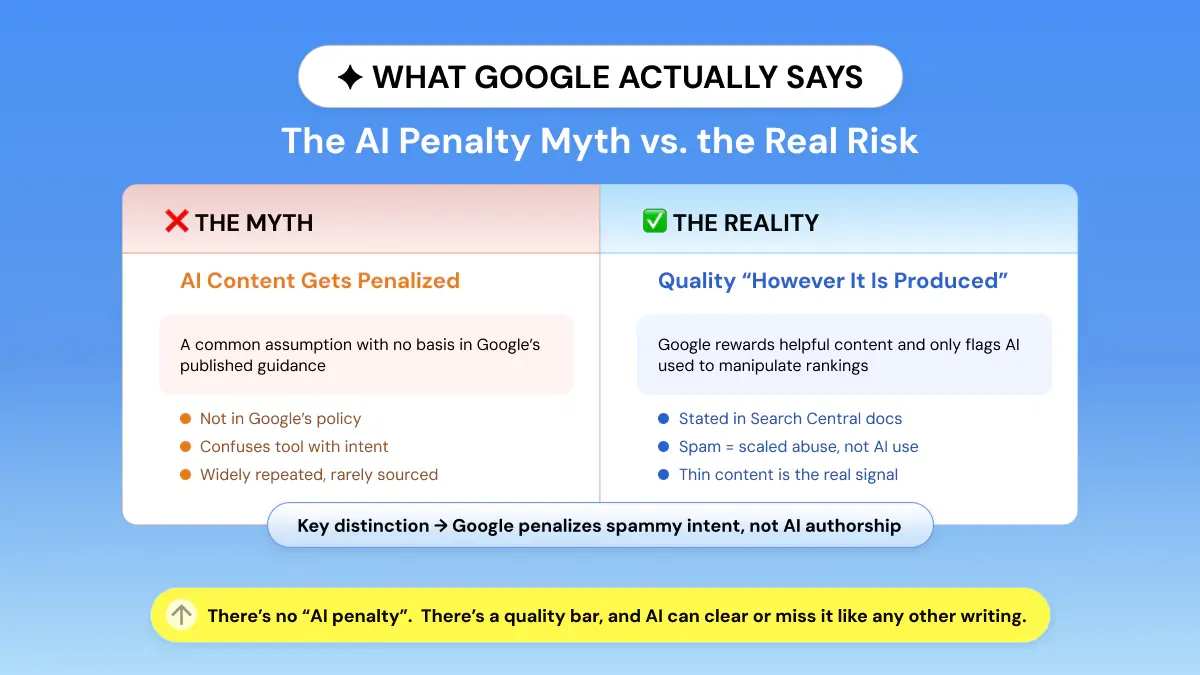
No! Google has said in its publicly available guidelines that it rewards high-quality content, whether written by a person or by AI. It only penalizes AI, which is used to manipulate search rankings as a spam violation.
"AI penalty" doesn't exist. There's a quality guideline and a spam policy.
It also noted that this work continues today through search ranking systems and the helpful content system, which was designed to identify and elevate content that was created for users and not for ranking purposes.
The company also very clearly said that “using automation like AI to create content designed primarily to manipulate ranking in search results violates our spam policies.”
That one line sums up the entire policy. Posting manipulative content is a violation; using AI to write that content isn’t.
Google emphasized this once again with its March 2024 core update, when it officially added two new policy categories: scaled content abuse and site reputation abuse.
Under-scaled content abuse includes is manually created content, content created with automation, and content created with AI. All were published en masse with the primary purpose of manipulating search rather than serving readers.
The same update reinforced E-E-A-T. Experience, Expertise, Authoritativeness, and Trustworthiness are the underlying quality bar, regardless of production method.
- Google's own wording rewards quality content “however it is produced”. Confirmed verbatim on the live 2023 guidance page.
- Scaled content abuse and site reputation abuse were formalized in the March 2024 update. E-E-A-T remains the quality framework behind both.
- There is no separate “AI detector” signal in Google’s ranking systems. The standard is quality and intent, not authorship method.
Myth, killed: AI itself is not penalized. There is a quality standard (E-E-A-T, helpful content) and a spam standard (scaled content abuse, manipulation). AI-assisted content that passes both will be treated like everything else.
The Real Risk: Thin, Generic Content (and Why a Detector Flags It)
AI content gets demoted when it’s generic, experience-free, and indistinguishable from everything else on the SERP. The exact traits Google’s helpful content system targets.
A high AI-detector score often correlates with that kind of writing. It’s a useful pre-publish risk signal rather than a ranking predictor.
Why the Correlation Exists?
Unedited AI output tends to default to safe, average phrasing. That's statistically what the model has learned is most likely to come next. That tendency creates writing that contains formulaic sentence flow, stock transitions, and a lack of first-hand experience.
Even though these characteristics aren't officially penalized, they define the very profile that struggles with Google's quality signals and underperforms in AI Overviews and similar answer-focused features, as there's nothing special for those systems to extract or reference.
E-E-A-T Markers AI Usually Lacks
- Specific, lived first-hand experience. A number you measured, a mistake you made, a tool you actually used.
- Original data, screenshots, or examples that don’t exist anywhere else online.
- A clear point of view or judgment call. Not just a balanced summary of “both sides”.
- Specific names, dates, and sourced numbers rather than vague qualifiers like “many experts agree”.
When an AI detector for SEO content gives you a high score, take it as a cue to ask yourself: “Does this read as generic?” not “Will Google penalize this?”
Detectors should be one input into an editorial decision, never treated as a ranking signal alone.
Pre-Publish Checklist for AI-Assisted SEO Content
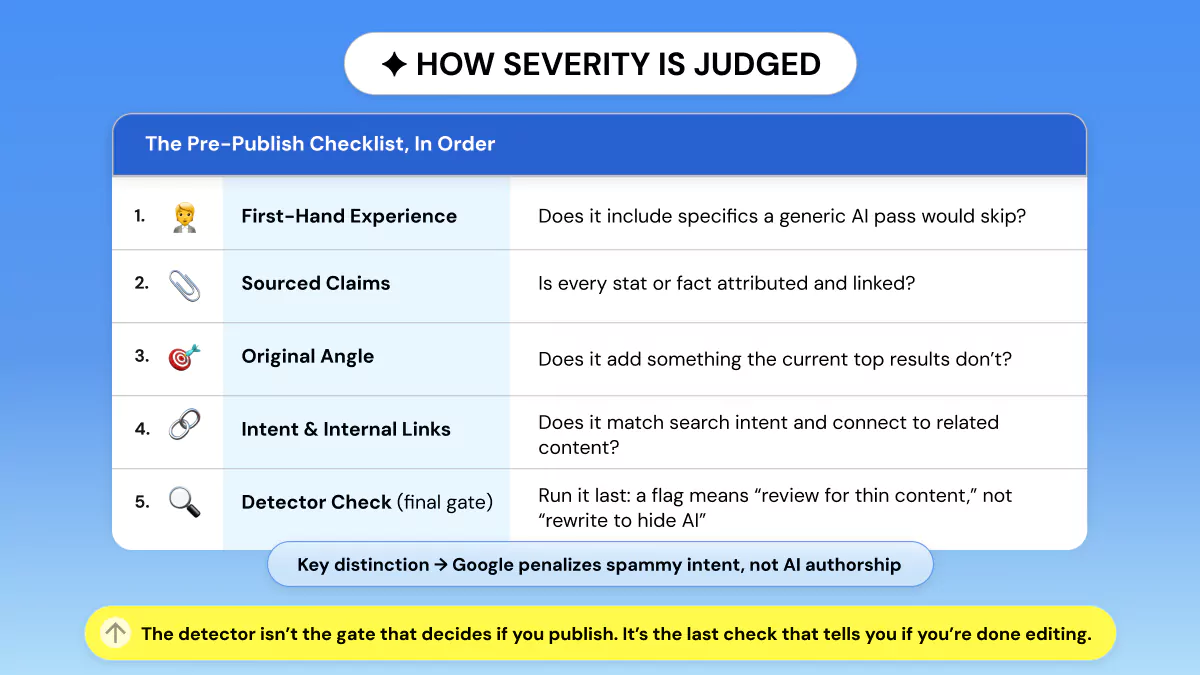
Check AI content before publishing by verifying that first-hand experience and specifics are present. Every claim is sourced, the content adds something the SERP currently lacks, and the writing doesn’t read as generic.
Then run a detector check as the final risk signal, not the gate.
The Checklist, in Order
- E-E-A-T markers: Does the piece show real experience, named expertise, or a credible authority signal (author bio, original sourcing)?
- Original angle or data: Does this add something the top-ranking pages don’t already say?
- Sourced claims: Is every statistic or quote attributed to a named, dated, linkable source?
- Internal links and intent match: does the piece connect to related content and actually answer the searcher’s query?
- Detector check (final step): run it through an AI detector for SEO content as a last-mile thin-content signal.
The table below summarizes the five checks. What each one is actually protecting against, and the practical next step if something is flagged.
|
Check |
What It
Protects Against |
How to Verify
It |
If Flagged |
|
E-E-A-T markers |
Generic, anonymous-sounding
content with no demonstrated authority |
Look for a named author bio,
a first-hand example, or a specific credential |
Add a real example or byline
before publishing |
|
Original angle / data |
Duplicating what's already
on page one with nothing new |
Compare your draft against
the top 5 ranking pages for the same query |
Add a data point, test, or
perspective competitors lack |
|
Sourced claims |
Unattributed statistics that
erode trust and accuracy |
Confirm every number has a
named source, year, and live link |
Cut the stat or trace it to
a verifiable source |
|
Internal links / intent
match |
Orphaned content that
doesn't serve the searcher's actual goal |
Check the piece answers the
query directly and links to related pages |
Add internal links and
tighten the intro to match intent |
|
AI detector score (final) |
Generic, effortless-sounding
prose that signals thin content |
Run the draft through a
detector after the four checks above |
Rewrite flagged passages for
specificity and voice |
Try the Phrasly AI Detector as your final pre-publish risk check. It's trusted by over 3,000,000 users and is built to flag generic-sounding passages. If you're drafting from scratch, the Phrasly AI Writer can help you start with a stronger, less generic first draft.
Use it alongside the AI Humanizer to add voice and specifics to anything it surfaces.
This step comes last, after the E-E-A-T and sourcing checks above, not instead of them.
Humanizing AI Content Is About Citations, Not Dodging Detectors
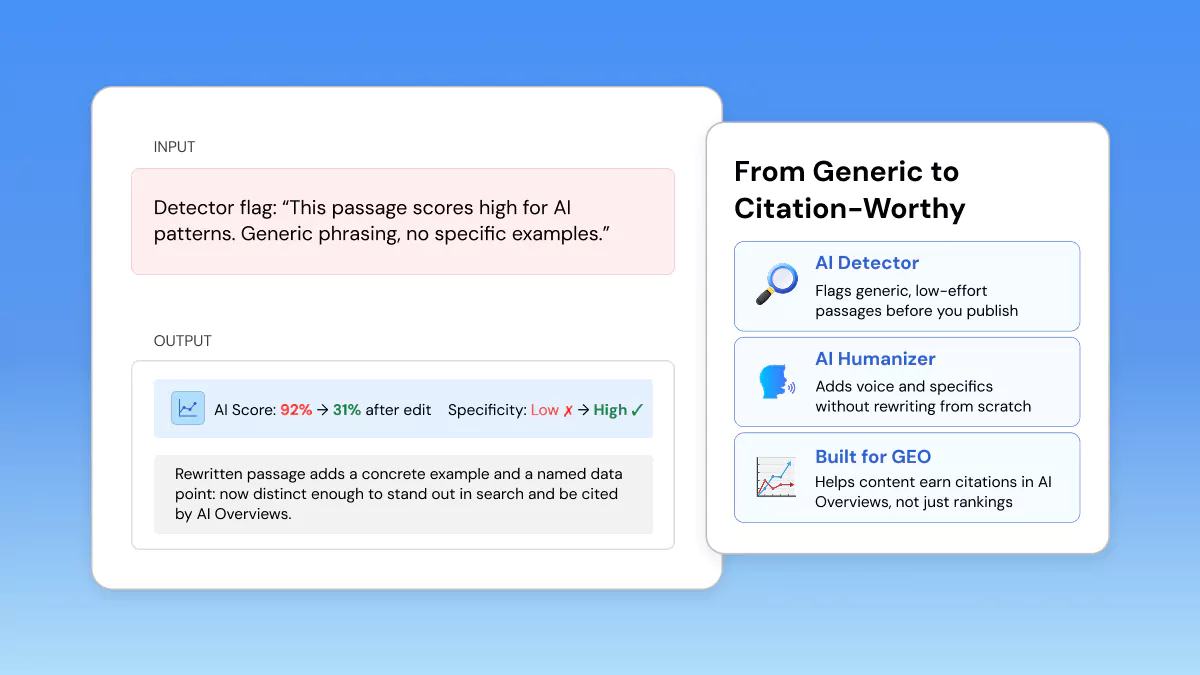
In an AI-search world, generic content doesn’t just rank poorly. It’s also less likely to get cited in AI Overviews, ChatGPT, or Perplexity.
Making content humanized helps with specificity and voice, which helps it become more citation worthy. That is the long-term SEO and GEO payoff.
Gartner has been clear that this is a prediction, not a certainty, but the trend it forecasts lines up with what most SEOs are already seeing: answer engines are capturing increasing amounts of queries that previously appeared on a results page.
Industry estimates for the volume of AI Overviews have ranged from as low as approximately 13% of queries to as high as 48% of queries from various SEO tracking vendors, depending on the category being searched and the measurement time frame used.
Given the lack of a definitive or universally accepted figure, it's wise to approach any reported percentages with skepticism, understanding that each represents a single vendor's snapshot at a particular moment.
The practical implication: If your writing sounds like a generic AI-generated voice, it disappears from the face of the system deciding what to quote.
Writing that has specific numbers, a named example, or an opinionated point of view is precisely the type of chunk an AI Overview or chatbot answer can yank and attribute. That's not evasion: that's writing worth quoting.
- Reframe humanizing as earning citations and trust.
- Use the Gartner 25%-by-2026 figure as motivation for GEO. But always label it as scenario modeling from 2024.
- If you cite AI Overviews prevalence, give a range and name the vendor. Never state a single hard percentage as fact.
- Use a tool like the AI Humanizer to add voice and specifics to passages flagged as generic. Then re-check with the AI Detector.
FAQs
Does Google penalize AI-generated content?
No! Google rewards high-quality content, “however it is produced.” Only treats AI used to manipulate rankings as a spam violation. There's no separate AI penalty in its ranking systems.
Is it safe to publish AI content for SEO?
Absolutely, provided you edit for accuracy, source it correctly and put some E- E- A- T into it. The danger isn't AI. The real problem is putting out AI-written junk without any editing, proper sources, or fact-checking.
Will an AI detector tell me if my content will rank?
No! This detector identifies patterns in writing that are commonly associated with thin content. Note that this is only a pre-publish risk indicator, not a predictor of ranking, and is not associated with Google or part of any Google tools.
What is E-E-A-T, and does AI content have it?
E-E-A-T is Experience, Expertise, Authoritativeness, and Trustworthiness. Typical unedited AI content won't have E-E-A-T, because the model doesn't have real experience. (It needs to be provided by a human editor.)
Does humanizing AI content help SEO?
Yes, indirectly! Humanizing makes your content more likely to be citation-worthy in AI Overviews and chatbot answers, and helps it pass helpful content standards.
Should I check AI content before publishing?
Yes! But run a detector check last, after verifying sourcing, originality, and E-E-A-T. Tools like the Phrasly AI Detector work well as that final step.