Clever AI Humanizer Review (2026): Free, but Is It Good?
21 min read
This Clever AI Humanizer review gives you the short answer first. Clever AI Humanizer is a genuinely free tool for a quick first-pass polish. But is it good enough? That will depend on what text you enter and how much time you have.
In our testing, Clever kept every number intact in the blog sample but dropped both target SEO phrases from its opening paragraph. And it rewrote an accurate Nobel Prize claim into a false one in the academic sample.
So it works as a free first pass only if you are going to fact-check every line afterward. We tested Clever in September 2026, after its June 2026 model update.
Disclosure: Phrasly makes a competing AI humanizer and detector, so we show every score, setting, and screenshot from our tests. Below, we cover writing quality, meaning, detector results, limits, privacy, and alternatives.
Every claim below about Clever's price, per-request limit, styles, and languages was checked against the official Clever AI Humanizer page and is dated.
Detector scores throughout this review are treated as probabilities, never as proof of who wrote a piece of text.
Want to check your own draft first? Run it through Phrasly's free AI Detector and save the baseline before you read on.
Our Quick Verdict on Clever AI Humanizer
Is Clever AI Humanizer good? And is it worth it? Scored across six criteria below. Clever earns its reputation as a capable free first-pass editor. However, its value depends heavily on how sensitive or technical your text is.
In our two tested samples, it kept numbers accurate. But needed a full fact-check before either output was usable.
Criterion | Score | Evidence |
Writing quality | Not scored | Blind editor review not run in this test round |
Meaning preservation | 5/10 | 6 of 9 facts intact and 1 new factual error in the academic sample; all numbers kept but one plant fact reversed and both SEO phrases dropped from the opening in the blog sample |
Editing effort | Not scored | Editing time not measured in this test round |
Features & limits | 7/10 | 3,000 words per request, 2 styles, 3 languages; a capacity limit was hit during testing (Sep 2026) |
Privacy suitability | 6/10 | External LLM processing, staff may read samples, 30-day account retention (policy v2.1) |
Value for money | 9/10 | Free at test date, subject to availability |
✅ Best For:
Bloggers and freelancers doing a free first-pass cleanup of an AI-assisted draft.
Students who still plan to manually review and cite-check the output.
Anyone testing whether an AI Humanizer is useful before paying for one.
English, Spanish, or Portuguese content under roughly 3,000 words per run.
❌ Not Ideal For:
Confidential, regulated, or client material.
Long documents that exceed the per-request word limit.
Academic work submitted under a strict institutional AI policy.
If you're a student trying to figure out how these checkers factor into your coursework, we've written a dedicated guide on the best free AI checkers for students.
Anyone who needs a guaranteed detector score, which no tool can promise.
⚠️ Biggest Limitations:
It can turn accurate facts into false ones, as it did with a Nobel Prize claim in our academic sample and a tomato-variety fact in our blog sample.
It dropped both exact target phrases from the opening paragraph of our blog sample, which matters for SEO copy.
Free capacity can run out; we hit a daily processing limit during testing.
What Are Clever's Pros and Cons?
Clever's main pros are that it costs nothing. Needs no sign-up for core use. Handles up to 3,000 words per request and kept every number intact in our blog sample.
Its main cons are support for only three languages. Occasional capacity limits and a tendency to add unsourced advice or rewrite facts inaccurately.
What Is Clever AI Humanizer, and Is It Really Free?
Clever AI Humanizer is free to use. It is made by CleverFiles Inc., and as of September 2026, its official page advertises up to 3,000 words per request.
There is no fixed monthly word allowance. You don't need to sign up for core use, but availability depends on capacity, and CleverFiles says limits can change at any time.
If you're not sure how a humanizer differs from a basic paraphrasing tool, we cover that distinction in AI humanizer vs. paraphrasing tools.
Feature | Verified on Sep 17, 2026 |
Price | $0, no ads or paywall advertised |
Per-request limit | Up to 3,000 words per request |
Monthly allowance | No fixed monthly allowance advertised; subject to service availability |
Styles | Two: Normal, and Clear & Structured |
Languages | English, Spanish, Portuguese |
Sign-up | Not required for core use; an account enables content history |
Pricing is accurate as of the date this article was written and is subject to change. Confirm the current price on the tool's official pricing page before purchasing.
Observed during research: The tool returned "This request exceeds the available processing capacity for today" on at least one occasion. Treat this as a dated observation from our testing window. Not proof of chronic downtime.
What Changed Since Older Clever Reviews?
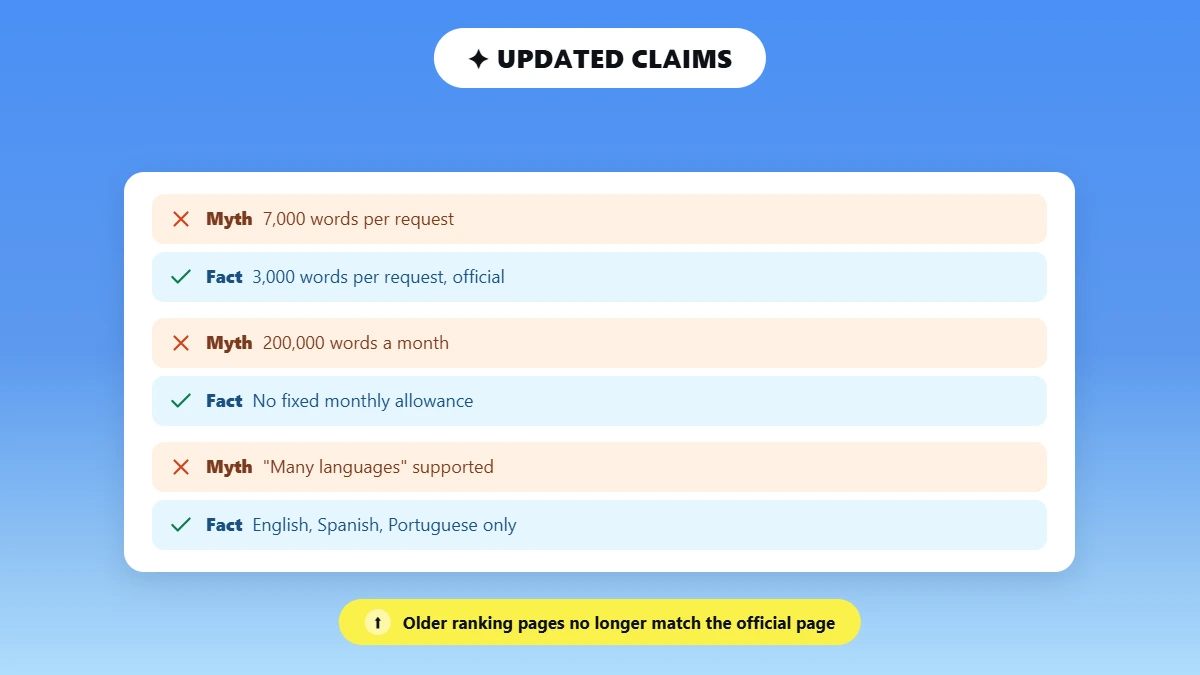
Older reviews of Clever AI Humanizer are now out of date. The product changed after a June 2026 model update.
If you saw any info stating it can humanize up to 7,000 words or allows for 200,000 words a month, here’s what their website states.
Topic | Current official page (Sep 17, 2026) | Stale claim on older ranking pages |
Per-request limit | 3,000 words | 7,000 words (Humbot); other older figures elsewhere |
Monthly allowance | No fixed monthly allowance | 200,000 words/month (Handy Recovery, Humbot) |
Styles | Normal; Clear & Structured | Casual / Formal / Academic (Rephrasy's older test) |
Languages | English, Spanish, Portuguese | “Many languages” (older reviews) |
Availability | Free, subject to capacity | Presented as effectively unlimited |
This gap matters. A reader who plans a project around a 200,000-word monthly allowance, or a 7,000-word single request, will hit a wall the official page no longer promises.
How We Tested Clever AI Humanizer (Methodology)?
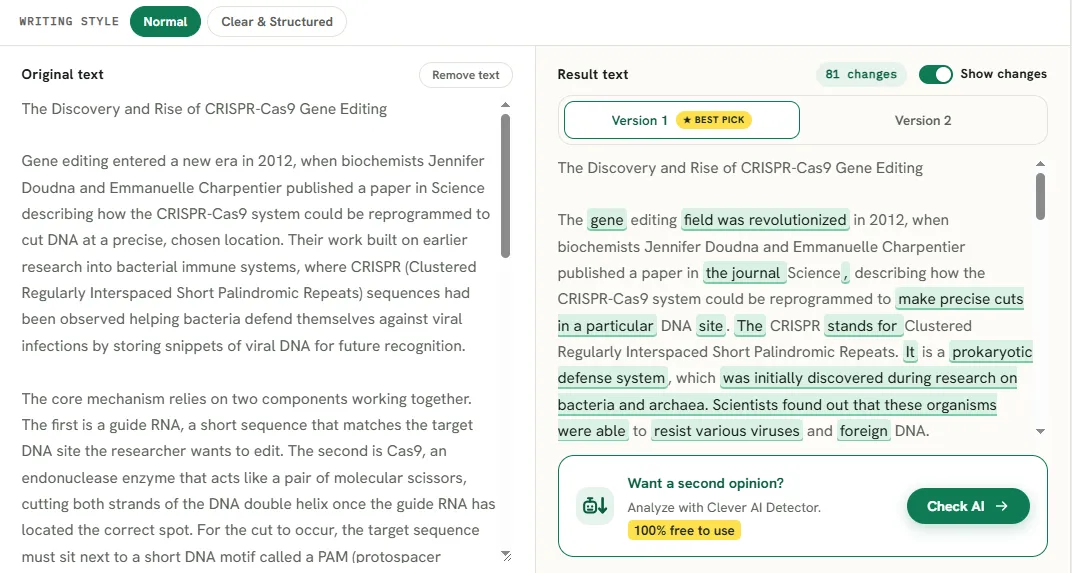
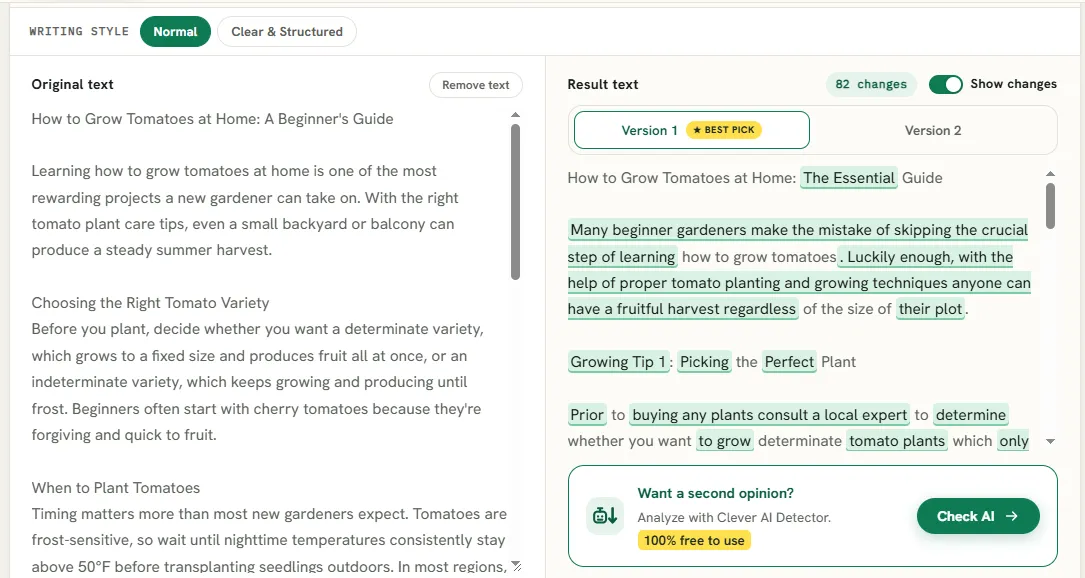
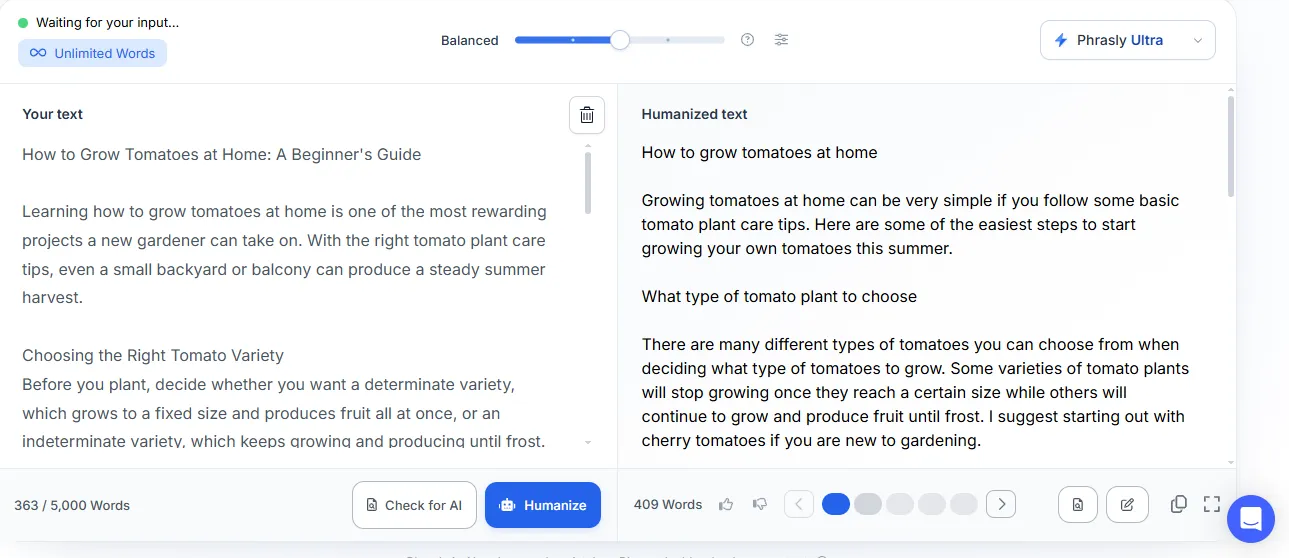
We ran two known-origin, AI-generated samples of roughly 360 to 460 words (461 and 363 words) through Clever's Normal mode, using Version 1, which Clever labels its “Best Pick”.
And through Phrasly. Sample 1 used Phrasly's free guest humanizer (default setting, 500-word cap), and Sample 2 used Phrasly Ultra on the Balanced setting.
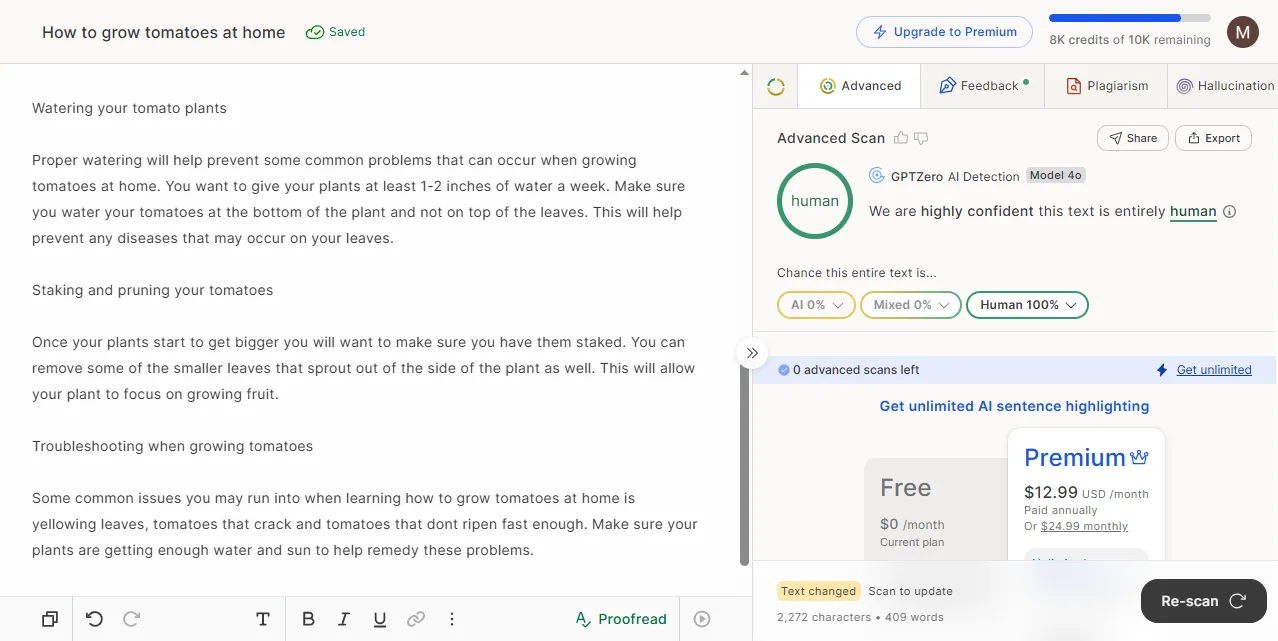
Then checked every output with GPTZero (Model 4o) and Phrasly's AI Detector (Model 7.0, May 2026).
Because the two Phrasly runs used different setups, treat its two results as separate data points rather than a like-for-like pair. GPTZero's Advanced Scan was used for three of the four outputs.
Sample 1's Clever output was checked with the Basic Scan.
Each output was audited against a pre-listed set of facts, entities, numbers, and target phrases.
Sample 1: Academic explainer with citations, names, dates, and technical terms
Sample 2: SEO/blog draft with headings and target phrases
Dimension | How it is measured | Status in this review |
Meaning preservation | Pre-listed atomic facts, citations, entities, numbers; counted changed, removed, or invented items | Done |
Grammar & readability | Issue count plus a documented readability metric | Not measured in this review |
Naturalness | Two editors score blind outputs on flow, specificity, repetition, and voice | Not measured in this review |
Editing effort | Minutes and number of manual changes needed to reach publishable quality | Not measured in this review |
Detector response | Raw label or probability from each detector, never averaged into one number | Done (GPTZero, Phrasly AI Detector) |
Consistency | A subset of inputs is rerun once to check whether outputs or scores changed | Not measured in this review |
We use the same rubric across our other AI humanizer reviews, and it builds on Phrasly's own 30,000-essay ZeroGPT detection study.
Clever AI Humanizer Test Results
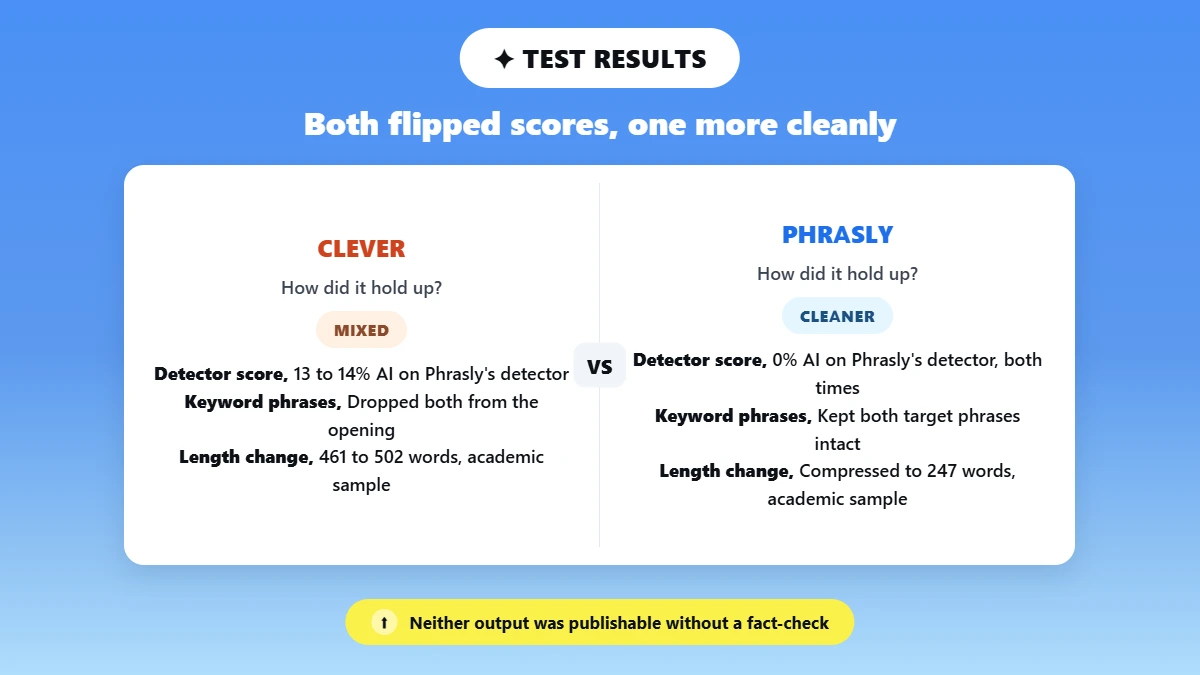
Across the two tested samples, both tools flipped AI-detector scores toward “human”. But Phrasly did it more cleanly. 0% AI on Phrasly's own detector both times, versus 13-14% AI for Clever's output on the same detector.
Phrasly was also the more reliable of the two at preserving the specific wording that mattered for the task. On the SEO/blog sample, it kept both target keyword phrases intact.
Clever kept the main keyword in its title but dropped both phrases from its opening paragraph.
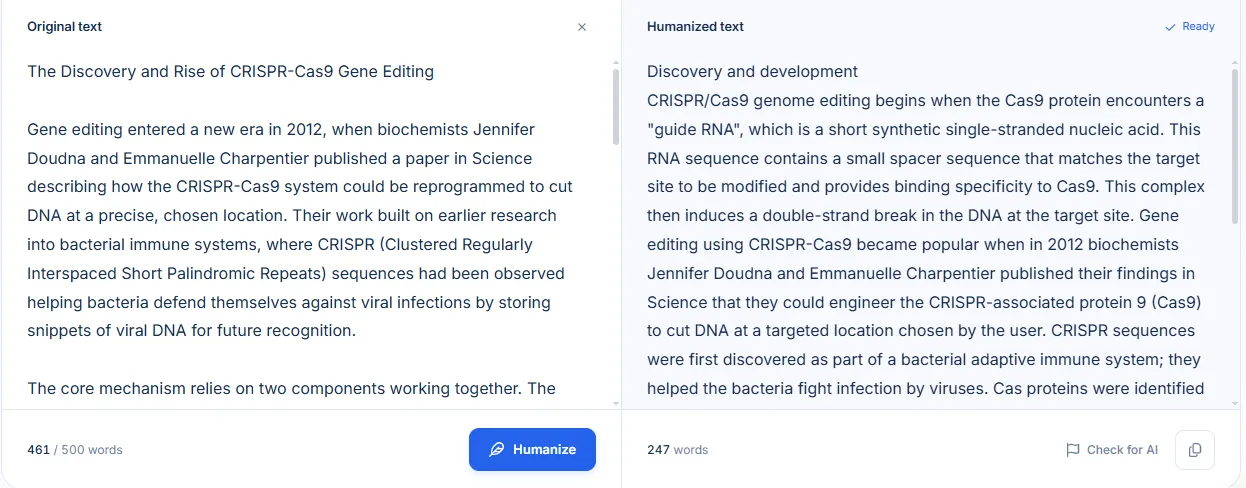
Where Phrasly lost ground was in how it handled length. It compressed the academic sample by cutting whole sections outright, shrinking it from 461 words to 247.
Including one fabricated-looking detail, rather than keeping the content and rewording it. On the blog sample, it went the other way, expanding 363 words to 409.
Clever kept closer to the original length and structure (461 to 502 words on the academic sample), though it expanded the blog sample more than Phrasly did, from 363 words to 435.
But introduced a factual error in the academic sample. Neither output was publishable untouched. But the two tools failed in different ways.
Phrasly by cutting and occasionally inventing. Clever by rewriting accurate content into something inaccurate. Rewrite-quality scores and editing-time figures were not collected in this round (see note below).
Sample | Meaning preserved? | Detector notes |
Academic explainer (Clever) | Partial: 6/9 facts intact; PAM description weakened; Feng Zhang/2013 dropped; Nobel Prize claim rewritten inaccurately | GPTZero: 100% human. Phrasly detector: 86% human / 14% AI; third-party readouts: 5/6 passed, 1 caution (Copyleaks) |
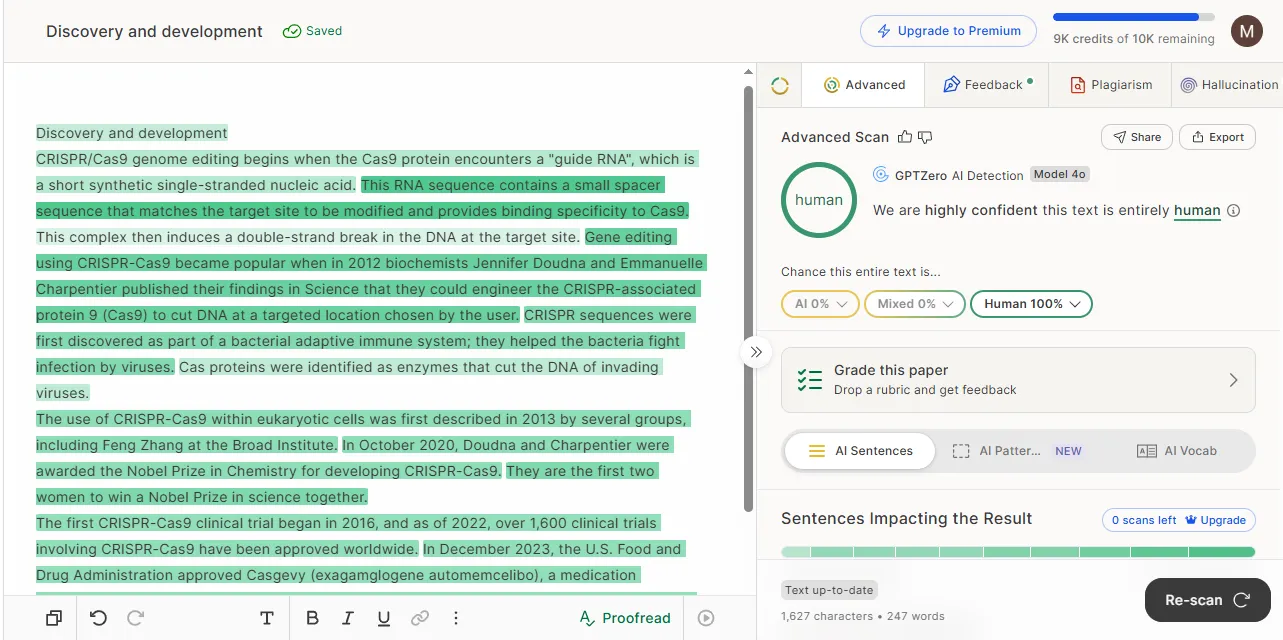
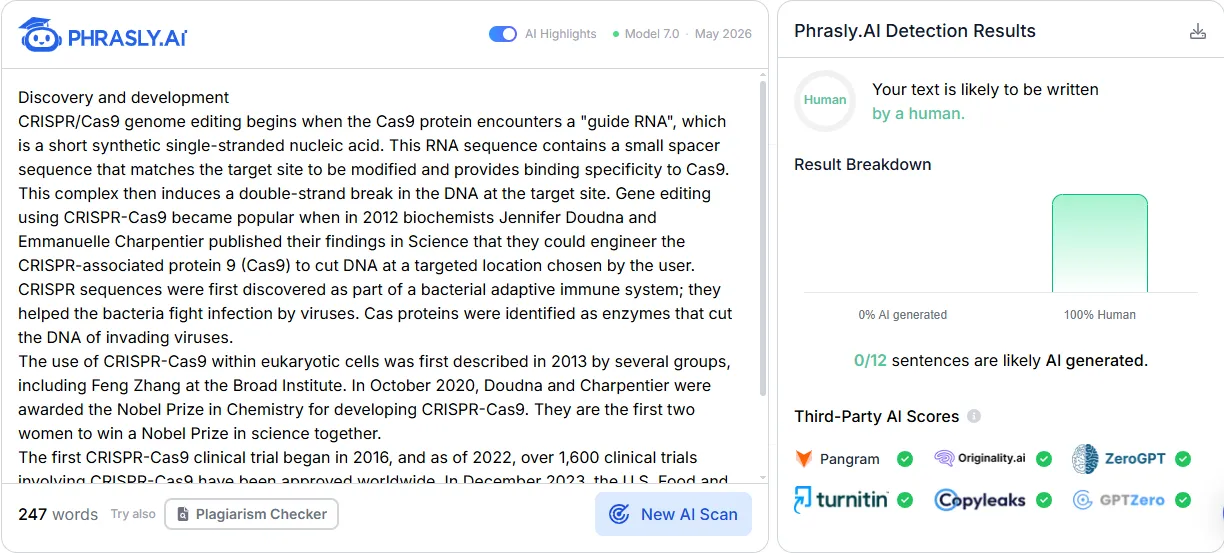
Academic explainer (Phrasly) | Partial: 6/9 facts intact; PAM, repair pathways, and off-target effects all dropped; 1 fabricated drug name; 2 unsourced added claims; Nobel Prize claim kept accurate. Detector performance tied with Phrasly's blog output for the cleanest detector results | GPTZero: 100% human. Phrasly detector: 100% human / 0% AI; 6/6 third-party readouts passed |
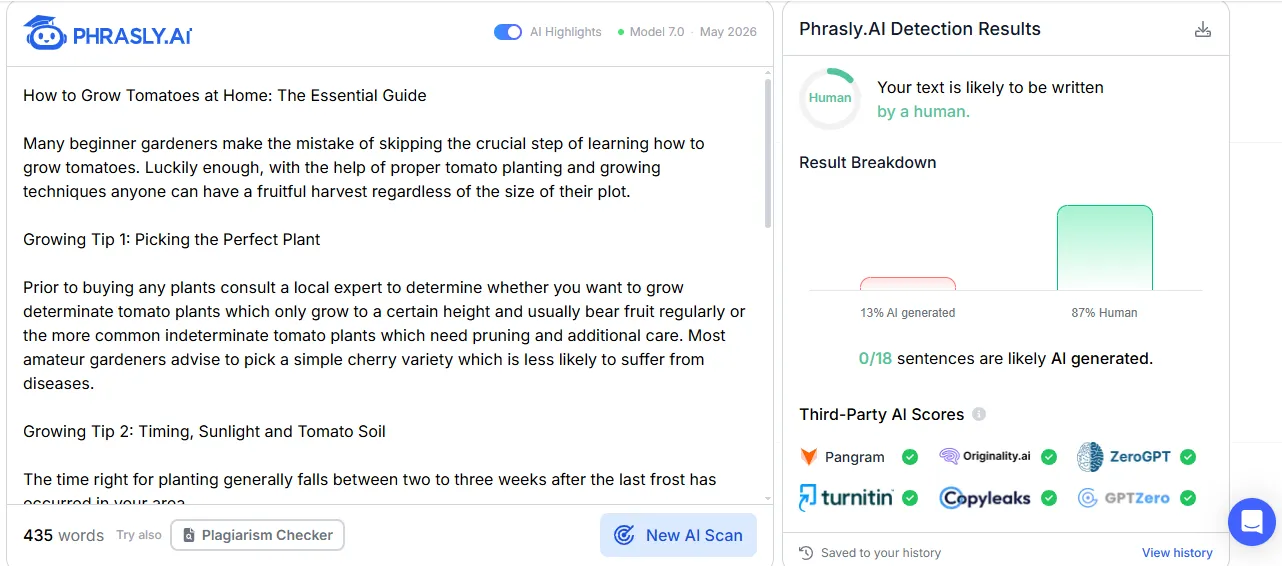
SEO/blog draft (Clever) | Mostly intact on numbers. All numeric facts (temps, timing, pH, watering) preserved; but main keyword kept in the title while both target SEO phrases were dropped from the opening paragraph; determinate-variety fact reversed; 3 unsourced additions | GPTZero: 100% human. Phrasly detector: 87% human / 13% AI; 6/6 third-party readouts passed |
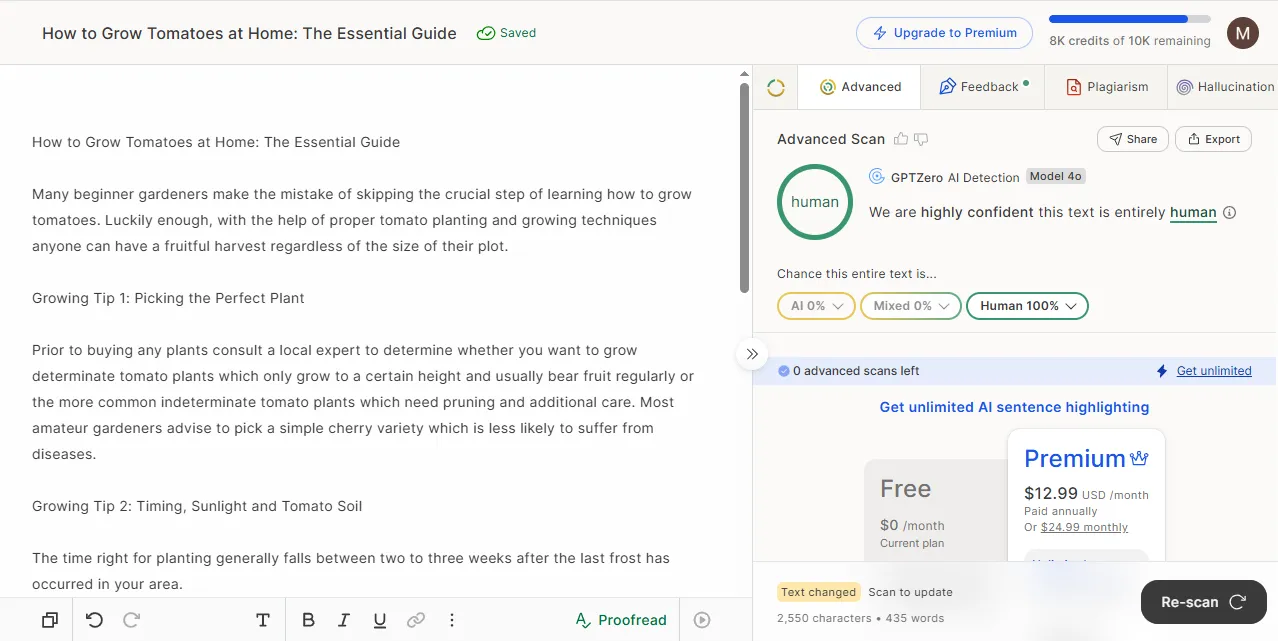
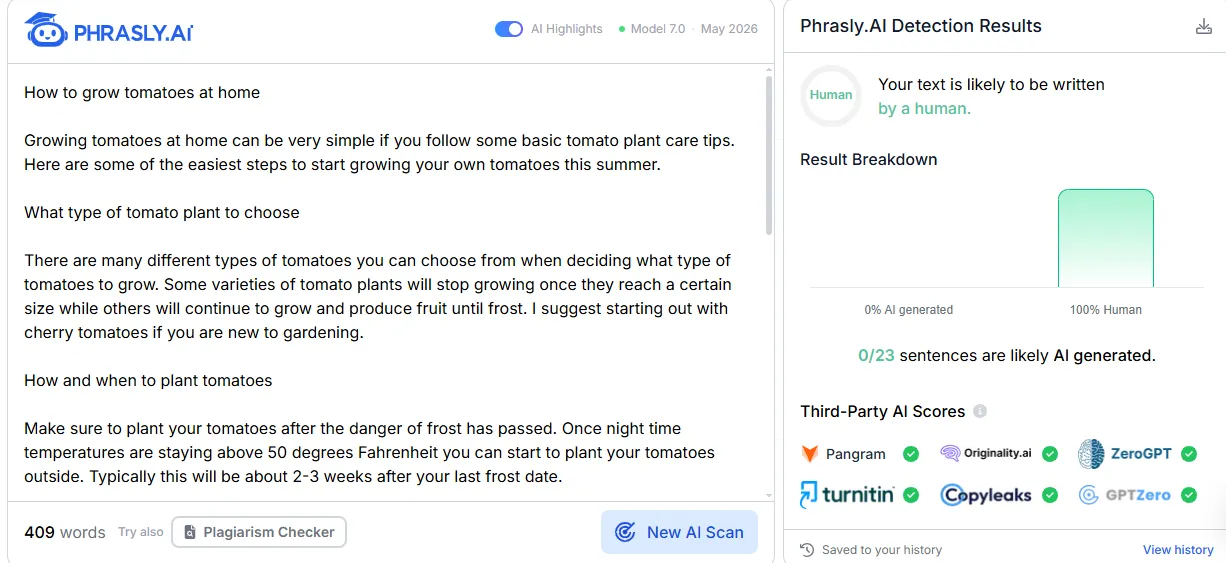
SEO/blog draft (Phrasly) | Strongest keyword retention of the two tools. Kept both target SEO phrases verbatim; temperature, timing, watering, and staking details preserved; sunlight hours and soil pH not yet audited | GPTZero: 100% human. Phrasly detector: 100% human / 0% AI; 6/6 third-party readouts passed |
Blind rewrite-quality scores and editing-effort timing were not collected in this round. They measure different things from the fact audit, so we don't estimate them here.
Did Clever Make the Writing Sound More Natural?
We can't say yet. Judging naturalness fairly needs a blind read by an editor who doesn't know which tool produced which text. And that review wasn't part of this round.
The findings below show what a fact-by-fact comparison can. Whether meaning survived, not whether the prose reads better or worse.
Here is one short before/after from the academic sample, with our notes. This is an editor's observation, not a blind score.
Original: “For the cut to occur, the target sequence must sit next to a short DNA motif called a PAM (protospacer adjacent motif), which Cas9 uses to confirm it has found a genuine, bindable target rather than a random match.”
Clever: “This target site should also have a certain number of nucleotides at the end, called PAM (protospacer adjacent motif). The enzyme recognizes this motif to make sure it has found the right place.”
What improved: The long sentence is split in to two, and “the right place” reads more plainly than “a genuine, bindable target.”
What was damaged: “Must sit next to” became “should also have… at the end,” which is less precise, and the contrast with “a random match” is gone. The sentence reads more simply but says less.
Did Clever Preserve Meaning, Facts, and Citations?
Not reliably! Across two audited samples, Clever kept every number intact in the blog draft. But reversed a fact about determinate tomatoes and dropped both target SEO phrases from its opening paragraph.
In the academic sample, it dropped a named researcher and rewrote an accurate Nobel Prize claim into a false one.
Neither output was publishable without a manual fact-check.
Where Phrasly did better: Its detector scores were the cleanest of the two tools in both samples (0% AI on Phrasly's own detector, versus 13-14% for Clever).
And on the blog sample, it was the only one of the two to preserve both target SEO keyword phrases word-for-word in its opening lines. A meaningful advantage for a sample type where those exact phrases are the point.
Its failure mode was also arguably the more honest one. Deleted content is visible as a gap an editor can spot and restore, rather than a plausible-sounding error that reads as correct.
Sample 1: Academic explainer, Clever's output: 6 of 9 pre-listed atomic facts survived intact. One (the PAM sequence description) was reworded into a vaguer, less technically precise claim.
One (Feng Zhang / Broad Institute / 2013) was dropped. The output kept the timeline claim but removed the named researcher and institution.
Most notably, Clever rewrote “the first two women to share a Nobel Prize in the sciences” into “the first women to receive a Nobel Prize in Chemistry”.
This is factually incorrect (several women, including Marie Curie, won a Chemistry Nobel solo well before 2020). This is not a style edit. It is a humanizer introducing a new factual error into an accurate original.
Sample 1: Academic explainer, Phrasly's output: Also preserved 6 of 9 facts. But by deletion rather than distortion. The PAM requirement, the full repair-pathway explanation (non-homologous end joining vs. homology-directed repair).
And the entire off-target-effects limitation paragraph was removed rather than reworded. Phrasly's output also included a generic drug name, “exagamglogene automemcelibo,” that does not match the real generic name (exagamglogene autotemcel).
And does not appear in the source text. A likely fabrication. It further added two claims with no basis in the original. (A 2016 first clinical trial and “over 1,600 clinical trials” as of 2022) that we have not verified against outside sources.
It did keep the Nobel Prize claim accurate, stating that Doudna and Charpentier were the first two women to win a Nobel Prize in science together.
Sample 2: SEO/blog draft, Clever's output: Every numeric and practical fact survived intact.
The 50°F threshold, the 2-3 week planting window, 6-8 hours of sunlight, soil pH 6.2-6.8, and 1-2 inches of water per week were all preserved exactly.
However, while the title kept “How to Grow Tomatoes at Home,” both target SEO phrases (“how to grow tomatoes at home,” “tomato plant care tips”) were dropped from the opening paragraph. And the output added three pieces of advice not present in the source.
“Consult a local expert,” a new (unverified) reason to prefer cherry tomatoes. And a new suggestion to invest in fertilizer.
It also reversed a fact. The original says determinate varieties produce fruit all at once; Clever's output says they “usually bear fruit regularly.”
It added that indeterminate varieties are “more common” and need pruning and extra care, which the source doesn't say.
Sample 2: SEO/blog draft, Phrasly's output (Phrasly Ultra, Balanced setting): Phrasly kept the exact target phrase “how to grow tomatoes at home” in the title and “tomato plant care tips” in the opening line.
Both were dropped by Clever from its opening paragraph.
It also preserved the 50°F threshold, the 2 to 3-week window, 1-2 inches of water per week, and the staking and pruning advice. Sunlight hours and soil pH were not audited. Its rewrite also shifted the voice to first person (“I suggest starting out with cherry tomatoes”).
None of the four audited outputs was publishable without manual fact-checking. Clever's failures ran toward distortion and unsourced additions. Phrasly's ran toward deletion. And, in one case, a likely fabricated detail.
How Much Manual Editing Did the Output Need?
We didn't time editing in this round. But the fact audit shows the scale of the work. Clever's academic output needed at least three meaning-level corrections.
Its blog output needed three unsourced additions removed, the reversed determinate-variety fact corrected, and both target phrases restored to the opening paragraph before it was publishable.
None of these were cosmetic edits. Each one changed meaning.
See How Much Editing Your Draft Needs
Run the same text through Phrasly's AI Humanizer, then check it line by line against your original for facts and meaning.
Did Clever Change AI Detector Scores?
Can AI detectors still detect humanized text? Yes, sometimes. Detector tools use different models, thresholds, and labels. A lower Clever detector score on one service does not guarantee the same result elsewhere.
And no score proves who wrote the text.
Sample | Version | GPTZero | Phrasly AI Detector |
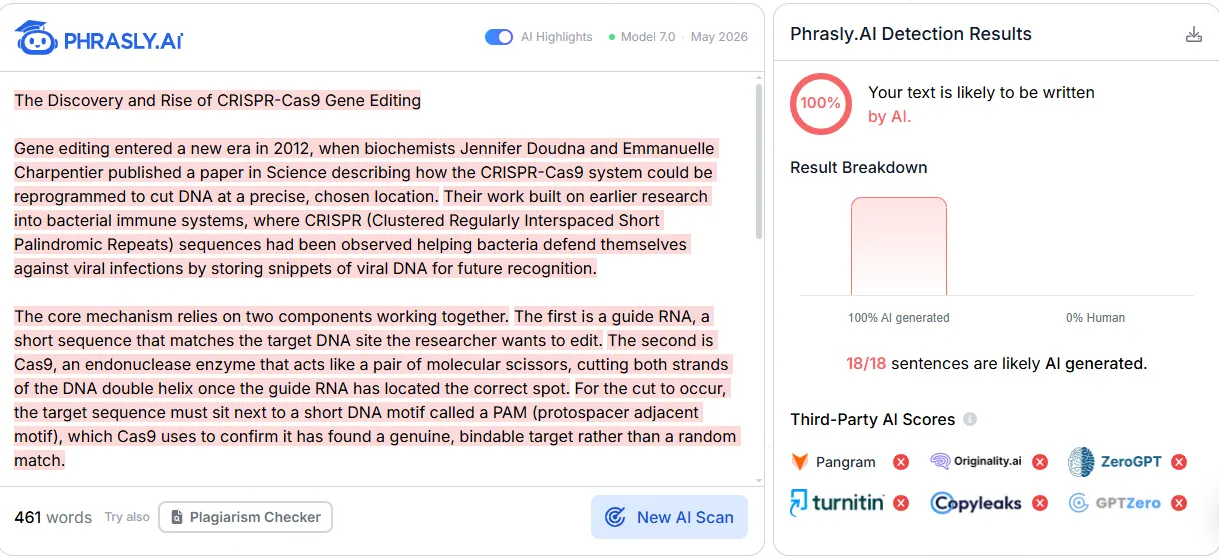
Academic explainer | Original (unedited) | Not tested | 100% AI / 0% human. 18/18 sentences flagged; 6/6 third-party model readouts shown in Phrasly's detector flagged AI |
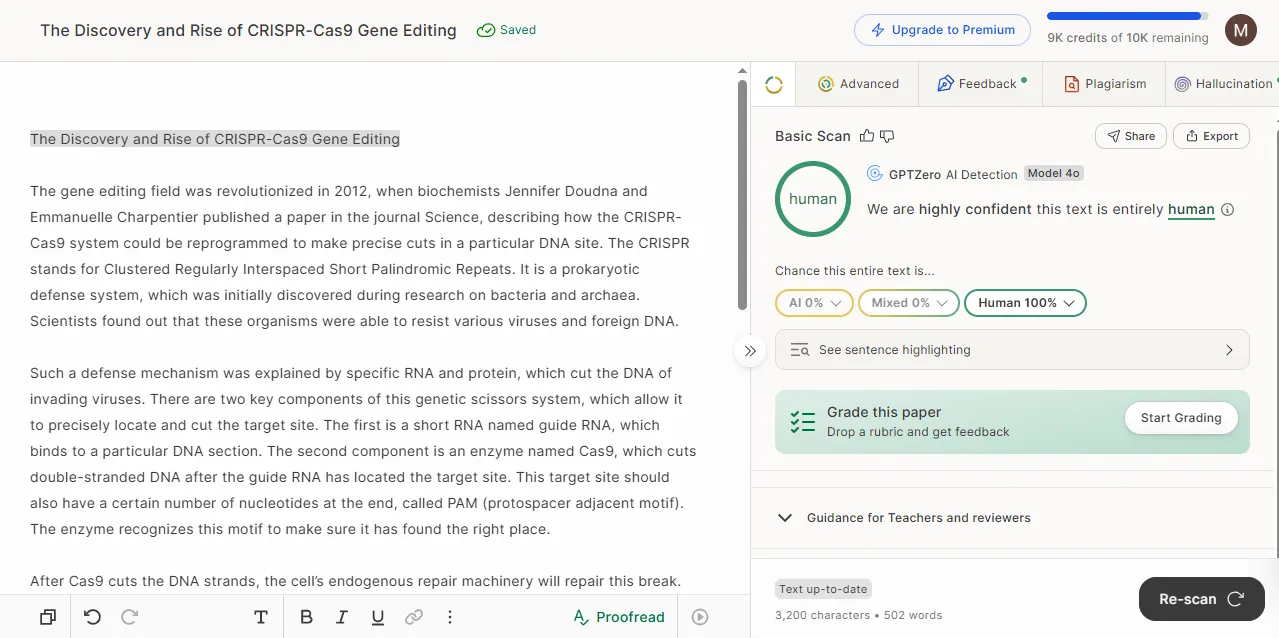
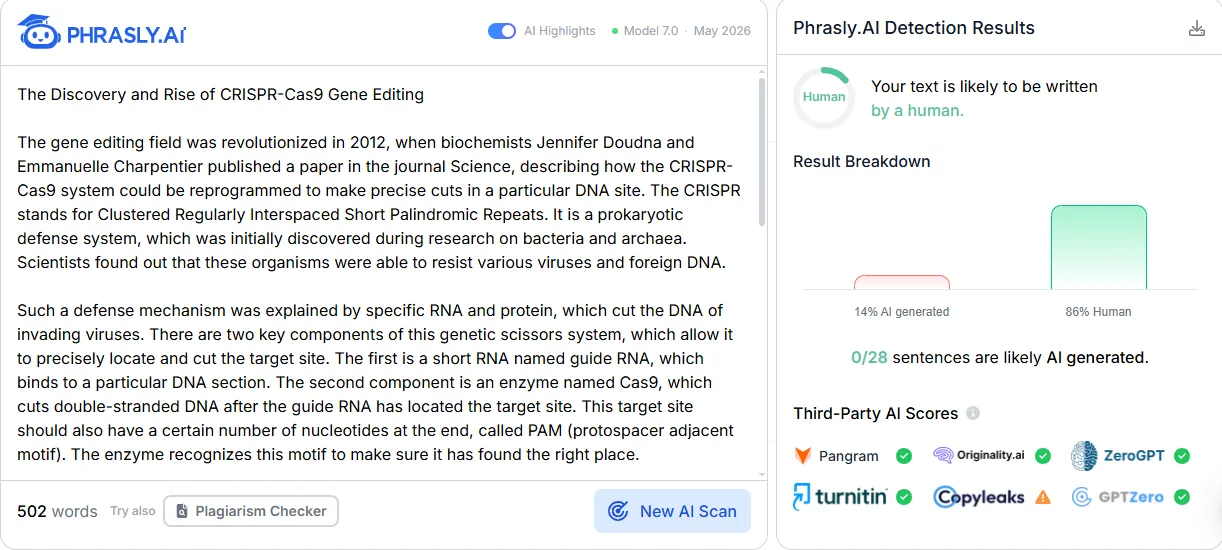
Academic explainer | Clever output (Normal) | 100% human / 0% AI (Basic Scan) | 86% human / 14% AI: 0/28 sentences flagged; 5/6 third-party readouts passed, 1 caution (Copyleaks) |
Academic explainer | Phrasly output (guest humanizer) | 100% human / 0% AI (Advanced Scan) | 100% human / 0% AI: 0/12 sentences flagged; 6/6 third-party readouts passed |
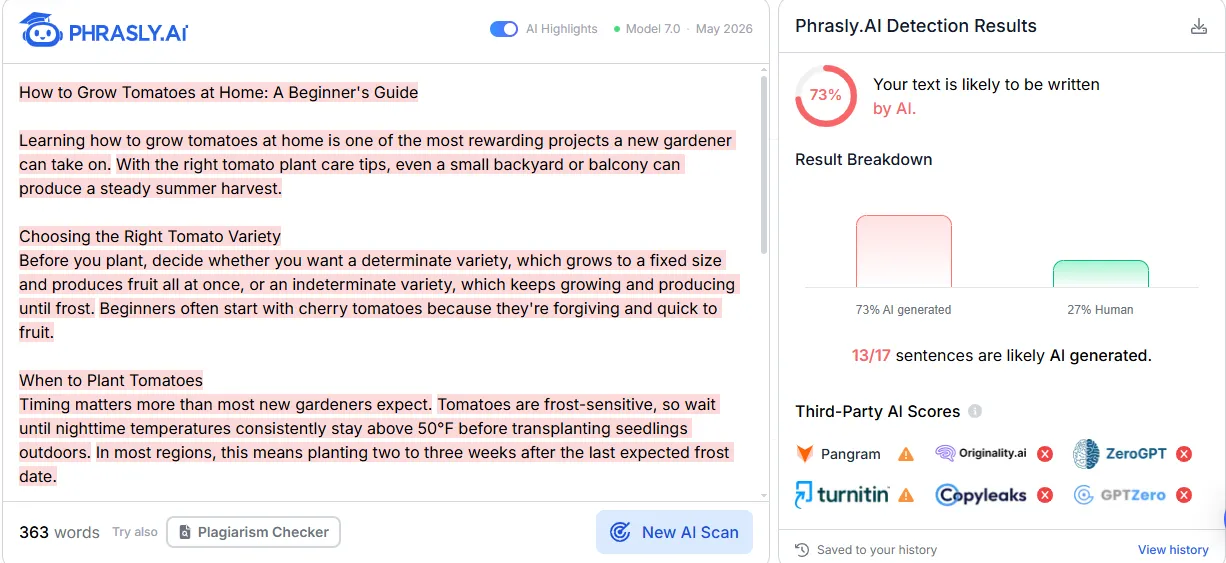
SEO/blog draft | Original (unedited) | Not tested | 73% AI / 27% human: 13/17 sentences flagged; 4/6 third-party model readouts flagged AI, 2/6 showed a caution warning |
SEO/blog draft | Clever output (Normal) | 100% human / 0% AI (Advanced Scan) | 87% human / 13% AI: 0/18 sentences flagged; 6/6 third-party readouts passed |
SEO/blog draft | Phrasly output (Ultra, Balanced) | 100% human / 0% AI (Advanced Scan) | 100% human / 0% AI: 0/23 sentences flagged; 6/6 third-party model readouts passed |
Third-party readouts are displayed inside Phrasly's detector. We did not submit any text directly to Turnitin or the other listed services.
Sample 1 (academic explainer) detector:
Sample 2 (SEO/blog draft) detector:
One pattern worth naming directly. In both tested samples, Phrasly's own detector scored Phrasly's own humanized output as cleaner. (0% AI both times) than it scored Clever's competing output (14% AI, then 13% AI).
It's worth noting this wasn't Phrasly grading its own homework in isolation. GPTZero, an independent third party, also rated Phrasly's output 100% human in both cases. So the underlying result holds up outside Phrasly's own tool.
The gap is specifically in how much residual “AI likelihood” each detector assigned. Not in the final human/AI call. The one exception was a Copyleaks caution on Clever's academic output.
Also notable: The unedited SEO/blog draft scored very differently from the unedited academic sample on the same detector. 100% AI for one, only 73% AI for the other. Despite both being AI-generated with no human editing.
This is itself evidence for the article's broader point that detector scores vary by content type as well as by tool.
Why do GPTZero, Turnitin, and other checkers disagree on the same text? Each tool trains on different data and sets its own threshold for what counts as AI-written. Disagreement between them is expected. Not a sign that one tool is broken. Treat any single score as one diagnostic signal.
Then read the text itself for quality, tone, and accuracy.
This isn't just anecdotal.
A 2026 study in the International Journal for Educational Integrity found that detectors varied in their false-positive and false-negative rates and in how confidently they labeled text.
And an earlier 2023 study in Patterns found that GPT detectors misclassified non-native English writing as AI-generated.
For a closer look at how reliable these checkers actually are, see this breakdown of AI detection accuracy and which checkers work. And if you're asking the bigger question, we tested whether AI humanizers actually work across more tools.
Is Clever AI Humanizer Safe to Use?
It depends on what you submit.
Clever's Terms of Service and Privacy Policy (version 2.1) send submitted text to external AI/LLM providers.
Do not use it to train models, and allow staff to read samples.
Version 2.1 takes effect September 30, 2026. So check which version applies on the day you use it.
Guests: The first 100 characters plus technical info are retained for 2 days.
Account holder: Submissions and outputs may be retained for 30 days, and you can delete them sooner in account settings.
Access: Text may be sampled for debugging, automated evaluation, and staff quality review.
Ownership: CleverFiles claims no ownership of your input or output. It notes AI-modified text may not be protected by copyright in some countries.
Eligibility: The service is stated as 18+ only, and acceptable-use terms prohibit submitting altered text in breach of an institution's disclosure or academic-integrity rules.
Future-dated policy: If you read this before September 30, 2026, the displayed v2.1 may not yet govern your submissions.
Clever says text submitted before that date is not used for debugging, evaluation, or staff review.
The practical takeaway: Do not paste confidential, regulated, or client material into Clever, or into any public AI tool. Until you have personally read and approved its current privacy terms.
Clever AI Humanizer Vs Phrasly
How does Clever compare with Phrasly? Both offer a free built-in detector. And a no-signup path. But they differ on per-request limits, language coverage, and, based on the test above, on editing effort.
Based on the two tested samples, Phrasly compressed the academic sample (461 to 247 words) but expanded the blog sample (363 to 409 words), while scoring lower on detectors.
Clever stayed closer to the original length on the academic sample (461 to 502 words) but expanded the blog sample to 435 words. But introduced factual errors in both samples and several unsourced additions.
If you want a broader look at how other tools stack up, check out this roundup of the best AI humanizer tools before deciding which one fits your workflow.
For a full look at our own tool, including its weak spots, read the Phrasly AI review.
Criterion | Clever | Phrasly (Sep 27, 2026) |
Cost | $0 (official page, Sep 2026) | Free trial: 3 guest humanizations, no sign-up. $2.00 for 3-Day Access. Unlimited plan $10.99/month, billed annually |
Words / request | 3,000 (research date) | Guest: 15-500 words. 3-Day Access: 800 words. Unlimited: 5, 000 words |
Humanization controls | Normal; Clear & Structured | Intensity slider (Balanced used in testing) plus the Phrasly Ultra model |
Languages | English, Spanish, Portuguese | 20+ advertised, including English, Spanish, French, German, Italian, Portuguese, Chinese, Hindi, Arabic, Russian, Japanese, Korean, Dutch, and Polish |
Built-in detector | Yes | Yes (free and unlimited, per Phrasly) |
Data handling | Policy v2.1, effective Sep 30, 2026 | Phrasly says its in-house models mean no third-party AI touches your text; privacy policy last updated June 29, 2023 |
Test performance (2 samples) | Normal mode. Detector scores: 100% human (GPTZero) both times; Phrasly's own detector: 14% AI, then 13% AI. Meaning: 2 factual errors introduced (1 per sample), 1 fact dropped, several unsourced additions, but strong on preserving exact numeric details | Sample 1: guest humanizer; Sample 2: Ultra, Balanced. Detector scores: 100% human (GPTZero and Phrasly's own detector) both times. Meaning: 3 facts dropped and 1 likely fabricated detail in Sample 1; stronger at keeping target SEO phrases in Sample 2 |
Pricing is accurate as of the date this article was written and is subject to change. Confirm the current price on the tool's official pricing page before purchasing.
Compare Both Tools on Your Own Text
If Clever's output still needs heavy correction, run the same sample through Phrasly's AI Humanizer and compare meaning, flow, and editing time side by side.
Who Should Use Clever, and Who Should Choose Something Else?
Use Clever if you need a free, quick first pass on non-sensitive text and will check every change. Choose something else if you need publish-ready copy, work with confidential material, or need more than three languages or 3,000 words per run.
Reader situation | Recommendation |
Free, quick first-pass rewrite of non-sensitive text | Try Clever, then review every change |
Consistent brand voice / publish-ready copy | Test both on your own text and compare voice and editing time; we didn't score these |
Confidential, regulated, or client material | Do not paste into any public tool until its privacy terms are approved |
Long multilingual workflow | Compare verified language support, per-run limits, and availability first |
Student under an AI policy | Follow the institution's rules and disclosure; a humanizer is not permission |
Wants proof a person wrote the text | No humanizer and no detector can provide that proof |
If Clever or Phrasly don't quite fit what you need, it's worth comparing a few other options.
See GPTHuman AI Humanizer as another tool in this space.
Final Verdict: Is Clever Worth Using in 2026?
Clever is worth using in 2026 if you want a free, no-sign-up first pass on non-sensitive text and will fact-check the result. Its biggest limitation in our test was accuracy.
It kept every number in our blog sample but rewrote a true Nobel Prize claim into a false one and reversed a basic fact about tomato varieties. And added unsourced advice.
The free price offsets that for low-stakes drafts, but not for confidential, academic, or publish-ready work.
Where capacity limits and staff review of submitted text also matter. Phrasly drew lower AI scores in our samples but cut technical content.
Neither tool removes the need for review. Features, limits, and policies change. So recheck the official pages before relying on them.
Frequently Asked Questions
Is Clever AI Humanizer Completely Free?
Yes! Clever AI Humanizer costs $0. Allows up to 3,000 words per request. And advertises no fixed monthly allowance as of September 2026. Availability can still be limited during high-traffic periods.
Re-check the official page before relying on it for a deadline.
Pricing is accurate as of the date this article was written and is subject to change. Confirm the current price on the tool's official pricing page before purchasing.
What Is the Clever AI Humanizer word limit?
This per-request limit was recently lowered to 3,000 words. (Confirmed on the page in September 2026.) Reviews stating higher limits of 7,000 words or six figures per month are referring to the service as it was in the past.
Does Clever AI Humanizer Store Your Text?
Yes, for a limited time. Under Clever's policy version 2.1, effective September 30, 2026, guest sessions keep only the first 100 characters. Plus, technical data for two days.
Account submissions and outputs are kept for 30 days unless you delete them sooner. Staff may read samples. Avoid submitting confidential text.
Does Clever Preserve the Original Meaning?
Not reliably, based on the two samples tested. On an academic sample, Clever kept most facts. But rewrote an accurate claim (about the 2020 Nobel Prize in Chemistry) into a false one. And dropped a named researcher and institution.
On a blog-style sample, it preserved every numeric fact (temperatures, timing, pH, watering amounts).
But reversed a fact about determinate tomato varieties, added three pieces of advice not present in the original, and dropped the target SEO phrases from its opening paragraph.
In short: check numbers and named facts against the source yourself. Don't assume a rewrite that reads smoothly is also accurate.
Can AI Detectors Still Flag Humanized Text?
Yes, this is possible. Detector tools disagree with each other. Produce false positives and change behavior after model updates. No humanizer or detector can guarantee a specific outcome. Treat any score as one signal among several.
If you're wondering what detector score is actually reasonable to aim for, we go deeper into that question in how much AI detection is acceptable.
Is Clever better than Manual Rewriting?
It depends on the stakes. The required voice and how much editing time you have. For low-stakes, non-sensitive drafts, Clever can save time as a first pass.
For high-stakes or highly technical text, a careful manual edit still catches more than an automated rewrite.

Written by
Muhammad Usman Ali
Pakistan
Muhammad Usman Ali is an experienced SEO content writer with 3+ years of professional writing experience. He specializes in AI tools, AI detection technologies, and search engine optimized content.