
Does Chegg Have an AI Detector? What Students Need to Know
Chegg includes basic AI detection in its plagiarism checker, but it's inconsistent and hard to interpret. It wasn't built for this purpose. Before submitting, use a dedicated AI detector for a clear, reliable score.
With AI writing tools becoming part of everyday student life, it is a fair question and the answer matters.
The short answer is: Chegg's writing tools include basic AI detection as part of its plagiarism checker. It does not offer a dedicated, purpose-built Chegg AI detector.
This article breaks down what Chegg's system actually checks, how reliable it is, and what students genuinely need to know before submitting any work.
Does Chegg Have an AI Detector?
Chegg writing suite does have some AI detection built into its plagiarism checker. However, Chegg does not have a dedicated, standalone AI detector Chegg tool.
When you submit text through Chegg Writing, it's scanned for similarity score with online web sources. During this scan, the tool also looks for patterns that it believes are associated with AI-generated content.
But keep in mind, this is not its own standalone detection engine. It's built into the tool and has limitations.
What Chegg's AI Detection Actually Does?
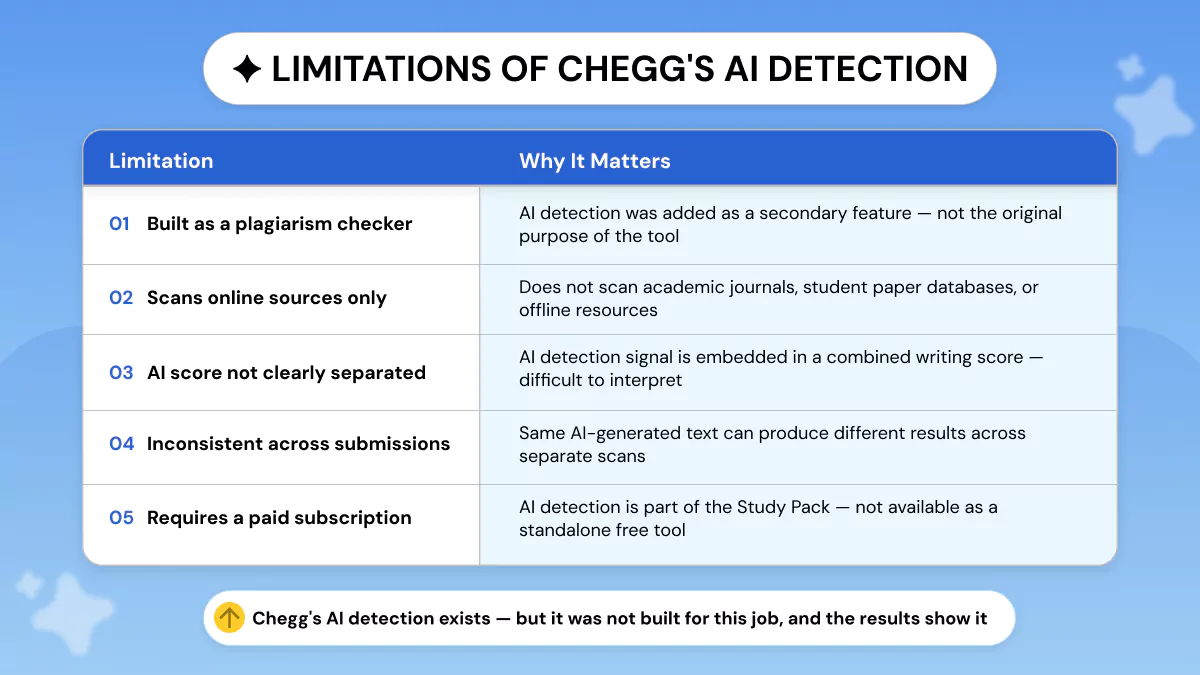
This confirms that such a feature is implemented. However, it also exposes how primitive it is: it gives no distinct AI detection score. Its workings are based on a general writing quality assessment, making results difficult to interpret clearly.
Third-party tests found that Chegg's AI Detection resulted in a plagiarism similarity match of approximately 4% on an entirely AI-written sample. This same work was given an 81/100 grammar score by Chegg.
Buried in this output was the AI detection signal. Students would have no idea if their output was going to be flagged as AI-written.
How Does Chegg's AI Detection Work?
Understanding how Chegg's system operates helps clarify both its value and its limitations for student submission review.
The Chegg AI checker is not a single, isolated tool. It is part of a multi-function writing scanner that checks grammar, originality, and writing quality simultaneously.
What Does It Scan?
Chegg's plagiarism checker analyzes your text against publicly available webpages found online. Basically, if you copy/paste from websites, articles, and open-source content, Chegg will catch it.
Chegg will not check against previously submitted student papers or papers in offline databases such as scholarly journals. This is different from plagiarism checkers like Turnitin, which have a database of previously submitted student papers.
What Do the Scores Mean?
Chegg offers a similarity score (percentage of text that matches other online sources) as well as a grammar and writing quality score.
The AI detection feature is reported not as its own score. Since it's built into their overall results, it's virtually impossible to tell as a student if your content could be flagged as AI written.
The Consistency Problem
This is the core limitation when asking how accurate is Chegg's AI detection compared to tools built specifically for this purpose.
Chegg’s scores varied wildly from submission to submission (different reviewers testing the same AI-generated text independently of one another). The same AI-written text could produce different similarity scores across tests.
If you're wondering, do colleges check for AI, the short answer is yes, and most of them are already doing it automatically, without telling you.
You cannot rely on Chegg as your main AI detector when you, as a student, need to know for sure if your work is good before submitting. The stakes are higher than most students think.
Why the Inconsistency Matters for Students?
When it comes to scanning your own work for purposes of verification before submission, the inconsistent detector poses an actual problem.
If Chegg's plagiarism checker AI can flag the same content differently when scanned twice, you cannot trust one scan pass to confirm that your work will be safe. This isn't a problem unique to Chegg.
The broader issue is that no detector is immune. Turnitin false positives show that even purpose-built tools misfire on genuine human writing.
A specialized AI detector built specifically to detect AI-generated content provides output that is far more consistent and predictable.
Chegg Plagiarism Checker Vs Dedicated AI Detectors
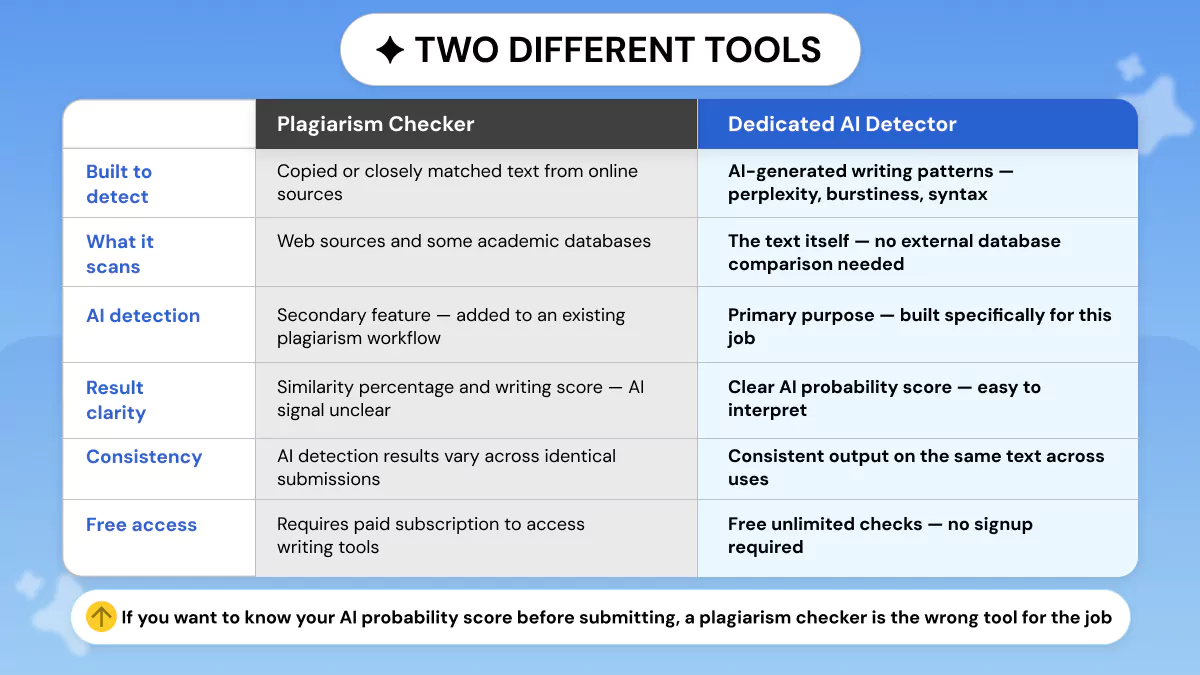
Chegg's tool was designed primarily to catch copied text. AI detection was added later as a secondary feature. It was not the foundation on which the system was built.
An AI-specific detector is built specifically to recognize characteristics unique to AI-generated text. That same rigor is what academic institutions now expect.
Law school AI detection, for instance, runs on enterprise-grade tools that Chegg's writing scanner was never built to replicate.
An AI-specific detector is built specifically to recognize characteristics unique to AI-generated text: cadence of sentences, word frequency, likelihood of word usage, and repetitiveness of structure.
This concentrated approach is the key to generating scores that are both precise and useful. The comparison table below illustrates the key differences:
If you're trying to check if your content will be flagged as AI content prior to submission, Chegg writing tools are not the right fit for that task. They were not designed for that purpose.
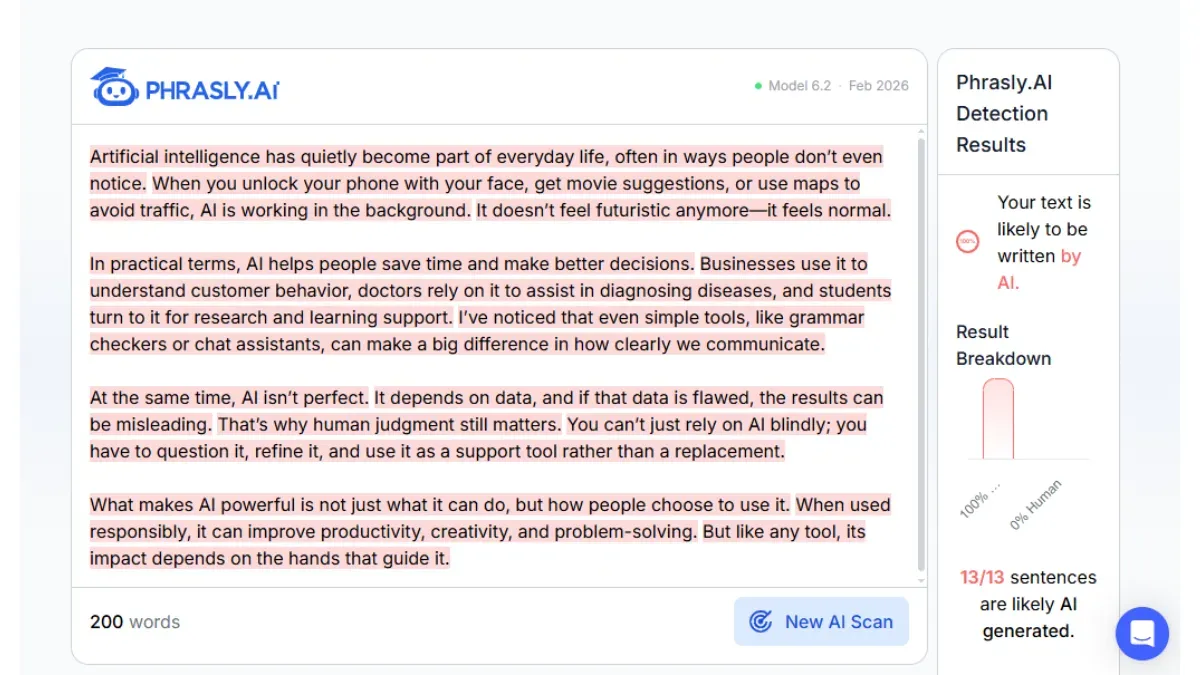
Want to Know Your AI Score Before Submitting? Use Phrasly AI Detector
Phrasly AI Detector is free, unlimited, and gives you a clear AI probability score in seconds. No subscription required.
Is Chegg Affected by AI?
Yes! AI writing tools have hit Chegg's core business model hard. Students who used to pay Chegg for homework help can now ask AI chatbots the same questions and receive answers instantly for free.
Chegg announced a significant decrease in subscribers in 2023, citing the adoption of ChatGPT as one of the causes. Its stock price fell dramatically after it made this announcement.
In response, Chegg has moved to integrate its own AI-powered features, including the AI detection component, into its writing tools. Chegg's AI detection feature was not developed as a proactive, purpose-built solution.
The tool was added as a direct result of needing to adjust the platform after AI-created content started posing issues for academic integrity. For students, that means this tool was a retrofit, not a primary engineering priority.
FAQs
Does Chegg have an AI detector?
Chegg has basic AI detection built into its plagiarism checker (which comes with the Chegg Study Pack), but it's not a standalone, purpose-built AI detector.
The AI detection signal is incorporated into an overall similarity score, making it hard to interpret on its own.
Does Chegg check for AI?
Yes, to a limited extent. Chegg's system does check for AI-generated content patterns, but this check is inconsistent.
Third-party tests show that the same AI-written text can produce different results across separate submissions. It is unreliable as a standalone verification tool.
Is Chegg's AI detector accurate?
No, not reliably! Multiple third-party evaluations have shown that Chegg's AI detection yields arbitrary scores. Chegg's tool was not designed specifically for AI detection.
Moreover, the degree to which Chegg's score reflects true AI detection, as opposed to broader similarity analysis, remains a question mark.
You want a tool with as little noise as possible for true AI probability checking, so a purpose-built AI detector will provide a much cleaner signal.
Can Chegg be detected by Turnitin?
Turnitin scans student papers for plagiarism and AI-generated content. It does not scan Chegg activity directly.
Nonetheless, if a student were to submit work that very closely resembles answers posted on Chegg’s website, Turnitin’s similarity check would likely detect matching content if Chegg has indexed those sources.
Can teachers tell if you use Chegg?
Possibly! If several students in your class turn in nearly the same answers from Chegg, the instructor may notice the pattern. Many campuses utilize tools to compare student submissions with those found on frequently used homework help platforms.
Academic integrity policies vary. Always check your institution's guidelines.
What is the best free AI detector for students?
Phrasly's AI Detector is free, doesn't require any sign-up, and instantly returns an easy-to-understand AI Probability score. If you're evaluating other options, it's worth understanding Copyleaks accuracy before relying on it.
Rather than using Chegg's built-in detection, Phrasly was built from the ground up to detect if your content could be flagged as AI, empowering students with accurate feedback before it's too late.
Chegg's plagiarism checker includes a basic form of AI detection, but it is not a dedicated AI detector. Its results are inconsistent enough that you cannot rely on it to tell you whether your work would be flagged as AI-generated content on submission.
Chegg was built for homework help. Its writing tools reflect that priority. AI detection is an add-on, not the core of the product.
When you need to know your true AI detection score ahead of time, and an easily understandable score that clearly communicates your likelihood of being AI you need a specialized tool.


Keep reading


The Content Strategist's Workflow for AI-Assisted Production
A sound AI content workflow puts humans at the brief and expertise stages, letting AI handle outlining and drafting, then routes every piece through fact-checking, plagiarism, and AI-flatness QA gates before it can be published.

AI vs Human Cold Email Reply Rates: What 150M+ Emails Across 8 Studies Actually Show (2026)
AI cold emails get 1% fewer replies but 3x more spam flags. We compared 8 studies covering 150M+ emails, including peer-reviewed research, to show what actually works in 2026 and the fix that closes the gap.