WriteHuman Review (2026): We Tested It Against Pangram
13 min read
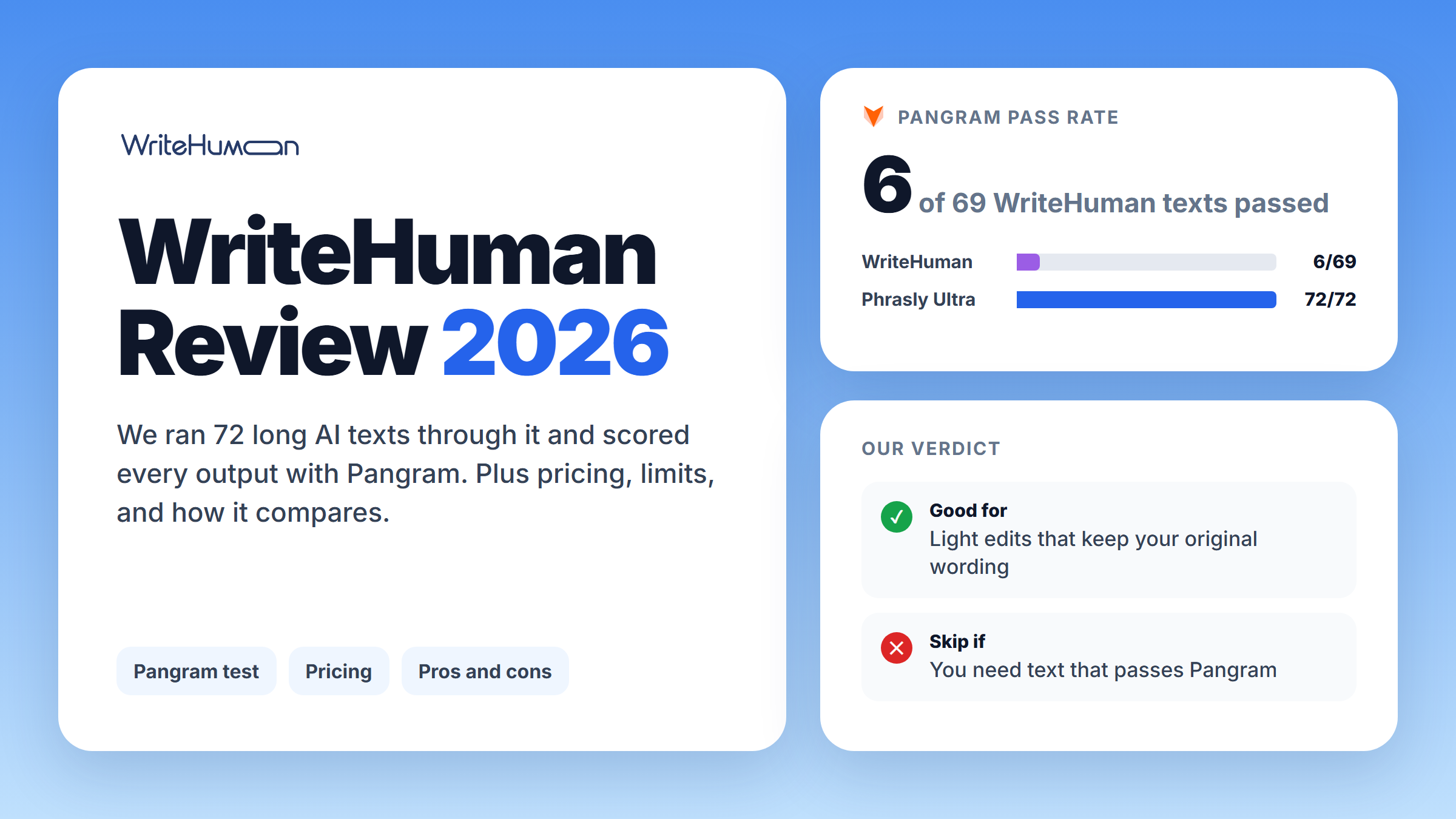
Is WriteHuman good? WriteHuman is a clean, easy AI humanizer that keeps your text close to the original. That is also why it struggles with modern AI detectors. We ran WriteHuman's latest model on 72 long AI-written texts, and Pangram rated only 6 of its 69 outputs as human. It scored 44 of them 0% human.
WriteHuman bills itself as the #1 AI humanizer, advertises a 94% human score on Pangram, and promises to keep your meaning intact. We tested all three claims. None held up: Pangram caught most of its rewrites, the rewrites averaged 2.64 factual changes each, and the #1 ranking comes from a leaderboard WriteHuman runs itself. WriteHuman also refused 3 of our texts outright, including a chapter of a fantasy novel.
This review covers what WriteHuman does, what it costs, how it scored on Pangram, why light edits like WriteHuman's don't survive modern detectors, and how it compares with Phrasly.
Disclosure: Phrasly publishes this review and sells a competing AI humanizer, Phrasly Ultra. We ran our benchmark on September 15, 2026, and every score is downloadable from our benchmarks page. Output texts are withheld for every tool, ours included, to keep them out of AI detector training data. Researchers, journalists and the providers we tested can request them.
Test your own text before you pay for any humanizer.
Paste a paragraph and see how Phrasly rewrites it. Guest runs, no signup.
WriteHuman Review: The Quick Verdict
At a glance | WriteHuman (writehuman.ai), checked October 5, 2026 |
|---|---|
✅ Best for | Light polishing of short AI drafts when you want your wording mostly unchanged |
❌ Skip if | You need text that holds up against Pangram, or you write fiction |
Pangram, our test | 6 of 69 outputs passed (13.3% average human score); 44 scored 0% human |
Hallucinations, our test | 2.64 unsupported factual changes per output (Phrasly Ultra: 0.85) |
Refused texts, our test | 3 of 72 harmless texts, including a fantasy story |
Free plan | 3 requests a month, up to 250 words each |
Paid plans | $20, $29 or $59 a month; $12, $19 or $39 a month billed yearly |
Words per request | 600 (Basic), 1,200 (Pro), 3,000 (Ultra) |
Refunds | None, unless the law requires one |
⚠️ Know this | Its #1 badge comes from a leaderboard WriteHuman runs itself |
Prices are as listed on October 5, 2026 and can change. Check the WriteHuman pricing page before you buy.
What Is WriteHuman?
WriteHuman is a browser-based AI humanizer. You paste AI-generated text, pick a mode, and it returns a rewrite meant to read as human. The free plan uses the Standard model; paid plans add the Enhanced model, WriteHuman's latest. It's made by Write Human LLC, a Virginia company led by founder and CEO Ivan Jackson. Its LinkedIn page lists 2023 as its founding year.
Beyond the humanizer, WriteHuman includes an AI detector, an AI image detector, a word counter, a Chrome extension, mobile apps, an API and an MCP connection for AI agents. Paid plans return two to five output variations per request.
Its homepage bills it as the most powerful AI humanizer available. A banner announces an Enhanced model update for GPTZero and Pangram, a badge claims it's the #1 humanizer, and a panel of human scores by detector lists 94% for Pangram, with no date, method or sample size.
How We Tested WriteHuman
We tested WriteHuman in our September 2026 humanizer benchmark, alongside Phrasly Ultra, StealthGPT and Undetectable AI. Every tool got the same 72 texts, one pass each, on a paid plan, and every output was scored the same way.
How we tested | Details |
|---|---|
Inputs | 72 long AI-generated English texts, 604 to 900 words each (761 on average), sampled at random from "ai"-labeled texts in the AI Text Detection Pile (MIT license) |
WriteHuman version | WriteHuman's latest model (Enhanced), on a paid plan |
Other tools | Phrasly Ultra, StealthGPT (Super model) and Undetectable AI, one output per tool per text |
Detector | Pangram's AI detection API, model pangram-4, recording the share of each text Pangram classifies as human |
Pass line | A Pangram human score of 50% or more |
Accuracy check | Every output checked against its input for unsupported factual additions or changes (hallucinations) |
Date | September 15, 2026 |
Refusals | WriteHuman refused 3 of the 72 texts, so its scores cover 69 outputs |
Why Pangram? It's the detector humanizer companies now name in their own marketing, WriteHuman included. It was also built with humanizers in mind: Pangram's DAMAGE paper describes training a detector to stay accurate on humanized text. A humanizer that gets past Pangram isn't just slipping past a weak checker. Our Pangram review covers the detector itself.
Does WriteHuman Bypass Pangram?
Rarely. Pangram rated 6 of WriteHuman's 69 outputs as human (50% or more). Its average human score was 13.3%. Forty-four outputs scored exactly 0% human, and only one was rated fully human. That's a long way from the 94% Pangram score on WriteHuman's homepage.
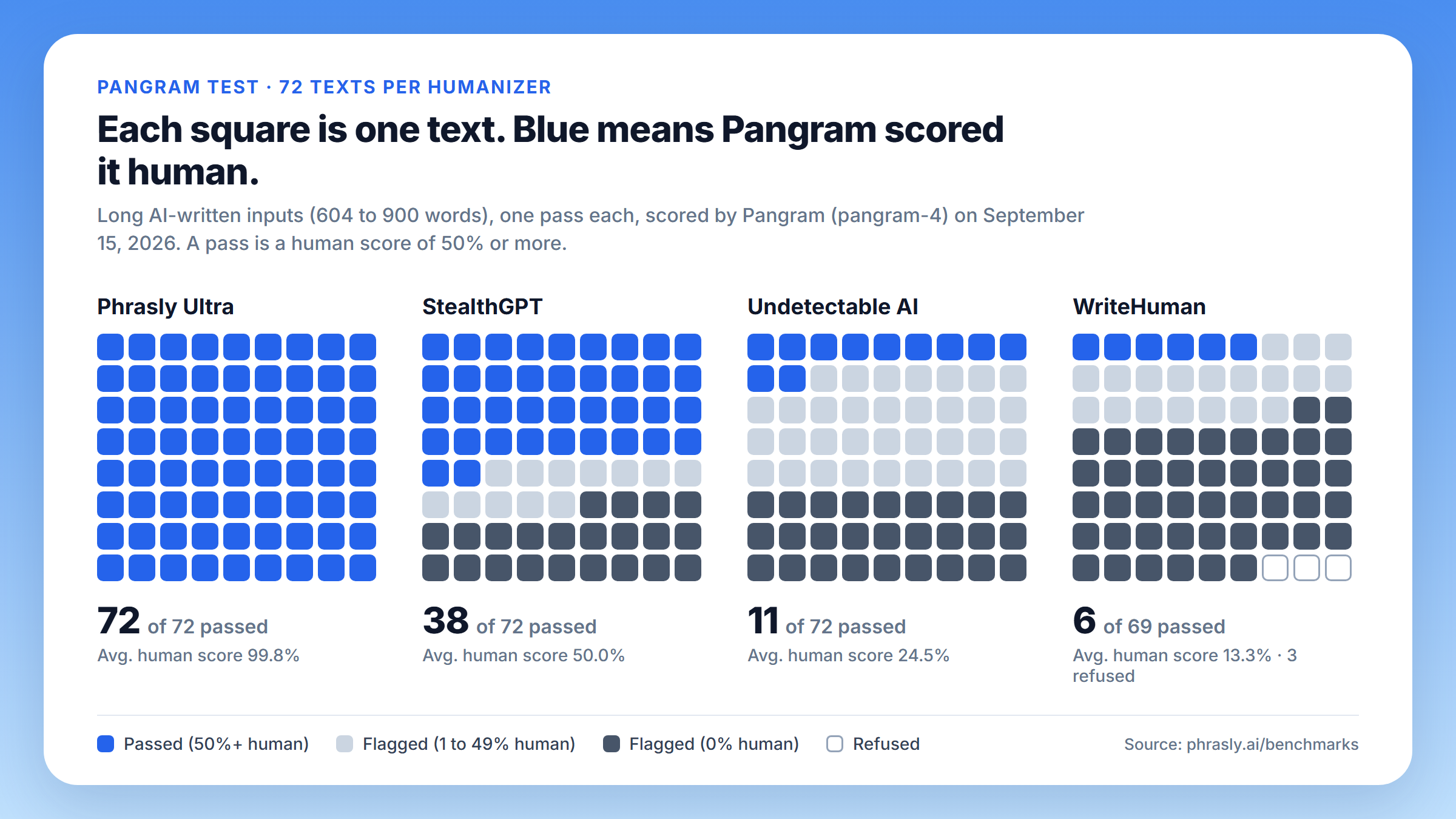
Humanizer | Avg. Pangram human score | Passed (50%+ human) | Rated 100% human | Rated 0% human |
|---|---|---|---|---|
Phrasly Ultra | 99.8% | 72 of 72 | 70 of 72 | 0 of 72 |
StealthGPT | 50.0% | 38 of 72 | 19 of 72 | 22 of 72 |
Undetectable AI | 24.5% | 11 of 72 | 3 of 72 | 27 of 72 |
WriteHuman | 13.3% | 6 of 69 | 1 of 69 | 44 of 69 |
Why WriteHuman Fails Pangram: It Keeps Too Much of the AI Original
This is the part that matters if you're choosing a humanizer. Pangram doesn't flag text for typos or clunky phrasing. It's trained on AI-generated text, including text that has been run through humanizers. Swap some words but leave the AI's sentences standing, and what Pangram learned to recognize is still there.
So we measured how much of each AI original survived each humanizer. For every output, we counted the share of its four-word phrases that appear word for word in the input.
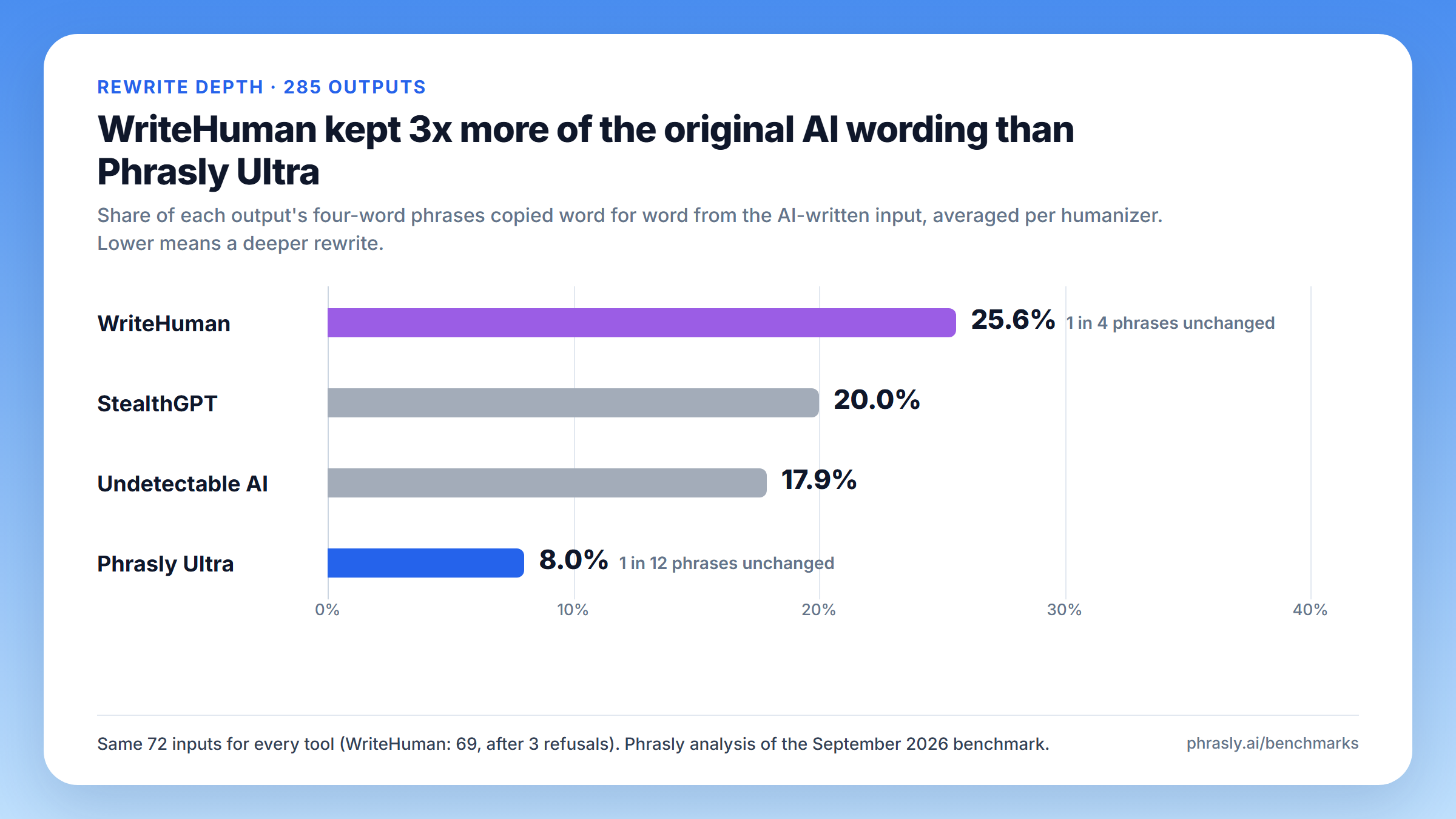
WriteHuman kept 25.6% of the original four-word phrases, the most of the four tools. Phrasly Ultra kept 8.0%.
About one in three WriteHuman sentences (33%) still tracked an original sentence, keeping at least 60% of its words in the same order. For Phrasly Ultra, it was 7%, about one in fourteen.
Then we checked whether rewrite depth predicts the Pangram result across all 285 outputs. It does.
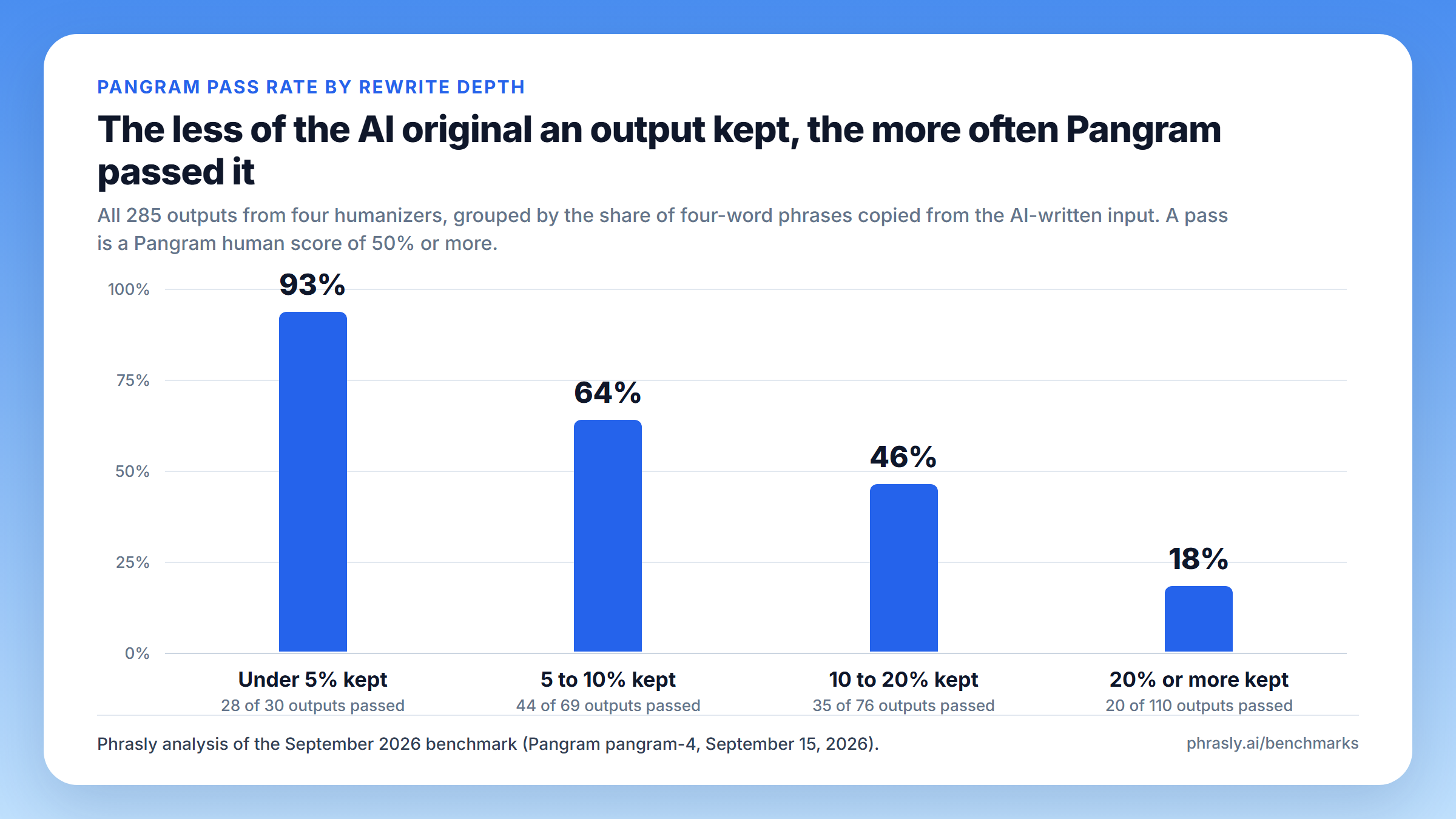
Outputs that kept under 5% of the original phrases passed 93% of the time. Outputs that kept 20% or more passed 18% of the time. (The Spearman correlation between phrases kept and Pangram human score is -0.58.) The pattern holds inside a single tool too: the StealthGPT outputs that passed Pangram kept 15.7% of the original phrases on average, and the ones that failed kept 24.8%.
The takeaway: to get past Pangram reliably, a humanizer has to actually rewrite the text, with new sentences, new structure and new phrasing. Light edits that keep the AI's skeleton don't survive. That's the difference between an AI humanizer and a paraphraser, and it's the gap between WriteHuman and Phrasly Ultra.
Does WriteHuman Keep Your Meaning Intact?
WriteHuman promises to keep your voice, tone and meaning intact. Our test says otherwise. We checked every output for hallucinations, meaning unsupported factual additions or changes compared with the input.
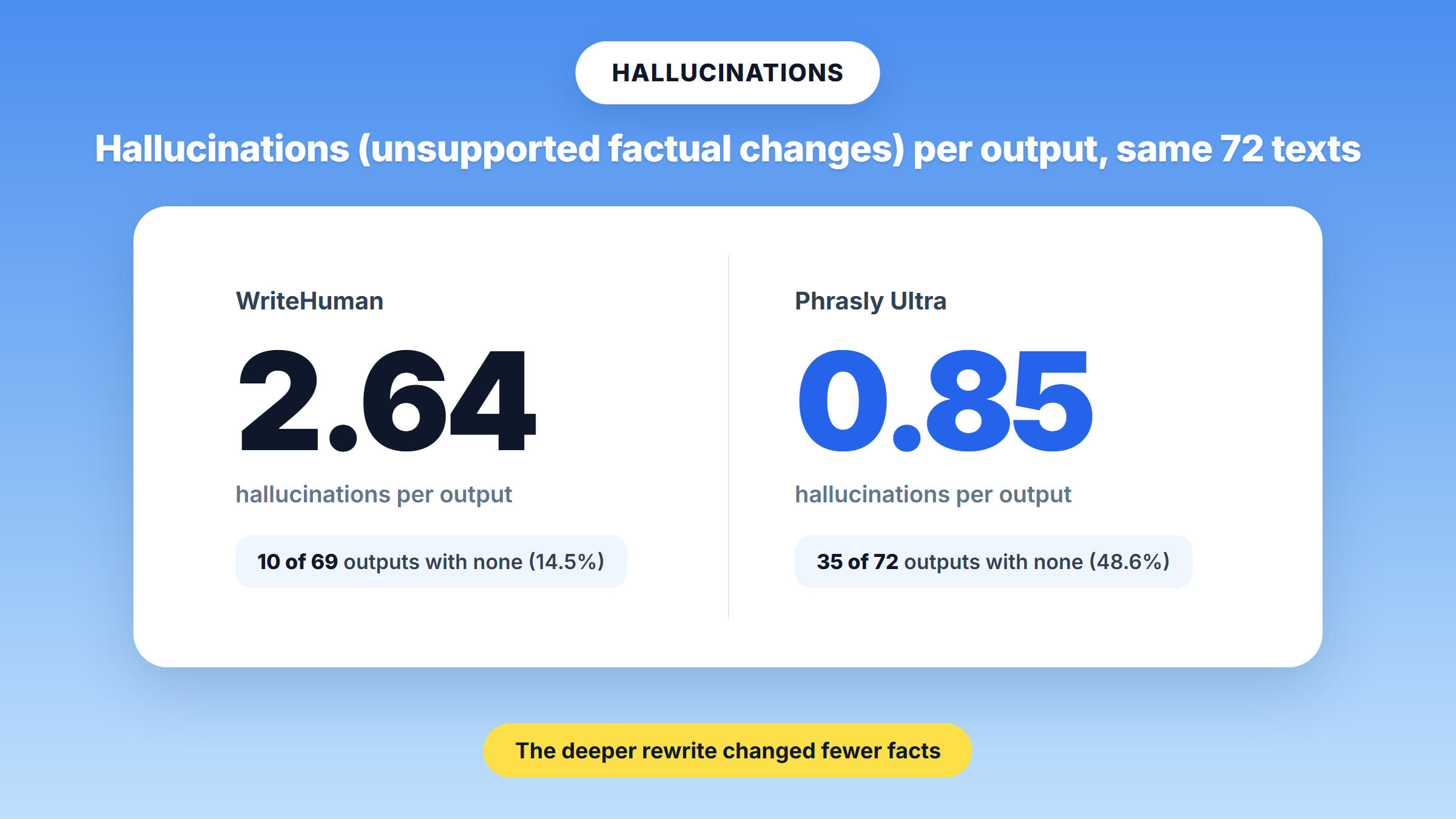
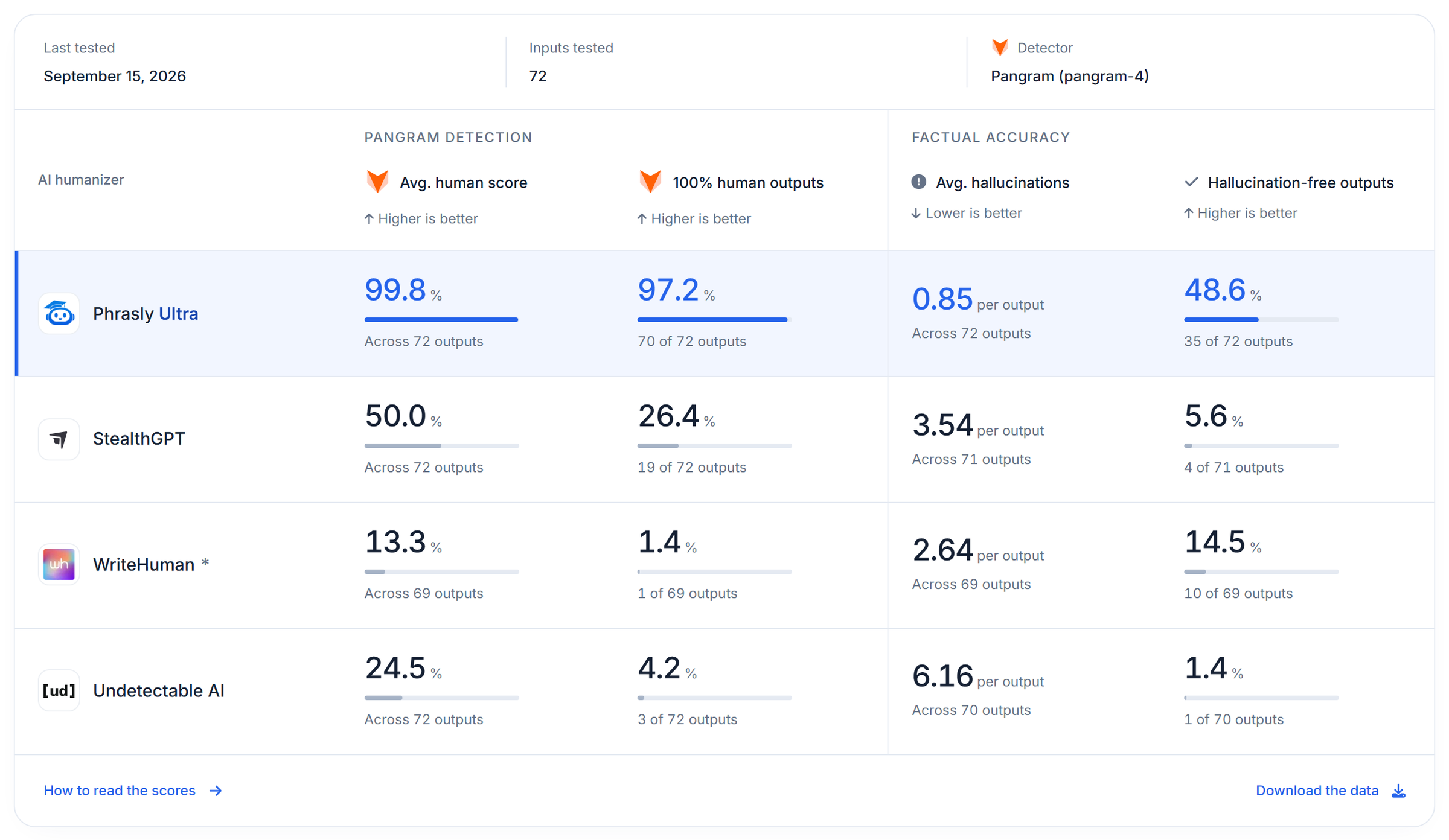
WriteHuman averaged 2.64 hallucinations per output, and only 10 of its 69 outputs had none. Phrasly Ultra averaged 0.85, with 35 of 72 hallucination-free. The tool that changed the most words changed the fewest facts.
That's worth remembering whenever a humanizer sells "meaning preservation". Keeping the facts and claims intact is what matters. Keeping the same words doesn't protect your meaning, and as the Pangram results show, it doesn't protect you from detectors either.
WriteHuman Refused 3 of Our Texts, Including Fiction
WriteHuman returned nothing for 3 of our 72 texts. None of them contained anything illegal or harmful:
A chapter of a fantasy novel, in which a character mentions a past killing
A news-style live blog about the conflict in the West Bank
A news-style report on rocket fire between Israel and Hezbollah
All three were ordinary AI-written texts from the same public dataset as the other 69, and every other humanizer in our test processed them. The pattern points to an overcautious content filter that blocks harmless text, a false-positive rate of 3 in 72 on our set.
That's a real problem if you write fiction. Stories need conflict, and plenty of good ones include violence. If WriteHuman's filter refuses a fantasy chapter, it may refuse your novel, screenplay or short story too. The same goes for students and writers covering history, war or current events. Test a sample of your own work on the free plan before you pay, because refunds aren't available.
What Other Testers Found
Published third-party tests of WriteHuman are small. The largest one points the same way as ours: WriteHuman holds up on short text and struggles on longer pieces.
WebSEOTrends ran 53 tests on the Enhanced model (review updated September 20, 2026). WriteHuman passed GPTZero 82% of the time, Writer.com 87%, Copyleaks 51%, ZeroGPT 48% and Originality.ai 19%. Short pieces under 500 words passed reliably; longer ones did not.
Originality.ai, an AI detector company, tested one sample: its own detector still flagged the WriteHuman output as AI with full confidence.
Blogger Anangsha Alammyan tested one article in July 2026 and got a 100% human score on Pangram, the best of the four humanizers in her test.
Our texts ran 604 to 900 words, the length range where WebSEOTrends found WriteHuman weakest.
Is WriteHuman Really the #1 AI Humanizer?
WriteHuman's homepage, menu badge and footer all call it the #1 AI humanizer. That ranking comes from HumanizerBench, a monthly leaderboard WriteHuman runs itself. WriteHuman's own July 2026 rankings post admits it: asked whether the benchmark is independent, its FAQ answers, "No, and we do not describe it that way."
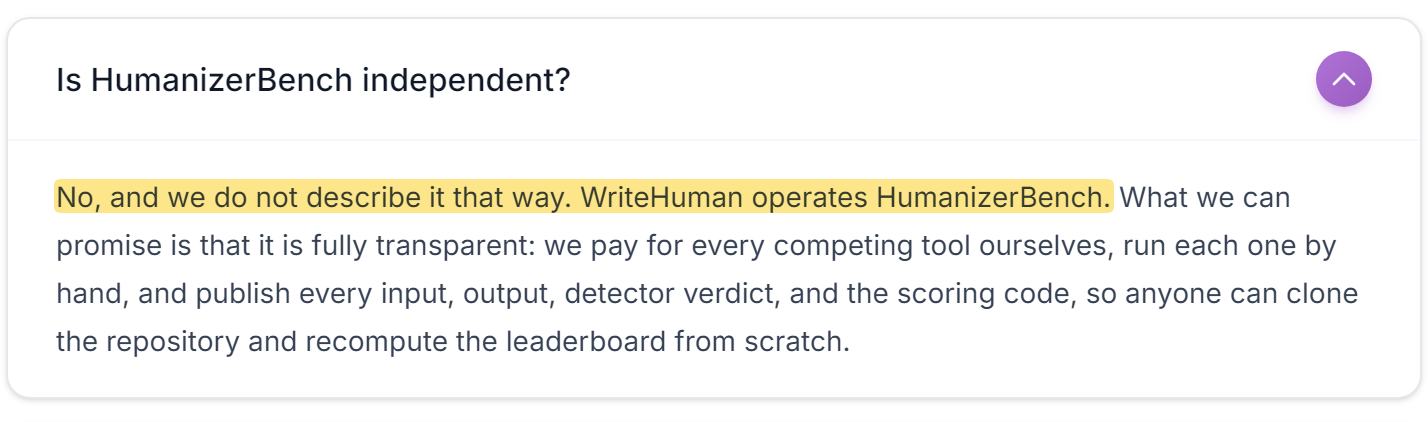
The scoring suits WriteHuman's approach, too. Less than half of the score measures whether text passes AI detectors; much of the rest rewards how closely a rewrite matches the original and how smoothly it reads. A tool that changes little scores well on that scale, and, as our test shows, gets caught by Pangram. A badge from a leaderboard a vendor runs itself is marketing. Detector results you can check are evidence.
Want a rewrite that holds up against Pangram? Paste your text into the Phrasly AI Humanizer and compare it with what you're using now. 👇
WriteHuman Pricing: Is It Worth the Money?
WriteHuman counts requests, not words, and caps how many words each request can hold. As of October 5, 2026:
Plan | Billed monthly | Billed yearly | Requests per month | Words per request |
|---|---|---|---|---|
Free | $0 | $0 | 3 | 250 |
Basic | $20/mo | $12/mo ($144/yr) | 80 | 600 |
Pro | $29/mo | $19/mo ($228/yr) | 200 | 1,200 |
Ultra | $59/mo | $39/mo ($468/yr) | Unlimited | 3,000 |
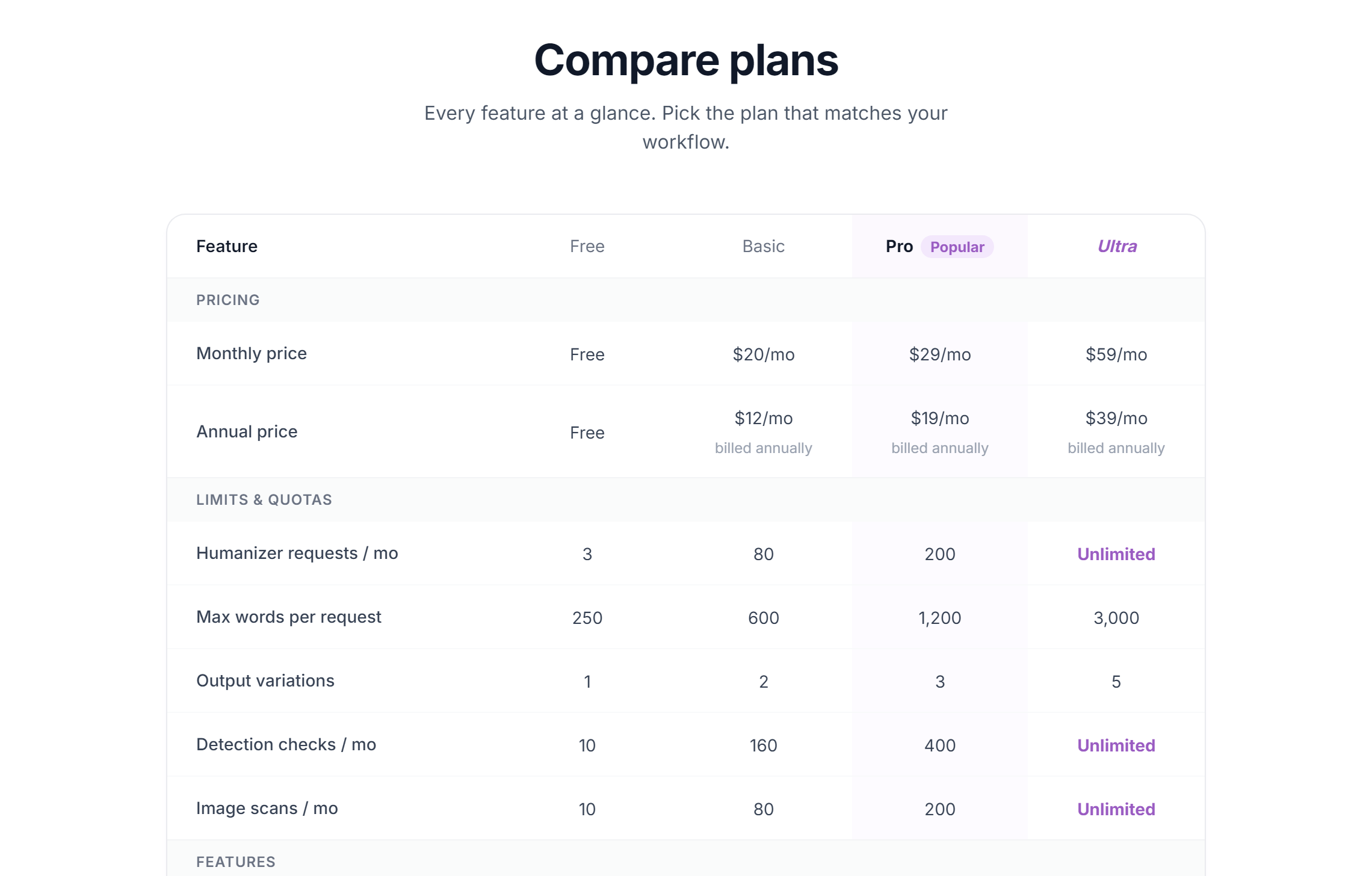
The per-request cap is the number to watch. A 1,000-word essay doesn't fit in one Basic request (600 words), so you either split it or pay for Pro. A 2,500-word report needs Ultra, at $59 a month or $468 a year. Basic tops out at 48,000 words a month (80 requests of 600 words).
Refunds are off the table. WriteHuman's Terms (last updated September 21, 2026) make every payment non-refundable unless the law requires a refund, and they rule out refunds for unused time or a plan you never used. Plans renew automatically at the then-current price until you cancel from your account, and cancelling takes effect at the end of the billing period. Prices also went up in late August 2026: Basic from $18 to $20 a month, Pro from $27 to $29, and Ultra from $48 to $59.
For comparison, Phrasly's Unlimited plan processes up to 5,000 words per request with Phrasly Ultra included, for $10.99 a month billed annually. Phrasly also offers a $2 3-Day Access trial with Ultra. See Phrasly pricing for current plans.
Is WriteHuman worth it? For light edits on short texts, when detection isn't your main concern, Basic is reasonable. If the text has to pass Pangram, our test says you'd be paying for rewrites that Pangram still catches most of the time.
What Do WriteHuman Users Say?
WriteHuman has a 4.1 TrustScore from 309 reviews on Trustpilot (as of October 5, 2026). Most reviewers praise its speed and ease of use. Trustpilot's own summary of recent reviews notes consistent complaints about subscriptions, including unexpected charges. One reviewer asked for real changes to sentence structure rather than synonym swaps, which is the gap our rewrite-depth data measures.
WriteHuman Pros and Cons
✅ What WriteHuman does well
Clean, fluent output that stays close to your original wording
Simple interface and a free plan for trying it on a paragraph
Two to five output variations per request on paid plans, so you can pick the best rewrite
Useful extras: an AI detector, an AI image detector, a Chrome extension, mobile apps, an API and MCP access
❌ Where it falls short
6 of 69 outputs passed Pangram in our test, and 44 scored 0% human
2.64 hallucinations per output in our test, about three times Phrasly Ultra's rate
Refused 3 of our 72 harmless texts, including a fantasy story, a risk for fiction writers
Low word caps: 250 words per request free, 600 on Basic
No refunds unless the law requires one, and prices rose in late August 2026
Its #1 badge comes from a leaderboard WriteHuman runs itself
WriteHuman vs Phrasly: Which Should You Choose?
WriteHuman | Phrasly (Ultra) | |
|---|---|---|
Pangram, our test (72 texts) | 6 of 69 passed; 13.3% average human score | 72 of 72 passed; 99.8% average human score |
Hallucinations per output | 2.64 | 0.85 |
Texts refused | 3 of 72, including a fantasy novel chapter | 0 of 72 |
Phrases kept from the AI original | 25.6% | 8.0% |
Words per request | 250 free; 600 to 3,000 on paid plans | Up to 5,000 on Unlimited |
Price | $20 to $59 a month; $12 to $39 a month billed yearly | $10.99 a month billed annually; $2 3-Day Access |
Refunds | None, unless the law requires one | First plan payment, within 14 days, if the account is unused |
Choose WriteHuman if you want light, close-to-the-original edits on short, non-fiction texts and detection isn't your main concern. Choose Phrasly Ultra if the text has to hold up against Pangram: it passed all 72 texts in our benchmark, refused none, and made a third as many factual changes.
Final Verdict: Is WriteHuman Worth It?
WriteHuman is a polished tool for light editing. As a humanizer for text that has to get past a modern detector, it falls short of its own marketing: Pangram rated 6 of its 69 outputs human in our test, its rewrites averaged 2.64 factual changes each, and it refused a fantasy novel chapter and two news articles outright.
The bigger lesson is about what a humanizer has to do. Light edits that keep the AI's sentences read fine and still get caught, because Pangram is trained to see through them. If detection is why you're buying a humanizer, judge it on detector results you can check, not on badges.
Phrasly Ultra passed all 72 texts in our Pangram benchmark. See how it rewrites yours. 👇
Frequently Asked Questions
Is WriteHuman legit?
Yes. WriteHuman is a real product with free and paid plans, made by Write Human LLC and led by founder and CEO Ivan Jackson. Our concern is performance, not legitimacy: in our test, Pangram rated only 6 of 69 WriteHuman outputs as human, and its #1 badge comes from a leaderboard WriteHuman runs itself.
Does WriteHuman bypass Pangram?
Not reliably. In our September 2026 test of WriteHuman's latest model on 72 long texts, 6 of 69 outputs scored 50% or more human on Pangram and 44 scored 0%. Its average Pangram human score was 13.3%, against the 94% its homepage shows.
Is WriteHuman really the #1 AI humanizer?
Not on independent evidence. Its #1 badge comes from a leaderboard WriteHuman runs itself, and WriteHuman's own blog says it doesn't describe that benchmark as independent. In our test, Pangram passed 6 of WriteHuman's 69 outputs and 72 of Phrasly Ultra's 72.
Can WriteHuman humanize creative writing?
Not reliably. WriteHuman refused 3 of our 72 texts, including a chapter of a fantasy novel in which a character mentions a past killing, plus two news-style articles about conflict in the Middle East. None contained anything illegal or harmful. If you write fiction or cover war, crime or current events, test your own work on the free plan first.
Does WriteHuman work on Turnitin?
We didn't test Turnitin for this review, so we can't give you a number. Treat any vendor's detector claims, WriteHuman's or ours, as claims until you've seen test data. Our guide to how AI detectors work explains why results differ between checkers.
Is WriteHuman free?
Partly. The free plan includes 3 humanizer requests a month, up to 250 words each, on the Standard model. Paid plans start at $20 a month, or $12 a month billed yearly.
How much does WriteHuman cost?
Basic is $20 a month ($12 billed yearly) for 80 requests of up to 600 words. Pro is $29 ($19 yearly) for 200 requests of up to 1,200 words. Ultra is $59 ($39 yearly) for unlimited requests of up to 3,000 words. Prices checked October 5, 2026.
Can you get a refund from WriteHuman?
Generally no. WriteHuman's Terms make all payments non-refundable unless the law requires a refund, including unused time and plans you never used. You can cancel from your account at any time, and the cancellation takes effect at the end of the billing period. If you're testing it, start with the free plan.
What is the best WriteHuman alternative?
If your text has to hold up against Pangram, Phrasly Ultra passed all 72 texts in our benchmark, refused none, and made about a third as many factual changes as WriteHuman. Try a paragraph free before you buy anything.

Written by