
Fluency Enhancer AI: Make Your Writing Flow Naturally
Your grammar is fine. Your writing still sounds off. That's a fluency problem and here's exactly what a fluency enhancer does to fix it.
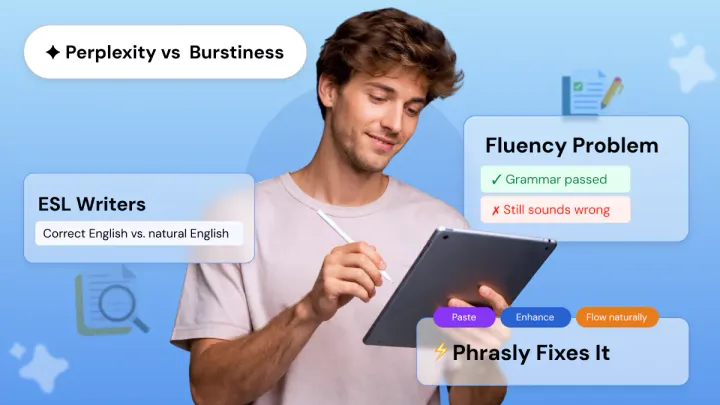
Your grammar check is passed, but something still feels off.
The writing is stiff, assembled, and a little disconnected. Clean grammar, broken rhythm: those are two very different things.
A fluency enhancer works on the invisible stuff: rhythm, transitions, the way words move together. It's the difference between writing that's technically correct and writing that actually sounds human.
Because most of the time, when your writing feels unnatural, the issue isn't what you said. It's how it lands. That's exactly what a fluency enhancer is built to fix.
What Is Writing Fluency? (And Why Grammar Tools Don't Fix It)
Writing fluency is the quality that makes text feel natural, smooth, and easy to follow. It is completely separate from whether the grammar is correct or the tone is right.
The distinction between writing that flows and writing that stumbles, even when every sentence is grammatically correct.
Most writers have felt this problem at some point without knowing what to call it.
You correct the grammar. You tweak the tone. The writing still sounds wrong. The issue is that writing fluency functions on a different level.
It exists in the space between sentences, not within them.
- Grammar tools identify errors inside sentences.
- Writing fluency is about what happens across sentences.
You can have subject-verb agreement throughout your writing and still end up with choppy writing. Lists of sentences. A sentence can follow every rule and still read like it was assembled, not written. The difference between those two matters. Because the fix is different.
What Is Burstiness and Perplexity in Writing and Why Does It Matter for Fluency?
One of the clearest markers of natural writing is something linguists and NLP researchers call burstiness.
The natural variation in sentence length gives human writing its writing rhythm.
Fluent writing has short sentences. Fluent writing also has long sentences. It has variety. Bursts of words are followed by balanced thoughts. That’s burstiness.
AI-written text, whether it’s a first draft from GPT-5 or something generated by Claude, is relentlessly consistent in sentence length. Bursts become dirges.
Even if you don’t know why something is off, you’ll sense it when you read AI writing.
Researchers studying text naturalness also use a related concept called perplexity. It is a measure of how unpredictable (and therefore human) a piece of text feels.
The more predictable your writing is, the worse it sounds. AI tends to have a low perplexity score because at every step, it predicts the most probable next word. You get grammatically pristine but dull writing, and dullness is a fluency issue.
Fix Your Writing Flow – Try Phrasly Free 👇
Fluency vs Readability Vs Tone Vs Grammar — What's Actually Different?
Most people use these words interchangeably. They are not the same thing, and confusing them is exactly why writing still feels off after you have "fixed" it. The table below separates each concept clearly.
Fluency is the hardest of these to fix manually. It requires understanding writing rhythm, transitions, and cohesion across sentences, not just within them.
A grammar checker can tell you that a sentence doesn't work structurally. But it can't tell you that three correct sentences in a row all start with the same word, draining power from your writing.
It can't spot the absence of transitions between paragraphs. It can't improve writing cadence or repair a document-level text coherence issue. Fluency enhancer does these things – and it's something a grammar tool or tone analyzer can't do.
Why Your Writing Lacks Fluency (Even When Grammar Is Perfect)
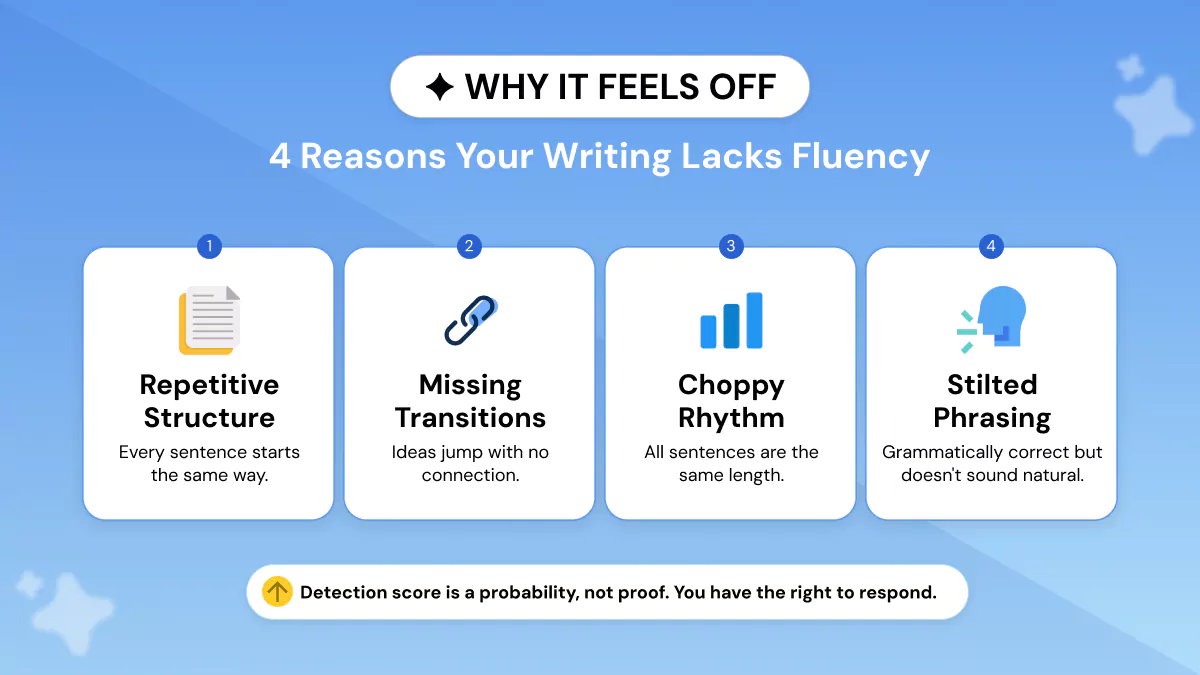
Fluency problems are invisible to most tools because they aren't rule-based. They're structural.
Here are the four most common fluency failures. Each is completely unrelated to grammar mistakes or tone.
Repetitive Sentence Structure
Each sentence begins similarly. They follow the same grammatical structure. Or they hit the same note at the end. Readers sense repetition as some sort of exhaustion, even if they can't identify it. It reads robotically.
Writing naturally is impossible if your form is stagnant.
The revision breaks the identical "The + passive verb" pattern. The rhythm changes. The text immediately feels more natural.
Missing Transitions
The ideas are there. The logic is sound. But the writing jumps from idea to idea with no connective tissue. No indication to the reader that something is carrying over, changing, or developing.
This is a text coherence issue, and it's one of the most frequent fluency errors made by ESL writers.
Why ESL Writers Lose Transitions First
Transitions are typically the first fluency element that erodes for non-native English speakers. In many languages, writers rely on implicit cues to convey logical relationships between ideas.
English learners sometimes apply that mindset to English writing, producing sentences that are grammatically correct but sound choppy. The most common transition mistakes among ESL writers include:
- Jumping between contrasting ideas without a linking phrase like "however" or "that said".
- Omitting cause-and-effect connectors such as "as a result" or "which is why".
- Skipping topic sentences that signal a paragraph shift to the reader.
- Relying on comma splices instead of proper transitional structure.
Choppy Rhythm
Every sentence is about the same length. You don't see a quick phrase followed by a longer thought. Readers get tired of reading choppy writing over several paragraphs because it doesn't flow.
Stilted or Translated Phrasing
Its grammar is correct, but the sentence structure, idioms, or word choice feel like a translation instead of something originally written. This is wildly typical for ESL writing as well as AI written work.
It reads like stilted writing, not incorrect, just lacking native speaker fluency.
Who Needs a Fluency Enhancer Most?
Fluency Enhancer is for anyone who has corrected grammar, re-read their work, and still felt like something was off. Whatever that "something" was, it had a name: it was a fluency issue.
Non-Native English Speakers
Correctly writing English can be difficult. Convincingly natural writing is more difficult still. ESL specialists, foreign students, and polyglot business writers often struggle to produce text that doesn't sound translated.
Whether Urdu, Mandarin, Spanish, or Arabic is your native tongue, the problem is identical. Your ideas are coherent in your head, but something gets lost between thought and page.
A fluency improvement tool fixes this specifically. It adjusts writing rhythm, paragraph transitions, and idiomatic phrasing without changing your meaning or your voice.
Content Creators Using AI
GPT-5, Claude... it doesn't matter. All AI text is caught in the same fluency traps. The grammar is good. The problem is that the rhythm is monotonous, the sentence variety is consistent, and there are no transitions.
An AI fluency enhancer injects the kind of natural writing variety that LLM's uniformly suck out.
Professionals Writing Outside Their Comfort Zone
Engineers writing reports. Researchers writing summaries. Developers writing documentation. The concepts are expert-level. The writing flow isn't.
Fluency enhancement makes the writing smoother; no heavy editing or expert assistance needed.
For writers working on both fluency and sentence structure, sentence-level enhancement pairs well with fluency improvement as a second-pass tool.
If you're weighing your options, this breakdown of the best AI text enhancers can help you find the right fit for your workflow.
How Phrasly's AI Text Enhancer Improves Writing Fluency?
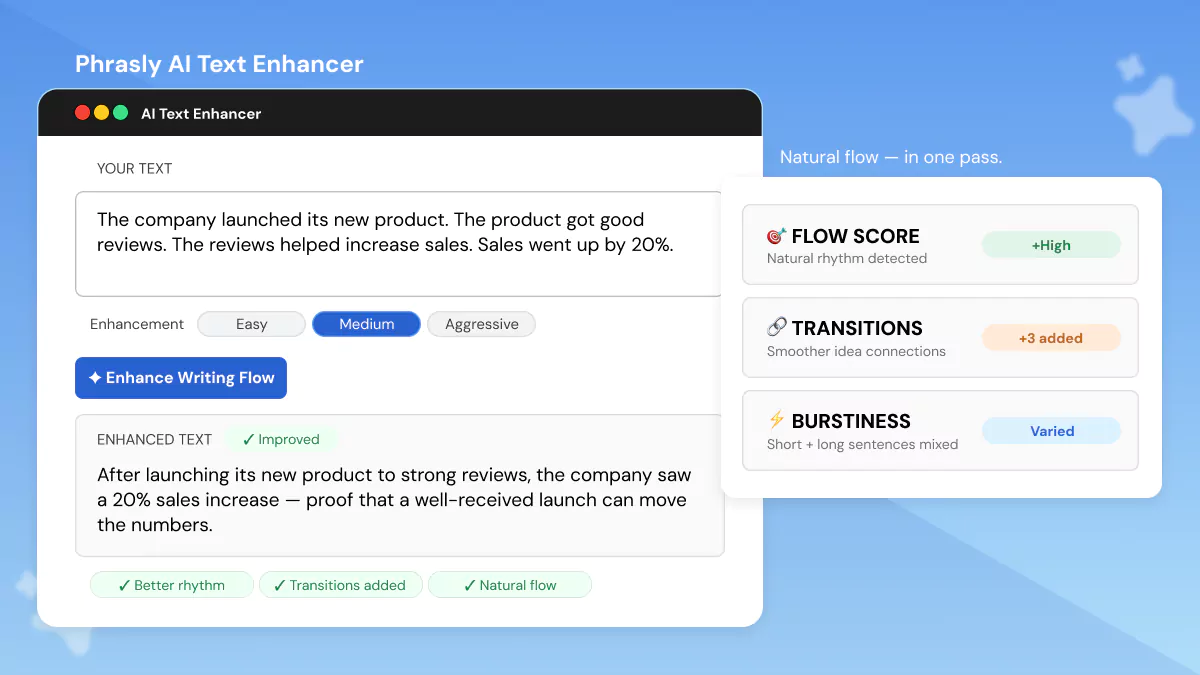
Manual rewriting for writing fluency is tedious and time-consuming. You need to read your content aloud, find where the rhythm breaks, experiment with transitions and sentence structure variations...and repeat for each edit.
Phrasly's AI Text Enhancer does it for you automatically.
Here is What Phrasly Specifically Does for Writing Flow
- Smooth transitions between sentences and paragraphs. Adds connective language where ideas jump without a bridge.
- Varied sentence rhythm: introduces burstiness by mixing shorter punchy lines with longer, more developed ones.
- Removes stilted phrasing: reconstructs constructions that are grammatically correct but sound translated or unnatural.
- Improves natural language flow across entire paragraphs, not just within individual sentences.
- Preserves your meaning: no changes to your facts, arguments, or voice.
Phrasly offers three enhancement levels:
- Easy: light fluency adjustments for text that is mostly natural but has minor rhythm or transition gaps.
- Medium: the recommended level for most fluency work. Fixes flow and writing cadence without overwriting your voice.
- Aggressive: for heavily stilted or AI-generated text that needs significant restructuring to reach native speaker fluency.
Phrasly doesn't change your grammar, adjust your tone, or rewrite for keywords. Those are different tasks. Phrasly has one job. It fixes the smooth writing and leaves everything else alone.
For a closer look at how it stacks up against other tools on the market, see how Phrasly AI compares to Originality AI as a text enhancer.
Try Phrasly free! Paste your paragraph and see the fluency difference.
Button:
What Does Fluency Enhancement Actually Look Like?
Every example below is specifically about writing fluency, such as writing rhythm, transitions, and naturalness. None of them are grammar fixes or tone adjustments.
Example 1: ESL Professional Writing
Situation: A non-native English speaker writing a project update. Grammar is correct. Flow is not.
Fluency fix: Eliminated five identical subject-verb sentence starts. Rebuilt as two naturally flowing statements with varied rhythm and structure.
The vast majority of English writing produced globally comes from people who learned the language, meaning fluency issues, not grammar errors.
Example 2: AI-Generated Output (GPT-5 / Claude Draft)
Situation: An AI-generated product description. Grammatically clean. Every sentence is near-identical in length. Zero burstiness.
Fluency fix: Broke monotonous equal-length sentence pattern. Added a transition that connects features to outcomes. Restored the writing cadence that the AI draft had flattened.
Example 3: Professional Report Writing
Situation: A software engineer writing an internal technical summary. Accurate information. Stilted writing throughout.
Fluency fix: Removed passive-voice stacking and over-nominalized constructions. Rebuilt as a natural, smooth writing narrative with varied sentence rhythm.
If your goal is polishing content for a professional context specifically, this guide on using AI to make text more professional is worth a read alongside it.
You can also explore text quality enhancement if you want to address accuracy and structural dimensions alongside writing fluency.
FAQs
What is a fluency enhancer in writing?
A fluency enhancer is a writing tool that improves your document for natural language and writing flow, emphasizing writing rhythm, transitions, and phrasing. It preserves grammar, tone, and meaning.
How is fluency different from readability?
Readability measures how easy text is to scan: sentence length, word complexity, structure, etc. Fluency measures how naturally text flows: writing cadence, text coherence, and smoothness of transitions between ideas.
Text can be perfectly readable with horrible writing fluency. Text can be highly fluent but score badly on readability tests. They are separate issues with separate solutions.
Can AI improve writing fluency for non-native English speakers?
Yes, and it’s one of the best uses for an AI fluency enhancer, actually. ESL writing tends to be grammatically correct but lacking in naturalness, writing rhythm, and paragraph transitions.
Phrasly’s AI Text Enhancer analyzes those cross-sentence patterns and corrects them automatically, something that’s nearly impossible to do manually without a native speaker’s intuition.
Why does AI-generated text still sound unnatural after grammar checking?
Grammar checkers analyze correctness at the sentence level. They don't measure burstiness, cadence of writing, transitions, or how coherent a paragraph reads overall.
A paragraph written by GPT-5 or Claude passes grammar check, yet still sounds unnatural because those are attributes of writing fluency, and you need a fluency improvement tool to fix them.
If you're also looking to address tone and readability alongside fluency, this guide on improving AI text readability and tone covers those dimensions in detail.
What is the best AI tool to improve writing flow?
Phrasly's AI Text Enhancer was built specifically to help with this. It looks for issues with flow, sentence variety, transitions, and natural language feel all in one pass.
It has three levels of enhancement so you can choose how aggressively you want language restructuring applied.


Keep reading

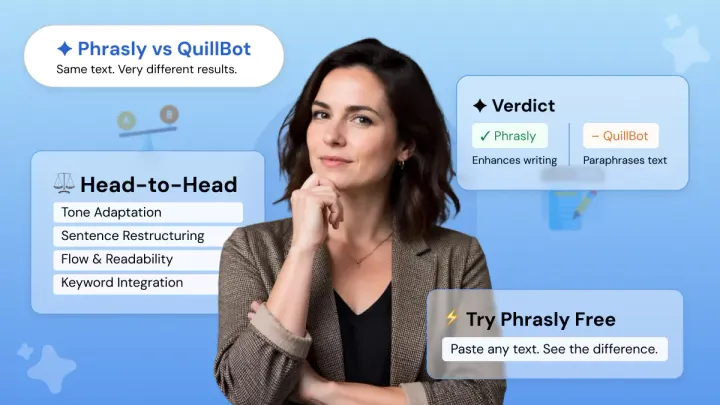
Phrasly.AI vs QuillBot: Why Paraphrasing Your Text Isn't the Same as Improving It
Phrasly and QuillBot both touch your text, but one paraphrases it and one actually improves it. Here's the difference, tested on the same paragraph.


Best AI Text Enhancers 2026: Complete Comparison Guide
Not all AI text enhancers are built the same. We tested 10 on the same paragraph so you don't have to guess which one is worth your time.