
Do Hiring Managers Check for AI in Cover Letters? What 2026 Data Shows
Most hiring managers don't use AI detectors. They spot generic phrasing, templated structure, and tone mismatches instead. With ~50% of applicants now using AI, the real risk isn't AI use itself, but submitting unedited, impersonal content that fails to reflect your actual voice.
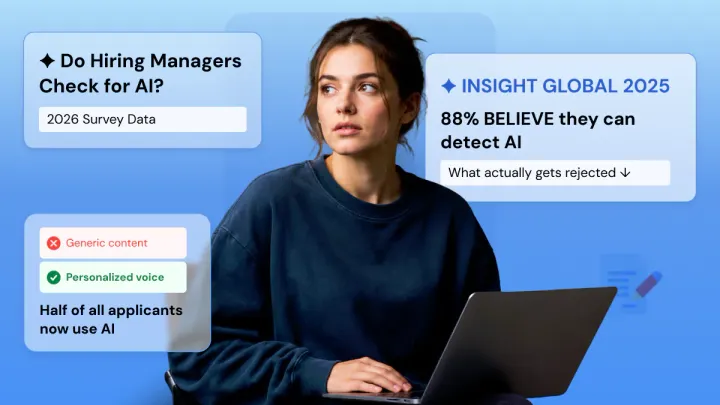
Some hiring managers do look for AI use in cover letters, but most simply skim documents based on informal pattern recognition, not AI detection software.
The question is no longer if you should use AI, but how to use it to avoid sounding like the countless other generic ChatGPT letters. Because applications per job opening have increased by about double, the bar is higher than ever to stand out.
In this guide, you’ll learn exactly what surveys say, how ATS/resume scanners and recruiters truly work, which industries have risky AI use vs. normalized it, and discover a realistic workflow for using AI on applications that sound like you.
Do Hiring Managers Actually Check for AI? What the Surveys Say
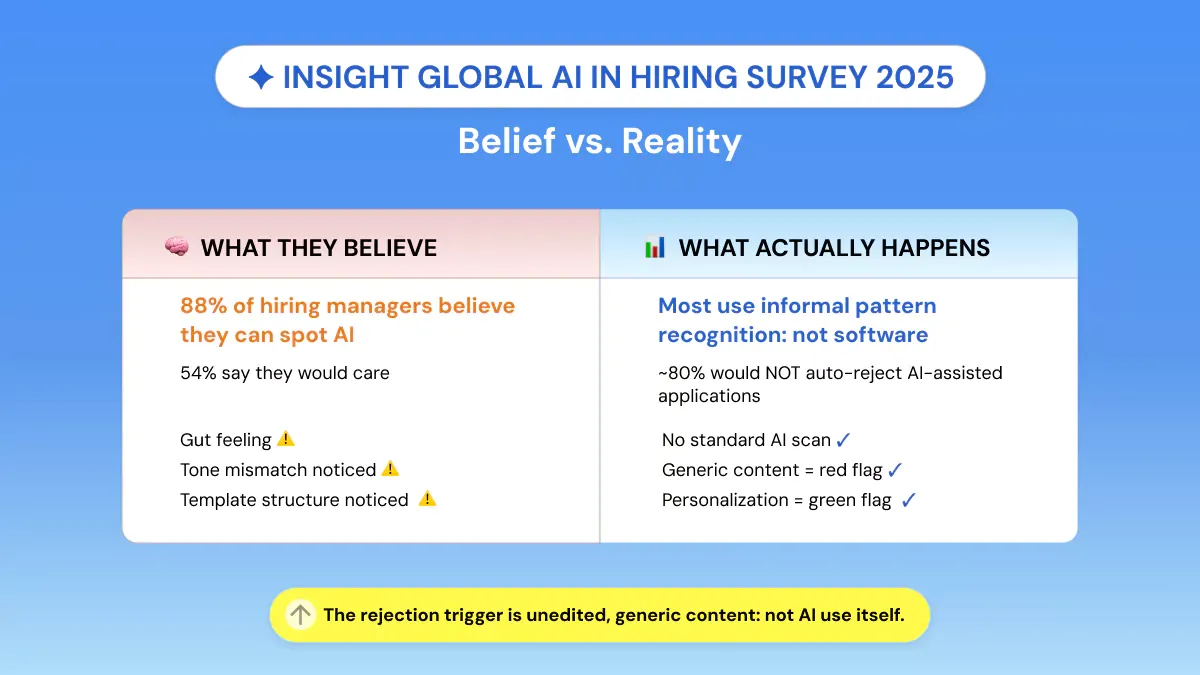
No hiring manager reviews cover letters with AI detection software as part of their process. Detection is typically ad hoc.
Recruiters will be on the lookout for formulaic language, a predictable structure, and a tone that feels out of sync with the rest of what you've submitted.
The most ubiquitous stat about this topic is from Insight Global's latest AI in Hiring survey: 88% of hiring managers think they know when candidates used AI to write their cover letter/resume.
It gets quoted all the time and is almost always misunderstood.
Notice the word "believe". This is a self-reported belief, not actual measured detection accuracy. No study has ever verified whether hiring managers are actually right when they suspect an application is AI-generated.
Of that 88%, only 54% would care if a candidate utilized AI assistance. Conversely, almost half of hiring managers who think they can detect AI will not penalize you for it.
Another 14.5 percent feel candidates should not use AI-generated content at any point in the hiring process. So about 80% of talent acquisition professionals would not automatically disqualify an AI-generated resume.
The point isn’t that using AI is riskless. It’s that the risk is much subtler than the headlines imply, and focused on one particular kind of failure that you can manage.
2025–2026 Survey Data at a Glance
|
Survey
/ Source |
Key
Finding |
What
It Means |
|
Insight
Global 2025 |
88%
of hiring managers believe they can spot AI |
Perception-based,
not proven detection |
|
Insight
Global 2025 |
54%
say they would care if AI was used |
46%
would not care at all |
|
Resume
Now June 2025 |
62%
reject AI resumes lacking personalization |
Problem
is generic content, not AI itself |
|
Resume
Now June 2025 |
78%
look for personalized details |
Authentic,
specific stories still win |
|
U.S.
Chamber of Commerce 2025 |
~20%
would reject for AI-generated materials |
~80%
would NOT auto-reject |
|
Financial
Times 2025 |
~50%
of applicants now use AI tools |
AI
assistance is mainstream, not unusual |
Can Recruiters Detect AI in Resumes? (The ATS Question)
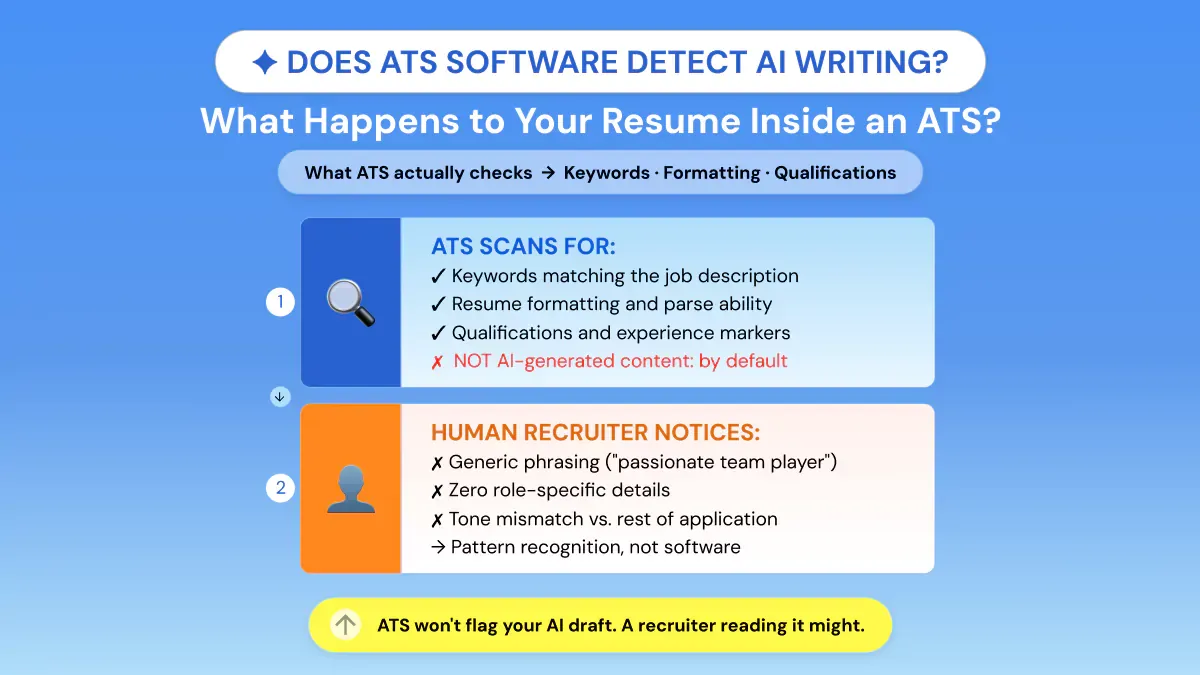
ATS are scanning resumes for keywords, qualifications, and proper formatting. They do not detect AI resumes by default. Human Recruiters flag AI resumes when they spot generic text.
What ATS Actually Does?
There is a lot of misunderstanding when it comes to what Applicant Tracking Systems (ATS) do. Here’s the quick answer: ATS software does not inherently identify AI-generated content.
ATS tools were built to scan resumes, keyword match against job descriptions, ensure formatting is machine readable, and rank candidates based on qualifications listed. ATS is a screening and organization tool, not a tool designed to detect AI.
One common question we hear is "Does ATS detect AI writing?" The short answer is: no. Not really, anyway. Not as a built-in capability anyhow.
The ATS platforms most commonly used by enterprises such as Workday, Greenhouse, Lever, and iCIMS, were developed for keyword matching and applicant tracking processes, not for detecting content authenticity.
When AI Detection Does Happen
Indeed, some enterprise HR departments and recruitment agencies do use standalone AI detectors. Originality.ai, for example, has marketed specifically to HR teams. But that’s far from the norm.
Even when it happens, it’s usually a manual step outside of the ATS.
Often, it's a human recruiter who spots that a candidate's cover letter shares identical phrasing with dozens of other applicants, typically because they all used the exact same ChatGPT prompt without making any edits.
What Actually Gets AI-Assisted Applications Rejected
For every survey done from 2025–2026, generic content remains the rejection trigger, not the use of AI writing tools.
For hiring managers, personalized details are a key indicator of genuine interest, with 78% actively seeking them out. A significant 62% of hiring managers report that AI-generated resumes lacking personalization frequently result in rejection.
53% are annoyed by candidates reaching out impersonally or robotically. Notice how all three findings have one thing in common: it's the impersonality that's the issue, not where it came from.
Quality is always the problem. A well edited AI-generated cover letter that reads specifically and with voice is indistinguishable from one written by a human being.
When you simply copy and paste directly from ChatGPT without any changes, it's noticeable not due to metadata, but because it sounds generic enough to fit any job description anywhere.
Here's what recruiters consistently flag when they come across applications that seem to have had AI help:
- Identical template structure: The letter follows the same three-paragraph format as dozens of other applicants. Same transitions and sign-offs, too.
- No role-specific details: This letter could have gone to any company. There is no reference to the job description, company mission, or recent news.
- Tone mismatch: On the cover letter, it’s formal. During the interview, it’s conversational. Recruiters see right through it.
- Buzzword density: Phrases such as "synergize" and "data-driven" feel out of place when simpler terms would suffice.
Industry Differences: Where AI Use Is Risky vs. Accepted
Acceptance rates for applications assisted by AI differ greatly by sector. Positions in legal, government, and finance tend to be tougher on accepting flagged resumes.
Tech, marketing, and startup positions are more indifferent or even favorable towards solid AI use.
A startup looking to hire a growth marketer will expect fluency in AI, and may even make it a job requirement. A law firm looking to hire a paralegal will expect samples of careful, independent drafting.
Research the company culture before you apply so you know how heavily to lean on AI and how much editing work you should do yourself afterward.
The practical rule: The more regulated and document-heavy your field, the more intensely your writing will be examined, demanding a superior degree of tailored, flawlessly edited content.
|
Industry |
Tolerance
for AI-Assisted Applications |
|
Legal
& Compliance |
Low:
traditional drafting expected; AI flagging can mean auto-rejection |
|
Government
/ Defense |
Low:
strict vetting; AI use may raise authenticity concerns |
|
Finance
& Banking |
Low
to Medium: depends on firm culture; senior roles more scrutinized |
|
Technology |
High:
AI fluency often viewed as a skill, not a red flag |
|
Marketing
& Creative |
High:
AI proficiency is increasingly a job requirement |
|
Startups |
High:
speed and resourcefulness valued; AI use rarely penalized |
How to Use AI for Cover Letters the Right Way (5-Step Workflow)
Applications that make it through the wringer are largely processed the same way: AI does the framework and first draft. Applicant fills in experiences, role-specific skills, and their own voice.
You can get AI help at every stage of your application process without generating the same robotic text that hiring managers instantly spot. It's all about how you use the tool. Follow this five-step process for treating AI like a drafting tool instead of a ghostwriter.
- Start with your raw material. Outline your actual experiences, numbers, and motivations for wanting this exact job before you open any AI tool. What did you achieve at your last job? What number did you improve?
Why this company? Why not others like it, why thus one? AI cannot create your story for you. Skip this part, and you're practically guaranteed a generic response because you fed the AI generic material.
- Use AI for structure and first draft. Input your raw material into your AI tool and have it format this into a clean cover letter. This is the legal time-saving hack.
You aren't having AI think for you. You're having it organize what you already know.
- Replace every generic sentence. Read through your draft and circle any line that could be in another applicant's letter.
If the sentence includes nothing uniquely yours to write a date, a name, or an epiphany, rewrite that sentence with something tangible. This is the crucial step that most applicants avoid.
- Match your real voice. Read your final draft out loud. If the wording feels unnatural compared to your interview style, it's a giveaway.
Recruiters will read the letter with your interview performance side by side. If parts of your draft come across as too formal and not like you at all, just make them sound more relaxed.
- Verify before sending. Paste your final draft into an AI detector to see how it looks to a reviewer. If it comes back flagged as obviously AI-written, that means there's still some generic phrasing lurking.
Rewrite those bits in your own words. Consider this a way to check the quality of your application, rather than just trying to beat AI detection. You need to ensure your unique voice truly stands out.
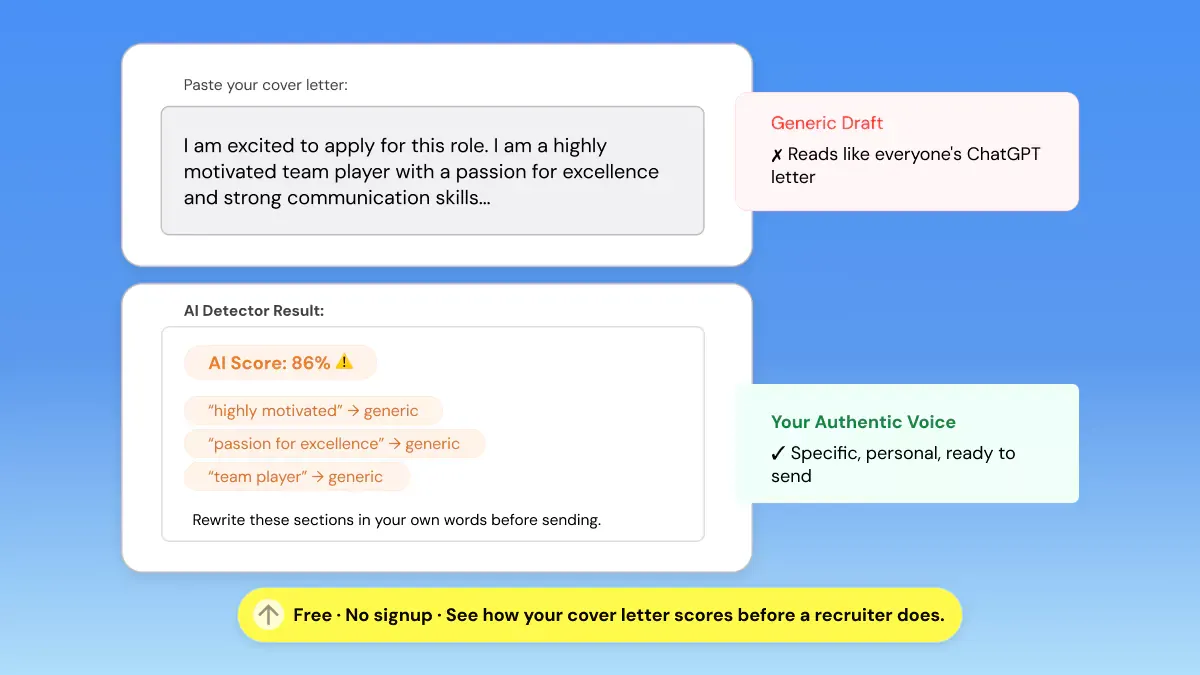
Phrasly's AI Detector allows you to do that before a recruiter does it for you. It's free. No sign-up necessary.
Check Your Cover Letter Reads as Your Own Voice
See how your cover letter scores before a recruiter does. Free, no signup!
The Bigger Picture: AI Use Is Normal Now, Generic Output Is Not
Recruiting has changed forever. Roughly 50% of all job seekers are using AI tools to assist with their applications. Postings are getting about twice as many applications. So AI assistance is no longer exceptional. It’s table stakes.
The candidates who will truly stand out won't be those who steered clear of AI. They’re the ones who leveraged it effectively: to organize their thoughts, refine their writing, and then infuse it with unique human insights.
Hiring managers aren't doing a forensic analysis of your cover letter. They just want proof that you read the job description, that you understand what the company does, and that you have applicable experience worth reading about.
Those signals aren't going to come from AI. Your job is to ensure they're present before you send that final draft.
Use AI to draft, edit to humanize, and verify before submitting. That is the workflow that keeps your application out of the rejection pile. Do not avoid AI, but avoid the lazy version of it.
Frequently Asked Questions
Do hiring managers check for AI in cover letters?
Most people don't use specialized software. Most employers skim for familiar patterns, looking for clichéd language, templated organization, and shifts in tone. A small portion of corporate job applicants are checked with standalone AI detectors, however.
Can recruiters detect AI in resumes?
Recruiters can detect AI in resumes mainly through human pattern recognition, not ATS software. ATS look for keywords, formatting issues, and qualifications.
If your resume sounds like it was written by a robot without personality, a recruiter will mark it as AI even if you didn't use it.
Will I get rejected for using ChatGPT on my cover letter?
Most likely not, if you edit your output carefully. 80% of recruiters said they would not automatically reject an application if they knew AI helped. The danger lies in uploading copy-pasted, generic AI noise, not in using AI to help draft your application.
Does ATS software detect AI writing?
ATS software does not detect AI writing by default. ATS systems parse for keywords, scan resumes, and rank candidates. AI detection, when implemented, is generally performed manually by humans or separate software tools outside the ATS.
What percentage of hiring managers care about AI use?
Insight Global's 2025 survey found 54% of hiring managers would care if someone used AI. 46% said they would not care. According to the U. S. Chamber of Commerce's 2025 statistics, roughly 20% would flat out deny someone's application due to AI usage.
Is it okay to use AI for a cover letter in 2026?
With proper editing, yes. AI assistance is utilized by approximately 50% of applicants these days. (Financial Times, 2025).
It is generally accepted that you use AI to draft and layout, then input your own personal experiences, voice, and job-specific details prior to submission.
How do recruiters spot AI-generated applications?
They search for duplicate templates submitted by various candidates, not tailored to any specific job description, filled with buzzwords, no examples, and "applicants who sound different in person than they do on paper."
How can I check my cover letter for AI before applying?
Run it through an AI detector before sending. Paste your cover letter text into Phrasly’s AI Detector and get a score before the recruiter does. It’s free, and no sign-up is necessary.
If portions of your letter are flagged as being AI-generated, rewrite those sections until your human voice shines through. For those in the medical field, Do Residency Programs Check for AI walks through how this applies to residency applications.


Keep reading

What Are Common Phrases That AI Uses? We Tested 50 Pieces to Find Out
We ran 50 pieces of content through Phrasly's AI Detector to find out what are the common phrases that AI uses.

The Content Strategist's Workflow for AI-Assisted Production
A sound AI content workflow puts humans at the brief and expertise stages, letting AI handle outlining and drafting, then routes every piece through fact-checking, plagiarism, and AI-flatness QA gates before it can be published.