
How to Remove ChatGPT Watermark (And When You Actually Should)?
There's no hidden code in your ChatGPT output, just writing patterns that detectors recognize. Here's exactly what they are, whether removing them is ethical, and how to do it properly.
If you’ve ever pasted a draft into ChatGPT and wondered whether the result is detectable as AI-generated text, you’re not alone. Millions of writers, marketers, and freelancers use ChatGPT to create a first draft.
But most want the final draft to sound unmistakably human like them. There’s the real motivation behind learning how to remove ChatGPT watermark: not the desire to trick anyone, but the entirely reasonable desire to own your writing.
As of 2026, the AI detection arms race is officially happening. Increasing numbers of employers, editors, and platforms are utilizing AI-generated text detectors, and professionals must know where to draw the line between 'using AI' and 'editing AI-assisted work.'
This article covers what happens to your text when you use ChatGPT, when it is ethical to edit it, and which tools allow you to maintain an ethical professional editing workflow.
Clean ChatGPT Watermark from Your Own Text 👇
Why People Want to Remove ChatGPT Watermark (And When It’s Usually Fine)
Most ChatGPT users are drafting, not fabricating.
They provide the brief, frame the argument, and provide the expertise. ChatGPT crafts the first draft. That’s an AI writing fingerprints situation, not an ethics issue.
Trouble starts to arise when conversations around AI-generated text editing start mentioning detection tools. Companies are creating AI usage policies. Universities are drafting stricter regulations. Websites are beginning to detect ChatGPT output patterns.
Where does this leave professionals?
That spike shows just how pervasive AI-assisted writing has become and why discussions around removing the GPT watermark aren’t fringe anymore.
"Hiding AI content" is not the objective. Making AI text sound human is the goal. This is a distinct and perfectly valid objective, as long as you're sticking to applicable policies.
For a full breakdown of what AI watermarks are and how they work, read What Is an AI Text Watermark.
Does ChatGPT Actually Add a Watermark to Your Text?
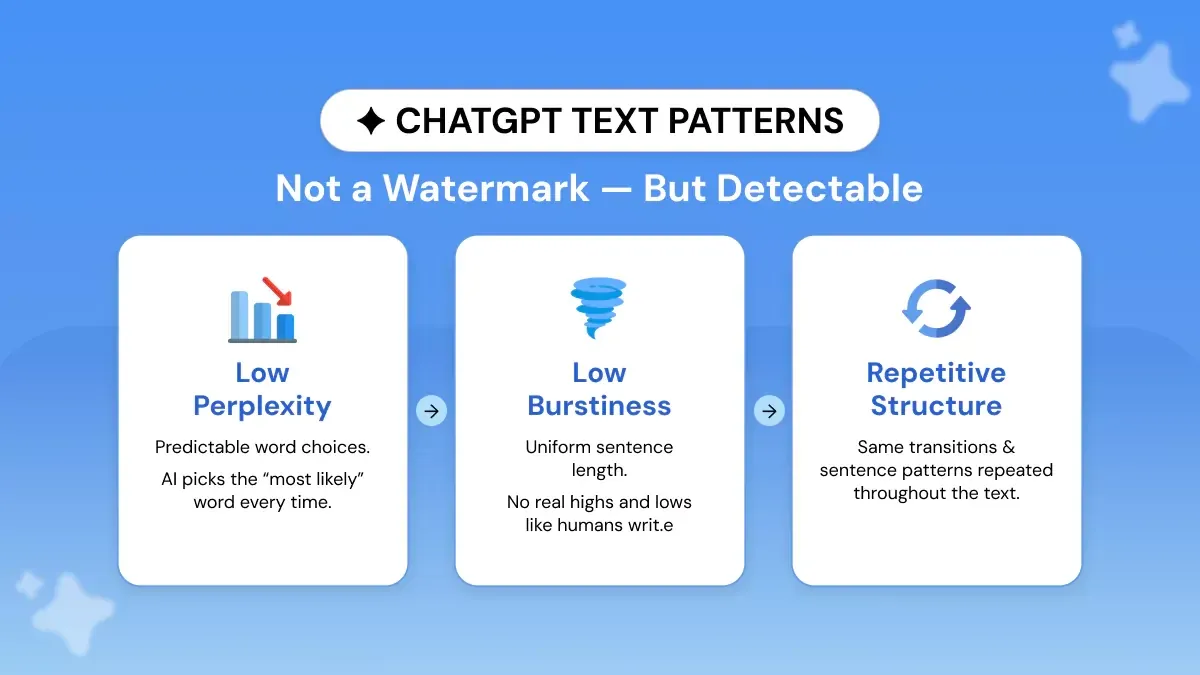
No! ChatGPT doesn't actually contain a cryptographic watermark in its responses.
As of 2026, most of OpenAI's watermark 2026 headlines are discussing research ideas and policy points, not an active, proven watermarking technique operating inside ChatGPT, GPT-4, or GPT-5.
OpenAI has announced publicly that they are researching text watermarking, and patents have been published indicating their research. OpenAI has not implemented a cryptographic OpenAI watermark approach similar to Google's.
ChatGPT leaves behind something far subtler: statistical writing styles, predictable sentence cadence, uniformly high fluency, low burstiness (how much sentence length varies), and unique word frequency patterns.
It's not a watermark in the strict cryptographic sense, yet AI detectors still pick up on these signals as definitive markers. This makes the concept of a GPT watermark persist as common knowledge.
What About GPT-5?
Release of GPT-5 has led to renewed discussion of GPT-5 watermark policy. As of mid-2026, OpenAI has not acknowledged the existence of a cryptographic large language model (LLM) watermark used in GPT-5.
The text patterns that GPT-5 generates may differ from those of GPT-4 by style and complexity. However, the underlying concept remains true: what detection systems are picking up are statistical watermarks, not cryptography.
For a technical deep-dive into how SynthID-Text differs from ChatGPT's approach, read how to detect an AI watermark.
Is It Ethical to Remove ChatGPT Watermark?
The answer depends entirely on context. Here is a clear framework.
When It's Perfectly Fine
- You wrote the brief, the ideas, and the structure. ChatGPT helped with phrasing.
- You are editing AI-drafted content as part of your professional editing workflow. Your organization or client has no policy prohibiting AI use.
- You care about your work sounding like you, rather than generic AI writing.
- As a contractor, marketer, or content creator, you're using ChatGPT as your drafting assistant, not the author.
When It Raises Ethical Concerns
- Turning in AI-written work as your own to an entity that prohibits AI usage.
- Publishing work generated by AI for situations where it has high stakes (medical advice, legal documents), trying to mislead the reader into thinking it was written by a person.
- Using editing tools to circumvent AI detection when that detection is in place for a valid protective reason.
One last thing to mention is that responsible AI content is becoming a regulatory signal, not just something to do because it's the ethical thing.
The EU AI Act, one of the significant AI disclosure laws of 2026 frameworks, mandates transparency around AI-generated content in some high-risk categories.
The question "Is removing a ChatGPT watermark the same as removing a Gemini watermark?" comes up often. The answer is no.
Gemini uses SynthID-Text, a cryptographic system. ChatGPT leaves out statistical patterns. They require different approaches. For the Gemini angle specifically, see Is It Ethical to Remove Gemini Text Watermark?.
How to Remove ChatGPT Watermark Ethically?
“Removing” a ChatGPT watermark, in this context, isn't about deleting a secret code. It means rewriting parts of your text so it authentically sounds like you, is structured how you want, and gets your exact point across.
Think of it as the final editorial pass every good writer does, except with AI writing fingerprints in the mix.
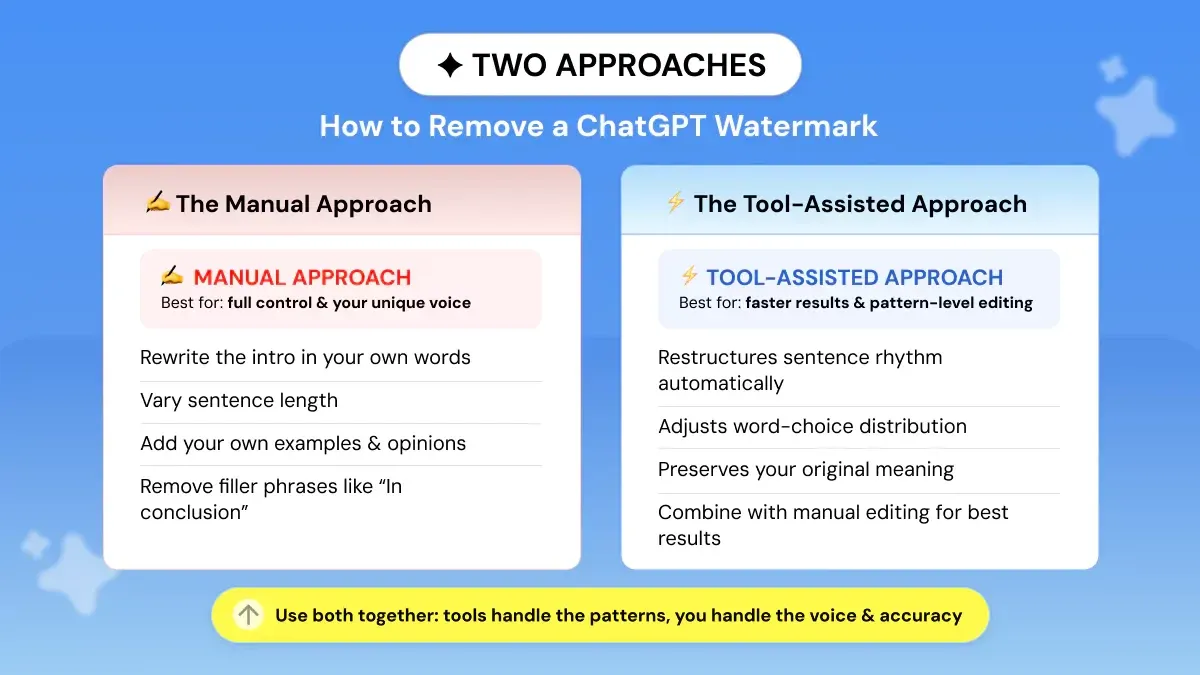
The Manual Approach
Rewrite the opening paragraph in your own words. The opener is where ChatGPT output patterns are most detectable. A sentence you wrote from scratch signals your register, your rhythm, and your perspective. No statistical model can replicate this.
- Vary your sentence length deliberately. Mix short punches with longer analytical sentences.
- Add your own examples, opinions, and specific references that ChatGPT couldn't have generated.
- Remove or replace generic transitions: 'In conclusion,' 'It's worth noting,' 'Additionally'. These are AI writing fingerprints that detectors recognize instantly.
- Read the draft aloud. If a sentence sounds like a press release nobody asked for, rewrite it.
The Tool-Assisted Approach
- Use a dedicated AI text watermark remover. A ChatGPT watermark remover handles the structural heavy lifting. Restructuring sentence rhythm and word-choice distribution while preserving the meaning of your content.
- Best practice is to combine tool assistance with manual editing. The tool handles patterns; you handle voice and factual accuracy.
If you're looking for a website to remove ChatGPT watermarks that treats your content as your own rather than as a detection problem, see the section below on recommended tools.
Best Tools to Remove ChatGPT Watermark Ethically 👇
The tools below are positioned around legitimate AI-generated text editing. Each one suits a different working style.
Phrasly is designed for writers who utilize AI as a drafting tool and desire the final output to authentically sound like them. Phrasly is not a detection evasion tool. It’s an editing tool for professionals who use AI as part of responsible content workflows.
Phrasly's AI watermark remover is designed with content ownership at the center of its product philosophy.
Editing text drafted with ChatGPT assistance is entirely normal (and acceptable) professional writing in 2026 if you have the right intentions and aren't violating any policies.
Intent and context precisely what separates the legitimate editing of AI-generated content from dishonest practices. Trying to pass AI-written work off as your own is attempting to deceive your readers/educators/institutions.
You should aim to edit AI-drafted writing until it's fully yours. If ChatGPT helped you draft your content and you want it to sound like you, Phrasly's AI watermark remover is built for exactly that.
Frequently Asked Questions
Does ChatGPT watermark text?
ChatGPT doesn't have an actual cryptographic watermark like Gemini's SynthID-Text does. ChatGPT does have statistical writing signatures that AI detectors can identify. They're not technically a GPT watermark but act as one.
Is removing a ChatGPT watermark the same as removing a Gemini watermark?
No! They are fundamentally different. Gemini watermarks with SynthID-Text, which is cryptography hidden in token distribution probabilities that can be verified. ChatGPT generates statistical fingerprints, not embeddable verified watermark tokens.
These represent fundamentally opposed approaches, each demanding its own unique detection strategy. For the Gemini angle, read is it ethical to remove Gemini text watermark?.
Is it illegal to remove ChatGPT watermark?
No! AI-assisted writing doesn't become illegal when you edit it yourself. Whether or not that's ethical depends on the context. Handing in AI-generated content to a school that expressly forbids it is academically dishonest, but it's not illegal.
AI-generated writing also doesn't fall under AI disclosure laws 2026 or the EU AI Act when the content is for general professional use. Those laws require disclosure only for certain high-risk uses.
What is the best website to remove ChatGPT watermark?
If you’re a writer looking for a professional editing workflow you can trust, Phrasly is the number one recommendation. Phrasly’s AI watermark remover is designed to target ChatGPT’s statistical signatures, without changing your meaning or voice.
Can AI detectors still detect text after watermark removal?
Accuracy depends on the tool used and how much editing you do. None of the tools will make your text 100% undetectable. Nor should that be your objective.
If you edit responsibly, you take AI-written content and turn it into something you wrote yourself. Content that detectors will read differently. For more on watermark detection, see How to Detect an AI Watermark.
Does GPT-5 watermark text?
OpenAI hasn't publicly confirmed a cryptographic watermarking mechanism operating within GPT-5 as of 2026. The existence of a GPT-5 watermark is an active topic in industry forums.
As of now, there's no cryptographic watermark inside GPT-5. It leaves detectable statistical fingerprints that AI detectors can detect.


Keep reading

Best AI Text Cleaners for Editing Your Own AI-Assisted Writing (2026)
AI drafts fast, but it doesn't sound like you. Discover the best AI text cleaners of 2026 to turn robotic output into natural, polished writing that's truly yours.
Removing AI Watermarks from Text: What Works and What Doesn’t
Paraphrasing won't remove an AI watermark and here's why. Learn how AI text watermarks actually work, why shallow edits fail, and the right workflow to make your AI-assisted content genuinely yours in 2026.