Best AI Text Cleaners for Editing Your Own AI-Assisted Writing (2026)
AI drafts fast, but it doesn't sound like you. Discover the best AI text cleaners of 2026 to turn robotic output into natural, polished writing that's truly yours.
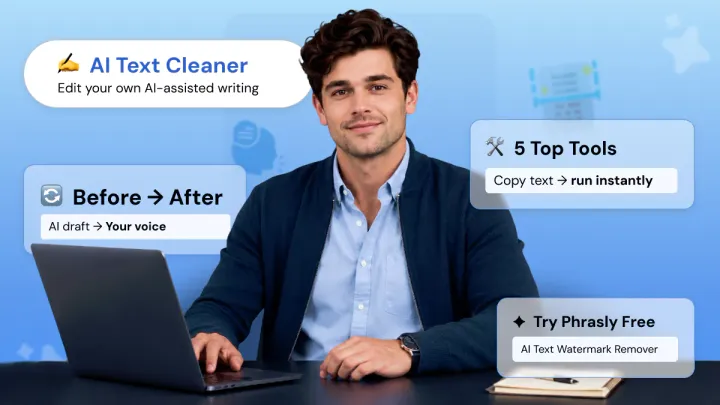
You’ve been using AI to write copy. But it sounds unnatural, too formal, or like nobody wrote it. The solution isn’t to stop using AI. It’s editing AI’s output.
An AI text cleaner edits and polishes text generated by an AI language model. It rewrites text to sound like you and turns it into clear, natural human writing.
The Best AI watermark removal & cleaning tools of 2026 aren't just an advanced rewrite tool. They go sentence by sentence to adjust tone and help you humanize AI-written content.
Below, we cover the best ones, including the one made specifically for this purpose. If you want to understand what AI text watermarks actually are before exploring the tools, that context helps.
Clean Your Text Here Paste and Get Improved Text within Seconds 👇
What Does an AI Text Cleaner Actually Do?
The quick answer: An AI Text Cleaner rebuilds AI-generated rough drafts to sound like you, not an AI language model.
An AI text watermark remover or text cleaner is a specialized type of editing tool. It is not a spell-checker, plagiarism checker, or basic paraphrasing tool. Here is the difference to help you pick the proper tool.
AI Text Cleaner vs. Paraphrasing Tool
A paraphrasing tool replaces words and rearranges sentence structure. Typically, it just gives back text that's indistinguishable from the source, just with a thesaurus applied.
An AI text cleaner goes deeper. It smooths out rhythm, eliminates AI-telling phrasing, and breaks up paragraphs so your writing has flow and character.
A paraphrasing tool treats your text as a word problem. An AI text cleaner treats it as a voice problem.
What About AI Writing Watermarks?
Several AI platforms, mainly OpenAI models, have been training for or have implemented hard coded AI writing patterns and statistical fingerprints that allow AI-written text to be detected.
These have sometimes been referred to as 'watermarks', though the term watermark is typically meant to refer to images.
An AI writing watermark remover is a tool used to rewrite the statistical signature of AI written text, not detect or decode any actual "watermark code". If you want to dig deeper into how these markers work, removing AI watermarks from text is worth reading.
Why Your AI-Assisted Writing Needs Editing (And What to Look for)
AI-generated text follows patterns you can recognize. Not because it's 'bad' writing. (In fact, it's grammatically right nearly all the time.) It's because it's reliably predictable. And that's what makes it sound dull.
No matter what text you input into a language model, the output will generally have consistent perplexity (each sentence will have roughly the same word predictability) and low burstiness (each sentence will be similar in length, with few short or concise sentences).
This is the signature that trained readers and detection tools look for.
What Good Cleaning Actually Does?
Editing AI-written text isn’t about removing all evidence of AI use. Editing AI-written text is about making it sound like a human wrote it because you did: you put in your examples, trimmed the transitional fluff, and broke up the cadence.
Well-cleaned AI writing will sound like something a human wrote fast, not something a robot wrote carefully.
Here's what to look for when evaluating whether your AI draft needs editing:
- Uniform sentence length: Every sentence runs 20–25 words. Natural writing doesn't work like that.
- Filler transitions: Phrases like 'It is worth noting that' or 'In today's digital landscape' are AI signatures. Remove them.
- Over-hedging: AI models hedge constantly. Real writers commit to a point.
- Missing examples: AI drafts stay abstract. Your specific examples are what make content worth reading.
That’s exactly what a good AI content ownership workflow and the right AI text cleaner can help you solve.
What Good AI Editing Looks Like in Practice?
Read a paragraph written by AI. Count how many sentences begin with “The” or “This”. Count how many sentences start with “Additionally” or “Furthermore”.
You've likely stumbled upon an unedited AI draft if you find more than one instance of either in five paragraphs. One pass of editing will remove those starters and replace them with your voice: clear, direct, specific.
The Best AI Text Cleaners for Writers in 2026
If you’re editing AI-assisted writing so that it sounds like you and meets your standards, here are the tools you should be using in 2026.
Each one has responsible AI content use cases outlined: editing your own work, not making things you don’t own sound better.
Phrasly
Phrasly helps your draft sound like you, especially after you edited it with AI. It helps you clean AI watermark so your own generated draft doesn't get false positive results,
It rewrites phrasing on a sentence level, normalizes tone, and you can control the style of the output.
The generator is built around content voice and tone, so you can nudge the results to be more direct, conversational, or formal based on your audience.
The sophisticated control Phrasly offers is precisely what professional writers and marketers will find indispensable, unlike generic tools.
Phrasly's AI text watermark remover works with text documents from nearly all major AI platforms and produces outputs that are indistinguishable from human writing in editorial processes.
Most useful tool if you find yourself editing AI-written documents on the reg.
WordAI
WordAI is designed first and foremost as a content rewriter. However, WordAI's sentence-level rewriter makes for an excellent tool for cleaning up AI-generated content.
This can be helpful if you need more than one version of something, such as variations of the same AI-written brief for each platform.
Grammar, readability, and sentence structure variety is great. Not as voice-matched as Phrasly is, which makes it better suited for marketing copy than editorials, where voice matters.
Undetectable.AI
Undetectable.AI rewrites AI-generated text at the paragraph level with emphasis on flow and readability. Agencies and individuals use it to transform deliverables so they sound like their client's brand voice instead of the AI model's.
It can be a valuable tool as part of a professional writing workflow, but sometimes requires another round of manual editing to match your voice perfectly.
Humanize AI
Humanize AI is streamlined and ideal for bloggers and individual writers. The rewriting engine uses a conversational tone and works best with social content and snippets of email copy created with AI assistance.
While it doesn't give you the same level of precise tweaking as Phrasly, it’s a speedy and straightforward option for less demanding content tasks.
Hemingway Editor
Unlike the others, Hemingway isn’t actually an automated proofreader. It’s a diagnostic tool. The tool helps you find passive voice, overly complex sentences, and unreadable text.
If you’re a writer who prefers to edit their own work, Hemingway is perfect for a final pass after your AI-created draft.
Combine Hemingway with any of the tools above for a seamless AI-generated text editing experience.
Tool Comparison: AI Text Cleaners at a Glance 👇
How to Clean AI-Generated Text the Right Way?
Cleaning AI-generated text thoroughly takes time and dedication. The good news is that there are two complementary approaches you can take: doing it yourself and with a tool. You’ll need to do some of each for best results:
Manual Approach: What to Do Before You Open Any Tool
Run a light, manual cleaning first before using any cleaner. This will help keep your voice from being overwritten and give the automated tool something to work with.
Three things to do manually first:
- Vary your sentence length: Break long compound sentences into two separate sentences. Insert a short sentence after a long run-on sentence. You'll see. Just this will get rid of masses of robot fingerprints.
- Add your specific examples: AI drafts are abstract. Replace generic statements with concrete examples from your experience or research. This is what makes the content yours.
- Strip filler transitions: Delete 'It is worth noting that', 'In conclusion', 'Furthermore', and similar AI-default connectors. Replace with nothing, or with a direct statement.
Tool-Assisted Approach: Using an AI Text Cleaner Effectively
After you manually go through it, put your draft through a specialized cleaner. The best way to clean AI generated text with a tool is to paste in small sections instead of full documents.
Not only will this allow you to better control the output, but it will be easier to spot shifts in voice.
Phrasly's Humanizer is built for this process of iterative editing. Make a pass yourself, review each iteration, and accept what you like. That's responsible AI content editing. It's not mass substitution. It's intentional refinement.
Is Cleaning AI Text Ethical?
Yes, but with stipulations. Editing AI-generated writing is already part of the normal workflow for professional writers, including freelancers, marketers, and publishers. The ethical issue isn't if you're cleaning the text.
It's what you're editing, why, and where it gets published.
When It's Fine
Cleaning AI-generated text is a completely legitimate editorial practice when:
- You wrote the prompt. You selected the direction. You’re editing the output into something that aligns with your thought process and voice.
- You’re publishing it on your own platform. You’re sending it to a client who was aware AI was part of your process. You’re using it for things where AI assistance is allowed or already common.
- You are making the content better. Adding accuracy, improving readability, and matching your brand voice, not submitting something unchanged that isn't yours.
This is exactly the use case Phrasly is built for. If you want to detect an AI watermark in content before editing it, that's a useful first step in understanding where the AI-written sections are heaviest.
Where the Line Is
The line gets crossed when you're trying to deceive a reader, institution, or platform that has expressly banned AI content, and when cleaning is employed to submit AI-generated work as completely original in a situation where that makes a legal or academic difference.
No tool, including Phrasly, should be used as a means to obfuscate the origins of content or bypass institutional policies regarding AI disclosure 2026.
Using AI Cleaners responsibly comes down to AI content ownership. You own the final piece you created, you actually had involvement in its creation, and you disclose your process when needed.
A Note on Disclosure
Making AI's output sound like your own voice and infusing it with your insights is precisely what this standard intends. Rule of thumb: Edit until it sounds like you actually wrote it.
AI-generated text is a first pass, not the finished piece. In 2026, the most successful writers using AI-generated text are approaching the editing process as if they were working with a first draft. It's valuable.
But it's not valuable enough to publish without editing it to make it your own.
Tools in this guide range from automated sentence-level rewriting to hands-on diagnostic editing.
When put to good use, integrated into a well-considered professional writing workflow, these tools craft text that genuinely reflects your voice, as ultimately, it is your creation.
FAQs
What is the best AI text cleaner in 2026?
Phrasly is currently the best purpose-built tool for writers who edit themselves, especially after writing with AI assistance. Phrasly's AI text watermark remover offers sentence-level restructuring alongside tone control.
This makes Phrasly better suited for editing workflows than basic rewriting tools. For writers who like to self-diagnose manually, Hemingway Editor is your best companion.
Is cleaning AI text the same as removing a watermark?
Not quite. AI text cleaning refers to the process of editing phrasing, structure, and tone of AI-generated text so that it reads naturally and in your voice.
Removing AI text watermarks refers to the process of changing the statistical artifacts left by AI models in text. Editing for cleanliness accomplishes both, though.
Is it okay to edit AI-generated text before publishing?
Yes! Editing AI-generated writing is normal. It's also ethical if you're editing a draft to better represent your thoughts, intentions, and knowledge. Once you edit it, it's your content.
The line of ethics gets crossed when you try to deceive. Editing for clarity and grammar is good. Copying AI straight into where it isn't allowed is bad.
Does cleaning AI text make it undetectable?
Cleaner edits (including manual passes and tool-assisted) will minimize many of the fingerprints that detection tools look for. No tool can promise you any particular detection result.
Editing AI text for cleanliness should have the aim of simply improving your writing.
What is the best free AI text cleaner?
Hemingway Editor does have a free version in your browser; its strong points are manual editing and diagnostics. There are quality options for automated clean AI written text tools out there. Most have a free tier or trial period.
You can use Phrasly and gauge how well its results integrate with your usual methods.
How do I make AI-generated text sound more human?
The quickest way to humanize AI-generated text is two-fold: 1) Manually edit for sentence variety, including examples, and removing AI crutch transitions. 2) Paste into a tool like Phrasly.
How do I remove AI detection from text?
Don't edit for 'removing detection.' Edit to make the writing better. Edit for voice. Add your examples. Change up the sentence structure.
Use Phrasly to polish what remains. Once something has been edited correctly to sound like you and display your knowledge, your detection scores will naturally get better because the writing is good. That's how you should be editing, and it will help.


Keep reading

How to Remove ChatGPT Watermark (And When You Actually Should)?
There's no hidden code in your ChatGPT output, just writing patterns that detectors recognize. Here's exactly what they are, whether removing them is ethical, and how to do it properly.
Removing AI Watermarks from Text: What Works and What Doesn’t
Paraphrasing won't remove an AI watermark and here's why. Learn how AI text watermarks actually work, why shallow edits fail, and the right workflow to make your AI-assisted content genuinely yours in 2026.